Celtic Christianity and thin places
Celtic Christianity is the name now given to the faith of the early Christians of Ireland, Scotland, Wales, and northern England, saints such as Patrick, Brigid, Columba, and Aidan, and to the prayer traditions that grew from it. It is known for prayers that bless every part of daily life and for a strong sense of God’s presence in creation. A thin place is a place where heaven and earth seem especially close.
Surely the LORD is in this place, and I didn’t know it.
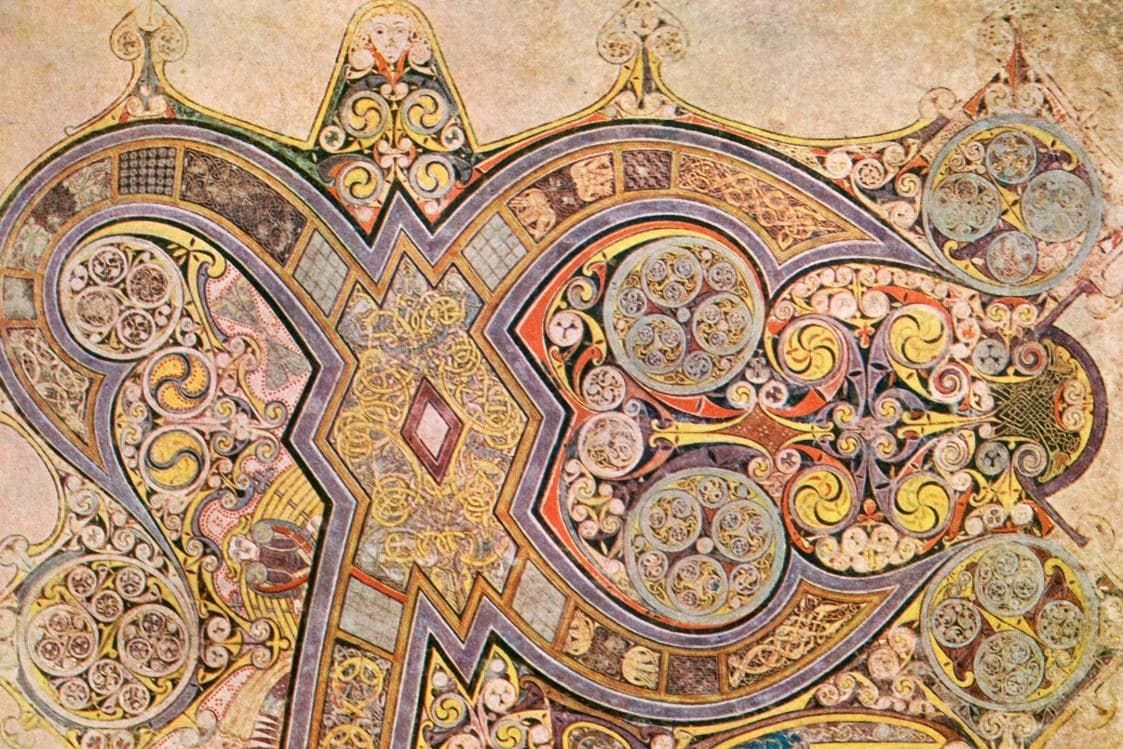
Celtic Christianity is the faith of the early saints of Ireland and Britain and the prayer that grew from it, known for blessing every part of ordinary life and for seeing God’s glory in creation. If you have ever felt closer to God on a mountain trail or by the ocean than anywhere else, the Celtic saints would understand. They would also hand you a psalter, take you to church, and teach you to pray while you cook, work, and fall asleep.
Who were the Celtic saints?
Patrick was a young Briton, the son of a church deacon, who was carried off by Irish raiders at about sixteen and spent six years as a slave herding animals. He escaped, was ordained, and in the fifth century returned to Ireland as a missionary bishop; he tells the story himself in his Confession. Brigid, who died around 525, is remembered as the founder of a monastery at Kildare. In 563 the Irish monk Columba, also called Colum Cille, founded a monastery on Iona, a small island off the west coast of Scotland. From Iona the monk Aidan went in 635 to Lindisfarne, a tidal island off Northumbria, to bring the gospel to the English.
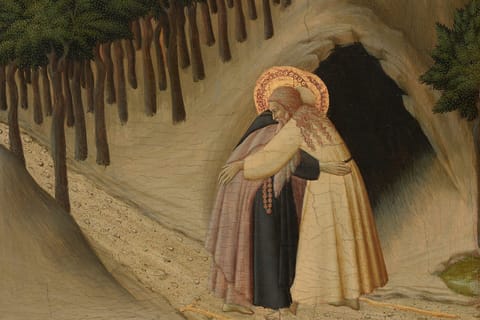
These monasteries were centers of prayer and learning. Their monks copied the Gospels in books such as the Book of Kells, made around 800, probably begun on Iona. Many went into voluntary exile for Christ; Columbanus founded monasteries in what are now France and Italy. They looked to the Desert Fathers and Mothers of Egypt as their models, and several Irish high crosses carve the desert hermits Antony and Paul sharing a loaf of bread (see the Desert Fathers and Mothers). Because these saints lived before the split between the Eastern and Western churches in 1054, many Orthodox Christians honor them as their own.
The Celtic saints were also strict ascetics. Bede, the eighth-century English historian, tells that Cuthbert of Lindisfarne prayed through the night standing in the cold North Sea, and that two otters came out of the water afterward to warm his feet.
Historians add a fair caution. There was no separate “Celtic Church”; these Christians belonged to the one Western church and differed in local customs such as the date of Easter, which the Synod of Whitby settled for Northumbria in 664. Ian Bradley, a Church of Scotland minister and professor at St Andrews, has shown in Celtic Christianity: Making Myths and Chasing Dreams (1999) how each age has reimagined the Celtic saints in its own image. The real saints are more demanding and more interesting than the legend.
What are thin places?
A thin place is a place where the boundary between heaven and earth seems to grow thin, so that God feels especially near. Writers often call the idea ancient and Celtic. The phrase owes much of its modern popularity to George MacLeod, a Church of Scotland minister from Govan in Glasgow, who in 1938 took ministers and working men to Iona to rebuild its ruined medieval abbey and founded the Iona Community. MacLeod called Iona a “thin” place between heaven and earth, and the ecumenical community he started still welcomes guests to pray and work there.
Marcus Borg, the New Testament scholar, widened the idea in The Heart of Christianity (2003). Thin places, he wrote, are places “where the veil momentarily lifts, and we behold God.” For Borg a thin place could be found in nature, music, worship, or the sacraments, anywhere a heart opens to God (see how can I experience God?).
Scripture tells of such places. Jacob fell asleep on a stone in the wilderness, dreamed of a stairway with angels going up and down, and woke saying:
Surely the LORD is in this place, and I didn’t know it.
He named the spot Bethel, “house of God.” At the burning bush Moses heard, “the place you are standing on is holy ground” (Exodus 3:5). The psalmist knew that God is present everywhere: “Where could I go from your Spirit? Or where could I flee from your presence?” (Psalm 139:7). A thin place, then, is where you wake up, as Jacob did, to the God who was there all along.
Eastern Orthodox Christians speak of the liturgy in the same way. The Russian Primary Chronicle tells that envoys of Prince Vladimir of Kyiv, after attending worship in Constantinople around 987, said they did not know whether they had been in heaven or on earth. Orthodox churches are filled with icons, which believers often call windows into heaven (see why do Orthodox Christians pray with icons?).
What do Celtic prayers sound like?
The best-known Celtic prayer is St. Patrick’s Breastplate, an Old Irish prayer for protection. Tradition credits it to Patrick, and scholars date the text to around the eighth century. It calls on the Trinity, the angels, the saints, and the powers of creation, and then surrounds the one praying with Christ. In James Henthorn Todd’s 1864 translation:
Christ with me, Christ before me,
Christ behind me, Christ within me,
Christ beneath me, Christ above me,
Christ at my right, Christ at my left, …
Christ in the heart of every man who thinks of me,
Christ in the mouth of every man who speaks to me,
Christ in the eye of every man that sees me,
Christ in the ear of every man that hears me.St. Patrick’s Breastplate (trans. J. H. Todd, 1864)
Cecil Frances Alexander turned the prayer into the hymn “I bind unto myself today” in 1889. The Old Irish poem behind “Be thou my vision,” often dated to the eighth century, was translated by Mary Byrne in 1905 and set in verse by Eleanor Hull in 1912; it appears in the hymnals of the United Methodist Church, the ELCA, and the PC(USA).
In the nineteenth century Alexander Carmichael, a Scottish tax official, wrote down hundreds of prayers that Gaelic-speaking people in the Highlands and Islands still prayed at their work, and he published them as Carmina Gadelica in 1900. There are prayers for kindling the fire in the morning, milking the cow, and banking the fire at night, when a woman would ask “The sacred Three / To save, / To shield, / To surround / The hearth, / The house, / The household.” These prayers live out the command to speak of God’s words “when you lie down, and when you rise up” (Deuteronomy 6:7).
How can I pray in the Celtic way this week?
- Wake with the Breastplate. Before you check your phone, pray the lines above slowly, turning toward each direction as you name Christ there.
- Bless one ordinary task. Write a two-line blessing for something you do every day, such as making coffee, riding the bus, or locking the door, and pray it each time.
- Find a thin place near you. Choose a park, a shoreline, a garden, or an old church, and go back to it weekly. Leave your phone in your pocket and read Psalm 139 there.
- Sing an old Irish hymn. Learn “Be thou my vision” and sing it on your walk.
- Pray at the edges of the day. Use the Carmina Gadelica prayer below at night. For more on still prayer, see contemplative prayer and what is Christian mysticism?.
Someday you might make a pilgrimage to Iona, or walk the tidal causeway to Lindisfarne at low tide. Until then, the Celtic saints would say that the kitchen table and the walk to work are holy ground too. This prayer was taken down in 1866 from Mary Macrae of Harris and printed in the first volume of Carmina Gadelica:
God with me lying down,
God with me rising up,
God with me in each ray of light,
Nor I a ray of joy without Him,
Nor one ray without Him.Christ with me sleeping,
Christ with me waking,
Christ with me watching,
Every day and night,
Each day and night.Carmina Gadelica, vol. 1 (1900)
Common questions
Is Celtic Christianity pagan?
The Celtic saints were Christian monks and missionaries devoted to the Trinity, the psalms, and the Gospels. Some images from older Irish and British culture lived on in Christian form, such as the sun, fire, and wind named in St. Patrick’s Breastplate as works of God. Their prayers praise the Creator through creation.
Was there a separate Celtic Church?
Historians today do not speak of a separate Celtic Church. The Christians of early Ireland and Britain belonged to the one Western church and differed only in local customs, such as how they calculated the date of Easter. At the Synod of Whitby in 664 the church in Northumbria adopted the Roman dating.
Why is Iona called a thin place?
Iona is the small Scottish island where Columba founded a monastery in 563, and pilgrims have come to pray there ever since. George MacLeod, the Church of Scotland minister who founded the Iona Community in 1938, popularized the phrase “thin place” when he spoke of Iona. Many visitors describe a strong sense of God’s nearness on the island.
What does the circle on a Celtic cross mean?
The Celtic cross has a ring joining its arms, and it was carved on the great stone high crosses of Ireland and Scotland in the early Middle Ages. No early source explains the ring. Christians today often read it as a sign of eternity or of Christ’s victory encircling the whole world.
Sources
- Genesis 28:10–17 (WEB)
- Psalm 139:7–10 (WEB)
- Deuteronomy 6:7 (WEB)
- Saint Patrick’s Breastplate (Wikipedia), with J. H. Todd’s 1864 translation
- Alexander Carmichael, Carmina Gadelica, vol. 1 (1900) (Internet Archive)
- James Hawkey, Sermon at Evensong, Fourteenth Sunday after Trinity 2024 (Westminster Abbey)
- Iona Community (Wikipedia)
- “Open Hearts and Thin Places” (Marcus J. Borg Foundation)
- Marcus Borg, The Heart of Christianity (HarperOne, 2003)
- Ian Bradley, Celtic Christianity: Making Myths and Chasing Dreams (Edinburgh University Press, 1999)
- Be Thou My Vision (Hymnary.org)
- Bede, Life of Saint Cuthbert