The Desert Fathers and Mothers
The Desert Fathers and Mothers were Christian men and women who, from the late third century onward, left the towns of Egypt, Palestine, and Syria to pray in the desert. The best known include Antony of Egypt, Pachomius, Macarius, Moses the Black, Amma Syncletica, and Amma Sarah. Their short sayings on prayer, humility, and not judging others shaped Christian monasticism and still guide Christians who want a deeper life with God.
But he withdrew himself into the desert and prayed.
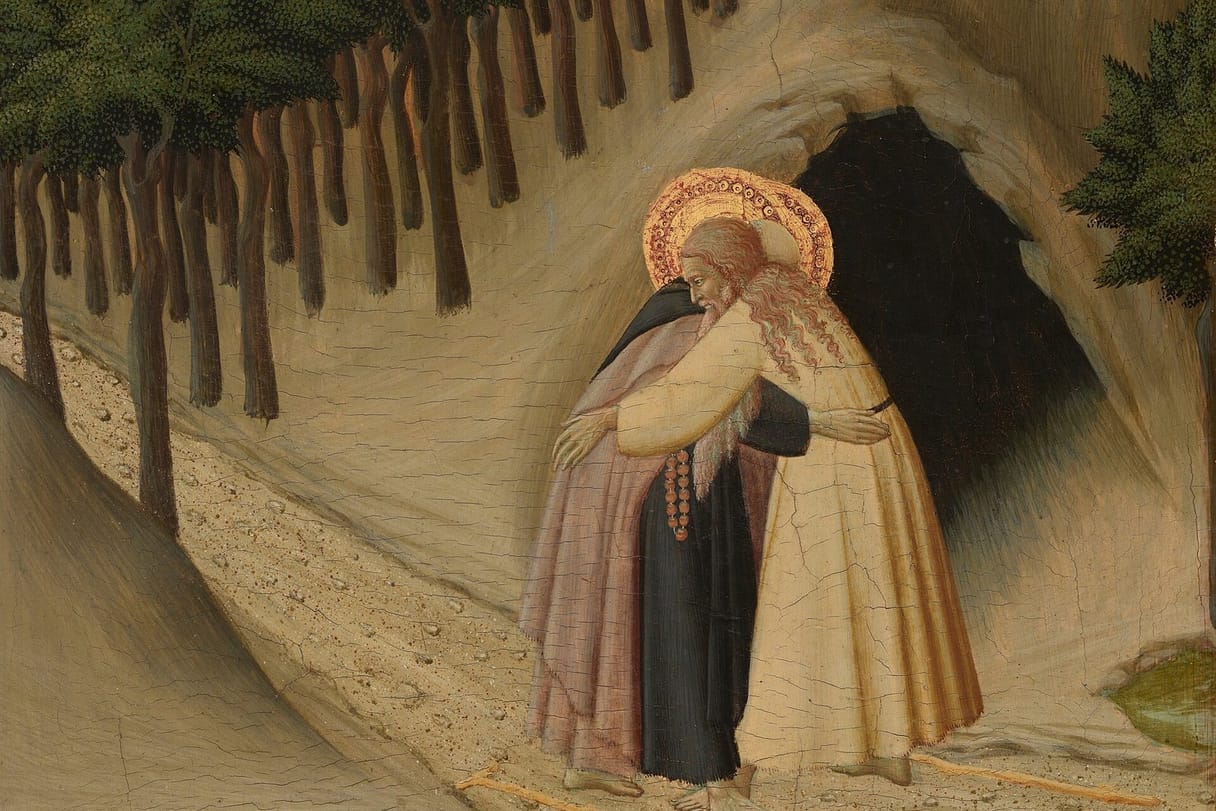
The Desert Fathers and Mothers were Christian men and women who, beginning in the late third century, left the towns of Egypt, Palestine, and Syria to pray in the desert. People called them abba (father) and amma (mother), and visitors walked for days to ask them for “a word,” a short saying to live by. Their sayings are brief, earthy, and often funny. If your days are crowded with noise and your phone never stops buzzing, these elders went looking for what you may be looking for too: a life given wholly to God, and a heart at rest.
Who were the Desert Fathers and Mothers?
The most famous is Antony of Egypt (about 251–356). As a young man, after his parents died, he heard the Gospel read in church: “If you want to be perfect, go, sell what you have, and give to the poor… and come, follow me” (Matthew 19:21). He gave away his family’s land and went out to pray, first near his village and then deep in the desert. Athanasius of Alexandria wrote his Life of Antony soon after Antony died, and it was read across the Roman world. Augustine tells in his Confessions how hearing the story of Antony moved him toward his own conversion.
Others followed by the thousands. Pachomius (about 292–348) gathered monks into communities along the Nile, where they prayed, worked, and ate together, and his sister Mary led a community of women. At Scetis, in the desert west of the Nile Delta, Macarius the Great taught generations of monks. Abba Moses, called the Black, had been a robber, according to tradition, before he became one of the gentlest of the elders. Women such as Amma Syncletica of Alexandria and Amma Sarah were honored as teachers, and their words were kept with the men’s.
Evagrius Ponticus (345–399), a learned monk of the desert, mapped the eight “thoughts” that trouble the soul: gluttony, lust, love of money, sadness, anger, acedia (restless boredom), vainglory, and pride. In the West his list later became the seven deadly sins. In the fifth century monks gathered the elders’ teachings into collections known as the Sayings of the Desert Fathers.
Why did they go into the desert?
They went where Jesus went. “Immediately the Spirit drove him out into the wilderness” (Mark 1:12), and during his ministry “he withdrew himself into the desert and prayed” (Luke 5:16). The prophets had promised that God meets people in the wilderness:
Therefore behold, I will allure her, and bring her into the wilderness, and speak tenderly to her.
When the persecutions of Christians ended early in the fourth century, faith became safe and even fashionable. Many who longed to give their whole lives to Christ saw the desert as a new kind of martyrdom, a daily dying to self in place of a single death in the arena. They also went to face their own hearts. Away from the crowds, anger, envy, and boredom had nowhere to hide, and the monks learned to meet them with prayer.
What did the Desert Fathers and Mothers teach?
Stay put. A brother asked Abba Moses for a word, and Moses told him to go and stay in his cell, because his cell would teach him everything.
Humility. Antony once saw in a vision the snares the enemy had spread across the whole world, and he groaned and asked who could get through them. A voice answered him: humility.
Do not judge. When a brother had sinned, the monks of Scetis called Abba Moses to a meeting to judge him. Moses came carrying a leaking jug of water on his shoulder. Asked why, he said that his own sins were running out behind him where he could not see them, and yet he had come to judge someone else’s. The brothers forgave the man. Jesus said, “Don’t judge, and you won’t be judged” (Luke 6:37; see what does “judge not” mean?).
Keep going. Amma Syncletica compared the start of the spiritual life to lighting a fire. At first the smoke stings your eyes and makes you weep, and then the fire catches and gives warmth and light.
Ask for strength. For thirteen years Amma Sarah struggled against the spirit of lust, and through all those years she asked God for one thing: strength to bear it.
Become fire. Abba Lot told Abba Joseph that he kept his little rule of prayer, fasting, and stillness, and asked what more he could do. Joseph stood up and stretched his hands toward heaven, and his fingers shone like ten lamps. He told Lot that he could become all flame.
How can I practice desert spirituality today?
Six steps for this week:
- Make a cell. Choose one place and fifteen minutes a day. Leave your phone in another room and be still before God (see contemplative prayer).
- Ask for a word. Read one saying of the desert elders each morning and carry it through the day.
- Pray while you work. The monks wove baskets and ropes while they prayed the psalms. Say a short prayer while you walk, wash dishes, or wait in line, such as the Jesus Prayer (see hesychasm and the Jesus Prayer).
- Notice your thoughts. When anger, envy, or restlessness comes, name it before God and turn back to prayer.
- Refuse to judge. When you feel the urge to criticize someone, pray for that person instead.
- Tell your thoughts to someone you trust. The elders taught that thoughts brought into the light lose their power. A pastor or spiritual director can play the part of an abba or amma (see what is spiritual direction?).
Were the desert monks too extreme?
Some were. In Syria, Simeon the Stylite lived for decades on top of a pillar. The elders themselves prized moderation. A hunter once found Antony relaxing with some brothers and was shocked. Antony told him to put an arrow to his bow and draw it, and then draw it further, and further still. The hunter protested that the bow would break. Antony answered that the same is true of the work of God: push the brothers beyond measure and they will soon break. John Cassian records that Antony judged discretion, the gift of knowing what is right for each person, to be the virtue that guides all the others.
Some sayings reflect the fears of their age, including suspicion of women and of the body. Augustine taught that any reading of Scripture that fails to build up love of God and neighbor has not yet understood it, and the same rule guides a reader of the desert sayings. Solitude can also deepen loneliness or sadness, and the elders rarely went into it without a guide. If time alone leaves you feeling worse, reach out to others (see loneliness and community).
How did the desert shape the church?
John Cassian visited the Egyptian monks and carried their teaching to Gaul in his Institutes and Conferences. Benedict’s Rule commended Cassian’s books to its monks, and through Benedict the desert shaped monasteries across the West. Place names such as Dysart in Ireland and Scotland come from díseart, the Irish form of the Latin desertum, a reminder that Irish monks saw themselves as heirs of the desert (see what is Celtic Christianity?). In the East, the desert teaching on prayer flowed into hesychasm and the Philokalia.
The mainline churches have drawn on the desert too. John Wesley printed a long extract of the Spiritual Homilies attributed to Macarius as the first volume of his Christian Library in 1749. Benedicta Ward, an Anglican nun, translated the Sayings in 1975. Rowan Williams, Archbishop of Canterbury from 2002 to 2012, wrote Silence and Honey Cakes (2003) on what the desert offers today. Roberta Bondi, professor emerita of church history at Candler School of Theology, a United Methodist seminary at Emory University, has written and taught about the desert mothers and fathers, including at The Upper Room’s Academy for Spiritual Formation.
When the monks asked Abba Macarius how to pray, he told them that prayer does not require many words. It is enough to say, “Lord, as Thou wilt and as Thou knowest, have mercy on me.” You can pray those words today, wherever your own desert is, and trust the God who meets people in the wilderness to speak tenderly to you.
Common questions
Who was the first Desert Father?
Antony of Egypt (about 251–356) is usually called the father of monks. Athanasius’s Life of Antony mentions older hermits who lived near the villages before him, and tradition honors Paul of Thebes as an even earlier hermit. Antony’s fame, spread by Athanasius’s book, drew thousands into the desert.
Were there women in the desert?
Women were among the desert elders from the start. The Sayings of the Desert Fathers preserve the words of three ammas, or spiritual mothers: Syncletica, Sarah, and Theodora. Pachomius’s sister Mary led a community of women, and Mary of Egypt became one of the most beloved saints of the Orthodox Church.
What should I read about the Desert Fathers and Mothers?
Benedicta Ward, an Anglican nun and Oxford historian, translated The Sayings of the Desert Fathers in 1975. Thomas Merton’s The Wisdom of the Desert (1960) is a short selection. Rowan Williams’s Silence and Honey Cakes (2003) reflects on what the desert teaches today, and Roberta Bondi’s To Love as God Loves (1987) introduces the early monks’ teaching on love.
What is acedia?
Acedia is the restless boredom and listlessness that Evagrius Ponticus called the noonday demon. It makes the hours drag, makes one’s room feel unbearable, and makes every other place look better. The desert teachers met it by staying put, working with their hands, and praying through it.
Sources
- Matthew 19:21 (WEB)
- Hosea 2:14 (WEB)
- Mark 1:12–13 (WEB)
- Luke 5:16 (WEB)
- Luke 6:37 (WEB)
- Athanasius, Life of Antony (New Advent)
- Augustine, Confessions, Book VIII (New Advent)
- John Cassian, Conferences, Conference 2: On Discretion (New Advent)
- Venerable Macarius the Great of Egypt (OrthoChristian.com)
- Stephen Plant and Marcus Plested, “Macarius, St Gregory of Nyssa, and the Wesleys,” Epworth Review 33.1
- Encountering a Loving God through Prayer with Roberta Bondi (The Upper Room)
- Christian mysticism (Wikipedia)
,_The_Meeting_of_Saint_Anthony_and_Saint_Paul,_c._1430-1435,_NGA_436.jpg)