How to pray
To pray, start small and start today. Find a still moment, pray the Lord’s Prayer slowly, then tell God what is on your heart: thanks, sorrow, worries, and the needs of other people. Leave some silence to listen. No special words are required, and silence offered to God is prayer too. The Psalms and the church’s old services of morning and evening prayer give you words when your own run out.
But whenever you pray, go into your room and shut the door and pray to your Father who is in secret, and your Father who sees in secret will reward you.
Matthew 6:6, NRSVUE
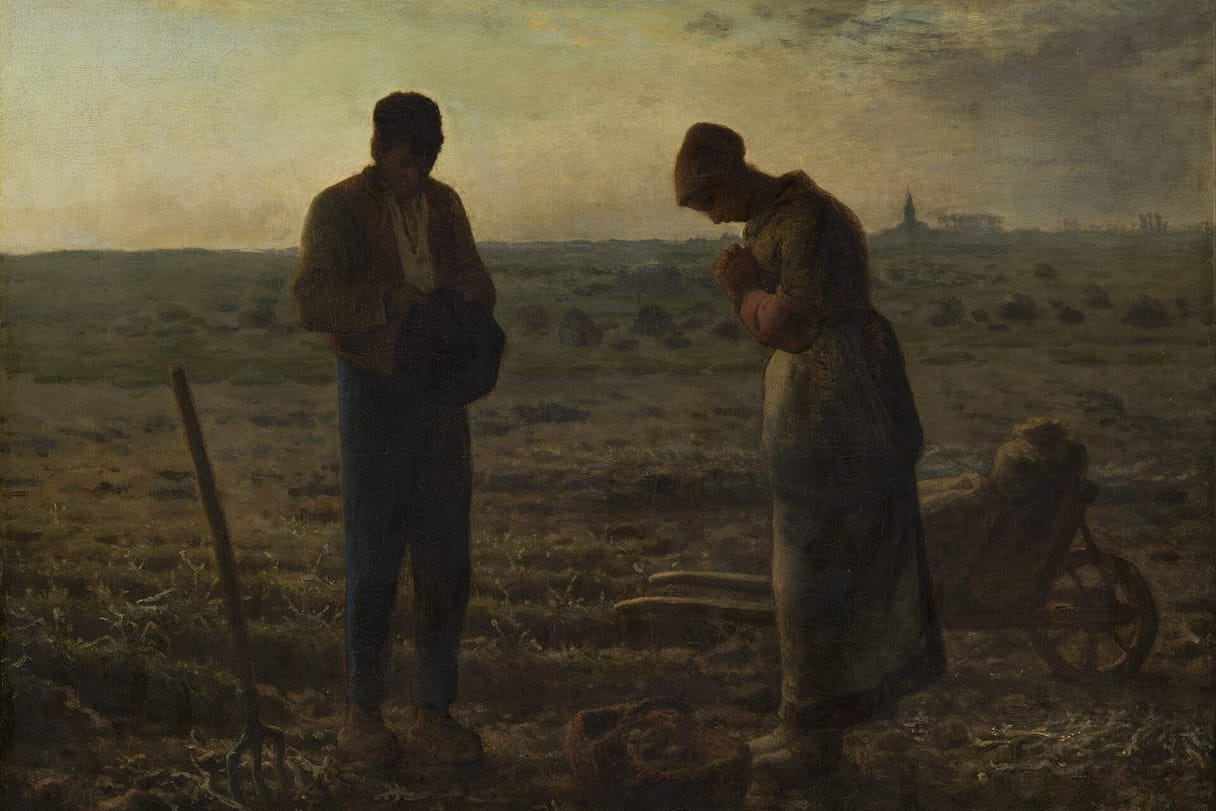
If you want to pray and are not sure how to begin, the wish itself is a good place to start. Prayer is turning your attention to God, to speak, to listen, or to rest in God’s presence. You do not need special words, a special place, or a feeling of holiness. John of Damascus, the eighth-century monk whose summary of the faith became a standard in the Eastern churches, defined prayer as the raising of the mind to God, or asking God for what is fitting (Exact Exposition of the Orthodox Faith 3.24). God is already present and already loves you, and prayer is your response.
Even the people closest to Jesus felt they needed help. The disciples once asked him, “Lord, teach us to pray” (Luke 11:1). He gave them a prayer to say, and Christians have been learning from it ever since.
What did Jesus teach about prayer?
Jesus told his followers to pray in secret, with no audience but God: “whenever you pray, go into your room and shut the door and pray to your Father who is in secret” (Matthew 6:6). He warned against “vain repetitions” and long speeches, because “your Father knows what things you need before you ask him” (Matthew 6:7–8). You pray to a Father who already knows what you need and cares about it. Then Jesus gave the Lord’s Prayer:
Our Father in heaven, may your name be revered as holy. May your kingdom come. May your will be done on earth as it is in heaven.
Matthew 6:9–10, NRSVUE
The prayer goes on to ask for “our daily bread,” for forgiveness “as we also forgive our debtors,” and for deliverance “from the evil one” (Matthew 6:11–13). It teaches an order: first God’s name, kingdom, and will, then our needs, our sins, and our dangers. It is also plural. Even when you pray it alone, you say “our” and “us,” and the whole church prays with you.
Christians have prayed it daily since the earliest centuries. The Didache, one of the oldest Christian handbooks outside the New Testament, gives the Lord’s Prayer and adds, “Thrice in the day thus pray” (chapter 8).
How do I start praying?
A simple pattern is enough to begin:
- Choose a time and a place. Morning and evening are the oldest times of Christian prayer. The psalmist prayed “Evening, morning, and at noon” (Psalm 55:17). Jesus himself rose “early in the morning, while it was still dark,” and went “into a deserted place, and prayed there” (Mark 1:35).
- Become still. Sit for a minute without hurrying, and let your breathing slow. “Be still, and know that I am God.” (Psalm 46:10).
- Pray the Lord’s Prayer slowly. Pause on any phrase that stands out.
- Speak from the heart. “Pour out your heart before him” (Psalm 62:8). Thank God for specific things, admit what you have done wrong, and say what you fear and hope for.
- Pray for others. Name the people you love, the people you find hard, the sick, and the suffering.
- Listen. End with a minute or two of silence. You may not hear anything, and that is normal. Silence with God is still prayer.
Paul sums up the spirit of it: “In nothing be anxious, but in everything, by prayer and petition with thanksgiving, let your requests be made known to God. And the peace of God, which surpasses all understanding, will guard your hearts and your thoughts in Christ Jesus” (Philippians 4:6–7).
What are the different kinds of prayer?
Paul named several kinds of prayer when he urged “that petitions, prayers, intercessions, and givings of thanks be made for all men” (1 Timothy 2:1). Christian teachers have sorted them in various ways, and most of their lists name the same movements of the heart.
Adoration and praise delight in God for who God is, asking nothing: “I will bless the LORD at all times. His praise will always be in my mouth” (Psalm 34:1). Thanksgiving thanks God for specific gifts, large and small. Confession names your sins truthfully and asks forgiveness, trusting the promise that “If we confess our sins, he is faithful and righteous to forgive us the sins and to cleanse us from all unrighteousness” (1 John 1:9). Offering gives yourself to God, as Paul urged Christians to “present your bodies a living sacrifice” (Romans 12:1). Intercession and petition ask God for what others need and for what you need.
A balanced prayer life includes all of them. Many people find that asking comes easily and praise does not, so it can help to start with thanks.
How can the Psalms and the Daily Office help me pray?
The Psalms are the prayer book of the Bible, and Jesus prayed them. They give you words for joy, gratitude, anger, grief, and fear, so that no feeling you bring to God is too strange to pray. Many Christians pray a psalm each morning, beginning with the words of Psalm 51: “Lord, open my lips. My mouth will declare your praise” (Psalm 51:15).
Christians have prayed at fixed hours since the early church, following the psalmist who said, “Seven times a day, I praise you” (Psalm 119:164). Over centuries these hours became the Daily Office, a cycle of morning, midday, evening, and night prayer built on the Psalms and Scripture readings. Lutheran, Presbyterian, Methodist, and Episcopal worship books all include services of morning and evening prayer that you can pray alone in ten or fifteen minutes, and the Orthodox churches pray the same hours as Matins and Vespers. When you pray them, you join a great company of Christians saying the same words that day.
Western services of daily prayer have for centuries opened with a verse from Psalm 70: “Hurry, God, to deliver me. Come quickly to help me, LORD” (Psalm 70:1). The early monastic writer John Cassian, who learned to pray from the desert monks of Egypt, recommended that verse as a prayer for every situation (Conferences 10.10). For guidance on reading Scripture alongside prayer, see Where should I start reading the Bible?
What if I don’t know what to say?
You are in good company. Paul admitted, “we don’t know how to pray as we ought. But the Spirit himself makes intercession for us with groanings which can’t be uttered” (Romans 8:26). The Holy Spirit prays in you even when you have no words (see What is the Holy Spirit?).
Short prayers help. The tax collector in Jesus’ parable prayed only, “God, be merciful to me, a sinner!” (Luke 18:13). Eastern Orthodox Christians pray a similar short prayer, the Jesus Prayer: “Lord Jesus Christ, Son of God, have mercy on me, a sinner.” Many people repeat it slowly with their breathing, sometimes with a prayer rope of knotted wool to keep count. The Orthodox monks who taught it, whose writings were gathered in the eighteenth-century collection called the Philokalia, saw it as a way to keep the mind in the heart and the heart turned toward Christ all day long.
Some days prayer will feel empty, and that is no sign that God has gone away. Julian of Norwich, the fourteenth-century English mystic, heard Christ say: “Pray inwardly, though thee thinketh it savour thee not: for it is profitable, though thou feel not, though thou see nought” (Revelations of Divine Love, chapter 41). If you are struggling with prayers that seem to go nowhere, see Why doesn’t God answer my prayers?
What do the churches teach about prayer?
The mainline churches and the Orthodox churches teach that Christian prayer is offered to the Father, through Jesus Christ, in the Holy Spirit, as Paul wrote: “through him we both have our access in one Spirit to the Father” (Ephesians 2:18). They also teach that private prayer belongs with common worship. Lutheran, Presbyterian, Methodist, Episcopal, and Orthodox Christians share the same core practices: the Lord’s Prayer, the Psalms, prayer for others, and Sunday worship. Many Orthodox homes also keep an icon corner, a shelf of icons with a small lamp, where the family stands to pray each morning and evening.
Prayer grows with practice, and no one masters it. The best way to learn is to begin today, with the words Jesus gave and whatever is in your heart, and to keep coming back. Praying with a congregation on Sunday will carry you on the days you cannot pray alone (see Is it a sin to not go to church?).
Augustine opened his Confessions with a prayer that names why anyone prays at all:
Thou awakest us to delight in Thy praise; for Thou madest us for Thyself, and our heart is restless, until it repose in Thee.
Augustine, Confessions 1.1, translated by E. B. Pusey
Common questions
Do I have to kneel or close my eyes to pray?
No. Christians pray standing, sitting, kneeling, walking, and lying in bed. Posture can help you pay attention, and kneeling can express humility, but God hears you in any position. Psalm 141 speaks of “the lifting up of my hands,” which is another old way of praying.
How long should I pray?
Start with a few minutes a day that you can keep up; God is glad of them. Jesus warned against “vain repetitions,” as if many words would earn a hearing. Regular short prayer at fixed times, morning and evening, is one of the oldest patterns of Christian prayer.
What does “pray without ceasing” mean?
Paul’s words in 1 Thessalonians 5:17 do not mean saying prayers every minute. They describe a life turned toward God all day long, often helped by short prayers repeated during ordinary tasks. The Jesus Prayer, “Lord Jesus Christ, Son of God, have mercy on me, a sinner,” is one way Christians, especially in the Orthodox churches, have tried to live out Paul’s words. The nineteenth-century Russian book The Way of a Pilgrim tells of a wanderer who learned to pray it with every breath.
Who do Christians pray to?
Christians usually pray to God the Father, through Jesus Christ, in the power of the Holy Spirit, following Paul’s words that through Christ “we both have our access in one Spirit to the Father” (Ephesians 2:18). Christians also pray directly to Jesus, as in the Jesus Prayer. Because the Father, Son, and Holy Spirit are one God, every Christian prayer is prayer to the one God.
Sources
- Matthew 6:5–13 (WEB)
- Luke 11:1 (WEB)
- Romans 8:26–27 (WEB)
- Psalm 55:17 (WEB)
- 1 Timothy 2:1 (WEB)
- Psalm 70:1 (WEB)
- Book of Common Prayer (1979), The Daily Office
- John of Damascus, An Exact Exposition of the Orthodox Faith, Book III (New Advent)
- The Way of a Pilgrim (Wikipedia)
- The Didache, chapter 8
- John Cassian, Conferences 10, chapter 10
- Julian of Norwich, Revelations of Divine Love, chapter 41
- Augustine, Confessions, Book I, translated by E. B. Pusey (Project Gutenberg)