The origins of Christmas
Christmas is the Christian feast of the birth of Jesus Christ, and it is not a pagan holiday; its name means “Christ’s Mass.” Historians debate why the church chose December 25: some think early Christians counted nine months from March 25, the date they assigned to Jesus’ conception, and others think the church set it against a Roman festival of the sun. Some Christmas customs, such as evergreens and feasting, have pre-Christian roots, but Christians gave them new meaning in Christ.
And the Word became flesh and lived among us, and we have seen his glory, the glory as of a father’s only son, full of grace and truth.
John 1:14, NRSVUE
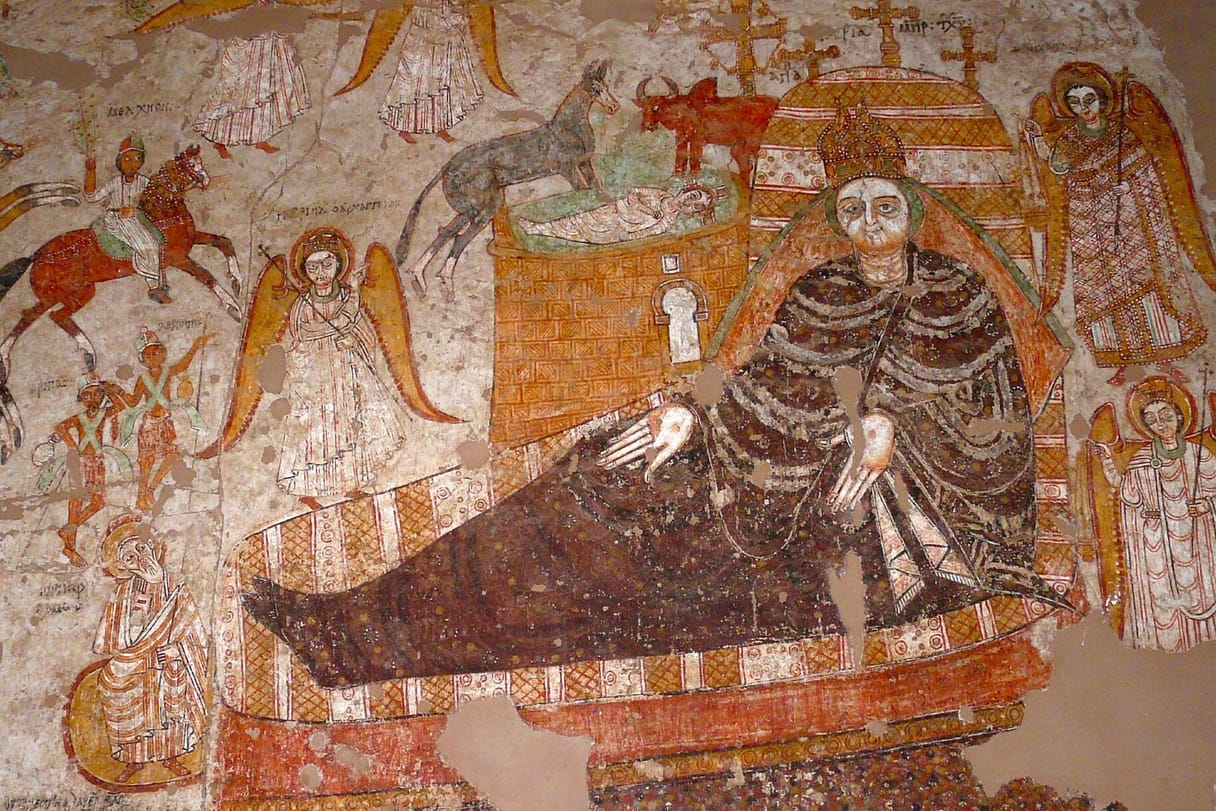
If you have heard that Christmas is secretly a pagan holiday, you may be wondering whether your family’s celebration honors God at all. You can keep the feast with a glad heart. Christmas is the church’s celebration of the birth of Jesus Christ, and its name means “Christ’s Mass.” Historians still debate how December 25 was chosen, and some Christmas customs are older than Christianity, but for more than sixteen centuries the feast has proclaimed one thing: in a child born at Bethlehem, God came to be with us.
What does Christmas celebrate?
Christmas celebrates the Incarnation, the Christian teaching that the eternal Son of God became a human being in Jesus of Nazareth. Luke tells of the angel’s announcement to the shepherds:
Do not be afraid, for see, I am bringing you good news of great joy for all the people: to you is born this day in the city of David a Savior, who is the Messiah, the Lord.
Luke 2:10–11, NRSVUE
Paul put the same faith in one sentence: “when the fullness of the time came, God sent out his Son, born to a woman” (Galatians 4:4). An old collect for Christmas, kept in the Book of Common Prayer, prays to the God “who hast caused this holy night to shine with the illumination of the true Light.”
The Eastern churches have kept Christmas with a sermon preached in Constantinople around 380 CE by Gregory of Nazianzus, one of the Cappadocian Fathers. It opens, “Christ is born, glorify Him” (Oration 38), and those words became the first line of an Orthodox Christmas hymn and the greeting Orthodox Christians still exchange at Christmas: one says “Christ is born!” and the other answers “Glorify him!” For the Eastern churches the feast celebrates what Athanasius had taught a generation earlier, that the Son of God became human so that human beings could share in the life of God.
Why is Christmas on December 25?
The Bible does not give the date of Jesus’ birth. The earliest record of a Christmas feast on December 25 is a list of Roman church commemorations preserved in a calendar compiled in Rome in 354 CE, whose entry for that day reads, in Latin, “Christ was born in Bethlehem of Judea.” Scholars offer two main explanations for the date, and both have serious defenders.
The first is the calculation theory. Some early Christians believed that Jesus died on March 25, and an ancient idea held that great figures of faith died on the same date they were conceived. Counting nine months from a conception on March 25 gives December 25. Augustine of Hippo, writing in On the Trinity in the early fifth century, recorded that Jesus “is believed to have been conceived on the 25th of March, upon which day also he suffered,” and was born “according to tradition, upon December the 25th.” The French historian Louis Duchesne proposed the calculation theory, the liturgical scholar Thomas Talley developed it, and the historian Andrew McGowan has defended it.
The second is the sun-festival theory. In 274 CE the emperor Aurelian promoted the worship of Sol Invictus, the “Unconquered Sun,” and the same Roman calendar of 354 marks December 25 as the birthday of the Unconquered. Many historians hold that the church in Rome set Christ’s birth against that pagan festival near the winter solstice. Others, such as the historian Steven Hijmans, argue that there is no clear evidence of a solar feast on December 25 before the Christian one.
Both theories may hold part of the truth. Even if the church chose the date with the sun festival in mind, it did so to proclaim that the true light of the world is Christ (John 8:12).
Did Christians worship the sun at Christmas?
The church guarded its people against any such confusion. Leo the Great, bishop of Rome, in a Christmas sermon in the fifth century, rebuked Christians in Rome who climbed the steps of St. Peter’s Basilica and then “turn round and bow themselves towards the rising sun.” He said the practice was “partly due to the fault of ignorance and partly to the spirit of heathenism,” and he told Christians to abstain “even from the appearance of this observance” (Sermon 27).
Christians did take up the image of the sun for Christ, from Scripture. The prophet Malachi promised that “the sun of righteousness” would “arise with healing in its wings” (Malachi 4:2), and Charles Wesley’s Christmas hymn “Hark! the Herald Angels Sing” hails Christ as the “Sun of Righteousness.”
Are Christmas customs pagan?
Some are older than Christianity, and many are not. Romans celebrated Saturnalia in mid-December with feasting and gifts, and northern Europeans marked midwinter with evergreens and fires. Other customs were Christian from the start. Santa Claus comes from Saint Nicholas, a fourth-century bishop of Myra in what is now Turkey, remembered for secret gifts to the poor. The Christmas tree as we know it grew up among Christians in Germany, and the crèche, or nativity scene, is traditionally credited to Francis of Assisi.
The church has often taken the customs of a people and filled them with the gospel, much as Paul in Athens began from an altar inscribed “TO AN UNKNOWN GOD” (Acts 17:23) to preach Christ. A custom’s origin does not decide its meaning. A wreath of evergreens means what the people who hang it mean by it, and in a Christian home it can speak of everlasting life in Christ.
Should Christians celebrate Christmas?
Most Christians do, and they have done so for more than sixteen centuries. Some Christians have objected: the Puritan-led English Parliament banned Christmas in 1647, and Boston outlawed it in 1659 with a fine of five shillings, a ban lifted in 1681. Jehovah’s Witnesses do not celebrate Christmas today. Christians who decline to keep Christmas usually do so out of a desire to worship God only as Scripture directs, and that desire deserves respect. Paul taught Christians not to judge each other over holy days:
Some judge one day to be better than another, while others judge all days to be alike. Let all be fully convinced in their own minds. Those who observe the day, observe it for the Lord.
Romans 14:5–6, NRSVUE
The Orthodox churches and the Lutheran, Presbyterian, Methodist, and Episcopal churches all keep Christmas as a major feast. In many of these churches the Christmas season lasts twelve days, from December 25 until the feast of the Epiphany on January 6.
The best answer to the worry that Christmas is pagan is to keep it as a Christian feast: to worship at church, to give to the poor as Saint Nicholas did, and to welcome the stranger, remembering that Mary laid her newborn son in a manger “because there was no room for them in the inn” (Luke 2:7). For the parallel question about the spring feast, see Is Easter a pagan holiday? For more about the child whose birth Christmas celebrates, see Who is Jesus? and Was Jesus born of a virgin?
However the date was first chosen, the feast asks the same thing of you each year: to come and see what the shepherds saw. John’s Gospel gathers the whole mystery into one sentence: “The Word became flesh and lived among us. We saw his glory, such glory as of the only born Son of the Father, full of grace and truth” (John 1:14). The child who was given no room at the inn still comes to anyone who makes room for him.
Common questions
Was Jesus born on December 25?
No one knows the day or the year of Jesus’ birth. The Gospels do not give a date, and the church did not celebrate his birth on December 25 until the fourth century. The date expresses the church’s faith that Christ came into the world, whatever the actual day was.
Is Christmas based on Saturnalia?
No. Saturnalia was a Roman festival held in mid-December, before December 25, with feasting, gift-giving, and the reversal of social roles. Some Christmas customs may resemble or have borrowed from it, but no ancient writer says that the church chose its date or its meaning from Saturnalia.
Does Jeremiah 10 forbid Christmas trees?
No. Jeremiah 10:3–5 describes a tree cut from the forest, carved by an artisan, and covered in silver and gold to make an idol. The prophet mocks such idols because they “don’t speak” and “must be carried, because they can’t move” (Jeremiah 10:5). The passage is about worshiping idols. A Christmas tree is a decoration, and Christians do not worship it.
Why do some Christians not celebrate Christmas?
Some Christians object that the Bible does not command a feast of Jesus’ birth and that some customs have pagan roots. The Puritan-led English Parliament banned Christmas in 1647, and Jehovah’s Witnesses do not celebrate it today. Paul taught that Christians may differ on holy days: “Those who observe the day, observe it for the Lord” (Romans 14:6).
Why do Orthodox Christians celebrate Christmas on January 7?
Many Orthodox churches keep Christmas on December 25 by the older Julian calendar, which now falls on January 7 of the modern Gregorian calendar. The Armenian Apostolic Church keeps the birth of Christ on January 6, together with Epiphany, an older Eastern custom.
Sources
- Andrew McGowan, How December 25 Became Christmas (Biblical Archaeology Society)
- Luke 2:1–20 (WEB)
- John 1:14 (WEB)
- Galatians 4:4–5 (WEB)
- Malachi 4:2 (WEB)
- Romans 14:5–6 (WEB)
- Jeremiah 10:3–5 (WEB)
- Leo the Great, Sermon 27, On the Feast of the Nativity (New Advent)
- Sol Invictus (Wikipedia)
- Christmas controversies (Wikipedia)
- Gregory of Nazianzus, Oration 38, On the Theophany, or Birthday of Christ (New Advent)
- The Book of Common Prayer (1979), Collects for Christmas Day