What Presbyterians believe
Presbyterians believe in the sovereign grace of God, who saves people through Jesus Christ by grace alone, and they receive Scripture as the authoritative witness to Christ. Their tradition comes from John Calvin in Geneva and John Knox in Scotland, and their churches are governed by elders. The Presbyterian Church (U.S.A.) confesses twelve creeds and confessions, baptizes infants, ordains women, and permits same-sex marriage; the Presbyterian Church in America does not.
For from him and through him and to him are all things. To him be the glory forever. Amen.
Romans 11:36, NRSVUE
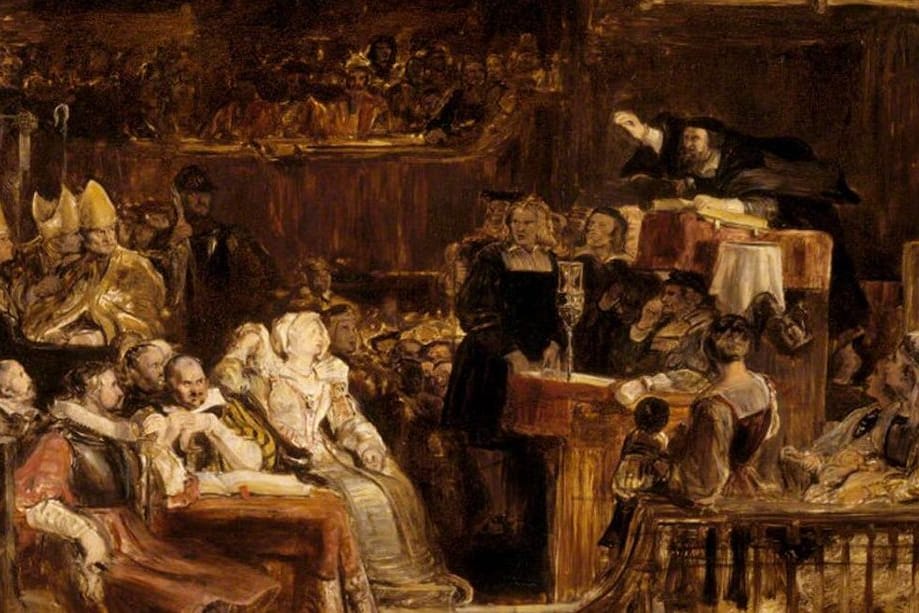
Presbyterians are Christians in the Reformed tradition, which began with John Calvin in Geneva and came to Scotland through John Knox. They teach that God is sovereign over all things and saves people by grace alone, through Jesus Christ, and they take their name from their way of governing the church through elders. The Reformed tradition is sometimes thought of as stern, yet one of its catechisms, the Heidelberg Catechism, opens by asking where you can find comfort, and answers that you belong to Christ. The largest Presbyterian church in the United States is the Presbyterian Church (U.S.A.), a mainline church formed in 1983. The more conservative Presbyterian Church in America (PCA) was organized in 1973.
Who were John Calvin and John Knox?
John Calvin (1509–1564) was a French scholar who became the leading pastor of the Reformation in Geneva, Switzerland. His Institutes of the Christian Religion, first published in 1536 and expanded until its final edition of 1559, became one of the most influential summaries of Protestant teaching. Calvin taught that salvation comes by faith in God’s grace, given through word and sacrament by the power of the Holy Spirit, and that good works are the fruit of a believer’s union with Christ.
Calvin organized the church in Geneva with four kinds of ministers: pastors, teachers, elders, and deacons. He believed that model came from the New Testament, and Presbyterian churches still follow it.
John Knox (c. 1514–1572) was a Scottish priest who became a Protestant preacher and spent years in exile, part of them in Calvin’s Geneva. He returned to Scotland in 1559 and led the Scottish Reformation, and in 1560 he and five colleagues wrote the Scots Confession. The Church of Scotland became the mother church of Presbyterians in the English-speaking world.
What are the Presbyterian confessions?
Presbyterians write confessions, statements of faith that explain what Scripture teaches, and they revise or add to them as the church faces new questions. The most influential is the Westminster Confession of Faith, written by an assembly of English and Scottish theologians at Westminster Abbey and completed in 1646. Its Shorter Catechism opens with a famous question and answer: “What is the chief end of man? Man’s chief end is to glorify God, and to enjoy him forever.” Generations of Presbyterian children learned from that answer that they were made for joy in God.
The PC(USA) gathers twelve documents in its Book of Confessions: the Nicene Creed, the Apostles’ Creed, the Scots Confession, the Heidelberg Catechism, the Second Helvetic Confession, the Westminster Confession with its Shorter and Larger Catechisms, the Theological Declaration of Barmen, the Confession of 1967, the Confession of Belhar, and A Brief Statement of Faith. Two of them were written in times of great trial. The Barmen Declaration was written in 1934 by German Christians resisting the Nazi takeover of the church, and the Belhar Confession came from South African churches opposing apartheid. A Brief Statement of Faith begins:
In life and in death we belong to God.
What do Presbyterians believe about God’s grace?
Presbyterians emphasize the sovereignty of God, the conviction that God rules over all things and that salvation is God’s work from beginning to end. Paul’s praise sums it up: “For from him and through him and to him are all things. To him be the glory forever. Amen” (Romans 11:36). The Heidelberg Catechism of 1563 begins by asking, “What is your only comfort in life and in death?” and answers, “That I am not my own, but belong—body and soul, in life and in death—to my faithful Savior, Jesus Christ.”
Calvin and the Westminster Confession taught predestination, the doctrine that God chooses, or elects, those who will be saved. Many Presbyterians today present election as a comfort. Salvation rests on God’s gracious choice, which holds firm even on the days when a person’s faith feels weak. Nothing can undo that choice, as Paul wrote, “nor any other created thing will be able to separate us from God’s love which is in Christ Jesus our Lord” (Romans 8:39). The Second Helvetic Confession of 1566 warns against judging anyone lost: “we must hope well of all, and not rashly judge any man to be a reprobate.”
In the twentieth century the Swiss Reformed theologian Karl Barth recast the doctrine. In Jesus Christ, he argued, God chose all of humanity, and Christ himself bore the rejection, so that election is God’s yes to every person. See are we saved by faith or works?
How do Presbyterians read the Bible?
At their ordination, PC(USA) ministers, elders, and deacons are asked whether they accept the Old and New Testaments “to be, by the Holy Spirit, the unique and authoritative witness to Jesus Christ in the church universal, and God’s word to you.” The confessions guide how the church reads Scripture, but the PC(USA) does not require its members to accept the confessions. Anyone who acknowledges Jesus Christ as Lord and Savior may join. Presbyterian seminaries teach the historical study of the Bible. See should we read the Bible as literal fact?
What are Presbyterian sacraments and worship like?
Presbyterians celebrate two sacraments, Baptism and the Lord’s Supper. They baptize infants as well as adults, and the Westminster Confession teaches that “the infants of one or both believing parents are to be baptized.” In the Lord’s Supper, Presbyterians follow Calvin in teaching that Christ is truly present by the Holy Spirit. Westminster says that believers “really and indeed, yet not carnally and corporally, but spiritually, receive and feed upon Christ crucified.” See what is Communion?
Presbyterian worship centers on the reading and preaching of Scripture, with prayer, hymns, and psalms. Many Presbyterian sanctuaries are plain, with the pulpit, the Communion table, and the baptismal font at the front, so that the eye goes to the places where God’s word is spoken and God’s gifts are given. Presbyterians are known for orderly church life, often quoting Paul: “Let all things be done decently and in order” (1 Corinthians 14:40).
How are Presbyterian churches governed?
The name Presbyterian comes from the Greek presbyteros, “elder.” Each congregation is led by a session, a council of elders elected by the members together with the pastor. Congregations belong to regional presbyteries, which ordain ministers, and presbyteries send representatives to synods and to a national General Assembly. The PC(USA)’s Stated Clerk, elected by the General Assembly, is the Rev. Jihyun Oh, elected in 2024. Presbyterians trust that the Holy Spirit can guide the church through elders who pray and decide together, in a congregation’s session as much as in the General Assembly.
What does the PC(USA) teach today?
American Presbyterians divided at the start of the Civil War, and on June 10, 1983, the southern Presbyterian Church in the U.S. and the northern United Presbyterian Church in the U.S.A. reunited in Atlanta to form the PC(USA).
Presbyterian women were first ordained as elders in 1930. Margaret Towner became the first woman ordained a Presbyterian minister in 1956, and the southern church ordained Rachel Henderlite in 1965. Since 2011 the PC(USA) has been able to ordain gay and lesbian Christians as ministers, elders, and deacons. Since 2015 its constitution has described marriage as “a unique commitment between two people, traditionally a man and a woman,” and no minister is required to perform a marriage against conscience. See can women be pastors? and can same-sex couples get married in church?
Since 1997 the PC(USA) has been in full communion with the Evangelical Lutheran Church in America, the Reformed Church in America, and the United Church of Christ.
How is the PC(USA) different from the Presbyterian Church in America?
The Presbyterian Church in America was organized in December 1973 at Briarwood Presbyterian Church in Birmingham, Alabama, by congregations that left the southern Presbyterian Church in the U.S. Its founders opposed what they saw as a long-developing theological liberalism and held to the traditional position on women in church office. The PCA holds the Westminster Confession and Catechisms as its doctrinal standards and teaches that Scripture is without error. PCA members hold these convictions out of reverence for Scripture and for the Reformed confessions.
The PC(USA) shares the same Reformed heritage but confesses a wider Book of Confessions, reads Scripture with historical scholarship, and ordains women and gay and lesbian Christians to every office. Both churches claim the Westminster Confession and Catechisms as part of their heritage. For the wider family of mainline churches, see what is mainline Protestantism?
The two great Reformed catechisms begin with words a person can carry through any day. The Heidelberg Catechism tells you that you belong, body and soul, to your faithful Savior. The Westminster Shorter Catechism tells you that you were made to glorify God and to enjoy him forever. Between them they hold the whole Presbyterian hope, that a life given to God is safe in God’s hands and full of joy.
Common questions
What is the difference between the PC(USA) and the PCA?
Both stand in the Reformed tradition and are governed by elders. The Presbyterian Church in America, organized in 1973, holds the Westminster Confession and Catechisms as its doctrinal standards, does not ordain women as elders or ministers, and teaches that marriage is between a man and a woman. The Presbyterian Church (U.S.A.) confesses a wider Book of Confessions, ordains women, ordains gay and lesbian Christians, and permits same-sex marriage.
Do Presbyterians believe in predestination?
John Calvin and the Westminster Confession taught that God chooses, or elects, those who will be saved. Presbyterians today usually present election as good news: salvation rests on God’s gracious choice, not on human effort. The Second Helvetic Confession, part of the PC(USA)’s Book of Confessions, teaches that Christians “must hope well of all.”
Do you have to agree with every Presbyterian confession to join?
No. The PC(USA) does not require members to accept its confessions; anyone who acknowledges Jesus Christ as Lord and Savior may join. Ministers, elders, and deacons promise at their ordination to be instructed and led by the confessions.
Why are they called Presbyterians?
The name comes from the Greek word presbyteros, “elder.” Presbyterian churches are governed by elders, ordained lay leaders elected by each congregation, who serve together with ministers in the session of each church and in larger bodies called presbyteries.
Sources
- Romans 11:36 (WEB)
- Romans 8:38–39 (WEB)
- PC(USA), The Book of Confessions (2016), including the ordination questions
- UCC: History (on John Calvin and the Institutes)
- Stories from the 1983 reunion General Assembly (PC(USA), 2022)
- PC(USA) celebrates 70 years of women clergy (2026)
- PC(USA) approves change in ordination standards (2011)
- Presbyterian Church (U.S.A.) approves marriage amendment (Presbyterian Outlook, 2015)
- PC(USA): Stated Clerk of the General Assembly
- ELCA: Full communion partners (A Formula of Agreement, 1997)
- Presbyterian Church in America: History
- Karl Barth, Church Dogmatics II/2: The Doctrine of God (1942), on election
_-_John_Knox_Preaching_before_the_Lords_of_the_Congregation,_10_June_1559_-_486166_-_National_Trust.jpg)