Going to church
Gathering for worship is one of God’s gifts for the Christian life, and missing church does not cut you off from God’s love. Christians have met on Sundays since the first century, Hebrews 10:25 urges believers against “neglecting to meet together,” and the mainline churches invite their members to worship week by week. If church has hurt you, you can take time to heal and look for a congregation that will welcome you back.
And let us consider how to provoke one another to love and good deeds, not neglecting to meet together, as is the habit of some, but encouraging one another, and all the more as you see the Day approaching.
Hebrews 10:24–25, NRSVUE

If you have been away from church for a while, you may feel some mix of guilt, longing, and perhaps hurt. God’s love has gone with you the whole time, and the church’s door is open. Gathering for worship is one of the gifts God gives for the Christian life. Christians have met every Sunday since the first century to hear Scripture, to pray, and to share the bread and cup of Holy Communion, and the New Testament urges believers to keep meeting because faith grows in company. The mainline churches invite their members to gather week by week, and they welcome back anyone who has been away, whether for a month or for twenty years.
What does the Bible say about going to church?
The clearest verse is in the Letter to the Hebrews:
And let us consider how to provoke one another to love and good deeds, not neglecting to meet together, as is the habit of some, but encouraging one another, and all the more as you see the Day approaching.
Hebrews 10:24–25, NRSVUE
The writer gives a reason for meeting: Christians gather to encourage one another and to stir one another to love. The first believers in Jerusalem did the same. Acts says, “They continued steadfastly in the apostles’ teaching and fellowship, in the breaking of bread, and prayer” (Acts 2:42). Jesus himself went to the synagogue on the Sabbath, “as was his custom” (Luke 4:16), and he promised, “where two or three are gathered together in my name, there I am in the middle of them” (Matthew 18:20).
Paul describes the church as a body in which every member needs the others:
If one member suffers, all suffer together with it; if one member is honored, all rejoice together with it. Now you are the body of Christ and individually members of it.
1 Corinthians 12:26–27, NRSVUE
Why do Christians go to church on Sunday?
Christians gather on Sunday because Jesus rose from the dead on the first day of the week. The Book of Acts describes the church at Troas meeting “On the first day of the week, when the disciples were gathered together to break bread” (Acts 20:7).
Around 150 CE, Justin Martyr described Christian worship to the Roman emperor. He wrote that “on the day called Sunday, all who live in cities or in the country gather together to one place” to hear the apostles and prophets read, to pray, and to share bread and wine over which thanks had been given (First Apology 67). Justin added that the offering collected went to orphans, widows, the sick, prisoners, and strangers. The pattern Justin describes, with Scripture, prayer, the Eucharist, and care for those in need, is still the pattern of Sunday worship.
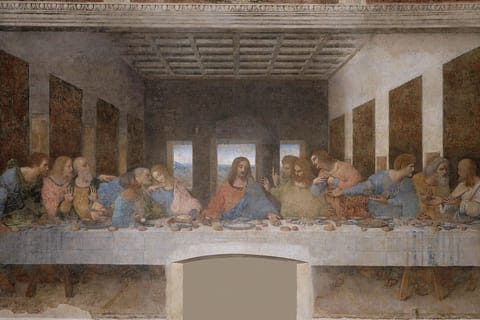
The heart of Sunday worship is Holy Communion, the meal Jesus told his followers to share “in memory of me” (1 Corinthians 11:23–26). The disciples at Emmaus recognized the risen Jesus after “he took the bread and gave thanks. Breaking it, he gave it to them” (Luke 24:30–31). A Christian can pray alone, but no one can share the Lord’s Supper alone; see What is Holy Communion?
Is it a sin to miss church?
The mainline churches treat Sunday worship as a gift and a calling. Martin Luther’s Small Catechism, which Lutherans in the ELCA still learn, explains the commandment to keep the Sabbath holy as a call to hold God’s word sacred and to hear and learn it gladly. The Heidelberg Catechism, part of the Presbyterian Church (U.S.A.)’s Book of Confessions, describes the day of rest as a time to gather with God’s people to hear the Word, share the sacraments, pray, and give to the poor. John Wesley’s General Rules, still part of United Methodist teaching, expect Methodists to keep “attending upon all the ordinances of God,” beginning with “the public worship of God.” The Catechism in the Episcopal Book of Common Prayer names the duty of all Christians “to come together week by week for corporate worship.”
God knows the reasons that keep people at home. Jesus said, “The Sabbath was made for man, not man for the Sabbath” (Mark 2:27). Sickness, a work shift you cannot change, caring for a baby or a sick relative, and a disability that makes getting out hard are good reasons. Pastors and priests in the mainline churches take Communion to people who are sick or homebound, so that no one has to go without the sacrament because they cannot get to church.
Over months and years, the habit of gathering keeps a person close to the community that feeds their faith, and that community needs each member’s gifts in return. If you have drifted away without quite meaning to, one Sunday is enough to begin again.
What if church has hurt me?
Many people stay away from church because a church hurt them. Some were shamed, some were rejected for who they are or whom they love, some were abused by people who should have protected them. Those wounds are real, and God honors the time you need to heal.
Jesus’ invitation still stands: “Come to me, all you who labor and are heavily burdened, and I will give you rest” (Matthew 11:28). In his parable, the shepherd leaves the ninety-nine to go after the one sheep that is lost, and carries it home rejoicing (Luke 15:4–6). God is still seeking you in the same way.
You can take time. You can try a different congregation, or a different tradition, where you are welcomed as you are. You can talk with a priest privately before you walk into a service. If someone in a church abused you, you have every right to report it and to stay away from that person. An early service with a small congregation, or a short evening service of prayers, can be an easier way back.
Can you be a Christian without going to church?
Yes. Baptism makes a person a Christian, and a Christian who cannot or does not attend church is still a member of Christ’s body; see Do you have to be baptized to be saved? Faith in Christ is God’s gift, received by grace; see What does it mean to be saved?
Christianity has always been a shared life, though. The Eastern Orthodox tradition puts this sharply. The nineteenth-century Russian theologian Aleksei Khomiakov wrote, “when any one of us falls, he falls alone; but no one is saved alone.” Orthodox writers such as Alexander Schmemann describe the Sunday liturgy as the moment when scattered believers become the church again, gathered around one table. Private prayer is good and necessary; see How do I pray? Many Christians find that their private prayer grows stronger when it is joined to the prayer of a congregation.
One of the oldest Christian prayers outside the New Testament, from a handbook called the Didache, was said over the bread at the church’s shared meal. It asks God to gather the scattered church as grain from many hills is gathered into one loaf, and it can be your prayer on the way back:
Even as this broken bread was scattered over the hills, and was gathered together and became one, so let Thy Church be gathered together from the ends of the earth into Thy kingdom; for Thine is the glory and the power through Jesus Christ for ever.
The Didache 9.4, translated by M. B. Riddle
Common questions
Do I have to go to church to be saved?
Salvation is God’s gift of grace, received in faith. The church is the community God gives believers for worship, the sacraments, and mutual care, and gathering with it is one of the ways that grace reaches you week by week.
Does watching church online count?
Online worship is a real way to pray with a congregation, especially for people who are sick, homebound, or far from a church. It cannot fully replace gathering in person, because Holy Communion is a meal shared together. If you cannot attend, ask a local pastor or priest; many congregations bring Communion to people at home.
Did Jesus go to church?
Jesus went to the synagogue on the Sabbath, as Luke’s Gospel says, “as was his custom” (Luke 4:16). He also worshiped at the Temple in Jerusalem. Christian worship grew out of the synagogue and the Temple, and the first Christians met on Sunday, the day of the resurrection.
Is it okay to take a break from church?
Sometimes, yes. After grief, burnout, or hurt from a congregation, a season of rest can be healthy, and God’s love goes with you while you are away. Keep praying, read Scripture, and stay in touch with at least one other Christian, so that returning stays possible.
Sources
- Hebrews 10:24–25 (WEB)
- Acts 2:42–47 (WEB)
- Acts 20:7 (WEB)
- 1 Corinthians 11:23–26 (WEB)
- 1 Corinthians 12:12–27 (WEB)
- Luke 4:16 (WEB)
- Justin Martyr, First Apology, chapter 67
- Book of Common Prayer (1979), An Outline of the Faith (Catechism)
- Martin Luther, Small Catechism, Part 1: The Ten Commandments (BookOfConcord.org)
- Heidelberg Catechism, Q&A 103
- The General Rules of the Methodist Church (United Methodist Discipleship Ministries)
- The Didache, chapter 9, translated by M. B. Riddle, Ante-Nicene Fathers vol. 7 (CCEL)
- Pemptousia, “No One Is Saved Alone” (on Aleksei Khomiakov)