Should we read the Bible as literal fact?
The Bible does not ask us to treat it as a literal history book. It is a holy text, God-breathed (2 Timothy 3:16), that teaches us how to love God and our neighbor. The Apostle Paul himself read the story of Sarah and Hagar as an allegory (Galatians 4:24), and Christians have long read Scripture for its spiritual sense. Some of its events also match what historians can confirm, such as the fall of Jerusalem to Babylon and the crucifixion of Jesus under Pontius Pilate.
Now this is an allegory: these women are two covenants.
Galatians 4:24, NRSVUE
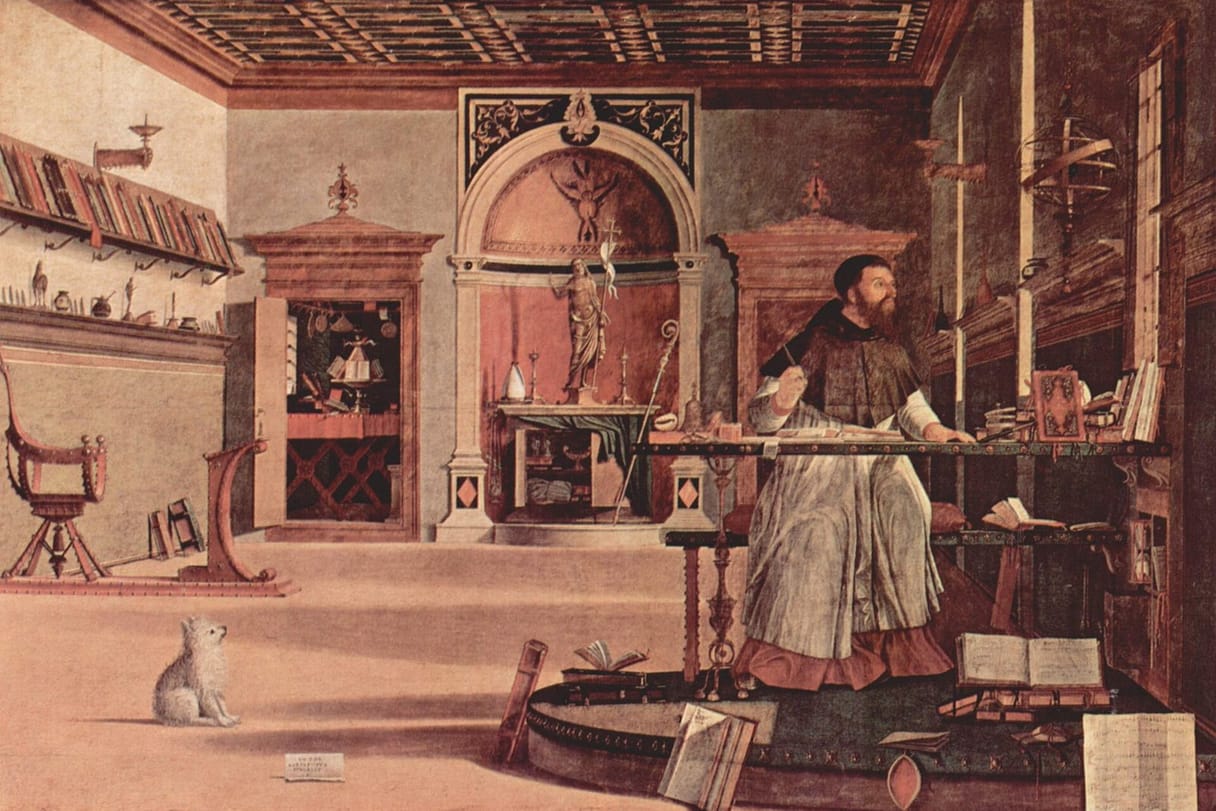
The Bible does not ask us to treat it as a literal history book. Rather, it is a holy text, God-breathed (2 Timothy 3:16), teaching us about how to love God and how to love our neighbor, the two commandments Jesus called the greatest (Matthew 22:37–40).
How did Paul read the story of Sarah and Hagar?
The Apostle Paul himself reads the scriptures metaphorically, in a striking instance. In his letter to the Galatians, he recounts the story of Sarah and Hagar, the wives of Abraham from Genesis (Genesis 16:3; Galatians 4:22–23). Then he says:
Now this is an allegory: these women are two covenants.
Galatians 4:24, NRSVUE
If you read about Sarah and Hagar in Genesis, it just reads like a narrative of historical events from ages past. Paul, however, is not interested in this excerpt from Genesis as a historical narrative but in what it illustrates about our relationship with God through Christ Jesus.
In this way, we can read much of the Bible with a spiritual lens, not an earthly literal lens. May we meditate upon these ancient texts and grow closer to God and to one another.
Is this a new way of reading the Bible?
Christians have read Scripture for its spiritual sense since the earliest centuries. Origen of Alexandria, in the third century, asked who would suppose that the first, second, and third days of creation “existed without a sun, and moon, and stars.” Gregory of Nyssa, in his Life of Moses, read the Exodus as the story of the soul’s ascent toward God, a reading the Eastern Orthodox Church still treasures. For these teachers, a spiritual reading did not make Scripture less true. It made the Bible a place where they met God.
Many Christians today read the stories of Genesis and Exodus as history, and their reverence for Scripture deserves respect. Readers on both sides can share the same hope: that these ancient words will draw them closer to God and to their neighbor.
Which parts of the Bible match what historians know?
Extrabiblical evidence for the events of the Torah (Adam through Moses) is scarce. Two major denominations of Judaism, Reform and Conservative, largely regard the Torah as mythological: not as historical fact but nevertheless central to religious study and worship.
Still, we can identify excerpts of the Bible that correspond with facts essentially beyond historical dispute.
The Hebrew Bible
- The luminaries, earth, skies, waters, sea animals, vegetation, land animals, birds, and humans were created, that is, there was a time before they existed (Genesis 1). Contrast Aristotle, who held that the world, and the kinds of plants, animals, and humans in it, have always existed (On the Heavens, Book I; Generation of Animals, Book II).
- A royal dynasty descended from David existed (2 Samuel 3:1; 1 Kings 12:19). The Tel Dan stele, a ninth-century BCE Aramaic inscription found in northern Israel in 1993, calls it the “house of David.”
- Shishak (Shoshenq I of Egypt) campaigned in the region (1 Kings 14:25–26). His own relief at Karnak records the campaign.
- Omri and Ahab were real kings of Israel (1 Kings 16:29–33). The Mesha Stele names Omri, and the Kurkh Monolith of the Assyrian king Shalmaneser III names Ahab at the battle of Qarqar in 853 BCE.
- Mesha of Moab rebelled (2 Kings 3:4–5). The Mesha Stele gives Mesha’s own version.
- Jehu seized the throne of Israel (2 Kings 9–10). The Black Obelisk of Shalmaneser III shows an Israelite king named Jehu paying tribute.
- Assyria took Samaria (2 Kings 17:5–6).
- Sennacherib took fortified cities of Judah and failed to capture Jerusalem in 701 BCE (2 Kings 18:13–16). The Taylor Prism and the Lachish reliefs tell the Assyrian side.
- Sennacherib was killed by his sons (2 Kings 19:37).
- Babylon took Jerusalem in 597 and 586 BCE (2 Kings 24:10–17; 2 Kings 25:1–12). King Jehoiachin was held in Babylon (2 Kings 25:27–30), and Babylonian ration tablets name him.
- The Jews were allowed to return during the Persian period, by Cyrus (Ezra 1:1–4). A governor named Tattenai appears in Ezra 5:3 and in a Babylonian tablet from the reign of Darius I.
- Isaiah was an eighth-century prophet in Jerusalem. Isaiah 7:1–9 sits in the crisis under King Ahaz, when Aram and Israel attacked Judah, and Isaiah 36–37 retells the siege of 701 BCE.
- Ezekiel was a priest and prophet among the exiles in Babylonia (Ezekiel 1:1–3).
- Belshazzar existed (Daniel 5:1); Babylonian records name him as the son of Nabonidus. Daniel 7–12 speaks of the persecution of the Jews under Antiochus IV, which began in 167 BCE, in the language of a prophetic vision.
- Hosea, Amos, Micah, and Zephaniah were eighth- and seventh-century prophets addressing real kingdoms. Amos 1:1 and Hosea 1:1 name real kings, such as Uzziah and Jeroboam II.
- Nahum celebrates the fall of Nineveh, which happened in 612 BCE (Nahum 3:7). Haggai 1:1–15 and Zechariah 1:1, 7 are dated to the second year of Darius I (520 BCE) and speak to the real rebuilding of the Temple.
The New Testament
- Jesus grew up in Nazareth.
- John baptized Jesus (Mark 1:9).
- Jesus proclaimed the kingdom of God (Mark 1:15; Luke 11:20).
- He taught in parables and gathered followers in Galilee.
- He went to Jerusalem at Passover and caused a disruption at the temple (Mark 11:15–17).
- The Romans crucified him under Pontius Pilate (Mark 15:1, 15, 24–26). Josephus and Tacitus independently attest the execution.
- His followers soon said they had encountered him risen. 1 Corinthians 15:3–8 is an early creed Paul received, naming Cephas, the Twelve, and others as witnesses.
- Claudius expelled Jews from Rome (Acts 18:2; Suetonius, Claudius 25). Gallio was proconsul of Achaia (Acts 18:12); a letter of the emperor Claudius inscribed at Delphi names him. Paul traveled to evangelize.
- Paul persecuted the churches, then had a call experience (Galatians 1:13–17).
- He met Cephas (Peter) and James in Jerusalem (Galatians 1:18–19), and later confronted Cephas at Antioch (Galatians 2:11–14).
- He traveled to Arabia, Damascus, Syria, and Cilicia, and churches existed in Judea, Galatia, Macedonia, Achaia, and Asia (Galatians 1:17–22; 2 Corinthians 8:1; 1 Corinthians 16:19).
- Paul raised a collection for Jerusalem (1 Corinthians 16:1–4; Romans 15:25–26) and planned to take it there and then go to Spain by way of Rome (Romans 15:23–28).
How do Reform and Conservative Jews read the Torah?
Reform and Conservative Judaism do not treat the Torah’s origin stories as literal history, and they hold the Torah at the center of their worship and study. The official Reform site, ReformJudaism.org, republished “Torah Is Not History,” an essay by Rabbi David Wolpe of Sinai Temple in Los Angeles. Wolpe writes that the Torah “is not a book we turn to for historical accuracy, but for larger truth.”
The Union of American Hebrew Congregations’ 1981 Torah commentary, edited by Rabbi W. Gunther Plaut, describes the Genesis stories as a mix of “myth, legend, distant memory and search for origins,” as The New York Times reported in 2002. Britain’s Movement for Reform Judaism states: “We believe that the Torah is a human creation – written by our ancestors and inspired by their understanding of themselves and the place of God in their lives.” Conservative Judaism’s pew commentary, Etz Hayim (2001), presents the Torah as reaching its final form after the Babylonian exile.
Conservative theologian Neil Gillman, who taught at the Jewish Theological Seminary in New York, called the Torah “an elaborate, complex myth,” and insisted that calling a theological claim a myth is not calling it “a fiction, a deliberate lie.” For these Jewish teachers, as for many Christians, the deepest truth of Scripture is the truth about God and about how to live.
How can I start reading the Bible this way?
Marcus Borg, a New Testament scholar, encouraged readers to ask two questions of each passage: what may have happened, and what the story means. You can begin with the stories you already love. Read one slowly, ask what it shows about God’s faithfulness and about your own life, and pray with it. Then read it again with others: a Bible study, a friend, a congregation. See How to start reading the Bible and The Bible as the Word of God.
Common questions
Do mainline churches read the Bible literally?
Not as a rule. The ELCA accepts the Scriptures “as the inspired Word of God,” and the PC(USA) receives them as “the unique and authoritative witness to Jesus Christ.” Neither statement requires reading every story as literal history, and the seminaries of the mainline churches teach modern biblical scholarship to their future clergy.
Did early Christians read the Bible literally?
Not always. Origen of Alexandria, writing in the third century in On First Principles, asked who would suppose that the first, second, and third days of creation “existed without a sun, and moon, and stars.” The Apostle Paul called the story of Sarah and Hagar an allegory in Galatians 4:24.
If the Bible is not literal fact, can it still be true?
Yes. Christians and Jews have long found the truth of Scripture in what it teaches about God and how to live, not only in whether each story happened as written. Rabbi David Wolpe put it this way: the Torah “is not a book we turn to for historical accuracy, but for larger truth.”
Can I still believe the Bible is literally true?
Many faithful Christians do, and their love for Scripture is a gift to the whole church. Reading the Bible for its spiritual sense does not require anyone to give up their faith in it; it opens another way into the same holy text, one that Paul, Origen, and Gregory of Nyssa all walked.
Did the Exodus really happen?
Archaeologists have found little outside the Bible about the Exodus as the Bible tells it, and many scholars think the story grew from the memories of a smaller group. Jews and Christians alike still read the Exodus every year as the story of their own liberation by God, at Passover and at Easter.
Sources
- Galatians 4:21–31 (WEB)
- 2 Timothy 3:16 (WEB)
- David Wolpe, “Torah Is Not History,” ReformJudaism.org
- Michael Massing, “As Rabbis Face Facts, Bible Tales Are Wilting,” The New York Times, March 9, 2002
- Hillel Halkin, “‘Boiling a Kid’: Reflections on a New Bible Commentary,” Commentary, April 2003
- Josh Levy, “Reform Judaism in 1000 Words: Torah,” Movement for Reform Judaism (2017)
- Neil Gillman, “Toward a Theology for Conservative Judaism” (Conservative Judaism, 1983), excerpted by Adath Shalom
- Aristotle, On the Generation of Animals, Book II (Wikisource)
- Aristotle, On the Heavens, Book I (Wikisource)
- Origen, On First Principles, Book IV (New Advent)
- Tel Dan stele (Wikipedia)
- Constitution of the Evangelical Lutheran Church in America, 2.03
- Presbyterian Church (U.S.A.), Book of Confessions (2016), introduction: ordination questions