What Lutherans believe
Lutherans believe that God saves people by grace alone, received through faith in Jesus Christ, and not by their own works, as Martin Luther taught from Paul’s letters in the sixteenth century. They confess the Apostles’, Nicene, and Athanasian Creeds and the Augsburg Confession of 1530. They baptize infants and teach that Christ’s body and blood are truly present in Holy Communion. The ELCA ordains women and gay and lesbian pastors; the Missouri Synod does not.
For by grace you have been saved through faith, and this is not your own doing; it is the gift of God—not the result of works, so that no one may boast.
Ephesians 2:8–9, NRSVUE
If you have ever lain awake wondering whether you could be good enough for God, you share the question that drove Martin Luther. Lutherans are Christians who follow the teaching of Luther, the sixteenth-century German reformer, and above all his discovery in Scripture that God saves sinners by grace, received through faith in Christ. The two largest Lutheran churches in the United States are the Evangelical Lutheran Church in America (ELCA), a mainline church, and the more conservative Lutheran Church–Missouri Synod (LCMS). Both confess the Apostles’, Nicene, and Athanasian Creeds and the Lutheran confessions gathered in the Book of Concord. They differ on how to read Scripture, on the ordination of women, and on same-sex relationships.
Who was Martin Luther?
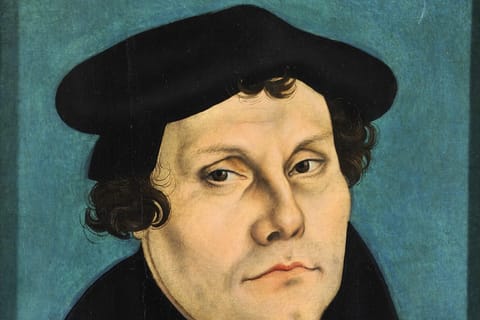
Martin Luther (1483–1546) was an Augustinian monk and a professor of the Bible at the University of Wittenberg in Germany. He was tormented by the question of how a sinner could stand before a righteous God, and no amount of prayer, fasting, or confession seemed to calm his conscience. Studying Paul’s Letter to the Romans, he came to understand that the righteousness of God Paul speaks of is a gift God gives to sinners:
For in it the righteousness of God is revealed through faith for faith, as it is written, “The one who is righteous will live by faith.”
Romans 1:17, NRSVUE
On October 31, 1517, Luther posted his Ninety-Five Theses against the sale of indulgences, certificates that promised to shorten punishment after death in exchange for money. The protest grew into the Protestant Reformation. Luther translated the Bible into German so that ordinary people could read it, wrote hymns such as “A Mighty Fortress Is Our God,” married a former nun, Katharina von Bora, and wrote the Small Catechism of 1529 to teach the faith in homes.
Luther also wrote cruel attacks on the Jewish people late in his life. The ELCA has formally repudiated those writings and committed itself to combating antisemitism.
What is the Augsburg Confession?
The Augsburg Confession is the founding statement of Lutheran belief. Written mainly by Luther’s colleague Philip Melanchthon, it was presented to Emperor Charles V at the Diet of Augsburg in 1530. Its 28 articles set out the faith of the reforming churches and argued that it agreed with the teaching of the whole church.
Article IV states the central Lutheran teaching, that people “cannot be justified before God by their own strength, merits, or works, but are freely justified for Christ’s sake, through faith.” Article VII teaches that the church is present wherever “the Gospel is rightly taught and the Sacraments are rightly administered,” and that Christians do not need identical ceremonies to be one church.
In 1580 Lutherans gathered their confessions into the Book of Concord. It contains the three ancient creeds, the Augsburg Confession and its Apology (defense), the Smalcald Articles, a treatise on the power of the pope, Luther’s Small and Large Catechisms, and the Formula of Concord.
What do Lutherans believe about grace and faith?
Lutherans teach that salvation is God’s gift from start to finish. The ELCA puts it this way: “We are saved (made right with God) by God’s grace alone, through Christ — not by prayer, mindset, or good deeds.” Paul’s words to the Ephesians are often quoted:
For by grace you have been saved through faith, and this is not your own doing; it is the gift of God—not the result of works, so that no one may boast.
Ephesians 2:8–9, NRSVUE
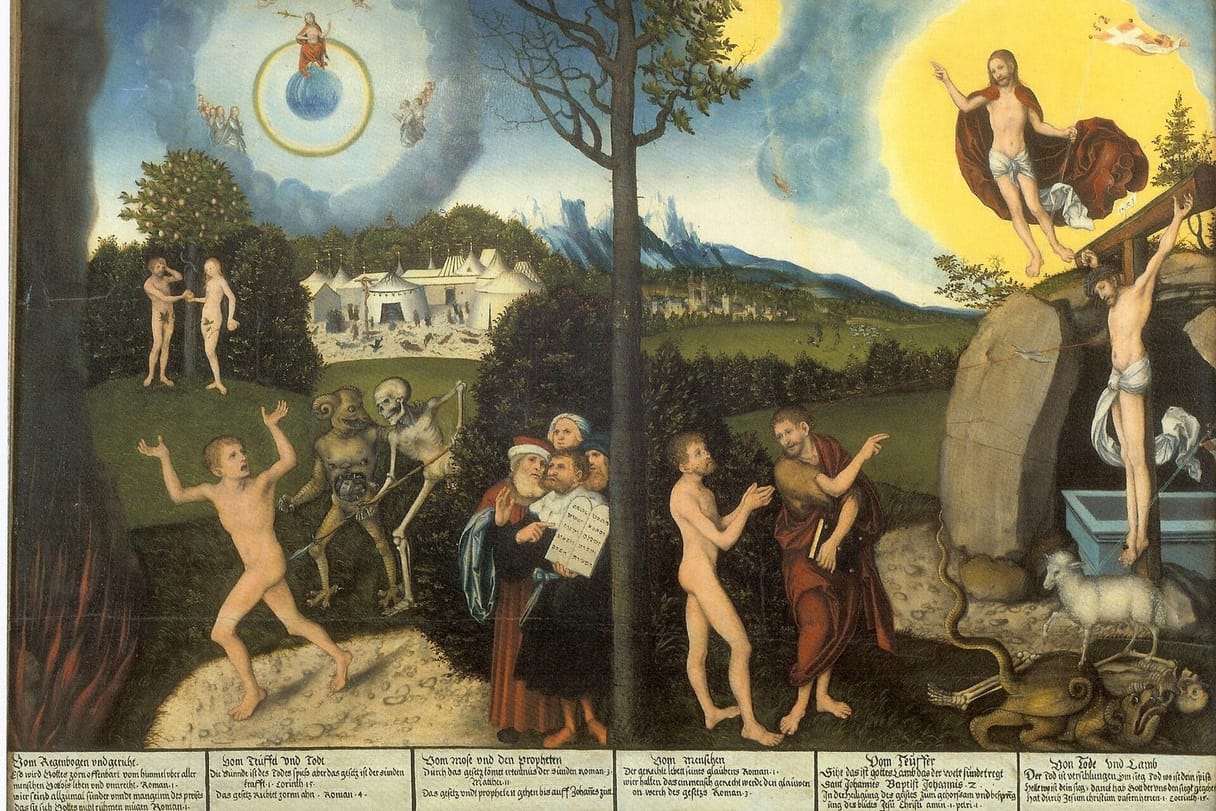
Lutherans distinguish between law and gospel. The law, God’s commandments, shows people their sin and their need for mercy, and the gospel announces that Christ has forgiven them. Lucas Cranach the Elder, a friend of Luther, painted that teaching in his Law and Grace of 1529. On one side Moses and the prophets hold the law while death drives a sinner away, and on the other John the Baptist points a sinner to Christ crucified and risen. A Christian is, in Luther’s phrase, at once righteous and a sinner, forgiven while still struggling with sin. That teaching has comforted many people who feel they will never be holy enough, because their standing with God rests on Christ.
Faith, for Luther, means trusting God’s promise with the whole heart. The ELCA quotes his description: “Faith is a living, daring confidence in God’s grace.” Good works grow from that faith as its fruit, done out of gratitude and love for the neighbor. No one needs to earn God’s favor, because God has already given it in Christ. See are we saved by faith or works?
Luther also taught that in faith Christ himself is present and unites the believer to himself. In the late twentieth century the Finnish theologian Tuomo Mannermaa and his students, working in dialogue with the Russian Orthodox Church, argued that this teaching stands close to the Orthodox idea of theosis, salvation as sharing in God’s own life, so that believers “may become partakers of the divine nature” (2 Peter 1:4).
What do Lutherans believe about the sacraments?
Lutherans celebrate Baptism and the Lord’s Supper as sacraments commanded by Christ, through which God gives grace together with the preached word. They baptize infants, because Baptism is God’s own act and promise, given before a child can ask for it. Luther’s Small Catechism says that Baptism “works forgiveness of sins, delivers from death and the devil, and gives eternal salvation to all who believe this.” In his Large Catechism Luther taught that “when our sins and conscience oppress us,” a Christian may take comfort and say, “Nevertheless I am baptized.”
Lutherans believe that Christ is truly present in Holy Communion. Article X of the Augsburg Confession teaches that “the Body and Blood of Christ are truly present, and are distributed to those who eat the Supper of the Lord.” Luther rejected the medieval theory of transubstantiation, which explained the change with Aristotle’s philosophy, and he also held that the bread and wine are more than symbols, a point on which Lutherans differ from some other Protestants. They rest on Christ’s words, “This is my body, which is broken for you” (1 Corinthians 11:24). See what is Communion?
What is Lutheran worship like?
Lutheran worship follows the historic liturgy of the Western church, with confession of sin, Scripture readings, a sermon, the creed, prayers, and Holy Communion. Lutherans keep the church year, from Advent and Christmas through Lent and Easter, and they are known for congregational singing, a tradition that began with Luther’s own hymns. The ELCA notes that styles vary across its congregations, from organ and choir to praise bands, while the readings, the sermon, and Communion remain common to all. Week by week the service tells the same good news, that God forgives sinners and feeds them at the Lord’s table.
What does the ELCA teach today?
The ELCA was formed in 1988 by the merger of the American Lutheran Church, the Lutheran Church in America, and the Association of Evangelical Lutheran Churches, and it reports about 8,400 congregations. Two of those predecessor churches began ordaining women in 1970. Elizabeth Eaton became the ELCA’s first woman presiding bishop in 2013, and Yehiel Curry, elected in 2025, is its first Black presiding bishop.
In 2009 the ELCA’s Churchwide Assembly opened its ministry to pastors in publicly accountable, lifelong, monogamous same-gender relationships. Its social statement on sexuality from the same year neither endorses nor forbids same-gender marriages, and the church leaves the decision to recognize them to each congregation and its pastor. No pastor is obliged to marry any couple. See can same-sex couples get married in church?
The ELCA is in full communion, sharing sacraments and clergy, with the Episcopal Church, the Presbyterian Church (U.S.A.), the Reformed Church in America, the United Church of Christ, the Moravian Church, and the United Methodist Church. For the wider family of churches it belongs to, see what is mainline Protestantism?
How is the ELCA different from the Missouri Synod?
The Lutheran Church–Missouri Synod confesses that the Scriptures “are breathed out by God and are, therefore, inerrant (without error or contradiction).” Its 2004 convention affirmed that women “may not serve in the office of pastor,” and its 2023 convention reaffirmed both closed Communion, in which only those who share the church’s confession receive the sacrament, and its teaching on marriage and sexuality. Missouri Synod Lutherans hold these positions out of reverence for Scripture and a desire to keep the Lutheran confessions whole.
Some ELCA congregations that disagreed with the 2009 decisions left to form the North American Lutheran Church, which ordains women but not pastors in same-sex relationships. The ELCA does not describe Scripture as inerrant, reads it with the tools of historical study, and ordains women and gay and lesbian Christians. Lutherans in all these churches still sing Luther’s hymns, learn his Small Catechism, and trust the same promise of grace. For three of the ELCA’s full-communion partners, see what do Presbyterians believe?, what do Methodists believe?, and what do Episcopalians believe?
Luther taught families to end each day with a short prayer from his Small Catechism. Many Lutherans still pray it at bedtime:
I thank Thee, my Heavenly Father, through Jesus Christ, Thy dear Son, that Thou hast graciously kept me this day, and I pray Thee to forgive me all my sins, where I have done wrong, and graciously keep me this night. For into Thy hands I commend myself, my body and soul, and all things. Let Thy holy angel be with me, that the Wicked Foe may have no power over me. Amen.
Martin Luther, Small Catechism (1529), Evening Prayer, in the Triglot Concordia translation (1921)
Common questions
What is the difference between the ELCA and the Missouri Synod?
Both confess the Augsburg Confession and the Book of Concord. The ELCA ordains women, allows pastors in same-gender relationships, and shares full communion with Episcopal, Presbyterian, Reformed, Moravian, Methodist, and United Church of Christ churches. The Lutheran Church–Missouri Synod teaches that Scripture is without error, does not allow women to serve as pastors, and practices closed Communion.
Do Lutherans believe in the real presence of Christ in Communion?
Yes. The Augsburg Confession teaches that “the Body and Blood of Christ are truly present” in the Lord’s Supper and are given to those who eat it. Lutherans do not offer a philosophical theory of how Christ is present; they rest on Christ’s promise, “This is my body.”
Are Lutherans Catholic or Protestant?
Lutherans are Protestants, the first church of the Reformation, but the Augsburg Confession presented their teaching as the faith of the whole church catholic, meaning universal. Lutherans kept the ancient creeds, the church year, and the historic liturgy of the Western church, and they confess “one holy catholic and apostolic Church” in the Nicene Creed.
Do Lutherans baptize babies?
Yes. Lutherans baptize infants because they understand Baptism as God’s gift, not a human achievement. Luther’s Small Catechism says that Baptism “works forgiveness of sins, delivers from death and the devil, and gives eternal salvation to all who believe this.”
Sources
- Ephesians 2:8–9 (WEB)
- Romans 1:17 (WEB)
- Augsburg Confession, Article IV: Of Justification (BookOfConcord.org)
- Augsburg Confession, Article VII: Of the Church (BookOfConcord.org)
- Augsburg Confession, Article X: Of the Lord’s Supper (BookOfConcord.org)
- Luther’s Small Catechism, Part IV: The Sacrament of Holy Baptism (BookOfConcord.org)
- ELCA: What Lutherans believe
- ELCA: Luther and Lutheranism
- ELCA: Full communion partners
- Presiding Bishop Eaton on the Supreme Court marriage decision (2015)
- Yehiel Curry to be installed as ELCA presiding bishop (ELCA, 2025)
- 2 Peter 1:4 (WEB)
- Tuomo Mannermaa, Christ Present in Faith: Luther’s View of Justification (Fortress Press, 2005)
- LCMS convention says women may hold all offices that do not involve pastoral functions (Reporter, 2004)
- LCMS convention affirms closed Communion and biblical sexuality (Reporter, 2023)
- A Lutheran Perspective on the ELCA (The Lutheran Witness, 2022)