Holy Communion
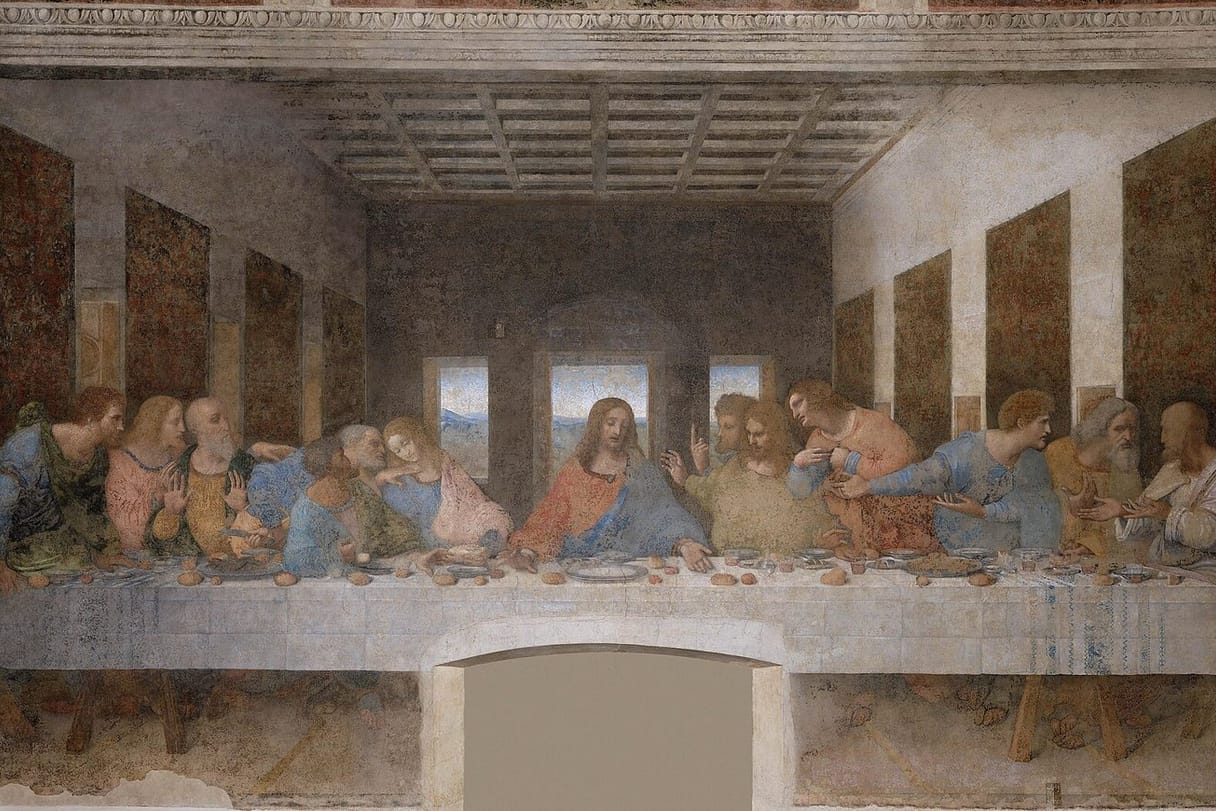
Holy Communion, also called the Eucharist or the Lord’s Supper, is the sacred meal Jesus gave his followers on the night before he died, when he took bread and said, “This is my body,” and took the cup and said, “This cup is the new covenant in my blood.” The Orthodox and the mainline churches teach that Christ is truly present in the meal and gives himself to those who receive it in faith, though they explain that presence in different ways.
For as often as you eat this bread and drink the cup, you proclaim the Lord’s death until he comes.
1 Corinthians 11:26, NRSVUE
Holy Communion is the meal in which Christ gives himself to his people, and the church has kept it since the days of the apostles. If you are asking about it, you may be visiting a church and wondering whether you may come forward, or you may feel unworthy to receive. The church’s answer to both is grace: the table belongs to Christ, who welcomed sinners and ate with them.
Holy Communion goes by several names. Paul calls it “the Lord’s supper” (1 Corinthians 11:20), many churches call it the Eucharist or the Mass, and the Orthodox call the whole service the Divine Liturgy. “Eucharist” comes from the Greek word for thanksgiving, because Jesus “had given thanks” over the bread.
Where does Holy Communion come from in the Bible?
The earliest written account comes from Paul, who passed on what he had received:
For I received from the Lord what I also handed on to you, that the Lord Jesus on the night when he was betrayed took a loaf of bread, and when he had given thanks, he broke it and said, “This is my body that is for you. Do this in remembrance of me.” In the same way he took the cup also, after supper, saying, “This cup is the new covenant in my blood. Do this, as often as you drink it, in remembrance of me.” For as often as you eat this bread and drink the cup, you proclaim the Lord’s death until he comes.
1 Corinthians 11:23–26, NRSVUE
Jesus gave this meal on the night he was betrayed, knowing that his friends would fail him, and he gave it to them anyway. Matthew, Mark, and Luke tell the same story of the Last Supper (Mark 14:22–25). After the resurrection, Luke tells of two disciples who walked with the risen Jesus to Emmaus without knowing him. At supper “he took the bread and gave thanks. Breaking it, he gave it to them. Their eyes were opened and they recognized him” (Luke 24:30–31). They told the others “how he was recognized by them in the breaking of the bread” (Luke 24:35).
From the start, the church gathered for this meal. The first Christians “continued steadfastly in the apostles’ teaching and fellowship, in the breaking of bread, and prayer” (Acts 2:42).
Why is it called Communion?
The name comes from Paul’s words to the Corinthians:
The cup of blessing that we bless, is it not a sharing in the blood of Christ? The bread that we break, is it not a sharing in the body of Christ? Because there is one bread, we who are many are one body, for we all partake of the one bread.
1 Corinthians 10:16–17, NRSVUE
The Greek word translated “sharing” is koinōnia, which means fellowship or participation. The King James Version translated it “communion.” Holy Communion is communion with Christ and, through him, with everyone else who shares the one bread, including people you have never met and people you find it hard to love.
Is Christ really present in the bread and wine?
Christians from the earliest centuries have believed that Christ is truly present in the Eucharist. In the Gospel of John, Jesus says, “I am the living bread which came down out of heaven,” and, “He who eats my flesh and drinks my blood lives in me, and I in him” (John 6:51, 56). Around 150 CE Justin Martyr wrote of the Eucharist, “not as common bread and common drink do we receive these” (First Apology 66).
Churches explain the presence in different ways, and each explanation tries to honor a mystery. The Eastern Orthodox churches teach that the Holy Spirit changes the bread and wine into the body and blood of Christ, and they call the change a mystery without defining how it happens. Lutherans confess that “the Body and Blood of Christ are truly present” (Augsburg Confession, Article X). The Church of England’s Article XXVIII rejected transubstantiation but affirmed that for those who receive with faith, “the Bread which we break is a partaking of the Body of Christ.”
Anglicans have usually declined to define how Christ is present. Richard Hooker, the great Elizabethan theologian, wrote, “The real presence of Christ’s most blessed body and blood is not therefore to be sought for in the sacrament, but in the worthy receiver of the sacrament.” He also said that what the bread and wine “are in themselves it skilleth not,” meaning it does not matter: “it is enough that to me which take them they are the body and blood of Christ” (Laws V.67).
John Calvin, whose teaching shaped the Presbyterian and Reformed churches, taught that in the Supper the Holy Spirit truly unites believers with the body of the risen Christ (Institutes IV.17). None of these churches claims that a chemist could detect a change in the bread. They proclaim that Christ gives himself to his people in this meal, and they invite you to receive him with faith.
What happens at a Communion service?
In the mainline churches the central prayer is called the Great Thanksgiving. The pastor or priest gives thanks to God for creation and redemption, repeats Jesus’s words over the bread and wine, and prays for the Holy Spirit to bless the gifts and the people. In many congregations the people proclaim, “Christ has died. Christ is risen. Christ will come again.” Then the bread is broken, and the people come forward to receive the bread and the cup, or pass them to one another in the pews.
The Orthodox Divine Liturgy, most often the liturgy that bears John Chrysostom’s name, gives special weight to the epiclesis, the prayer that asks the Holy Spirit to come down on the people and on the gifts. Alexander Schmemann, an Orthodox priest and dean of St. Vladimir’s Seminary in New York, titled his last book The Eucharist: Sacrament of the Kingdom, because in the liturgy the church is lifted into the presence of God and tastes the life of the world to come.
Christians have long named three gifts of Communion. Jesus gave the cup “for the remission of sins” (Matthew 26:28); the one bread makes many people one body (1 Corinthians 10:17); and the meal is a foretaste of the feast of God’s kingdom. Those who come are asked to examine their lives, repent of their sins, and be at peace with their neighbors.
Paul’s warning about eating “in a way unworthy of the Lord” (1 Corinthians 11:27–29) was aimed at a church where the wealthy ate and drank and put to shame those “who don’t have enough” (1 Corinthians 11:20–22). Coming to Communion while holding others in contempt contradicts the meal’s meaning. The person who comes feeling small and unworthy is the very one Christ came to feed.
Can I take Communion if I’m not a member, or not baptized?
If you are baptized, the mainline churches welcome you. The Evangelical Lutheran Church in America welcomes “all baptized persons” to Communion when they visit its congregations, and the Episcopal Church invites every baptized Christian, from any church, to receive. The Orthodox churches, for their part, give Communion only to members of the Orthodox Church, as an expression of their deep sense that sharing the cup means sharing one faith.
If you are not baptized, the ancient rule is that baptism comes first. The Didache, an early Christian church manual, says that no one should eat or drink of the Eucharist “but they who have been baptized into the name of the Lord.” The ELCA and the Episcopal Church keep that rule. The Presbyterian Church (U.S.A.) offers the bread and cup to all who come and invites the unbaptized to prepare for baptism, and United Methodist teaching welcomes “all who respond in faith to the invitation” while saying that baptism normally comes first.
Some congregations practice what is called an open table, inviting everyone present to receive. They point to Jesus, whose critics complained that he “welcomes sinners and eats with them” (Luke 15:2).
If you are not baptized and find yourself drawn to the table, that desire is a gift. Speak with the pastor or priest after the service. Many churches invite anyone not receiving to come forward for a blessing, and the pastor can help you prepare for baptism. (See Do you have to be baptized to be saved?)
What do the mainline churches teach about Holy Communion?
Orthodox, Lutheran, and Anglican Christians all teach that Christ is truly present in the Eucharist, though they explain the presence differently. Methodist, Presbyterian, and Reformed churches also celebrate the Lord’s Supper as a sacrament, a means by which Christ feeds his people. The ELCA, the PC(USA), the United Methodist Church, and the Episcopal Church all count Baptism and Holy Communion as the two sacraments given by Christ.
Every Communion looks back and forward at once. It remembers Christ’s death, receives the risen Christ now, and looks ahead to the feast of the kingdom, until he comes. (See What is heaven like?, What do Lutherans believe?, and What do Methodists believe?)
One of the oldest Communion prayers outside the Bible comes from the Didache. Its prayer over the bread asks God to gather the church as scattered grain is gathered into one loaf:
We thank Thee, our Father, for the life and knowledge which Thou madest known to us through Jesus Thy Servant; to Thee be the glory for ever. Even as this broken bread was scattered over the hills, and was gathered together and became one, so let Thy Church be gathered together from the ends of the earth into Thy kingdom; for Thine is the glory and the power through Jesus Christ for ever.
The Didache, chapter 9, trans. M. B. Riddle, Ante-Nicene Fathers, vol. 7 (1886)
Common questions
Can I take Communion at a church I don’t belong to?
In most mainline churches, yes. The ELCA and the Episcopal Church welcome all baptized Christians to receive, the United Methodist Church invites all who love Christ and repent of their sin, and the PC(USA) offers the bread and cup to all who come. The Orthodox churches give Communion only to Orthodox Christians, but visitors are often welcome to receive the blessed bread shared at the end of the service.
Can I take Communion if I’m not baptized?
Churches answer differently. The ELCA and the Episcopal Church reserve Communion for the baptized, as the early church did, while the PC(USA) offers the bread and cup to all who come and invites the unbaptized to prepare for baptism. If you are not baptized and feel drawn to the table, talk with the pastor or priest, who will welcome you and can prepare you for baptism.
Can children receive Communion?
Many mainline churches give Communion to baptized children. The Presbyterian Church (U.S.A.), for example, offers the bread and cup to all who come, “regardless of their age or understanding.” The Orthodox churches give Communion to infants from the day of their baptism, a practice that goes back to the early church.
What does it mean to take Communion “in an unworthy manner”?
Paul warned the Corinthians about eating “in a way unworthy of the Lord” (1 Corinthians 11:27) because the wealthy among them were eating and drinking while the poor went hungry. His concern was contempt for the church and for the poor. No one is worthy of Communion on their own merits, and no one needs to be; Christians come to it in repentance and love, trusting God’s grace.
Sources
- 1 Corinthians 11:20–29 (WEB)
- 1 Corinthians 10:16–17 (WEB)
- Luke 24:30–35 (WEB)
- John 6:51–56 (WEB)
- Matthew 26:26–28 (WEB)
- The Thirty-Nine Articles of Religion, Article XXVIII (Church of England)
- Richard Hooker, Of the Laws of Ecclesiastical Polity, Book V, ch. 67 (Internet Archive)
- Augsburg Confession, Article X (Book of Concord)
- Justin Martyr, First Apology, ch. 66 (New Advent)
- The Didache, ch. 9 (New Advent)
- General Convention 2024-D002, Archives research report (quotes Canon I.17.7, 2012-C029, ELCA, PC(USA), and UMC texts)
- John Calvin, Institutes of the Christian Religion, Book IV, ch. 17 (CCEL)
- Alexander Schmemann, The Eucharist: Sacrament of the Kingdom (St Vladimir’s Seminary Press, 1988)
- The Didache, ch. 9, trans. M. B. Riddle, Ante-Nicene Fathers vol. 7 (CCEL)