Baptism
Christians should be baptized, and God’s mercy reaches beyond the font to those who die unbaptized. Baptism is the sacrament Christ gave his church for making disciples, yet God’s power is not tied to it: Jesus promised paradise to the thief on the cross, who was never baptized (Luke 23:43), and the Holy Spirit came on Cornelius’s household before anyone baptized them (Acts 10:44–48).
Therefore we were buried with him by baptism into death, so that, just as Christ was raised from the dead by the glory of the Father, so we also might walk in newness of life.
Romans 6:4, NRSVUE
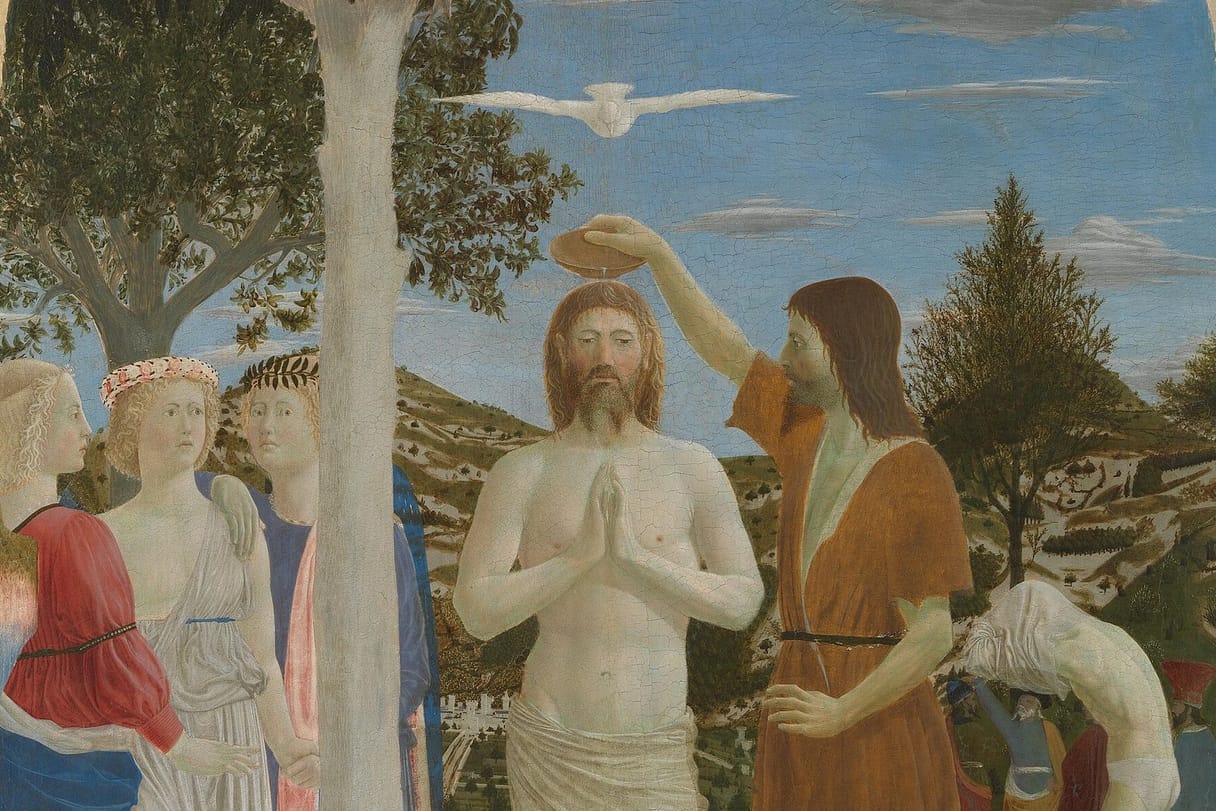
Christians should be baptized, and God’s mercy reaches further than the font. The question of whether baptism is needed for salvation usually comes from one of two places. Some people have been told that a loved one who died unbaptized is lost, and the fear has stayed with them. Others wonder whether baptism is a real gift or only a symbol. The church answers both with the same good news: baptism is God’s gift and command, and God remains free to save beyond it.
What does the Bible say about baptism and salvation?
The New Testament treats baptism as the way into the Christian life. The risen Jesus tells his followers, “Go and make disciples of all nations, baptizing them in the name of the Father and of the Son and of the Holy Spirit” (Matthew 28:19). On the day of Pentecost, Peter tells the crowd, “Repent and be baptized, every one of you, in the name of Jesus Christ for the forgiveness of sins, and you will receive the gift of the Holy Spirit” (Acts 2:38).
Paul describes baptism as sharing in Christ’s death and resurrection:
Do you not know that all of us who were baptized into Christ Jesus were baptized into his death? Therefore we were buried with him by baptism into death, so that, just as Christ was raised from the dead by the glory of the Father, so we also might walk in newness of life.
Romans 6:3–4, NRSVUE
Jesus tells Nicodemus, “unless one is born of water and Spirit, he can’t enter into God’s Kingdom” (John 3:5), and First Peter says that “baptism… now saves you” (1 Peter 3:21). These verses show why Christians have always taken baptism seriously, and why churches that stress its necessity do so out of reverence for Christ’s command.
The same New Testament insists that salvation is God’s gift: “for by grace you have been saved through faith, and that not of yourselves; it is the gift of God” (Ephesians 2:8). Baptism is a means of that grace, and grace comes first. (See Are we saved by faith or by works?)
What does Mark 16:16 mean?
The verse most often quoted on this question is Mark 16:16: “He who believes and is baptized will be saved; but he who disbelieves will be condemned” (Mark 16:16). Two facts about it can help.
First, it belongs to the “longer ending” of Mark, verses 9–20, which most scholars believe was added to the Gospel by a later writer. Many modern Bibles print these verses in brackets or with a note, because the oldest complete manuscripts of Mark, Codex Sinaiticus and Codex Vaticanus, end at 16:8. The church still reads the longer ending as Scripture.
Second, the warning in the verse falls only on “he who disbelieves.” Even read at face value, the verse’s warning concerns unbelief, and its promise belongs to everyone who believes.
What about the thief on the cross?
As Jesus was dying, one of the two criminals crucified with him turned to him:
Then he said, “Jesus, remember me when you come in your kingdom.” He replied, “Truly I tell you, today you will be with me in paradise.”
Luke 23:42–43, NRSVUE
The man had no chance to be baptized. All he had was a dying prayer, and Jesus answered it with a promise. Augustine, who held a high view of baptism, drew the lesson in On Baptism (4.22): when baptism is impossible “for want of time,” then “faith and conversion of heart” can supply what is lacking.
Scripture gives another example. When Peter preached to the Roman officer Cornelius and his household, “the Holy Spirit fell on all those who heard the word” before anyone baptized them. Peter then asked, “Can anyone forbid these people from being baptized with water? They have received the Holy Spirit just like us” (Acts 10:44–47). God gave the Spirit first, and the church followed with baptism.
Medieval theologians drew the same lesson. Thomas Aquinas taught that a person who wants to be baptized but dies before it can happen is saved through that desire, because God’s “power is not tied to visible sacraments” (Summa Theologiae III, q. 68, a. 2). He cites Ambrose of Milan, who said of the young emperor Valentinian II, who died while preparing for baptism, “I lost him whom I was to regenerate: but he did not lose the grace he prayed for.”
Do babies who die without baptism go to heaven?
Christians can trust that God receives them with love. Jesus said of children, “Allow the little children to come to me! Don’t forbid them, for God’s Kingdom belongs to such as these,” and “he took them in his arms and blessed them, laying his hands on them” (Mark 10:14–16).
For centuries many Western theologians, following Augustine, held that unbaptized infants could not enter heaven, because they believed every child is born guilty of Adam’s sin; some medieval writers, troubled by that conclusion, proposed “limbo” as a gentler place for them. The Christian East never accepted the idea of inherited guilt. Orthodox theology speaks instead of “ancestral sin”: every child is born into a world wounded by sin and subject to death, and no one is guilty of a sin they did not commit. (See What is original sin?)
Gregory of Nyssa, one of the fourth-century bishops known as the Cappadocian Fathers, wrote a short treatise, On Infants’ Early Deaths, for a friend who asked what becomes of babies who die. He answered that a child who dies before knowing good or evil goes on to grow in the knowledge and life of God. If you have lost a child before baptism, you can be at peace. Your child is held by the God who took children in his arms.
Why do churches baptize babies?
Most churches, including the Orthodox, Lutheran, Episcopal, Methodist, and Presbyterian churches, baptize infants. The New Testament records whole households being baptized (Acts 16:31–33), and Peter says the promise “is to you and to your children” (Acts 2:39). Martin Luther defended infant baptism in his Large Catechism, arguing that baptism rests on God’s word and promise, whatever the strength of the faith of the person baptized, and John Calvin compared it to circumcision, the sign God gave to Israel’s sons at eight days old (Institutes 4.16).
In the Orthodox churches a baby is immersed three times, then anointed with holy oil as the seal of the Holy Spirit (a rite called chrismation) and given Holy Communion, all in the same service, so the child belongs fully to the church from the start. In the mainline churches, parents and godparents make promises for the child, which the child later affirms. Baptist and many evangelical churches baptize only people old enough to profess faith themselves, out of a sincere conviction that baptism should follow personal faith.
What do the mainline churches teach about baptism?
The Evangelical Lutheran Church in America (ELCA), the Presbyterian Church (U.S.A.), the United Methodist Church, and the Episcopal Church all count baptism as one of the two sacraments Christ gave his church, together with Holy Communion. All four baptize both infants and adults, with water in the name of the Father, the Son, and the Holy Spirit, by pouring or by immersion. None of them baptizes a person twice, and each recognizes baptisms performed in other churches in the name of the Trinity.
The liturgies of these churches describe what God does in baptism: God joins the person to Christ’s death and resurrection, forgives sin, gives the Holy Spirit, and makes the person a member of the church. In several of these rites the minister then traces the sign of the cross on the forehead and declares that the newly baptized person is sealed by the Holy Spirit and belongs to Christ forever.
If you have come to believe in Christ and have not been baptized, the question of the Ethiopian official in Acts can be yours too: “Behold, here is water. What is keeping me from being baptized?” (Acts 8:36). Talk with a priest or pastor. (See How do I become a Christian? and What does it mean to be saved?)
If you have been baptized, your baptism is a promise God does not take back. Martin Luther taught that a Christian troubled by sin and conscience should “take comfort and say: Nevertheless I am baptized; but if I am baptized, it is promised me that I shall be saved and have eternal life, both in soul and body” (Large Catechism, Baptism 44). On hard days you can remember the water, and the name of the Father, the Son, and the Holy Spirit spoken over you.
Common questions
Do babies who die without baptism go to heaven?
Many Christians trust that God receives them. Jesus said of children that “God’s Kingdom belongs to such as these” (Mark 10:14). Eastern Christians, who never taught that babies inherit the guilt of Adam’s sin, entrust such children to God’s mercy, and Gregory of Nyssa wrote in the fourth century that a baby who dies grows into the life of God.
Can you be baptized more than once?
No. The Nicene Creed confesses “one baptism for the forgiveness of sins.” The ELCA, the Presbyterian Church (U.S.A.), the United Methodist Church, and the Episcopal Church do not baptize anyone twice, and they recognize any baptism with water in the name of the Father, the Son, and the Holy Spirit, whatever church it took place in.
Does baptism have to be by full immersion?
No. The mainline churches baptize either by immersing the candidate or by pouring water on the candidate, and either is a full baptism. The Orthodox churches immerse the candidate three times, once for each name of the Trinity. Some churches, including Baptist churches, baptize only by immersion, and they hold that view out of reverence for the New Testament image of burial and rising with Christ.
I was baptized as a baby. Do I need to do anything else?
Your baptism is complete. Many churches invite people baptized as infants to make a mature public affirmation of their faith, usually called confirmation or affirmation of baptism. This affirmation does not complete or repeat the baptism; it is the person’s own yes to the promises made for them.
Sources
- Luke 23:39–43 (WEB)
- Mark 16 with footnotes on the endings (WEB)
- John 3:5 (WEB)
- Acts 10:44–48 (WEB)
- Romans 6:3–4 (WEB)
- Mark 10:13–16 (WEB)
- Augustine, On Baptism, Against the Donatists, Book 4 (New Advent)
- Book of Common Prayer (1979), Holy Baptism
- Thomas Aquinas, Summa Theologiae III, q. 68, a. 2 (New Advent)
- Gregory of Nyssa, On Infants’ Early Deaths (New Advent)
- John Calvin, Institutes of the Christian Religion (CCEL)
- Martin Luther, Large Catechism, Part IV: Baptism (BookOfConcord.org)


.jpg)