Women as priests, pastors, and bishops
Women serve as priests, pastors, and bishops in the ELCA, the Presbyterian Church (U.S.A.), the United Methodist Church, the Episcopal Church, and the Church of England, and in 2026 Sarah Mullally became the first woman Archbishop of Canterbury. Scripture names women as leaders: Deborah judged Israel, Phoebe was a deacon, Paul called Junia “prominent among the apostles,” and Mary Magdalene was the first to announce the resurrection.
Then afterward I will pour out my spirit on all flesh; your sons and your daughters shall prophesy, your old men shall dream dreams, and your young men shall see visions.
Joel 2:28, NRSVUE
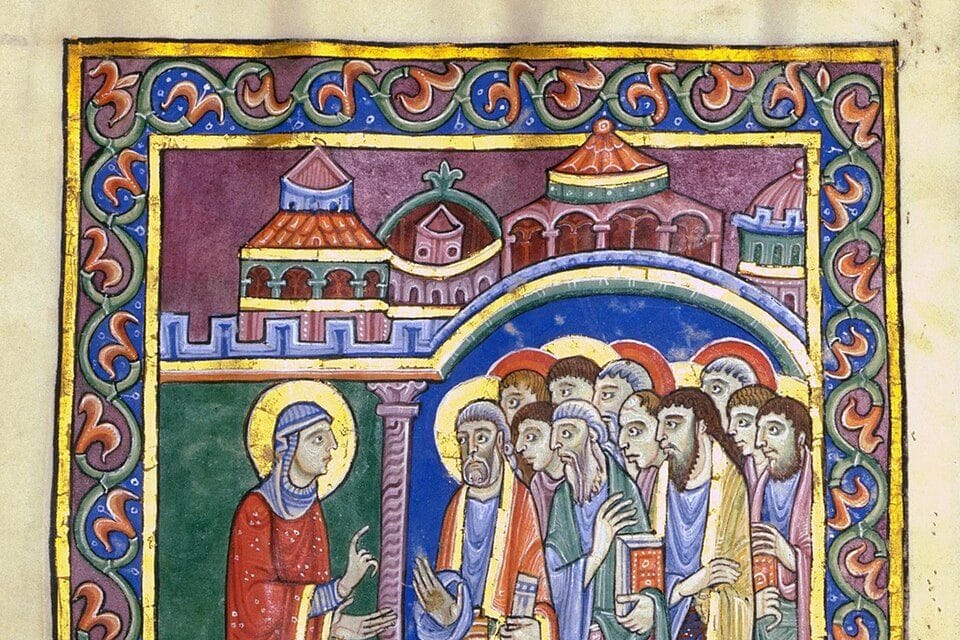
Women serve as pastors, priests, and bishops in the mainline churches, which read the whole of Scripture as calling women to every order of ministry. Perhaps you are a woman who senses God calling you to preach, to lead worship, or to care for a congregation, and you have been told that such a call cannot come from God. Perhaps you have a daughter, a friend, or a pastor whose gifts you have seen with your own eyes. Scripture is full of women whom God called and sent, and their stories are worth reading slowly.
The ELCA, the PC(USA), the United Methodist Church, and the Episcopal Church all ordain women. Other Christians, out of faithfulness to Scripture as they read it, ordain only men. The Orthodox churches ordain only men as priests, and the Southern Baptist Convention’s statement of faith, the Baptist Faith and Message 2000, says that “the office of pastor/elder/overseer is limited to men as qualified by Scripture.” Those churches rest their teaching mainly on two passages in Paul’s letters, 1 Timothy 2:12 and 1 Corinthians 14:34–35.
Which women led God’s people in the Bible?
The Book of Judges introduces Deborah as both a prophet and the leader of the nation:
At that time Deborah, a prophet, wife of Lappidoth, was judging Israel. She used to sit under the palm of Deborah between Ramah and Bethel in the hill country of Ephraim, and the Israelites came up to her for judgment.
Judges 4:4–5, NRSVUE
When a scroll of the law was found in the Temple in the reign of King Josiah, the priest Hilkiah and the king’s officials went to “Huldah the prophetess” and “talked with her” about what it meant (2 Kings 22:14). The king’s own priest sought out a woman to tell him what God was saying.
The prophet Joel promised a day when God’s Spirit would fall on everyone: “your sons and your daughters shall prophesy” (Joel 2:28). On the day of Pentecost, Peter announced that the day had come:
Even upon my slaves, both men and women, in those days I will pour out my Spirit, and they shall prophesy.
Acts 2:18, NRSVUE
Paul takes it for granted that women in the church at Corinth prayed and prophesied aloud in worship (1 Corinthians 11:5). And he wrote that in baptism “there is neither male nor female; for you are all one in Christ Jesus” (Galatians 3:28).
Who were Phoebe, Priscilla, and Junia?
Paul closes his letter to the Romans by commending a woman who served the church at Cenchreae, near Corinth:
I commend to you our sister Phoebe, a deacon of the church at Cenchreae, so that you may welcome her in the Lord, as is fitting for the saints, and help her in whatever she may require from you, for she has been a benefactor of many and of myself as well.
Romans 16:1–2, NRSVUE
The Greek word for “deacon” is diakonos, which can also be translated “minister” or “servant.”1 “Benefactor” translates prostatis, a word for a patron or protector.
Priscilla (also called Prisca) and her husband Aquila led a church that met in their house (Romans 16:3–5). The New Testament names the couple six times, and four of those times Priscilla’s name comes first. When the gifted preacher Apollos arrived in Ephesus, “Priscilla and Aquila … took him aside, and explained to him the way of God more accurately” (Acts 18:26).
Then Paul greets a woman apostle:
Greet Andronicus and Junia, my fellow Israelites who were in prison with me; they are prominent among the apostles, and they were in Christ before I was.
Romans 16:7, NRSVUE
The early church read Junia as a woman. John Chrysostom, the great preacher of the fourth century, wrote of her: “Oh! How great is the devotion of this woman, that she should be even counted worthy of the appellation of apostle!” (Homily 31 on Romans). Some medieval and Reformation commentators took the name as a man’s, “Junias.” The scholar Bernadette Brooten pointed out in 1977 that no ancient inscription or text had been found that uses “Junias” as a man’s name. Some modern translations render the Greek as “well known to the apostles,” which would not make her an apostle. The NRSVUE reads “prominent among the apostles.”
Paul names other women as partners in his work, including Euodia and Syntyche, who “labored with me in the Good News” (Philippians 4:2–3).
Why is Mary Magdalene called the apostle to the apostles?
On Easter morning the risen Jesus sends Mary Magdalene to the other disciples with the news. She becomes the first person to proclaim the resurrection:
Mary Magdalene went and announced to the disciples, “I have seen the Lord,” and she told them that he had said these things to her.
John 20:18, NRSVUE
Thomas Aquinas called her apostolorum apostola, “apostle of the apostles,” because the Lord sent her to the apostles. The Orthodox churches give her the title “Equal to the Apostles” and honor her on July 22 and again on the Sunday of the Myrrhbearing Women, two weeks after Easter, with the other women who came to the tomb. For more, see Who was Mary Magdalene?
What about 1 Timothy 2:12 and 1 Corinthians 14:34–35?
Churches that ordain only men rely mainly on two passages. The first says, “I don’t permit a woman to teach, nor to exercise authority over a man” (1 Timothy 2:11–12).
Traditional readers take the verse as a rule for all times, because the next verses ground it in Adam and Eve, and they want to obey Scripture even where obedience is costly. Mainline churches note three things. Most biblical scholars think 1 Timothy was written by a follower of Paul after Paul’s death, to address a particular church (see Who wrote the Bible?). The Greek words for “a woman” and “a man” in the verse, gynē and anēr, also mean “a wife” and “a husband.” And the same paragraph says a woman “will be saved through her childbearing” (1 Timothy 2:15), which churches of every tradition interpret with great care.
The second passage reads, “Let the wives be quiet in the assemblies” (1 Corinthians 14:34–35). Some ancient manuscripts place verses 34–35 after verse 40, at the end of the chapter. Because the two verses move around in the ancient manuscripts, some scholars think they began as a note in the margin that a copyist later wrote into the text. The verses are also hard to square with Paul’s words three chapters earlier about women praying and prophesying, and with his words three verses earlier: “you all can prophesy one by one” (1 Corinthians 14:31).
When did churches begin ordaining women?
- Presbyterians. Presbyterian women were first ordained as elders in 1930, and in 1956 Margaret Towner became the first woman ordained a Presbyterian minister.
- Methodists. In 1956 the Methodist Church, one of the bodies that later formed the United Methodist Church, granted women full clergy rights.
- Lutherans. In 1970 the Lutheran Church in America and the American Lutheran Church, two of the bodies that later formed the ELCA, both voted to ordain women. Elizabeth Platz was ordained in the Lutheran Church in America that November.
- Episcopalians. In 1974 eleven women, remembered as the Philadelphia Eleven, were ordained priests before the church’s canons allowed it, and in 1976 the General Convention opened the orders of bishop, priest, and deacon to women. Barbara Harris became the first woman bishop in the Anglican Communion in 1989.
- The Church of England. On March 12, 1994, thirty-two women were ordained priests at Bristol Cathedral. The General Synod approved women bishops in July 2014, and Libby Lane was consecrated Bishop of Stockport at York Minster on January 26, 2015. Sarah Mullally, formerly Bishop of London, was installed as the first woman Archbishop of Canterbury on March 25, 2026.
Behind each of those dates are women who heard God’s call and waited, sometimes for decades, for the church to recognize it. If you are hearing such a call, talk with your pastor and pray with others who can help you test it, as every candidate for ministry does. The First Letter of Peter says, “As each has received a gift, employ it in serving one another, as good managers of the grace of God in its various forms” (1 Peter 4:10). And you can pray with Mary, the first to carry the Word of God into the world:
My soul magnifies the Lord. My spirit has rejoiced in God my Savior, for he has looked at the humble state of his servant. For behold, from now on, all generations will call me blessed. For he who is mighty has done great things for me. Holy is his name.
Notes
-
Greek (SBL Greek New Testament): Συνίστημι δὲ ὑμῖν Φοίβην τὴν ἀδελφὴν ἡμῶν, οὖσαν καὶ διάκονον τῆς ἐκκλησίας τῆς ἐν Κεγχρεαῖς, ἵνα αὐτὴν προσδέξησθε ἐν κυρίῳ ἀξίως τῶν ἁγίων, καὶ παραστῆτε αὐτῇ ἐν ᾧ ἂν ὑμῶν χρῄζῃ πράγματι, καὶ γὰρ αὐτὴ προστάτις πολλῶν ἐγενήθη καὶ ἐμοῦ αὐτοῦ. Diakonon tēs ekklēsias means “deacon (or minister) of the church.” Prostatis means “patron” or “protector.” ↩︎
Common questions
Is it a sin for a woman to preach?
God calls women to preach, as Scripture shows from the first Easter onward. On the day of Pentecost, Peter announced that God's Spirit had come so that “your sons and your daughters will prophesy” (Acts 2:17). Paul assumed that women in the church at Corinth prayed and prophesied aloud in worship (1 Corinthians 11:5). Mary Magdalene preached the first Easter message when she told the disciples, “I have seen the Lord” (John 20:18).
When did mainline churches begin ordaining women?
Presbyterian women were first ordained as ministers in 1956, the same year the Methodist Church, one of the bodies that later formed the United Methodist Church, granted women full clergy rights. Two Lutheran bodies that later formed the ELCA began ordaining women in 1970, and the Episcopal Church opened all three orders of ministry to women in 1976.
Do the Orthodox churches ordain women?
No. The Orthodox churches ordain only men as priests and bishops. They honor Mary Magdalene with the title “Equal to the Apostles,” and in the early church women served as deaconesses, among them Olympias of Constantinople, a close friend of John Chrysostom.
Who is the Archbishop of Canterbury?
Sarah Mullally, formerly Bishop of London, was named Archbishop of Canterbury in October 2025 and installed at Canterbury Cathedral on March 25, 2026. She is the first woman to hold the office. Before her ordination she worked as a nurse.
Sources
- Judges 4:4–5 (WEB)
- Romans 16:1–7 (WEB)
- John 20:17–18 (WEB)
- 1 Timothy 2:11–15 (WEB)
- 1 Corinthians 14:31–36 (WEB)
- John Chrysostom, Homily 31 on Romans (New Advent)
- Bernadette Brooten, “Junia … Outstanding among the Apostles” (1977)
- PC(USA) celebrates 70 years of women clergy (2026)
- General Commission on Archives and History: Maud Jensen
- Episcopal General Convention 1976-B005: Amend Canon III.9
- Archives of the Episcopal Church: Irregular Ordination
- List of the first women ordained as priests in the Church of England in 1994
- NPR: For the first time in more than 1,400 years, the Church of England gets a woman leader (2026)
- Baptist Faith and Message 2000