The Nicene Creed
The Nicene Creed is the Christian statement of faith first adopted by the Council of Nicaea in 325 and expanded by the Council of Constantinople in 381. It confesses one God, Father, Son, and Holy Spirit, and teaches that Jesus Christ is “of one Being with the Father.” It is the most widely shared creed in Christianity, said by Orthodox, Anglican, Lutheran, and many other churches at Holy Communion.
yet for us there is one God, the Father, from whom are all things and for whom we exist, and one Lord, Jesus Christ, through whom are all things and through whom we exist.
1 Corinthians 8:6, NRSVUE
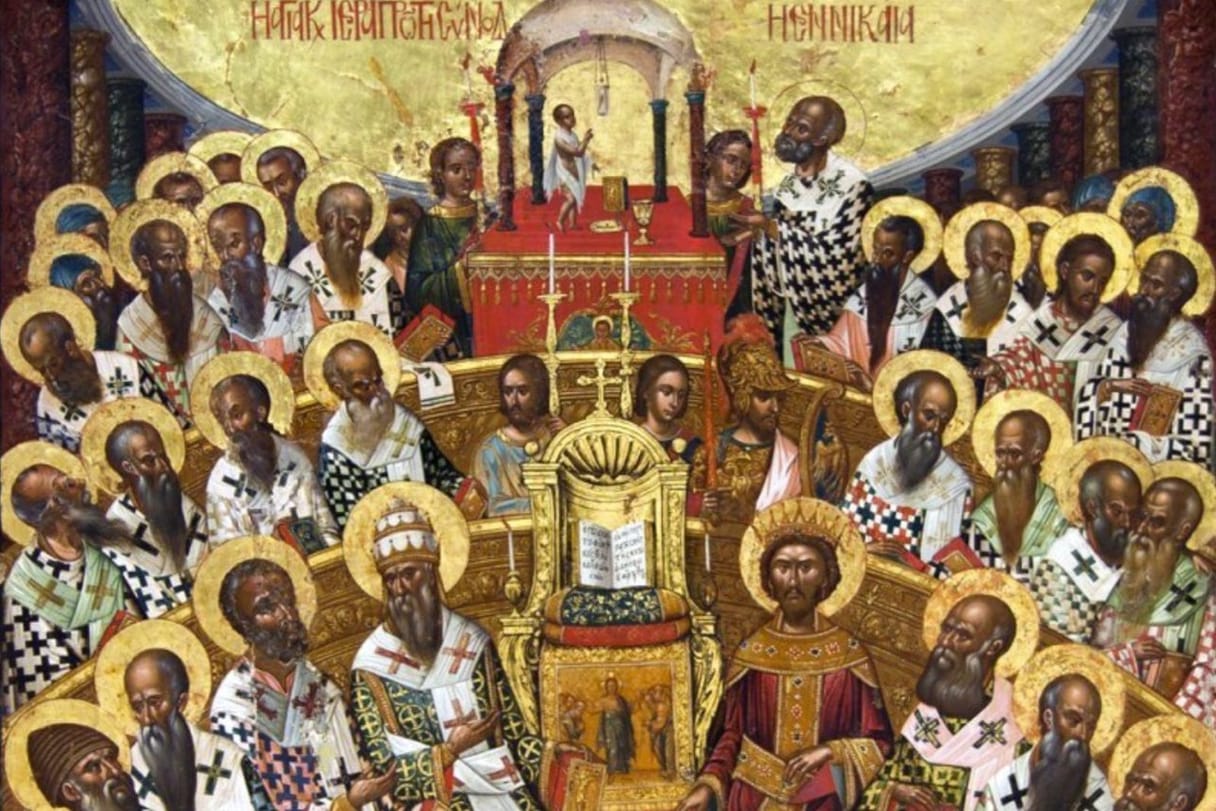
When Christians stand on Sunday and say the Nicene Creed, they join a confession that the churches of East and West have shared for more than sixteen centuries. The Nicene Creed is the statement of faith first adopted by the Council of Nicaea in 325 and expanded by the Council of Constantinople in 381. It tells, in a few lines, the whole story of God’s love: the Father who made all things, the Son who came down “for us and for our salvation,” and the Spirit who gives life. If you have said it for years without stopping to ask what it means, or if you are hearing it for the first time, its words reward slow attention.
What does the Nicene Creed say?
This is a modern English text of the Nicene Creed, as printed in the Book of Common Prayer. The versions in Lutheran, Presbyterian, and Methodist worship books differ from it only in details of wording:
We believe in one God,
the Father, the Almighty,
maker of heaven and earth,
of all that is, seen and unseen.We believe in one Lord, Jesus Christ,
the only Son of God,
eternally begotten of the Father,
God from God, Light from Light,
true God from true God,
begotten, not made,
of one Being with the Father.
Through him all things were made.
For us and for our salvation
he came down from heaven:
by the power of the Holy Spirit
he became incarnate from the Virgin Mary,
and was made man.
For our sake he was crucified under Pontius Pilate;
he suffered death and was buried.
On the third day he rose again
in accordance with the Scriptures;
he ascended into heaven
and is seated at the right hand of the Father.
He will come again in glory to judge the living and the dead,
and his kingdom will have no end.We believe in the Holy Spirit, the Lord, the giver of life,
who proceeds from the Father and the Son.
With the Father and the Son he is worshiped and glorified.
He has spoken through the Prophets.
We believe in one holy catholic and apostolic Church.
We acknowledge one baptism for the forgiveness of sins.
We look for the resurrection of the dead,
and the life of the world to come. Amen.The Book of Common Prayer (1979), pp. 358–359
The creed has three paragraphs, one for each person of the Trinity. The article what is the Trinity? explains the belief that God is one God in three persons.
Why was the Nicene Creed written?
Early in the fourth century, Arius, a priest of Alexandria in Egypt, taught that the Son of God was the first and greatest of God’s creatures, and so not God in the same sense as the Father. The dispute divided churches across the Roman Empire, and the emperor Constantine called the bishops to Nicaea in 325 to settle it.
The council answered Arius with the phrases that still stand at the center of the creed: the Son is “begotten, not made” and “of one Being with the Father.” The Greek word behind “of one Being” is homoousios, “of the same substance.” Older English translations say “of one substance with the Father,” and some newer ones say “consubstantial with the Father.” All of these mean that the Son is fully God, as the Father is God.
The bishops believed they were stating what Scripture already taught:
In the beginning was the Word, and the Word was with God, and the Word was God. He was in the beginning with God. All things came into being through him, and without him not one thing came into being. …
John 1:1–3, NRSVUE
Paul had already joined “one God, the Father” and “one Lord, Jesus Christ, through whom are all things” in a single confession (1 Corinthians 8:6). The creed’s line “Through him all things were made” echoes both passages. For the belief itself, see is Jesus God?
How did the creed change in 381?
The creed of 325 ended its third section briefly, with belief in the Holy Spirit, and did not explain who the Spirit is. After further debate about the Holy Spirit, the Council of Constantinople in 381 expanded that section. The longer text calls the Spirit “the Lord, the giver of life,” to be “worshiped and glorified” with the Father and the Son, and adds the lines on the church, baptism, the resurrection of the dead, and the life of the world to come. The article what is the Holy Spirit? explains this teaching.
The earliest surviving record of the longer text comes from the Council of Chalcedon in 451, and scholars still discuss exactly how it was composed. Most agree that it is rightly associated with the Council of Constantinople. Its formal name is the Niceno-Constantinopolitan Creed, and nearly everyone calls it the Nicene Creed.
What is the filioque?
Filioque is Latin for “and the Son.” The creed of 381 said that the Holy Spirit “proceeds from the Father,” following the words of Jesus in John’s Gospel:
When the Advocate comes, whom I will send to you from the Father, the Spirit of truth who comes from the Father, he will testify on my behalf.
John 15:26, NRSVUE
In the West, churches began to say that the Spirit proceeds “from the Father and the Son.” The words appear in the records of the Third Council of Toledo in Spain in 589, spread through the Frankish churches, and entered the creed as it was sung in Rome in 1014. The Eastern churches objected that no council of the whole church had approved the change. The dispute became one of the causes of the break between the Eastern and Western churches in 1054, and the Orthodox churches still say the creed without the filioque.
Orthodox theologians have argued that more than procedure is at stake. In their tradition, following the Cappadocian Fathers of the fourth century, the Father is the one source of both the Son and the Spirit, and in the twentieth century Vladimir Lossky argued that the added words blur the distinct person of the Spirit. Many Western Christians have come to agree that the words should not have been added without the East, and the long conversation between the churches has been marked by growing respect. The Lambeth Conferences of 1978 and 1988 advised Anglican churches to omit the clause, and many mainline worship books still include it. Christians on both sides confess the same Trinity.
Who uses the Nicene Creed today?
The Eastern Orthodox churches say or sing the creed at every Divine Liturgy, in the form “I believe.” Just before it, the deacon calls the people to love one another, and the clergy exchange the kiss of peace, because in Orthodox worship confessing the faith and loving one another belong together.
The Evangelical Lutheran Church in America (ELCA), the Presbyterian Church (U.S.A.), the United Methodist Church, and the Episcopal Church all affirm the Nicene Creed. The PC(USA) places it first in its Book of Confessions. In many Lutheran and Episcopal congregations it is said after the sermon at Holy Communion on Sundays and feast days, and Presbyterian and Methodist congregations use it as well, especially at Holy Communion.
On November 28, 2025, marking 1,700 years since the council, Ecumenical Patriarch Bartholomew of Constantinople, Pope Leo XIV, and other church leaders prayed together at İznik, the site of ancient Nicaea, and recited the Nicene-Constantinopolitan Creed together.
How do Christians understand the creed today?
The mainline churches confess the Nicene Creed without reservation. The articles on the virgin birth and the resurrection take up two of its claims in detail.
The creed was written in the language of its age. Phrases like “came down from heaven,” “ascended into heaven,” and “seated at the right hand of the Father” use images of height and rank to speak about God. Christians hold some of its clauses in different ways: some understand them as literal descriptions of events, and others as true in a deeper than literal sense. Both say the same words together.
The same is true of the line “He will come again in glory to judge the living and the dead.” It promises that the wrongs of history will be set right, and that the judge will be the Christ who died for the world. Some Christians believe that judgment will leave some people lost forever; many others, following Gregory of Nyssa and Isaac the Syrian in the early church, hope that it will heal, so that God will be “all in all” (1 Corinthians 15:28).
The creed begins “We believe.” It is the faith of the whole church, handed down for sixteen centuries, and no single worshiper carries it alone. If you struggle with a line of it, you can still stand with the congregation and say it as the church’s confession, trusting that the church believes with you and for you while your own understanding grows.
In the Orthodox Divine Liturgy, as Isabel Hapgood translated it in 1906, the deacon introduces the creed with the words “Let us love one another, that with one accord we may confess,” and the people answer, “Father, Son, and Holy Spirit, the Trinity, one in Essence and undivided.” The creed is meant to be said by people who are learning to love one another. Each time you say it, you are praising the God whose own life is love, together with the whole church.
Common questions
What is the difference between the Apostles’ Creed and the Nicene Creed?
The Apostles’ Creed is the ancient baptismal creed of the Western church. It is shorter, and many churches use it at baptisms and in daily prayer. The Nicene Creed is longer, comes from the councils of 325 and 381, and is often said at Holy Communion. The Nicene Creed is shared by the churches of East and West, and the Apostles’ Creed is used only in the West.
Why do some churches say “I believe” and others “We believe”?
The councils wrote the creed in the plural, “We believe,” as the faith of the whole church. The Eastern Orthodox churches and older Western liturgies use the singular, “I believe.” Most modern texts used in mainline churches say “We believe.”
What does “catholic” mean in the Nicene Creed?
Catholic means universal. Cyril of Jerusalem explained around 350 CE that the church is called catholic because it spreads through the whole world and teaches the whole faith to every kind of person. Christians of every denomination who say the creed confess belief in one holy catholic and apostolic church.
Do Protestants believe the Nicene Creed?
Most do. Lutherans, Anglicans, Presbyterians, and Methodists all include it among their statements of faith and use it in worship, and many other Protestant churches confess it or accept its teaching about the Trinity even when they do not recite it on Sundays.
Sources
- Book of Common Prayer (1979), Holy Eucharist: Rite Two, the Nicene Creed, pp. 358–359
- John 1:1–3 (WEB)
- 1 Corinthians 8:6 (WEB)
- John 15:26 (WEB)
- Cyril of Jerusalem, Catechetical Lecture 18 (New Advent)
- PC(USA), The Book of Confessions (2016)
- Holy See Press Office, ecumenical prayer at İznik for the 1700th anniversary of Nicaea (2025)
- Nicene Creed (Wikipedia)
- Filioque (Wikipedia)
- Isabel F. Hapgood, Service Book of the Holy Orthodox-Catholic Apostolic (Greco-Russian) Church (1906), Internet Archive