The Holy Trinity
The Trinity is the Christian teaching that there is one God who exists eternally as three persons: the Father, the Son, and the Holy Spirit. The three are not three gods, and they are not three masks worn by one person. Each is fully God, and they share one being, power, and glory. The church drew the teaching from Scripture, where the word Trinity itself does not appear, and set it out in the Nicene Creed.
The grace of the Lord Jesus Christ, God’s love, and the fellowship of the Holy Spirit be with you all. Amen.
If the Trinity has ever seemed like a puzzle you were supposed to solve, it may help to know that the church has always called it a mystery, in the old Christian sense of the word: a truth about God that can be known and loved and never fully grasped. The Trinity is the Christian teaching that the one God exists eternally as Father, Son, and Holy Spirit, and at its center is the claim that God is love. It is also the shape of ordinary Christian life. Christians are baptized in the name of the Trinity, pray to the Father through Christ in the Spirit, and end many prayers with “Glory to the Father, and to the Son, and to the Holy Spirit.”
Is the Trinity in the Bible?
The word Trinity is not in the Bible. The Greek word for it, trias, first appears in Theophilus of Antioch around 180 CE (To Autolycus 2.15), and Tertullian later used the Latin trinitas. The pattern the word names runs through the New Testament.
The Bible insists that God is one. Jesus quoted Israel’s great confession: “Hear, Israel, the Lord our God, the Lord is one” (Mark 12:29; see Deuteronomy 6:4). Yet the same New Testament speaks of the Father, the Son, and the Spirit together, as one name:
Go therefore and make disciples of all nations, baptizing them in the name of the Father and of the Son and of the Holy Spirit
Matthew 28:19, NRSVUE
Paul closes a letter with a blessing that names all three: “The grace of the Lord Jesus Christ, God’s love, and the fellowship of the Holy Spirit be with you all” (2 Corinthians 13:14). John’s Gospel opens by saying that the Word, who became flesh in Jesus, “was with God, and the Word was God” (John 1:1). Jesus promises that the Father will send “another Counselor,” the Spirit of truth (John 14:16–17). At Jesus’ baptism, the Gospels show the Son in the water, the Spirit descending like a dove, and the Father’s voice saying, “This is my beloved Son” (Matthew 3:16–17).
How did the church come to teach the Trinity?
The first Christians worshiped Jesus and experienced the Spirit as God’s own presence, while still confessing one God. Over three centuries they worked out how to say all of that at once without contradiction.
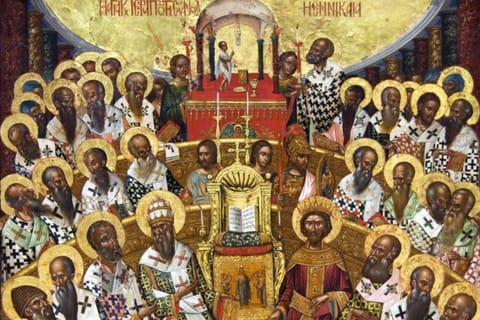
The Council of Nicaea in 325 CE taught that the Son shares the same being as the Father, which the creed now renders “of one Being with the Father.” The Council of Constantinople in 381 CE confirmed the Nicene faith, and the creed associated with it, the Nicene Creed Christians say today, gave fuller attention to the Holy Spirit: “We believe in the Holy Spirit, the Lord, the giver of life… With the Father and the Son he is worshiped and glorified.” For more on the creed itself, see What is the Nicene Creed?
Gregory of Nazianzus, a fourth-century bishop and theologian, explained why the doctrine emerged gradually: “The Old Testament proclaimed the Father openly, and the Son more obscurely. The New manifested the Son, and suggested the Deity of the Spirit” (Oration 31.26).
How can God be three and one?
The church’s answer uses two words. God is one in being (sometimes called substance or essence). God is three in persons. The Athanasian Creed, a Latin statement of faith from about 500 CE that Lutherans count among their confessions and Anglicans print in the Book of Common Prayer, states the rule: “we worship one God in Trinity, and Trinity in Unity, neither confounding the Persons, nor dividing the Substance.”
The rule guards against two ways of going wrong. The first would make the Father, Son, and Spirit three separate beings who agree to work together, three gods; the church teaches instead that they share one divine life, will, and power. The second would make them three roles that one person plays at different times, as an actor changes costumes. The Gospels speak against that picture too, because at Jesus’ baptism all three are present at once, and Jesus prays to the Father as someone other than himself. Common analogies such as water, ice, and steam, offered in good faith by many teachers, tend to slip toward the second picture.
The Cappadocian Fathers of the fourth century, Basil of Caesarea, his brother Gregory of Nyssa, and their friend Gregory of Nazianzus, gave the Eastern church its way of speaking about the Trinity. They began with the three persons and their communion, and they taught that the Father is the one source from whom the Son is begotten and the Spirit proceeds, so that God’s oneness is a shared life. Later Greek writers called that shared life perichoresis, the mutual indwelling of the three persons, each wholly in the others. Augustine admitted that the word “persons” is used “not that it might be [completely] spoken, but that it might not be left [wholly] unspoken” (On the Trinity 5.9.10). Gregory of Nazianzus described the experience of thinking about it: “No sooner do I conceive of the One than I am illumined by the Splendour of the Three; no sooner do I distinguish Them than I am carried back to the One” (Oration 40.41).
Is there a good analogy for the Trinity?
Augustine’s best-known analogy starts from the claim that God is love (1 John 4:8). Love, he observed, always involves “three things: he that loves, and that which is loved, and love” (On the Trinity 8.10.14). The Father loves, the Son is beloved, and the Spirit is the love that unites them. In Book 9 he tried another picture: the human mind, its knowledge of itself, and its love of itself, which are “three things, and these three are one.” Augustine knew these were only images, and he ended his long book on the Trinity with a prayer.
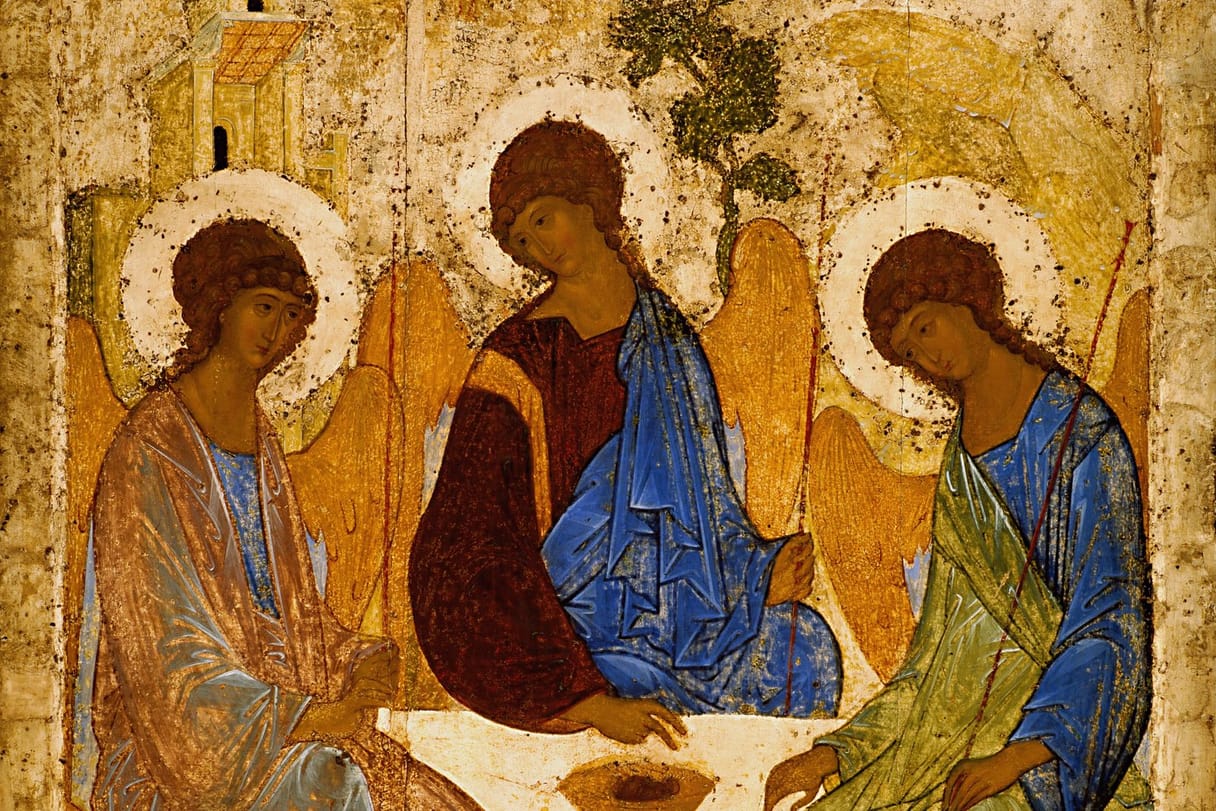
The most famous picture of the Trinity is an icon. In the early fifteenth century the Russian painter Andrei Rublev painted the three visitors who came to Abraham by the oaks of Mamre (Genesis 18:1–2). The icon was made in honor of Saint Sergius of Radonezh for his Trinity monastery near Moscow. Three angels sit around a table with a cup at its center, and the lines of their bodies form a circle. Christians have long read it as an image of the Trinity: three persons in perfect equality and mutual attention.
Why does the Trinity matter?
If God is love, then love belongs to God’s own life as well as to God’s dealings with us. The Trinity says that before creation there was already giving and receiving within God, and many Christian teachers have said that God made the world out of that overflowing love. Julian of Norwich heard Christ say, “I it am, the Trinity, I it am, the Unity” (Revelations of Divine Love, chapter 59).
The Trinity also explains how Christians pray. Paul writes that through Christ “we both have our access in one Spirit to the Father” (Ephesians 2:18), so Christian prayer goes to the Father, through the Son, in the Spirit. Jesus prays that his followers will share that life: “even as you, Father, are in me, and I in you, that they also may be one in us” (John 17:21). Eastern Orthodox Christians call this sharing in God’s life theosis, and they ground it in the words of Athanasius of Alexandria: Christ “was made man that we might be made God” (On the Incarnation 54). On that view, the Trinity is the life that salvation draws people into. For the Son and the Spirit in particular, see Is Jesus God? and What is the Holy Spirit?
What do the mainline churches teach about the Trinity?
The Evangelical Lutheran Church in America (ELCA), the Presbyterian Church (U.S.A.), the United Methodist Church, and the Episcopal Church all confess the Trinity in the Apostles’ and Nicene Creeds and baptize in the name of the Father, the Son, and the Holy Spirit. The first of the United Methodist Articles of Religion, which descend from the Church of England’s Thirty-Nine Articles, states that “in unity of this Godhead there are three persons, of one substance, power, and eternity—the Father, the Son, and the Holy Ghost.” Eastern Orthodox and Western churches alike confess the Trinity in the same Nicene Creed.
One difference remains between East and West. Western churches added the words “and the Son” to the creed’s line about the Holy Spirit, a practice that began in Spain after 589 CE. Eastern Orthodox churches never accepted the addition, and many Western Christians now agree that it should not have been made without the East. See What is the Nicene Creed?
Christians share in the life of the Trinity long before they can explain it. Every time you pray to the Father, through Jesus, with the help of the Spirit, you are already doing what the doctrine describes. The hymn known as Saint Patrick’s Breastplate, an old Irish prayer traditionally attributed to Patrick, begins by wrapping the one who prays in the Name of the three-personed God:
I bind unto myself today
the strong name of the Trinity,
by invocation of the same,
the Three in One, and One in Three.“Saint Patrick’s Breastplate,” trans. Cecil Frances Alexander (1889), first stanza
Common questions
Is the word Trinity in the Bible?
No. The Greek word for it first appears around 180 CE in Theophilus of Antioch, and Tertullian used the Latin form trinitas soon after. The church used the word to name a pattern already present in Scripture, where Jesus commands baptism in the name of the Father, the Son, and the Holy Spirit.
Do Christians worship three gods?
No. Christians confess with Israel that the Lord is one. The doctrine of the Trinity says the one God exists eternally as Father, Son, and Holy Spirit, who share one being. The Athanasian Creed puts it this way: “we worship one God in Trinity, and Trinity in Unity.”
What is the best analogy for the Trinity?
Every analogy falls short, and the church fathers said so. Augustine compared the Trinity to love, which always involves a lover, a beloved, and the love between them. He also said that the church uses the word “persons” so that something can be said about God, even though no word explains God fully.
Why do Orthodox and Western churches disagree about “and the Son”?
The Nicene Creed as agreed in the fourth century says the Holy Spirit proceeds from the Father. Western churches later added “and the Son,” and Eastern Orthodox churches have objected to the addition ever since, partly because no council of the whole church approved it and partly because they hold that the Father is the one source of the Son and the Spirit. Both sides confess the same three persons in one God.
Sources
- Matthew 28:19 (WEB)
- 2 Corinthians 13:14 (WEB)
- John 1:1–3, 14 (WEB)
- Ephesians 2:18 (WEB)
- Book of Common Prayer (1979), Historical Documents: the Athanasian Creed
- Theophilus of Antioch, To Autolycus, Book 2 (New Advent)
- Gregory of Nazianzus, Oration 40 (On Holy Baptism)
- Augustine, On the Trinity, Book 8
- Augustine, On the Trinity, Book 5
- Athanasius, On the Incarnation of the Word, section 54 (New Advent)
- United Methodist Articles of Religion
- Cecil Frances Alexander, “St. Patrick’s Breastplate” (Hymnary.org)