The virgin birth
The mainline churches confess, with the whole church, that Jesus was born of a virgin: the Apostles’ Creed says he was “born of the Virgin Mary.” The story appears in Matthew and Luke, which tell it differently, while Mark, John, and Paul do not mention it. Christians hold the virgin birth in different ways, many as a literal miracle and others as true in a deeper than literal sense. All confess that Jesus came from God.
The angel said to her, “The Holy Spirit will come upon you, and the power of the Most High will overshadow you; therefore the child to be born will be holy; he will be called Son of God.
Luke 1:35, NRSVUE
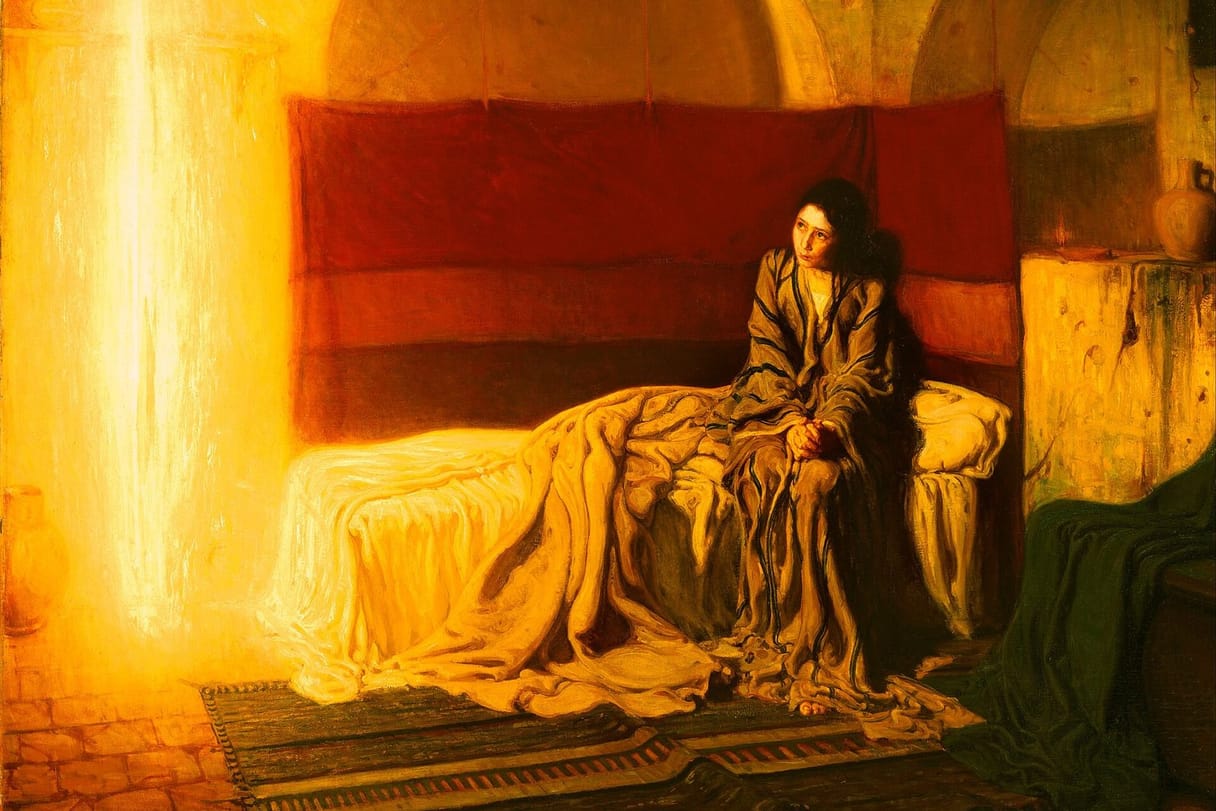
The mainline churches confess, with the whole church, that Jesus was “born of the Virgin Mary,” in the words of the Apostles’ Creed. If you say those words and wonder what they ask of you, or if you love the Christmas story and want to understand it more deeply, you are welcome here. Christians hold the virgin birth in different ways, some as a literal miracle and others as true in a deeper than literal sense, and all of them confess the same wonder: that Jesus came to us from God.
What do Matthew and Luke say about the virgin birth?
Matthew tells the story from Joseph’s side. Mary is engaged to Joseph and becomes pregnant before they live together, and Joseph plans to end the engagement privately. Then an angel speaks to him in a dream:
“Joseph, son of David, do not be afraid to take Mary as your wife, for the child conceived in her is from the Holy Spirit. She will bear a son, and you are to name him Jesus, for he will save his people from their sins.”
Matthew 1:20–21, NRSVUE
Luke tells the story from Mary’s side. The angel Gabriel comes to her in Nazareth and announces that she will bear a son. Mary asks the obvious question:
Mary said to the angel, “How can this be, since I am a virgin?” The angel said to her, “The Holy Spirit will come upon you, and the power of the Most High will overshadow you; therefore the child to be born will be holy; he will be called Son of God.”
Luke 1:34–35, NRSVUE
Mary’s answer has been prayed by Christians ever since: “Behold, the servant of the Lord; let it be done to me according to your word” (Luke 1:38).
How do the two birth stories differ?
Matthew and Luke agree on the main points. Both name Mary and Joseph, both place Jesus’ birth in Bethlehem in the days of King Herod, and both say Mary conceived by the Holy Spirit before she and Joseph lived together.
Beyond those points, the two stories hardly overlap. In Matthew, the family appears to live in Bethlehem, magi from the east visit the child, and the family flees to Egypt to escape Herod (Matthew 2:1, 13–15). Only after Herod dies do they settle in Nazareth (Matthew 2:23). In Luke, Mary and Joseph live in Nazareth and travel to Bethlehem for a Roman registration, shepherds visit the manger, and the family returns home to Nazareth after presenting Jesus at the temple (Luke 2:1–7, 39).
The two Gospels also give different family trees for Joseph. Matthew names Joseph’s father as Jacob (Matthew 1:16), and Luke calls Jesus “the son (as was supposed) of Joseph, the son of Heli” (Luke 3:23). Most scholars date both Gospels to around 80 to 90 CE and think Matthew and Luke wrote independently of each other. That two separate writers both tell of a conception by the Holy Spirit suggests the belief was known before either of them wrote.
What about Isaiah 7:14 and the word “virgin”?
Matthew says Jesus’ birth fulfilled a prophecy: “Behold, the virgin shall be with child, and shall give birth to a son. They shall call his name Immanuel,” which means “God with us” (Matthew 1:23). Matthew is quoting Isaiah 7:14 from the Septuagint, the Greek translation of the Hebrew Scriptures made by Jews in the centuries before Jesus.
The Hebrew text of Isaiah reads differently. In the NRSVUE it says:
Therefore the Lord himself will give you a sign. Look, the young woman is with child and shall bear a son and shall name him Immanuel.
Isaiah 7:14, NRSVUE
The Hebrew word is almah (a young woman of marriageable age).1 Hebrew has a separate word, betulah, for a virgin. The Greek translators rendered almah as parthenos, the ordinary Greek word for a virgin. In Isaiah, the sign was given to King Ahaz of Judah in the eighth century BCE, and verse 16 says the threat facing Ahaz would pass before the child was old enough to choose between good and evil. Most scholars therefore read Isaiah 7:14 as a sign for Ahaz’s own time. Christians have long read it as well in a fuller sense, as Matthew did, finding in Jesus the truest meaning of “God with us.”
Why don’t Mark, John, and Paul mention it?
Mark, the earliest Gospel, begins with Jesus as an adult and never mentions his birth. In Mark the people of Nazareth call him “the son of Mary” (Mark 6:3). John opens with the eternal Word becoming flesh and does not tell a birth story, and in John’s Gospel people call him “Jesus of Nazareth, the son of Joseph” (John 1:45). Paul says only that God sent his Son, “born to a woman, born under the law” (Galatians 4:4).
Their silence does not prove that these writers denied the virgin birth. The earliest Christian preaching centered on Jesus’ death and resurrection, and the church came to tell the story of his conception as it reflected on who he was. Early in the second century, Ignatius of Antioch wrote that Jesus “was truly born of a virgin,” and the confession entered the church’s baptismal creed.
How do Christians understand the virgin birth?
Many Christians, including the Eastern Orthodox churches and most Protestants, believe that Mary conceived Jesus without a human father by a direct act of God. For them, the miracle marks Jesus’ life as God’s new beginning and God’s initiative from the first moment. Many mainline Christians hold this belief with joy.
Other Christians believe the birth stories are true in a deeper than literal sense, whatever happened biologically. The New Testament scholars Marcus Borg and John Dominic Crossan read the stories “as neither fact nor fable, but as parable,” in their book The First Christmas (2007). They focus on the stories’ “more-than-literal” meanings and put the question of fact aside: “Believe whatever you want about whether the stories are factual—now, let’s talk about what these stories mean.”
Both groups say the creed together, and the church does not ask either to look down on the other. For more on the difference between literal and deeper readings, see Should we read the Bible as literal fact?
What does the virgin birth mean?
The virgin birth proclaims that Jesus came from God as a gift, beyond anything human effort or a great family could produce. John says the same thing in other words about everyone who receives Christ, who are “born, not of blood, nor of the will of the flesh, nor of the will of man, but of God” (John 1:13).
The story also honors Mary. God’s plan waited on the free answer of a young woman from a small village, and her song, the Magnificat, celebrates a God who “has put down princes from their thrones, and has exalted the lowly” (Luke 1:52). The Council of Ephesus in 431 called Mary Theotokos, “God-bearer,” because the child she bore is God the Son. Cyril of Alexandria and the bishops at Ephesus insisted on the title to honor Mary and, above all, to protect the truth that her son is fully God as well as fully human, and the title runs through Eastern Orthodox prayer to this day. See What do Christians believe about Mary? and Is Jesus God?
What do the mainline churches teach?
The Evangelical Lutheran Church in America (ELCA), the Presbyterian Church (U.S.A.), the United Methodist Church, and the Episcopal Church all confess the virgin birth in the Apostles’ and Nicene Creeds. The Lutheran Augsburg Confession of 1530 says that the Son of God took on human nature “in the womb of the blessed Virgin Mary,” and the Methodist Articles of Religion say that he “took man’s nature in the womb of the blessed Virgin.”
These confessions put the weight on God’s act and on Jesus’ full humanity, received from his mother. Every Christian, however they read the stories, can confess both. If you are wondering about Jesus’ family, see Did Jesus have brothers and sisters?
Mary answered the angel’s word with trust, and then she sang. Her song, the Magnificat, has been part of the church’s evening prayer for centuries, and you can make its opening lines your own:
Mary said, “My soul magnifies the Lord. My spirit has rejoiced in God my Savior, for he has looked at the humble state of his servant. For behold, from now on, all generations will call me blessed. For he who is mighty has done great things for me. Holy is his name.
Notes
-
Hebrew (Westminster Leningrad Codex): לָ֠כֵן יִתֵּ֨ן אֲדֹנָ֥י ה֛וּא לָכֶ֖ם א֑וֹת הִנֵּ֣ה הָעַלְמָ֗ה הָרָה֙ וְיֹלֶ֣דֶת בֵּ֔ן וְקָרָ֥את שְׁמ֖וֹ עִמָּ֥נוּ אֵֽל׃ Ha-almah means “the young woman” (of marriageable age); the word does not specify virginity. Harah means “pregnant” or “with child.” Immanu el means “God is with us.” ↩︎
Common questions
Does Isaiah 7:14 say virgin or young woman?
The Hebrew word in Isaiah 7:14 is almah, which means a young woman of marriageable age, and the New Revised Standard Version translates it “young woman.” The ancient Greek translation used by Matthew rendered it parthenos, the usual Greek word for a virgin. Matthew 1:23 quotes the Greek wording.
Can I be a Christian if I am unsure about the virgin birth?
Yes. The church invites you to say the creed with the whole church and to keep asking what it means. Christians who read the birth stories literally and Christians who read them as true in a deeper sense worship side by side and receive the same Communion.
Did Jesus have brothers and sisters if Mary was a virgin?
Mark 6:3 names four brothers of Jesus and mentions his sisters. Orthodox Christians traditionally understand them as children of Joseph from an earlier marriage, Jerome in the fourth century argued that they were cousins, and many Protestants read them as later children of Mary and Joseph. The creeds speak only of Jesus’ conception and birth.
Sources
- Matthew 1:18–25 (WEB)
- Luke 1:26–38 (WEB)
- Isaiah 7:10–16 (WEB)
- Galatians 4:4 (WEB)
- Book of Common Prayer (1979), The Apostles’ Creed (Morning Prayer II)
- Ignatius of Antioch, Letter to the Smyrnaeans, ch. 1
- Marcus J. Borg and John Dominic Crossan, The First Christmas (HarperOne, 2007)
- The Articles of Religion of the Methodist Church, Article II (United Methodist Church)
- Augsburg Confession (1530), Article III (Book of Concord)
- OrthodoxWiki, “Theotokos”
_-_The_Annunciation_-_Google_Art_Project.jpg)