The resurrection of Jesus
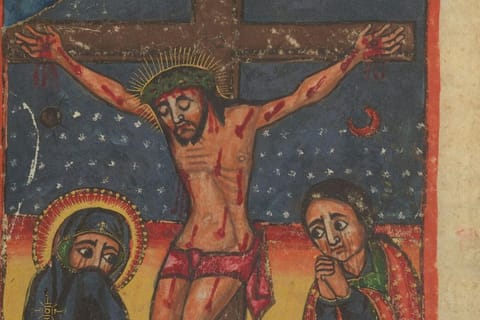
The church proclaims that God raised Jesus from the dead, and the creeds confess that “on the third day he rose again.” The earliest written testimony, Paul’s list of appearances in 1 Corinthians 15:3–8, dates from about twenty-five years after the crucifixion. Christians hold the resurrection in different ways, many as a bodily event and others as true in a deeper than literal sense, and all confess that death did not have the last word.
But in fact Christ has been raised from the dead, the first fruits of those who have died.
1 Corinthians 15:20, NRSVUE
The church proclaims that God raised Jesus from the dead, and Christians confess in the creeds that “on the third day he rose again.” Easter stands at the center of the Christian faith. Paul told the Corinthians, “If Christ has not been raised, your faith is vain” (1 Corinthians 15:17).
Some people ask whether Jesus really rose because they are standing beside a grave; others want to believe and cannot yet. The New Testament has room for both, because the first witnesses were also grieving and slow to believe, and the risen Christ came to them anyway.
What is the earliest evidence for the resurrection?
The oldest written testimony comes from Paul’s First Letter to the Corinthians, written from Ephesus in the mid-50s CE. Paul reminds the Corinthians of a summary of the faith that he had received from others and passed on to them:
For I handed on to you as of first importance what I in turn had received: that Christ died for our sins in accordance with the scriptures and that he was buried and that he was raised on the third day in accordance with the scriptures and that he appeared to Cephas, then to the twelve.
1 Corinthians 15:3–5, NRSVUE
Paul continues the list: Jesus appeared to “over five hundred brothers at once, most of whom remain until now,” then to James, then to all the apostles, and “last of all” to Paul himself (1 Corinthians 15:6–8). Scholars widely agree that the summary Paul quotes is older than his letter and goes back to the first years of the church. Paul knew two of the witnesses on the list personally, since he stayed with Cephas (Peter) in Jerusalem for fifteen days and met James, the Lord’s brother (Galatians 1:18–19).
What do the Gospels say about the empty tomb?
The earliest Gospel, Mark, was written around 70 CE. Mark tells how Mary Magdalene, Mary the mother of James, and Salome went to anoint Jesus’ body early on the first day of the week and found the stone rolled back. They had come to care for the body of someone they loved. A young man in a white robe was sitting inside:
“Do not be alarmed; you are looking for Jesus of Nazareth, who was crucified. He has been raised; he is not here. Look, there is the place they laid him.”
Mark 16:6, NRSVUE
In the oldest complete manuscripts of Mark, such as the fourth-century Codex Sinaiticus and Codex Vaticanus, the Gospel ends two verses later: “They said nothing to anyone; for they were afraid” (Mark 16:8). Later scribes added longer endings, which modern Bibles print in brackets.
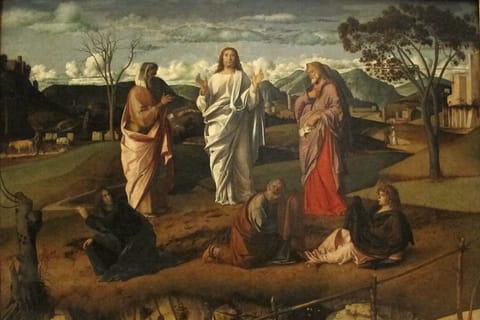
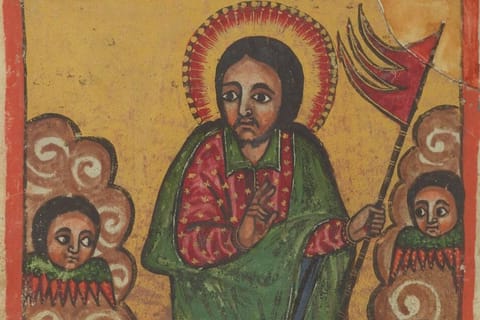
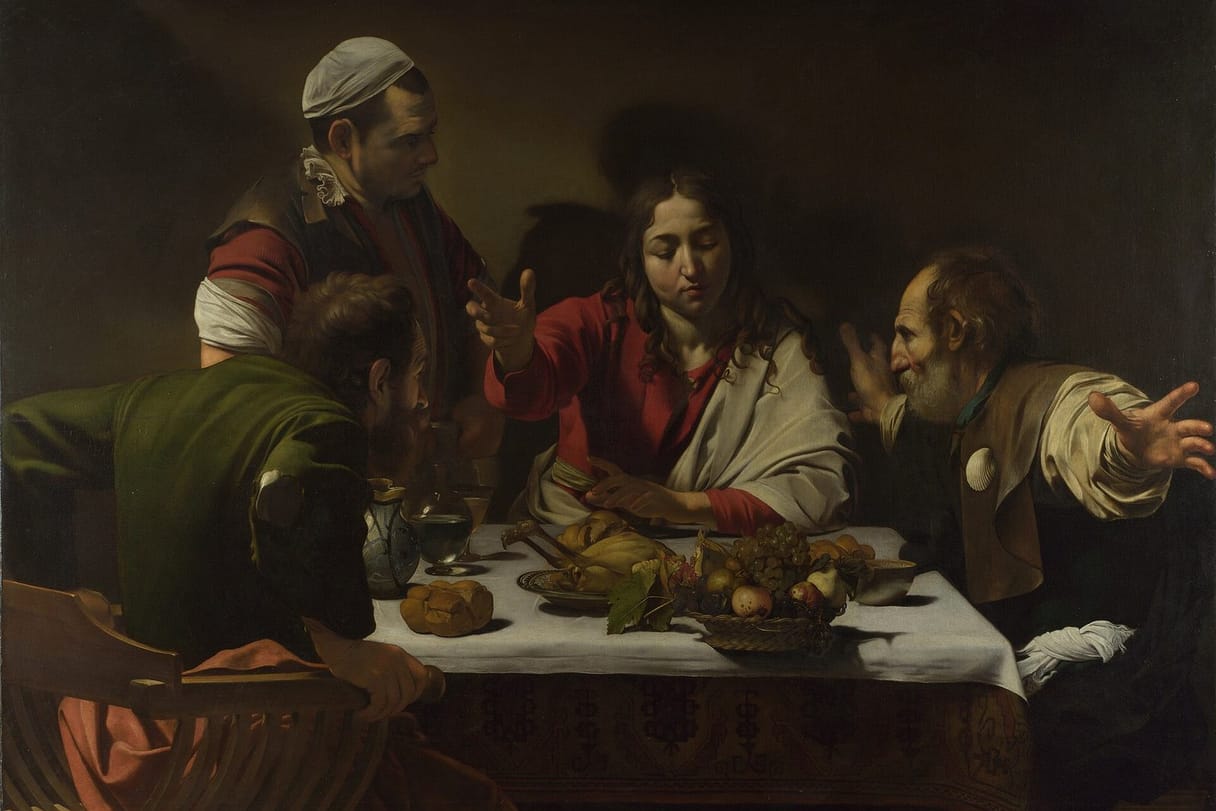
Matthew, Luke, and John add stories of the risen Jesus meeting his followers, and the stories pull in two directions. In Luke, Jesus invites the disciples to touch him, saying “a spirit doesn’t have flesh and bones, as you see that I have,” and he eats a piece of broiled fish (Luke 24:39–43). In the same chapter, two disciples walk with him to Emmaus without recognizing him, and when they finally know him in the breaking of bread, “he vanished out of their sight” (Luke 24:31). In John, Mary Magdalene takes him for the gardener until he calls her by name, and he comes and stands among the disciples although “the doors were locked” (John 20:19). The risen Jesus in the Gospels is the same Jesus, yet changed, and again and again he is known in a word spoken or a meal shared.
What did Paul mean by a “spiritual body”?
The Corinthians asked Paul how the dead are raised and what kind of body they have. Paul answers with the image of a seed, which must die before it grows into a plant that looks nothing like it. Then he says:
So it is with the resurrection of the dead. What is sown is perishable; what is raised is imperishable. It is sown in dishonor; it is raised in glory. It is sown in weakness; it is raised in power. It is sown a physical body; it is raised a spiritual body.
1 Corinthians 15:42–44, NRSVUE
A few verses later Paul adds that “flesh and blood can’t inherit God’s Kingdom” (1 Corinthians 15:50). Paul describes his own meeting with the risen Christ as the time when it was “the good pleasure of God … to reveal his Son in me” (Galatians 1:15–16), and Acts describes it as a light from heaven and a voice (Acts 9:3–5). Readers have argued for centuries about exactly what Paul meant by a “spiritual body.” Whatever else he meant, Paul was describing a real and transformed life, beyond the reach of decay and death.
How do Christians understand the resurrection?
Christians who say the same creed understand Easter in more than one way.
Many Christians, including most through the church’s history, believe that Jesus’ tomb was empty because God raised his body and transformed it. The fourth of the Thirty-Nine Articles, the historic Anglican statement of faith, says that “Christ did truly rise again from death, and took again his body, with flesh, bones,” and ascended into heaven, and the United Methodist Articles of Religion say the same (Article III). The Orthodox and evangelical churches teach the bodily resurrection, and many mainline Christians hold it gladly.
Other Christians hold that the resurrection is true in a deeper than literal sense, and they do not rest Easter on what happened to Jesus’ body. Marcus Borg, a New Testament scholar who served as canon theologian of Trinity Episcopal Cathedral in Portland, Oregon, wrote: “I regard it as a fact of history that Jesus was experienced after his death as a living figure of the present and not just as a dearly-remembered figure of the past.” Borg said it did not matter to him whether the tomb was empty, and he grounded his Easter faith in the experience of Jesus’ followers and of Paul.
Borg and his friend N. T. Wright, who defends the bodily resurrection, set out their two views side by side in The Meaning of Jesus: Two Visions (1999). Both men were Anglicans, and their book is a good model of disagreement in charity. The church has room for both readings, and Christians who hold them can kneel together at the same table on Easter morning. For the wider question of literal and deeper readings of Scripture, see Should we read the Bible as literal fact?
What does the resurrection mean?
On this question Christians across the range agree. The resurrection means that God vindicated Jesus, and the powers that crucified him did not have the last word. Borg put it this way: “Easter is about God’s ‘yes’ to Jesus and God’s ‘no’ to the powers that killed him.”
The resurrection also means hope beyond death. Paul calls the risen Christ “the first fruits of those who have died” (1 Corinthians 15:20), the first sheaf of a harvest that will include everyone. First Peter says God “caused us to be born again to a living hope through the resurrection of Jesus Christ from the dead” (1 Peter 1:3). Jesus himself says, “I am the resurrection and the life. He who believes in me will still live, even if he dies” (John 11:25). If you are grieving, this hope is meant for you and for the one you have lost. See What happens when you die?
The Christian East has kept this hope at the center of its worship. At the Orthodox Easter service, held at midnight, the congregation sings again and again, “Christ is risen from the dead, trampling down death by death, and upon those in the tombs bestowing life.” The priest then reads the Easter sermon attributed to John Chrysostom, the archbishop of Constantinople who died in 407, which ends: “Christ is risen, and life reigns. Christ is risen, and not one dead remains in the grave.”
The resurrection also opens a new way of living now. Paul tells the Romans, “We were buried therefore with him through baptism into death, that just as Christ was raised from the dead through the glory of the Father, so we also might walk in newness of life” (Romans 6:4).
What do the mainline churches teach?
The ELCA, the PC(USA), the United Methodist Church, and the Episcopal Church all confess the resurrection in the Apostles’ and Nicene Creeds. The Apostles’ Creed says, “On the third day he rose again,” and ends with “the resurrection of the body, and the life everlasting.” The creeds proclaim that Christ is risen without describing how, which leaves room for the different understandings described above.
If you doubt, you are in good company. When the women first reported the empty tomb to the apostles, their words “seemed to them to be nonsense” (Luke 24:11), and Matthew says that even on the mountain in Galilee, when the eleven saw Jesus, “they bowed down to him; but some doubted” (Matthew 28:17). Jesus kept the doubters with him and gave them his peace and his work to do. For why Jesus died in the first place, see Why did Jesus die on the cross?
Easter is the chief feast of the Christian year. On Easter morning many Christians greet one another with the words the disciples said that first evening: “The Lord is risen indeed” (Luke 24:34). Whatever you can say today, you are welcome to stand among them, and to let their joy carry you until it becomes your own.
Common questions
Can you be a Christian and have doubts about the resurrection?
Yes. Matthew says that when the eleven disciples saw the risen Jesus, “they bowed down to him; but some doubted.” Thomas would not believe until he saw for himself. The church baptizes and welcomes people who are still working out what they believe about Easter, and it invites them to say the creed with the whole church.
Why do the Gospel resurrection stories differ?
The four Gospels were written decades apart for different communities, and each tells the story its own way. In Mark the young man at the tomb says Jesus is going ahead to Galilee, while Luke places the appearances in and near Jerusalem. All four agree that the tomb was found empty on the first day of the week.
What is the difference between resurrection and resuscitation?
A resuscitated person, like Lazarus in John 11, comes back to ordinary life and will die again. The New Testament describes Jesus’ resurrection as entry into a new kind of life over which death has no power. Paul calls the risen body “imperishable” and “spiritual,” and he calls Christ “the first fruits” of the resurrection of all.
What do Christians mean by the resurrection of the body?
The Apostles’ Creed ends with belief in “the resurrection of the body, and the life everlasting.” Christians hope that God will raise the dead to a transformed life, as God raised Jesus. The hope is for the whole person, body and soul together.
Sources
- 1 Corinthians 15:3–8 (WEB)
- 1 Corinthians 15:12–20 (WEB)
- 1 Corinthians 15:35–44 (WEB)
- Mark 16:1–8 (WEB)
- Luke 24:13–43 (WEB)
- John 20:11–29 (WEB)
- Book of Common Prayer (1979), Historical Documents: Articles of Religion
- The United Methodist Church, Articles of Religion
- John Chrysostom, The Paschal Sermon (Orthodox Church in America)
- Marcus Borg, “Easter Again” (April 17, 2014)
- Marcus J. Borg and N. T. Wright, The Meaning of Jesus: Two Visions (HarperSanFrancisco, 1999)