Hesychasm and the Jesus Prayer
Hesychasm, from the Greek hesychia (stillness), is the Eastern Orthodox tradition of inner prayer. At its center is the Jesus Prayer: “Lord Jesus Christ, Son of God, have mercy on me, a sinner.” You pray the Jesus Prayer by repeating it slowly and attentively, aloud or silently, often with a knotted prayer rope, and returning to the words whenever your mind wanders. Beginners can start with ten or fifteen minutes a day.
Pray without ceasing.
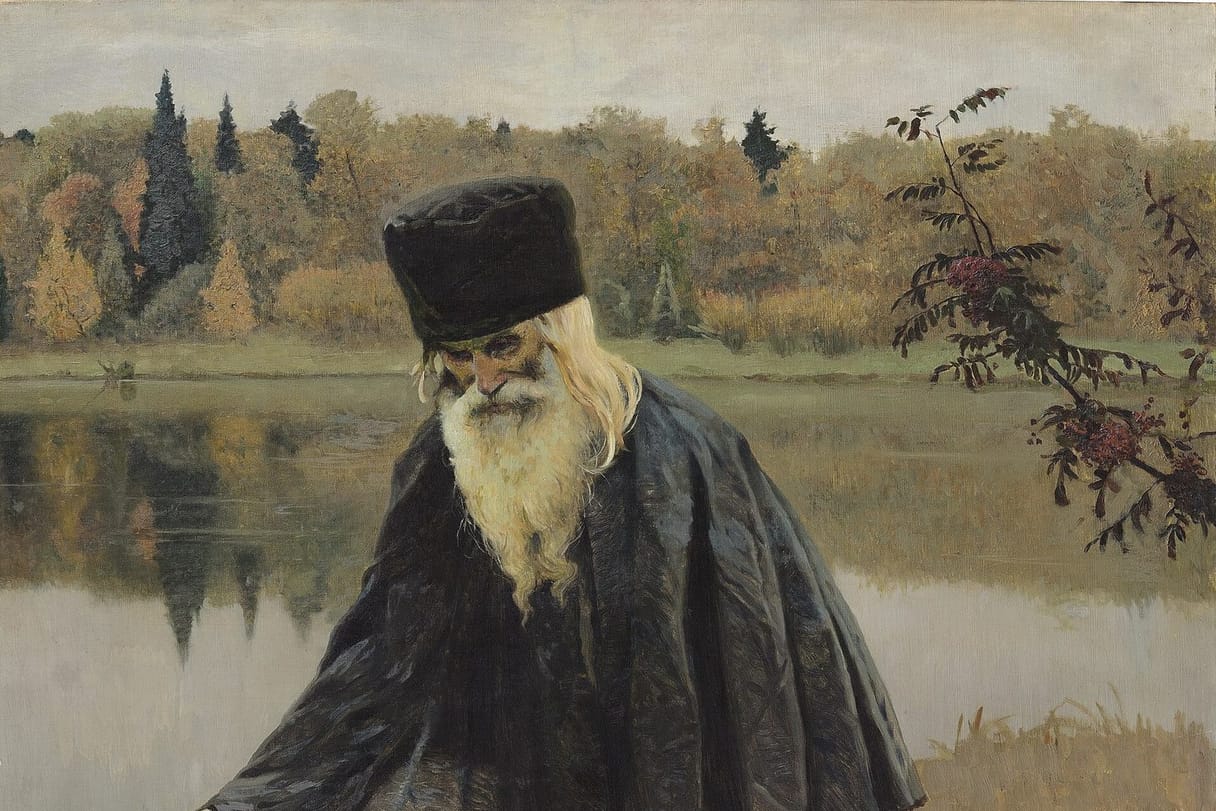
The Jesus Prayer is one sentence long: “Lord Jesus Christ, Son of God, have mercy on me, a sinner.” You can learn it in a minute and pray it for the rest of your life. Hesychasm is the tradition of prayer that grew up around it in the Orthodox churches of the East, and its name comes from the Greek hesychia, stillness. If your mind races when you try to pray, or if you want to meet God beneath the surface of words, this ancient practice is offered to you.
What is hesychasm?
Hesychasm is the Eastern Christian way of seeking God in inner stillness, above all through the Jesus Prayer. The practice takes its pattern from Jesus’s words: “enter into your inner room, and having shut your door, pray to your Father who is in secret” (Matthew 6:6).
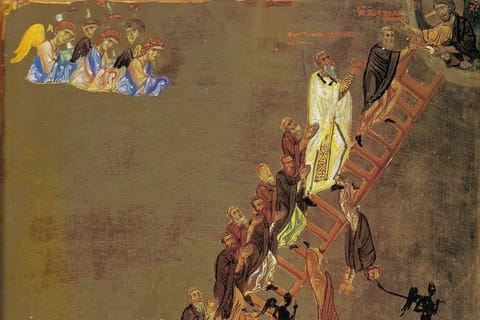
Its roots reach back to the monks and nuns of the Egyptian desert, who repeated short verses of Scripture all day long (see who were the Desert Fathers and Mothers?). Around 600, John Climacus, abbot of the monastery at Mount Sinai, urged readers of his Ladder of Divine Ascent to join the remembrance of Jesus to every breath. Symeon the New Theologian (949–1022) taught that Christians can know God by direct experience in prayer. In the fourteenth century the monks of Mount Athos made the Jesus Prayer the center of their life, and when the scholar Barlaam of Calabria mocked their methods, Gregory Palamas defended them. Councils in Constantinople upheld Palamas in 1341 and 1351.
Three old words help explain the prayer. The nous is the deepest part of the mind, which they called the eye of the soul. The heart, in the Bible’s sense, is the center of the whole person: “Keep your heart with all diligence, for out of it is the wellspring of life” (Proverbs 4:23). The aim is to bring the mind down into the heart, so that the whole person prays. Theophan the Recluse (1815–1894), a Russian bishop who became a hermit, taught that the main thing is to stand before God “with the mind in the heart” and to go on standing there for life.
A third word is nepsis, watchfulness, from the Greek verb in First Peter’s “Be sober and self-controlled” (1 Peter 5:8). The great collection of hesychast writings, the Philokalia, calls its authors the neptic Fathers, the watchful ones. It was published in Venice in 1782, translated into Slavonic in 1793, and later rendered into Russian by Theophan.
What does the Bible say about the Jesus Prayer?
The words of the Jesus Prayer come from the Gospels. A blind man named Bartimaeus called from the roadside, “Jesus, you son of David, have mercy on me!” (Mark 10:47), and Jesus healed him. In a parable of Jesus, a tax collector prayed, “God, be merciful to me, a sinner!” (Luke 18:13), and he went home justified. The prayer gathers these cries around the name Paul sang about:
Therefore God also highly exalted him, and gave to him the name which is above every name, that at the name of Jesus every knee should bow, of those in heaven, those on earth, and those under the earth…
Paul also told the Thessalonians, “Pray without ceasing” (1 Thessalonians 5:17). The Jesus Prayer is short enough to pray anywhere.
Some Christians worry that repeating a prayer is the “vain repetitions” Jesus warned against (Matthew 6:7). His warning concerns people who “think that they will be heard for their much speaking,” as if prayer could wear God down. The Jesus Prayer asks mercy of someone already merciful. Its repetition is the repetition of love, like the refrain of Psalm 136, which says twenty-six times, “for his loving kindness endures forever.”
In the Bible, mercy is God’s steadfast love reaching toward people in need, and asking for it is an act of trust. Kallistos Ware (1934–2022), an English convert who became an Orthodox bishop and taught at Oxford, wrote that you may say “have mercy on me” or “have mercy on us,” or use shorter forms such as “Lord Jesus Christ, have mercy on me” or “Lord Jesus.” The one essential element is the name of Jesus.
How do I pray the Jesus Prayer?
Ware’s first instruction to beginners was two words long: “Simply begin.”
- Choose a time and a place. Ten minutes in the morning or before bed is enough. Many Orthodox Christians pray before an icon with a candle lit (see why Orthodox Christians pray with icons).
- Settle your body. Be seated or stand, upright and still, and let your breathing slow by itself.
- Say the prayer slowly. Begin aloud or in a whisper, then silently if you like. Pause for a moment after each prayer.
- Keep your attention in the words. Mean each word as you say it. When your mind wanders, come back to the next word without scolding yourself.
- Use a prayer rope if it helps. Orthodox prayer ropes are knotted wool, often with 33, 50, or 100 knots, one prayer per knot.
- Carry it into the day. Ware describes the “free” use of the prayer in the scattered moments of life: washing dishes, walking, waiting in traffic, lying awake at night.
Some hesychast teachers linked the words to the breath, saying “Lord Jesus Christ, Son of God” while breathing in and “have mercy on me, a sinner” while breathing out. Ware explains that such bodily methods are optional. Without an experienced guide, a beginner should leave the breath and heartbeat alone, and the words will often fall into rhythm with the breath on their own. He advised people without a guide to pray for limited periods, “initially, for no more than ten or fifteen minutes at a time.” Discipleship Ministries of the United Methodist Church teaches a gentle form of breath prayer, which “takes the continuous and mechanical motions of our breathing and incorporates words of prayer.”
What are the dangers of the Jesus Prayer?
The tradition gives clear warnings. The first is prelest, a Russian word for spiritual delusion. It means mistaking one’s own imagination, pride, or excitement for a gift from God. The teachers warn beginners against seeking visions of light, sensations of warmth, or special states of mind. The real fruit of prayer looks ordinary: humility, patience, gentleness, and love for others.
The second warning concerns technique. The Russian bishop Ignatius Brianchaninov (1807–1867) advised against forcing the breathing method: “Many, wishing to learn it by experience, have damaged their lungs and gained nothing.” Anyone who wants to pray the Jesus Prayer for long periods, or with bodily methods, should do so under a spiritual father or mother, called in Russian a starets (see what is spiritual direction?).
The third concerns the mind. Repeated prayer can calm an anxious heart, and for some people it can also feed obsessive thoughts or fears about sin. If prayer begins to make you more anxious, or if you are in a dark place, talk with a doctor or counselor as well as a pastor. Prayer and good medical care belong together (see is anxiety a sin?).
Ware also insisted that the Jesus Prayer is addressed to a person, Jesus Christ, and that it belongs within a life of faith, worship, and the sacraments. Its purpose is communion with God, the life the Orthodox call theosis.
Do mainline Protestants pray the Jesus Prayer?
Christians of many churches pray it today. The Way of a Pilgrim, a nineteenth-century Russian story of a wanderer who learns to pray without ceasing, and J. D. Salinger’s Franny and Zooey (1961) introduced the prayer to a generation of American college students. Mainline Christians pray it alongside lectio divina and centering prayer (see contemplative prayer).
A column from PC(USA) News retells a story from Metropolitan Anthony Bloom (1914–2003), the Russian Orthodox bishop in London. An elderly woman told him she had prayed faithfully for years and never felt God’s presence. He suggested that she stop talking for a while: tidy her room each morning, then knit for fifteen minutes before God. As she knitted in silence before God, she began to sense his presence. The Jesus Prayer, prayed slowly, leads toward a stillness in which God is already waiting.
The Orthodox tradition’s best counsel is to pray the prayer itself. Say it once now, slowly:
Lord Jesus Christ, Son of God, have mercy on me, a sinner.
Common questions
Can Protestants pray the Jesus Prayer?
Christians of any church can pray the Jesus Prayer, because its words come straight from the Gospels: the cry of the blind man Bartimaeus and the prayer of the tax collector in Jesus’s parable. Many Protestants pray it today, and Discipleship Ministries of the United Methodist Church teaches a related practice called breath prayer.
How many times should I say the Jesus Prayer?
There is no required number. Orthodox prayer ropes often have 33, 50, or 100 knots, one prayer per knot. Kallistos Ware advised beginners without a spiritual guide to pray for ten or fifteen minutes at a time at first, and to say the prayer slowly and attentively.
Do I have to say “a sinner”?
The words “a sinner” are a traditional addition that underlines the prayer’s note of repentance. Kallistos Ware wrote that the form can vary: “have mercy on me,” “have mercy on us,” or shorter forms such as “Lord Jesus Christ, have mercy on me.” The one essential element is the name of Jesus.
What is a prayer rope?
A prayer rope is a loop of knotted wool used to count prayers. Russians call it a chotki and Greeks a komboskini. Orthodox monks and laypeople alike use them, moving one knot through their fingers with each Jesus Prayer.
Sources
- Luke 18:9–14 (WEB)
- Mark 10:46–52 (WEB)
- Philippians 2:9–11 (WEB)
- 1 Thessalonians 5:17 (WEB)
- Matthew 6:6–7 (WEB)
- Kallistos Ware, “The Jesus Prayer: Simplicity and Flexibility,” from The Power of the Name (OrthodoxPrayer.org)
- Kallistos Ware, “The Jesus Prayer: Breathing Exercises,” from The Power of the Name (OrthodoxPrayer.org)
- Breath Prayer: Personal and Community Prayers (Discipleship Ministries of the United Methodist Church)
- Diana Nishita Cheifetz, “Regarding ruling elders: spiritual leaders,” PC(USA) News, May 15, 2017
- Theophan the Recluse, quoted in Jim Forest, Praying with Icons (Spirituality & Practice)
- Philokalia (Encyclopaedia Britannica)
- Christian mysticism (Wikipedia)
.jpg)