Matthew 7:1 in context
In Matthew 7:1–5 Jesus forbids condemning other people, especially while ignoring your own faults: take “the log out of your own eye” first. He does not forbid telling right from wrong. In the same sermon he tells his followers to recognize false prophets “by their fruits,” and in John 7:24 he says, “judge righteous judgment.” Christians may name wrongdoing, but the final verdict on any person belongs to God.
Do not judge, so that you may not be judged.
Matthew 7:1, NRSVUE
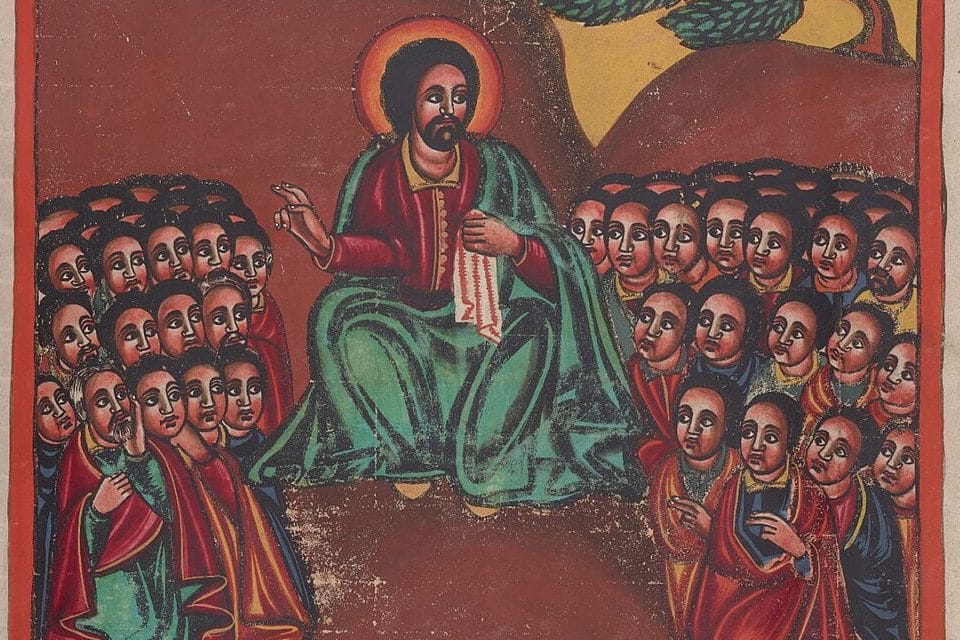
If you have been on the receiving end of harsh judgment, or if you have caught yourself judging others and felt uneasy about it, Jesus’ words in Matthew 7:1 are for you. His command “Do not judge” forbids a particular kind of judging: harsh, hypocritical, and final. It leaves room for careful discernment, gentle correction, and the defense of people who are being wronged. The final verdict on any human being belongs to God alone, and that is good news for everyone, including you.
What does Matthew 7:1–5 say?
Matthew 7:1 comes near the end of the Sermon on the Mount (Matthew 5–7), Jesus’ longest block of teaching in Matthew’s Gospel. The verse is the opening of a short, tightly built saying:
“Do not judge, so that you may not be judged. For the judgment you give will be the judgment you get, and the measure you give will be the measure you get.
Matthew 7:1–2, NRSVUE
The “measure” was a merchant’s measuring container. Jesus warns that God will deal with us the way we deal with others: generosity for the generous, strictness for the strict. The same idea appears in Jewish teaching; the Mishnah, compiled around 200 CE, states, “With the measure that a person measures, he is measured with it” (Sotah 1:7). It also echoes Jesus’ words about forgiveness earlier in the sermon (Matthew 6:14–15).
Jesus then gives a picture that is meant to make his hearers laugh, and then think:
Why do you see the speck in your neighbor’s eye but do not notice the log in your own eye? Or how can you say to your neighbor, ‘Let me take the speck out of your eye,’ while the log is in your own eye? You hypocrite, first take the log out of your own eye, and then you will see clearly to take the speck out of your neighbor’s eye.
Matthew 7:3–5, NRSVUE
The last line matters. Jesus does not tell his hearers to leave the speck alone. He says, “first take the log out of your own eye, and then you will see clearly to take the speck out of your neighbor’s eye.” Helping a neighbor with a fault is still in view. The sin Jesus names is hypocrisy: being blind to your own large faults while you hunt for small ones in others.
Does “judge not” mean Christians can never say something is wrong?
Jesus does not ask his followers to stop telling right from wrong. The verses around Matthew 7:1 assume that they will use judgment. The very next verse warns, “Don’t give that which is holy to the dogs, neither throw your pearls before the pigs” (Matthew 7:6), which requires telling who will receive a gift with respect. A few verses later Jesus says:
“Beware of false prophets, who come to you in sheep’s clothing but inwardly are ravenous wolves. You will know them by their fruits. Are grapes gathered from thorns or figs from thistles?
Matthew 7:15–16, NRSVUE
In John’s Gospel, Jesus answers critics who objected to his healing on the Sabbath: “Don’t judge according to appearance, but judge righteous judgment” (John 7:24). In Matthew 18 he gives instructions for what to do “if your brother sins against you”: go and talk with the person privately first (Matthew 18:15). Paul tells the Galatians to restore someone caught in wrongdoing “in a spirit of gentleness, looking to yourself so that you also aren’t tempted” (Galatians 6:1).
Christians, then, are allowed and even required to recognize sin, to warn against false teaching, to protect people from harm, and to speak up against injustice. Calling abuse “abuse” is not the judging Jesus forbids.
What kind of judging does Jesus forbid?
Luke’s version of the saying shows what Jesus has in mind:
“Do not judge, and you will not be judged; do not condemn, and you will not be condemned. Forgive, and you will be forgiven; give, and it will be given to you.
Luke 6:37–38, NRSVUE
Luke pairs “do not judge” with “do not condemn,” and he introduces the whole passage with “Therefore be merciful, even as your Father is also merciful” (Luke 6:36). The judging Jesus forbids is condemnation: deciding that another person is beyond hope, beyond mercy, or beneath you. Mercy is the measure Jesus asks his followers to use, because mercy is the measure God uses with them.
The rest of the New Testament says the same. Paul asks, “But you, why do you judge your brother? Or you again, why do you despise your brother? For we will all stand before the judgment seat of Christ” (Romans 14:10). The Letter of James asks the same question: “Only one is the lawgiver, who is able to save and to destroy. But who are you to judge another?” (James 4:12). Paul tells the Corinthians to “judge nothing before the time,” because the Lord will “reveal the counsels of the hearts” (1 Corinthians 4:5).
Three kinds of judging, then, fall under “judge not.” The first is condemning a person, as if you could pronounce God’s final verdict on someone’s soul. The second is assuming the worst about motives that you cannot see. The third is hypocrisy, holding others to standards you excuse in yourself.
How have Christians read this verse?
The Church Fathers read Matthew 7:1 the way the context requires. John Chrysostom, preaching in Antioch in the late fourth century, said of Jesus’ words: “He is not overthrowing reproof nor correction, but forbidding men to neglect their own faults, and exult over those of other men” (Homilies on Matthew 23). Chrysostom added that someone who neglects his own faults while searching out other people’s does not judge his brother “in care for him, but in hatred.”
Augustine, in his commentary on the Sermon on the Mount, drew a careful line. When it is uncertain why someone acted, he wrote, “we are to put the better construction on them.” In Augustine’s reading, Jesus’ saying “By their fruits you shall know them” refers to actions that “manifestly cannot be done with a good intention,” such as theft or drunkenness, and those may be called what they are (Our Lord’s Sermon on the Mount 2.18.59). Augustine’s counsel comes to this: judge actions when you must, give people the benefit of the doubt about their motives, and leave their souls to God.
How do I apply “judge not” today?
Before you correct someone, look at yourself first; that is the log. Ask whether you are speaking to help the person or to feel superior. Speak privately before you speak publicly, and speak gently. Separate the act from the person: you can say that something is wrong without saying that someone is worthless or lost.
Remember that, as John’s Gospel says, God sent his Son not “to judge the world, but that the world should be saved through him” (John 3:17). The people who received Jesus’ harshest words were the ones who were sure of their own righteousness. The people who received his mercy were the ones who knew they needed it. For more on mercy toward others, see Do I have to forgive someone who hurt me? and, on mercy toward yourself, Will God forgive me? Paul’s great chapter on love describes the same spirit: love “takes no account of evil” (What does 1 Corinthians 13 mean?).
Orthodox Christians pray the Prayer of St. Ephrem the Syrian through the weeks of Lent, and its last petition turns Matthew 7 into a prayer:
O Lord and Master of my life, grant not unto me a spirit of slothfulness, of discouragement, of lust of power, of vain babbling. But vouchsafe unto thy servant the spirit of continence, of meekness, of patience, and of love. Yea, O Lord and King, grant that I may perceive my own transgressions, and judge not my brother. For blessed art thou unto ages of ages. Amen.
Prayer of St. Ephrem the Syrian, translated by Isabel F. Hapgood (1906)
Common questions
Where in the Bible does it say “judge not”?
The saying comes from Jesus’ Sermon on the Mount in Matthew 7:1, which the King James Version renders “Judge not, that ye be not judged.” Luke’s Gospel has a parallel in Luke 6:37: “Do not judge, and you will not be judged; do not condemn, and you will not be condemned.”
Does “judge not” mean we can never say something is wrong?
Jesus himself names sins, warns against false prophets, and tells his followers to correct a brother or sister privately and gently (Matthew 18:15). What he forbids is condemning people, assuming the worst about their motives, and correcting others while ignoring your own faults.
What does the speck and the log mean?
In Matthew 7:3–5 Jesus pictures a person with a log in his own eye trying to remove a speck of sawdust from a neighbor’s eye. The image is deliberately absurd. It means that you should face your own larger faults first, before you try to correct anyone else’s smaller ones.
What does John 7:24 mean?
In John 7:24 Jesus tells critics who objected to his healing on the Sabbath, “Don’t judge according to appearance, but judge righteous judgment.” The verse shows that Jesus does not forbid all judging. He forbids shallow, unfair judgment and calls for judgment that is fair and merciful.
Is it judging to tell a friend they are doing something wrong?
Not in the sense Jesus forbids, if you speak privately, humbly, and for your friend’s good. Paul told the Galatians to restore someone caught in wrongdoing “in a spirit of gentleness” and to watch themselves at the same time (Galatians 6:1). Speaking up becomes judging when it turns into contempt, gossip, or a verdict on the person’s worth.
Sources
- Matthew 7:1–5 (WEB)
- Matthew 7:15–20 (WEB)
- Luke 6:36–38 (WEB)
- John 7:24 (WEB)
- Romans 14:10 (WEB)
- James 4:11–12 (WEB)
- Matthew 18:15–17 (WEB)
- Galatians 6:1 (WEB)
- Augustine, Our Lord’s Sermon on the Mount, Book II (New Advent)
- John Chrysostom, Homily 23 on Matthew (New Advent)
- Mishnah Sotah 1:7 (Sefaria)
- Prayer of St. Ephrem the Syrian, in Isabel F. Hapgood, Service Book of the Holy Orthodox-Catholic Apostolic Church (1906)

.jpg)