Original sin
Original sin is the Christian teaching that all human beings share a broken condition and a bent toward sin that they did not choose and cannot cure on their own. Augustine taught that everyone inherits Adam’s sin and its guilt. Eastern Orthodox Christians teach that people inherit the consequences of the first sin, above all death, but not its guilt. All agree that every person needs God’s grace, and that in Christ grace is stronger than sin.
Therefore just as one man’s trespass led to condemnation for all, so one man’s act of righteousness leads to justification and life for all.
Romans 5:18, NRSVUE
Original sin is the Christian name for something most people already know about themselves. Paul put it in one sentence: “For the good which I desire, I don’t do; but the evil which I don’t desire, that I practice” (Romans 7:19). Christians have understood the teaching in more than one way, and every version of it ends in grace. Every human being shares a broken condition and a bent toward sin, and every human being is offered a grace that is stronger.
Christians have explained original sin in different ways. The Western tradition, shaped by Augustine of Hippo in the early 400s, taught that all humanity inherits both Adam’s sin and its guilt. The Eastern Orthodox churches teach that human beings inherit the consequences of the first sin, above all death, and do not inherit its guilt. Many mainline Protestants today describe original sin as the shared human condition into which every person is born.
What does Genesis 3 say about the first sin?
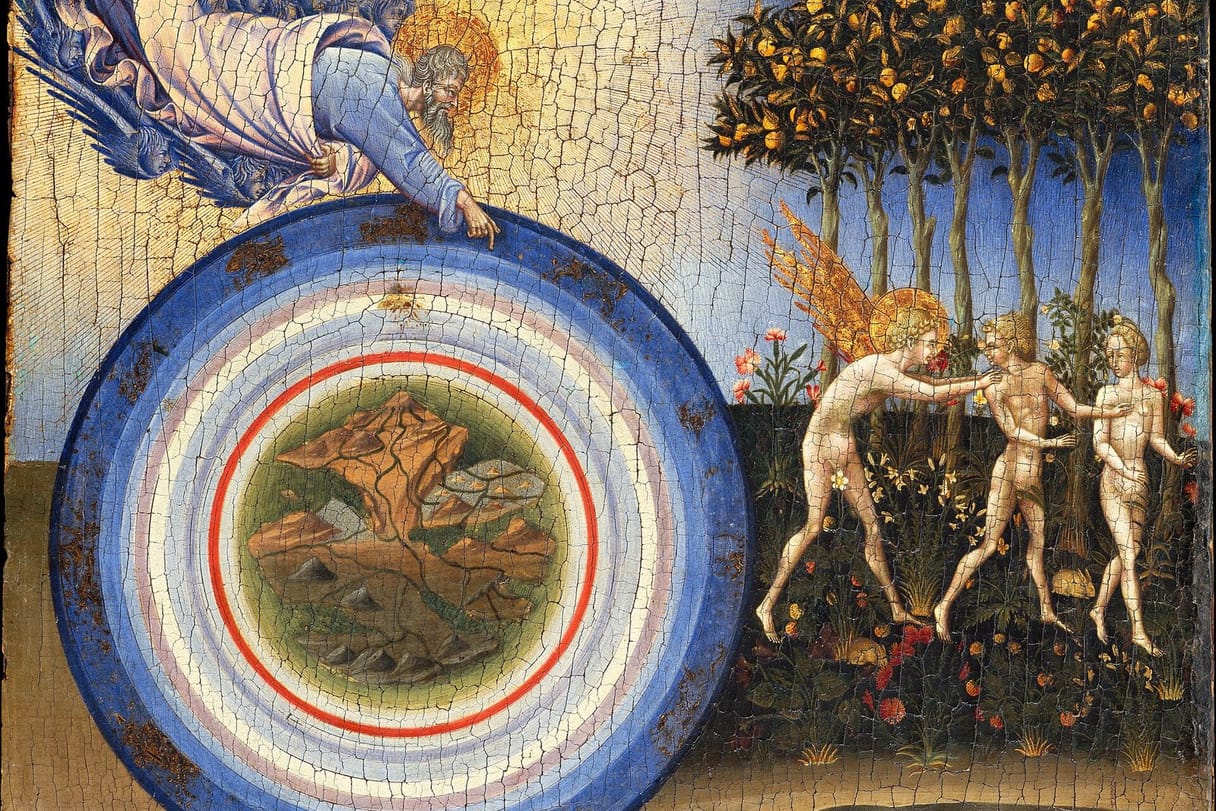
The story of Adam and Eve in Genesis 2–3 tells how the first humans, tempted by the serpent, ate from the one tree God had forbidden:
But the serpent said to the woman, “You will not die, for God knows that when you eat of it your eyes will be opened, and you will be like God, knowing good and evil.” So when the woman saw that the tree was good for food and that it was a delight to the eyes and that the tree was to be desired to make one wise, she took of its fruit and ate, and she also gave some to her husband, who was with her, and he ate.
Genesis 3:4–6, NRSVUE
The story goes on to describe shame, hiding, and blame, and it ends with the man and woman sent out of the garden, away from “the tree of life” (Genesis 3:22–24). Even then God does not abandon them; before they leave, God makes them garments of skins and clothes them (Genesis 3:21). The word “sin” never appears in Genesis 3. It first appears in the next chapter, when God warns Cain that “sin crouches at the door” (Genesis 4:7).
Many Christians, following mainstream biblical scholarship, read Genesis 2–3 as a sacred story that tells the truth about every human being: the wish to “be like God,” the refusal of limits, and the way sin breaks trust between people and God and between people themselves. Other Christians read it as a record of two historical people, and they too find in it the truth about every human heart. (See Were Adam and Eve real people? and Can Christians believe in evolution?)
Where does the doctrine of original sin come from?
The key New Testament text is Paul’s comparison of Adam and Christ in Romans 5:
Therefore, just as sin came into the world through one man, and death came through sin, and so death spread to all because all have sinned—
Romans 5:12, NRSVUE
Paul’s Greek says death spread to all “because all have sinned.”1 The Latin Bible that Augustine read translated the phrase in quo omnes peccaverunt, “in whom all sinned,” which suggested that everyone sinned in Adam himself (Romans 5:12, Vulgate). That translation shaped the Western doctrine.
Paul’s main concern in Romans 5 is the greater power of grace: “just as one man’s trespass led to condemnation for all, so one man’s act of righteousness leads to justification and life for all” (Romans 5:18), and “where sin abounded, grace abounded more exceedingly” (Romans 5:20). For Paul, Adam matters because Christ matters more.
The Old Testament also knows that sin runs deep. A psalm of repentance says, “Behold, I was born in iniquity. My mother conceived me in sin” (Psalm 51:5). After the flood, God says that “the imagination of man’s heart is evil from his youth” (Genesis 8:21). Yet the prophets reject the idea that children are punished for their parents’ sins: “The son shall not bear the iniquity of the father, neither shall the father bear the iniquity of the son” (Ezekiel 18:20).
What did Augustine and Pelagius disagree about?
Around 400 CE, a monk and teacher in Rome named Pelagius taught that human beings can obey God by their own effort and that Adam’s sin harms us only as a bad example. He rejected the idea that sin is passed down from Adam.
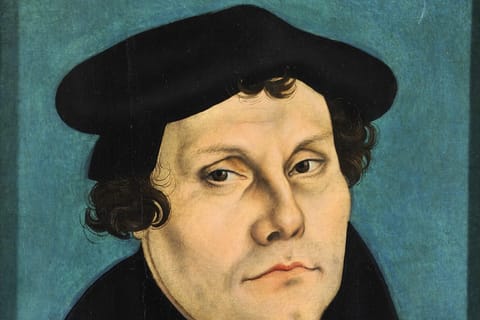
Augustine answered that sin had damaged human nature itself, so that no one can turn to God without grace. He knew this from his own life, which he told in his Confessions as the story of a man who could not free himself until grace freed him. In The City of God he wrote, “For we all were in that one man, since we all were that one man, who fell into sin” (13.14). A council of some two hundred bishops at Carthage in North Africa condemned Pelagius’s teaching on May 1, 418.
Augustine also drew conclusions that many Christians have since set aside. He taught that infants who die unbaptized receive “the mildest punishment of all” (Enchiridion 93), but punishment nonetheless. Most churches today entrust children who die without baptism to the mercy of the God who is love. (See Do you have to be baptized to be saved?)
The Church of England’s Thirty-Nine Articles followed Augustine. Article IX says that original sin “standeth not in the following of Adam, (as the Pelagians do vainly talk;) but it is the fault and corruption of the Nature of every man.”
How did Irenaeus and the Eastern churches see it?
Irenaeus of Lyons, writing in the late second century, pictured the first humans as children who were meant to grow toward God. He wrote that God could have made humanity perfect from the start, “but man could not receive this [perfection], being as yet an infant” (Against Heresies 4.38.1). In this view the first sin was the act of an immature creature who reached for something too soon, and human history is a long process of growing up into the likeness of God, with God patiently teaching along the way. Some Christians who accept evolution find Irenaeus’s picture especially helpful.
The Eastern Orthodox churches speak of “ancestral sin.” The Orthodox Church in America explains that “while everyone bears the consequences of the first sin, the foremost of which is death, only Adam and Eve are guilty of that sin.” Orthodox teaching stresses that human beings are born mortal and weakened, and that what they need most is healing. Salvation, in this view, is God’s healing of the whole person.
What do the mainline churches teach about original sin?
The mainline churches inherited the Western teaching through the Reformation, and they hold it in different ways. The Augsburg Confession of 1530, which the Evangelical Lutheran Church in America (ELCA) confesses, teaches that since the fall of Adam all people “are born with sin, that is, without the fear of God, without trust in God” (Article II). The Presbyterian Church (U.S.A.)’s Book of Confessions includes the Westminster Confession, which teaches original sin in Augustine’s strong form.
When John Wesley prepared Articles of Religion for the American Methodists in 1784, he kept the Church of England’s teaching that original sin is “the corruption of the nature of every man,” but he left out the line saying that it deserves “God’s wrath and damnation.” The United Methodist Church still uses Wesley’s version (Article VII). The Episcopal Church’s 1979 Catechism describes human sin without using the phrase “original sin” at all.
Many mainline Protestants hold that original sin is true as a description of the human condition. Every person is born into families, cultures, and systems already shaped by sin, and every person grows up with a heart that turns in on itself. God looks on every newborn with love. The doctrine’s claim is that all of us, without exception, need the grace that God gives freely in Christ: “For as in Adam all die, so also in Christ all will be made alive” (1 Corinthians 15:22). (See What is sin?)
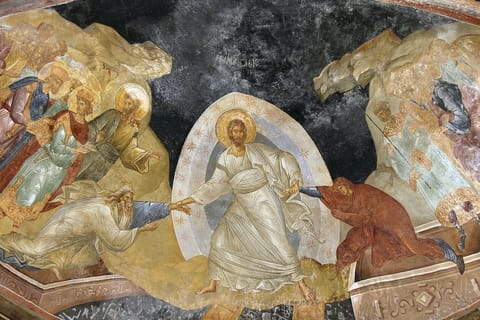
In the Orthodox icon of the Resurrection, the risen Christ stands over the broken gates of death and takes Adam and Eve by the hand to lift them from their tombs. Whatever you believe about how sin entered the world, that picture shows where the story ends. The same hand reaches for you.
Notes
-
Greek (SBL Greek New Testament): Διὰ τοῦτο ὥσπερ διʼ ἑνὸς ἀνθρώπου ἡ ἁμαρτία εἰς τὸν κόσμον εἰσῆλθεν καὶ διὰ τῆς ἁμαρτίας ὁ θάνατος, καὶ οὕτως εἰς πάντας ἀνθρώπους ὁ θάνατος διῆλθεν ἐφʼ ᾧ πάντες ἥμαρτον— Eis pantas anthrōpous means “to all human beings”; eph’ hō pantes hēmarton is usually translated “because all have sinned” or “because all sinned.” ↩︎
Common questions
Are babies born sinful?
Babies have committed no sins. The teaching of original sin says that they are born into a human race and a world already damaged by sin, and that they will grow up with the same bent toward self-centeredness as everyone else. Orthodox Christians teach that babies inherit mortality and weakness from Adam and Eve, and no guilt at all.
Was the forbidden fruit an apple?
Genesis never says so. The text says only that the woman “took of its fruit and ate” (Genesis 3:6). The apple comes from later Western art and storytelling.
Does God blame me for what Adam and Eve did?
No. The prophet Ezekiel says, “The son shall not bear the iniquity of the father” (Ezekiel 18:20). Original sin describes the condition all people share, and each person answers to God only for their own choices, before a God who is merciful.
Do I have to believe in a literal Adam and Eve to believe in original sin?
No. Many Christians read Genesis 2–3 as a true story about every human being, and others read it as a historical report about two people. Both can confess original sin, because the teaching rests on what Christians see in themselves and in history: everyone sins, and everyone needs grace.
Sources
- Genesis 3:4–7 and 3:22–24 (WEB)
- Romans 5:12–21 (WEB)
- Romans 5:12 (Vulgate)
- Ezekiel 18:20 (WEB)
- Augustine, The City of God, Book 13 (New Advent)
- Irenaeus, Against Heresies, Book 4, chapter 38 (New Advent)
- Catholic Encyclopedia, “Pelagius and Pelagianism” (New Advent)
- The Thirty-Nine Articles of Religion, Article IX (Church of England)
- Orthodox Church in America, “Original sin”
- Augsburg Confession, Article II: Of Original Sin (BookOfConcord.org)
- United Methodist Articles of Religion, Article VII (UMC.org)