The unforgivable sin
The unforgivable sin is what Jesus called blasphemy against the Holy Spirit (Mark 3:28–30). He was answering religious leaders who saw him heal people and said he did it by the power of the devil. Christian teachers from Augustine onward have understood the sin as a hardened, final refusal of God’s mercy. If you are worried that you have committed it, you have not, because the worry shows that you still want God.
“Truly I tell you, people will be forgiven for their sins and whatever blasphemies they utter, but whoever blasphemes against the Holy Spirit can never have forgiveness but is guilty of an eternal sin”—
Mark 3:28–29, NRSVUE
If you have come here afraid, lying awake over something you said or thought, begin with the good news: God’s mercy is wider than your fear, and your longing for forgiveness is itself the work of the Holy Spirit in you. Jesus spoke of “blasphemy against the Holy Spirit” in Mark 3:28–30, and Christian teachers from Augustine onward have understood it as a hardened, final refusal of God’s mercy. A heart that longs for God’s forgiveness is already turned toward the grace it seeks.
What did Jesus say about the unforgivable sin?
Jesus’s saying about the unforgivable sin appears in three Gospels. Mark, the earliest, reports it this way:
“Truly I tell you, people will be forgiven for their sins and whatever blasphemies they utter, but whoever blasphemes against the Holy Spirit can never have forgiveness but is guilty of an eternal sin”— for they had said, “He has an unclean spirit.”
Mark 3:28–30, NRSVUE
Notice how wide the first half of the saying is. Jesus begins by promising that people “will be forgiven for their sins and whatever blasphemies they utter.” The warning that follows is the exception to a sweeping promise of mercy.
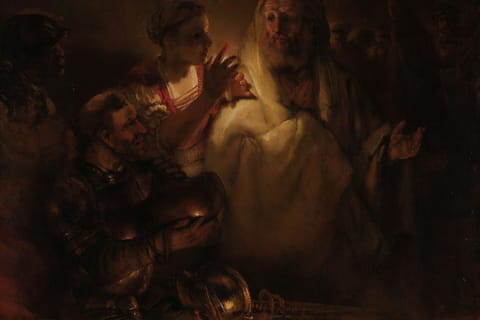
Matthew’s version adds, “Whoever speaks a word against the Son of Man, it will be forgiven him” (Matthew 12:32), and Luke has a shorter form (Luke 12:10). Speaking against Jesus himself is forgivable. Peter denied him three times and was restored.
What was happening in Mark 3?
Mark explains the occasion in verse 30: Jesus said this “for they had said, ‘He has an unclean spirit.’” Jesus had been healing the sick and freeing people from what the Gospels call unclean spirits. Crowds pressed around him. His own family thought he had lost his mind. Mark tells it this way:
When his family heard it, they went out to restrain him, for people were saying, “He has gone out of his mind.” And the scribes who came down from Jerusalem said, “He has Beelzebul, and by the ruler of the demons he casts out demons.”
Mark 3:21–22, NRSVUE
Jesus answers that the charge makes no sense: “How can Satan cast out Satan?” (Mark 3:23). In Matthew’s telling he adds, “But if I by the Spirit of God cast out demons, then God’s Kingdom has come upon you” (Matthew 12:28).
So the blasphemy against the Spirit, in its setting, is looking straight at God’s work of healing and calling it the devil’s work. In Mark’s telling, the scribes saw the healing clearly and chose to call it the devil’s work. A person in that state cannot receive forgiveness, because forgiveness comes through the same Spirit they have named as evil. The door is locked from the inside.
How have Christians understood the unforgivable sin?
The church’s great teachers have agreed that the sin is a hardened refusal of grace. No single word, spoken once, can commit it.
Augustine of Hippo, preaching on this passage, concluded that the blasphemy against the Spirit is impenitence, a heart that refuses to repent to the end of life: “This impenitence then is the blasphemy of the Spirit, which shall not be forgiven” (Sermon 71).
Thomas Aquinas, in the thirteenth century, explained that the sin is called unpardonable because by its nature it rejects the means by which sins are forgiven. He added: “This does not, however, close the way of forgiveness and healing to an all-powerful and merciful God” (Summa Theologiae II-II, q. 14, a. 3). In the same article he wrote, “We should despair of no man in this life, considering God’s omnipotence and mercy.”
The Christian East also stresses how far God’s mercy exceeds human sin. Isaac the Syrian, a seventh-century monk and bishop revered in the Orthodox Church, wrote: “As a handful of sand thrown into the great sea, so are the sins of all flesh in comparison with the mind of God.”
What do the mainline churches teach?
The Reformation churches addressed the fear directly. The Church of England’s Thirty-Nine Articles, the historic Anglican statement of faith, take it up in Article XVI. The article says: “Not every deadly sin willingly committed after Baptism is sin against the Holy Ghost, and unpardonable. Wherefore the grant of repentance is not to be denied to such as fall into sin after Baptism.” The article condemns those who “deny the place of forgiveness to such as truly repent.” The United Methodist Church’s Articles of Religion say the same in nearly identical words (Article XII).
The Lutheran Augsburg Confession of 1530 condemns those who refused to absolve people who had fallen into sin after baptism and then repented (Article XII). The Westminster Confession of Faith, part of the Presbyterian Church (U.S.A.)’s Book of Confessions, teaches that “there is no sin so great that it can bring damnation upon those who truly repent” (6.085).
The First Letter of John promises, “If we confess our sins, he is faithful and righteous to forgive us the sins” (1 John 1:9). For how to receive that forgiveness, see Will God forgive me?
Have I committed the unforgivable sin?
The sin Jesus described is a settled refusal of God’s mercy. If you fear losing God’s mercy, you still want it, and the Holy Spirit is the one stirring that desire in you.
The New Testament shows forgiven blasphemers. The First Letter to Timothy has Paul say, “I used to be a blasphemer, a persecutor, and insolent. However, I obtained mercy” (1 Timothy 1:13). God’s mercy reaches angry words at God, doubts, curses spoken in grief, and terrible thoughts that flash through the mind. See Is cursing a sin?
Some people are tormented by unwanted blasphemous thoughts that return no matter how much they pray. The International OCD Foundation lists “fear of offending God, damnation, and/or concern about blasphemy” among the common religious obsessions of obsessive-compulsive disorder, a condition often called scrupulosity. Scrupulosity is an illness, and it is treatable. If this describes you, talk with a priest or pastor who can reassure you, and look for a therapist who treats OCD. See Is anxiety a sin?
Jesus’s own promise stands over all of this: “He who comes to me I will in no way throw out” (John 6:37). If you fear that you have fallen too far, see also Can you lose your salvation?
In one of his parables, Jesus told of a tax collector who stood at the back of the Temple, too ashamed to lift his eyes, and prayed only one line. Jesus said that this man “went down to his house justified” (Luke 18:14). Orthodox Christians built the Jesus Prayer on his words. You can pray them now, as many times as you need:
God, be merciful to me, a sinner!
Common questions
Can a Christian commit the unforgivable sin?
A Christian who trusts God and wants God’s forgiveness is already receiving the mercy that this sin refuses. Jesus spoke the warning to opponents who called his healing work the work of the devil. The Anglican Thirty-Nine Articles and the United Methodist Articles of Religion both say that not every serious sin committed after baptism is the sin against the Holy Spirit, and that repentance must not be denied to those who fall.
Is cursing God the unforgivable sin?
No. Jesus says that people “will be forgiven for their sins and whatever blasphemies they utter” (Mark 3:28). Words said in anger, pain, or doubt are forgivable. The Book of Job and many psalms record people speaking bitterly to God, and Scripture keeps their words as prayers.
What if I have unwanted blasphemous thoughts?
Intrusive thoughts come unbidden, and God knows the heart that is troubled by them. Persistent fear of having blasphemed or offended God is a common form of obsessive-compulsive disorder called scrupulosity. A priest or pastor can reassure you, and a therapist who treats OCD can help you find relief.
What is the “sin that is deadly” in 1 John 5:16?
The First Letter of John mentions “sin leading to death” (in some translations, “sin that is deadly”) without defining it. Many interpreters connect it with the false teachers the letter opposes, who had left the community and denied that Jesus came in the flesh. The same letter promises that God forgives those who confess their sins (1 John 1:9).
Sources
- Mark 3:20–30 (WEB)
- Matthew 12:22–32 (WEB)
- Luke 12:10 (WEB)
- Augustine, Sermon 71 (Sermon 21 on the New Testament)
- Thomas Aquinas, Summa Theologiae II-II, question 14, article 3
- Isaac the Syrian, The Ascetical Homilies (Holy Transfiguration Monastery), sampler
- The Thirty-Nine Articles of Religion (1571), Article XVI
- Augsburg Confession (1530), Article XII
- Westminster Confession of Faith, chapter 15, Of Repentance unto Life (PC(USA) Book of Confessions 6.085)
- The United Methodist Church, Articles of Religion XII
- International OCD Foundation, About OCD (religious obsessions, or scrupulosity)
- Luke 18:9–14 (WEB)