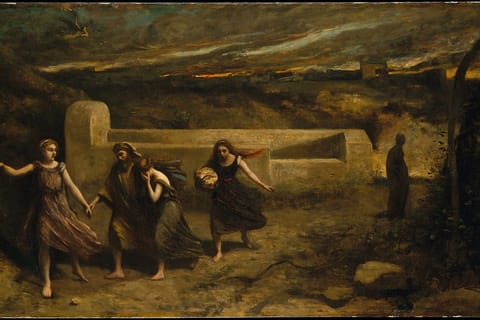
Adam and Eve
Adam and Eve were probably not the only two humans from whom everyone descends, since genetics shows our ancestors were never reduced to a single couple in at least the last 500,000 years. The ELCA, the PC(USA), the United Methodist Church, and the Episcopal Church do not require belief in a historical Adam and Eve. Many Christians, following Origen, read Genesis 2–3 as the true story of every human life; others hold that Adam and Eve were real individuals.
So God created humans in his image, in the image of God he created them; male and female he created them.
Genesis 1:27, NRSVUE

Christians have long read the story of Adam and Eve in more than one way. Some hold that Adam and Eve were real individuals, the first parents of the human race. Many others, following a way of reading that goes back to Origen in the third century, receive Genesis 2–3 as a true story about every human being, made by God, loved by God, and turning away from God. If you were taught that your faith depends on a literal first couple, and you have since learned what science says about human origins, the question may feel unsettling. The church has room for you either way, and the story still speaks to you of a God who made you and who has not given up on you.
What does Genesis say about Adam and Eve?
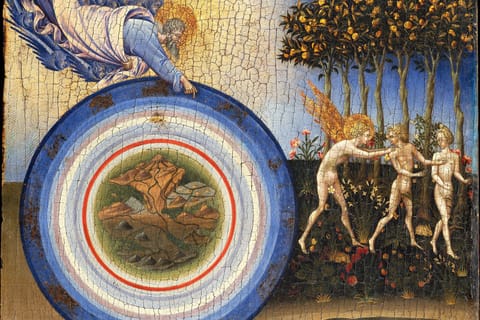
Genesis opens with two accounts of creation. In the first, God creates human beings, male and female together, on the sixth day:
So God created humans in his image, in the image of God he created them; male and female he created them.
Genesis 1:27, NRSVUE
The second account begins at Genesis 2:4 and tells the story differently. God forms the man first, then the plants and animals, and then the woman from the man’s rib:
then the Lord God formed man from the dust of the ground and breathed into his nostrils the breath of life, and the man became a living being.
Genesis 2:7, NRSVUE
Most biblical scholars hold that the two accounts come from different sources that were later woven together (see Who wrote the Bible?). The order of creation differs between Genesis 1 and Genesis 2, which is one reason scholars think so.
The names in the story carry meaning too. The Hebrew word adam means “human being” or “humankind,” and Genesis 2:7 makes a pun on adamah, the Hebrew word for “ground.” In most of Genesis 2–3 the Hebrew text calls him ha-adam, “the human,” and uses no personal name. Eve’s Hebrew name, Havvah, sounds like the word for “living,” and the text explains that she was called Eve “because she would be the mother of all the living” (Genesis 3:20). A story whose main characters are named “Human” and “Living” invites every reader to find himself or herself in it.
Did the early church read Adam and Eve literally?
Not always. Origen of Alexandria, the leading Christian Bible scholar of the third century, taught that some details in Genesis were meant to be read figuratively. In On First Principles (4.3.1) he asked who would be “so ignorant as to suppose that God, as if He had been a husbandman, planted trees in paradise, in Eden towards the east.” Origen held that the story of God walking in the garden and of Adam hiding among the trees (Genesis 3:8) points to a spiritual meaning.
Augustine of Hippo, writing around 401–415 CE, believed that Adam and Eve were real people. In the same commentary, The Literal Meaning of Genesis, he argued that the six days of creation were not ordinary days. Augustine also warned Christians against defending interpretations of Scripture that contradict what careful observers know about the natural world. He wrote that “it is a disgraceful and dangerous thing for an infidel to hear a Christian, presumably giving the meaning of Holy Scripture, talking nonsense on these topics” (1.19.39). Origen and Augustine read Adam differently, and both loved the same Scripture and served the same Lord.
What does science say about the first humans?
Fossils show that anatomically modern humans appeared in Africa hundreds of thousands of years ago, descended from earlier human species. Studies of genetic variation in living people show that the population of our ancestors numbered in the thousands. S. Joshua Swamidass, a Christian geneticist who has criticized overstated claims on the subject, concludes that the evidence rules out humanity descending from a single couple who were the only humans alive at any time in roughly the last 500,000 years.
Genesis itself places Adam and Eve in a much later world. Their son Abel keeps sheep and their son Cain is “a tiller of the ground” (Genesis 4:2), and Cain later builds a city (Genesis 4:17). Archaeology dates the first farming and herding to about 10,000 BCE. The story also assumes other people. After killing Abel, Cain fears that “whoever finds me will kill me” (Genesis 4:14).
Some Christians propose that Adam and Eve were a real couple whom God called out from a larger human population. Swamidass, in The Genealogical Adam and Eve (2019), argues that a couple living a few thousand years ago could be a genealogical ancestor of everyone alive today. Proposals like his come from Christians who take both Scripture and science to heart. Many mainline Christians find it more natural to read Genesis 2–3 as a story about all of us. On how the church has made peace with modern biology, see Can Christians believe in evolution?
Did Jesus and Paul believe Adam was real?
Probably, as did nearly everyone in the first century. When Jesus taught about marriage, he quoted both creation accounts, beginning with the words “Haven’t you read that he who made them from the beginning made them male and female” (Matthew 19:4–5). Luke traces Jesus’ ancestry back to “the son of Adam, the son of God” (Luke 3:38).
Paul compared Adam and Christ in two of his letters:
For since death came through a human, the resurrection of the dead has also come through a human, for as all die in Adam, so all will be made alive in Christ.
1 Corinthians 15:21–22, NRSVUE
In Romans 5:12–19 Paul writes that “sin entered into the world through one man,” and that “through one act of righteousness, all men were justified to life.” Paul’s main subject in both passages is Christ. Many theologians hold that Paul’s teaching stands whether Adam was one man or a figure for all humanity, because every person has sinned and dies, and Christ’s gift of life reaches further than Adam’s sin. Christians who hold to a historical Adam answer that Paul’s comparison needs a real first man. They are reading Paul with great care, and their conviction belongs to a long and faithful tradition.
What does the story of Adam and Eve teach?
The story of Adam and Eve teaches that human beings are made from the earth and given life by God’s own breath. It teaches that people are made for companionship: “It is not good for the man to be alone” (Genesis 2:18). It teaches that human beings reach for what is not theirs, blame one another, and hide from God.
Above all, it teaches that God comes looking for them anyway. In the cool of the day, while the man and woman hide among the trees, “The LORD God called to the man” and asked him, “Where are you?” (Genesis 3:9). Before they leave the garden, God makes them clothes: “The LORD God made garments of animal skins for Adam and for his wife, and clothed them” (Genesis 3:21). Even in judgment, God cares for the people who have turned away.
The Eastern Orthodox tradition reads the story with particular gentleness. In the second century Irenaeus of Lyons wrote that God could have made humanity perfect from the start, but the first humans could not receive it, “being as yet an infant” (Against Heresies 4.38). On that reading, Adam and Eve are like children who stumbled early in a long growth toward God. Orthodox theologians speak of “ancestral sin” in place of inherited guilt. Every person inherits death and an inclination toward sin, but no one bears the guilt of a sin someone else committed. For the church’s teaching on how sin marks every human life, see What is original sin?
What do the churches teach about Adam and Eve?
The Evangelical Lutheran Church in America, the Presbyterian Church (U.S.A.), the United Methodist Church, and the Episcopal Church have no official teaching that requires members to believe Adam and Eve were historical individuals. The Nicene Creed and the Apostles’ Creed do not mention Adam. Sixteenth-century Protestant confessions assumed a historical Adam. The Lutheran Augsburg Confession speaks of all people born “since the fall of Adam,” and the Anglican Thirty-Nine Articles describe every person as one “that naturally is ingendered of the offspring of Adam.” Churches that still honor those confessions read those words in different ways today.
Many evangelical churches teach that a historical Adam and Eve are essential to the gospel, because Paul sets Adam beside Christ in Romans 5 and 1 Corinthians 15. Their concern grows from love for Scripture and for the good news of Christ, and Christians on every side of the question can honor it.
The mainline churches leave their members free to read Adam and Eve as figures for all humanity, as Origen read much of Genesis, and such a reading gives up nothing the creeds confess. For the wider question of how to read the opening chapters of the Bible, see Should we read the Bible as literal fact?
The first question God asks a human being in the Bible is “Where are you?” However you read the history of Adam and Eve, that question is addressed to you as well. It comes from the God who walked in the garden looking for the ones who hid, and who still seeks every person with patience and love.
Common questions
Who was Cain’s wife?
Genesis never says. Genesis 4 assumes other people already exist: Cain fears that “whoever finds me will kill me,” and later he has a wife and builds a city. Readers have noticed for centuries that the story of Cain takes a wider human world for granted, which fits a reading of Adam and Eve as figures for all humanity.
Do you have to believe in a literal Adam and Eve to be a Christian?
No. The Nicene Creed and the Apostles’ Creed, the church’s basic statements of faith, do not mention Adam or Eve. Christians confess that God made the world, that human beings have turned from God, and that God saves us in Christ, and Christians hold that faith whether they read Genesis 2–3 as history or as figurative truth.
Was the Garden of Eden a real place?
Genesis 2 says a river flowed out of Eden and divided into four, two of which are the Tigris and the Euphrates in Mesopotamia, so the writer imagined it in the world of the ancient Near East. No archaeological site has been identified as Eden. Origen in the third century already read the garden and its trees as figures with a spiritual meaning.
Did we inherit Adam’s guilt?
Christians answer differently. Western theology, following Augustine, has often spoken of original sin as a condition every person inherits. The Eastern Orthodox churches prefer the term ancestral sin: every person inherits the consequences of the first sin, above all death and an inclination toward sin, but no one is guilty of a sin someone else committed.
Sources
- Genesis 1:27 (WEB)
- Genesis 2:4–23 (WEB)
- Genesis 4:1–17 (WEB)
- Romans 5:12–19 (WEB)
- 1 Corinthians 15:21–22 (WEB)
- Origen, On First Principles, Book 4 (New Advent)
- Augustine, The Literal Meaning of Genesis 1.19.39 (World History Encyclopedia excerpt)
- Thirty-Nine Articles of Religion (Church of England)
- S. Joshua Swamidass, The Misunderstood Science of Genetic Bottlenecks (Peaceful Science)
- Irenaeus, Against Heresies 4.38 (New Advent)
- OrthodoxWiki, “Original sin” (on ancestral sin)
- Augsburg Confession (1530), Article II (Book of Concord)