Hell and the mercy of God
Many Christians and theologians hold that God’s love rules out hell as a real place of eternal torment. In their reading, the Bible’s images of Gehenna, fire, and darkness are picture-language for God’s judgment on wrongdoing, which answers the cry of victims for justice. Teachers revered in the Orthodox Church, from Gregory of Nyssa and Isaac the Syrian to Kallistos Ware, have hoped that God’s love will reconcile everyone, so that God may be “all in all” (1 Corinthians 15:28).
This is right and acceptable before God our Savior, who desires everyone to be saved and to come to the knowledge of the truth.
1 Timothy 2:3–4, NRSVUE
Few questions carry as much fear as this one. You may have been taught as a child that hell waits for anyone who doubts, or you may be afraid for someone you love who died without faith. Many Christians and theologians hold that God’s love rules out eternal conscious torment, the belief that God punishes people with pain that never ends, and most other pictures of hell. They start from the clearest thing the New Testament says about God: “God is love” (1 John 4:8). In their reading, the Bible’s hell-language is picture-language for God’s judgment on wrongdoing, which answers the cry of victims for justice in a world with so much evil.
Augustine of Hippo gave the church a test for reading the Bible, often called the rule of love. In On Christian Teaching (1.36.40), he wrote that whoever reads the Scriptures in a way that “does not tend to build up this twofold love of God and our neighbor, does not yet understand them as he ought.” Augustine himself believed in eternal punishment and defended it in Book 21 of The City of God. Many later Christians, applying his rule to the doctrine of endless punishment, have concluded that a God who torments people without end could not be the God whose Word builds up love.
What does the Bible mean by hell?
The English word “hell” stands for several different words in the Bible. Sheol is the Hebrew name for the shadowy realm where, in most of the Old Testament, everyone goes at death, righteous and wicked alike; even there, a psalmist tells God, “you are there!” (Psalm 139:8). Hades is the Greek word the ancient Greek translation of the Hebrew Bible used for Sheol.
Gehenna, the word Jesus uses for final judgment, is the Greek form of the Hebrew Ge Hinnom, the Valley of Hinnom, a ravine just south of Jerusalem. Jeremiah condemned the people of Judah for going there “to burn their sons and their daughters in the fire” (Jeremiah 7:31). By Jesus’s time the name of that cursed valley had become a name for God’s judgment.
Jesus describes Gehenna with the last verse of Isaiah, “where their worm doesn’t die, and the fire is not quenched” (Mark 9:48), and elsewhere speaks of “the outer darkness” (Matthew 8:12). Fire and total darkness cannot describe the same physical place, so many readers take both as pictures. The Greek word translated “eternal,” aiōnios, means “of the age,” especially the age to come, so many readers take “eternal punishment” (Matthew 25:46) to mean judgment belonging to God’s new age, and they do not read it as a measure of endless time.
Many modern theologians read hell as a symbol. Paul Tillich, in the third volume of his Systematic Theology (1963), treated heaven and hell as symbols for the deepest joy and the deepest despair a person can know before God. Marcus Borg argued in Speaking Christian (2011) that a “heaven-and-hell” framework, centered on the afterlife, had emptied Christian words of their older meaning.
Why does the Bible speak of judgment?
The Bible’s images of judgment answer the human need for justice in a world where so much evil goes unpunished. In Revelation, the souls of martyrs cry out from under the altar, “How long, Master, the holy and true, until you judge and avenge our blood on those who dwell on the earth?” (Revelation 6:10). The Psalms of lament ask the same question: “LORD, how long will the wicked, how long will the wicked triumph?” (Psalm 94:3).
Jesus aims his warnings mostly at people who harm the vulnerable. Whoever causes “one of these little ones” to stumble, he says, would be better off drowned with a millstone around his neck (Matthew 18:6). In the parable of the sheep and the goats, the nations are judged by whether they fed the hungry and welcomed the stranger: “because you didn’t do it to one of the least of these, you didn’t do it to me” (Matthew 25:45). The parable’s “eternal fire” (Matthew 25:41), on this reading, is an image of how seriously God takes the neglect of the poor. In the story of the rich man who ignored the beggar Lazarus at his gate, the two men’s places are reversed after death (Luke 16:19–31).
Read this way, these images say that wrongdoing matters to God and that its victims will be vindicated. The Croatian theologian Miroslav Volf, writing after the wars in the former Yugoslavia, argued in Exclusion and Embrace (1996) that “the practice of nonviolence requires a belief in divine vengeance”: people who have suffered atrocities can give up revenge when they trust that God will judge.
What is the river of fire?
Eastern Orthodox Christians often describe the last judgment with an image from Daniel, who saw that “a fiery stream issued and came out from before” God’s throne (Daniel 7:10). In the Orthodox picture, the fire is God’s own love, flowing out to every creature without change. Those who love God experience it as light and joy; those who have refused love experience the same love as burning pain.
The idea goes back to Isaac the Syrian, a seventh-century bishop of Nineveh whose Ascetical Homilies are loved in Orthodox monasteries. In the Holy Transfiguration Monastery translation, Isaac writes: “I also maintain that those who are punished in Gehenna are scourged by the scourge of love.” He adds that love works in two ways, tormenting those who have refused it and giving joy to those who have kept it. Isaac also wrote that “God is not one who requites evil, but He sets aright evil.”
The Greek Orthodox writer Alexandre Kalomiros developed the image in The River of Fire, a 1980 address to an Orthodox youth conference in Seattle. Kalomiros argued that God torments no one: the same river of divine love is paradise for those who love God and torment for those who hate God, so “paradise for the one is hell for the other.” In this picture, God builds no torture chamber; hell names the condition of a heart closed to a love that never stops.
What does Easter say about hell?
Orthodox Easter worship speaks of hell as something Christ has already defeated. At the Easter night service, Orthodox churches read aloud the Paschal sermon attributed to St. John Chrysostom (died 407). Near its end the sermon takes up Paul’s taunt to death in 1 Corinthians 15:55. In the Orthodox Church in America’s translation: “O Death, where is your sting? O Hell, where is your victory? Christ is risen, and you are overthrown.”
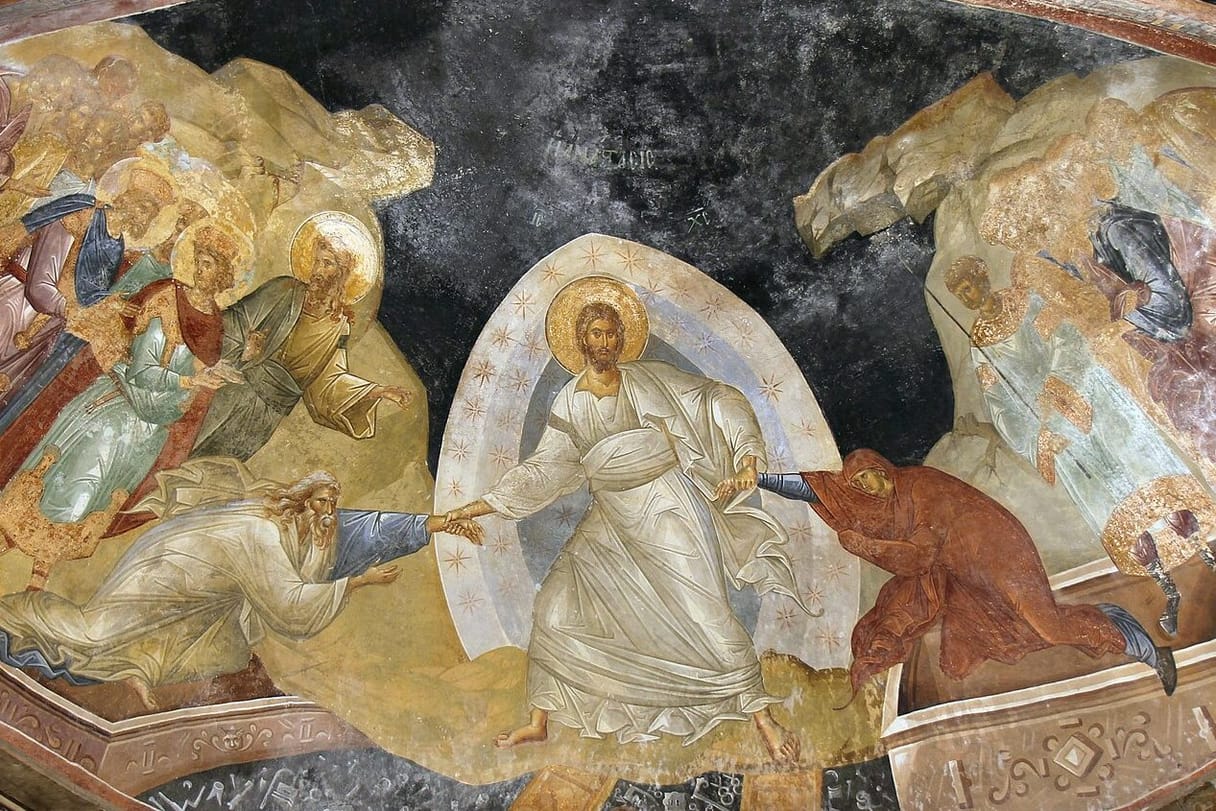
The Orthodox icon of Easter, the Anastasis (Greek for “resurrection”), shows the risen Christ standing on the broken gates of Hades, with locks and keys scattered in the darkness below, pulling Adam and Eve out of their tombs by the wrists. The best-known example is the fresco painted around 1320 in the Chora Church in Istanbul. For the teaching behind the icon, see Did Jesus go to hell?
Will God save everyone in the end?
Scripture speaks often of God’s purpose to save everyone. God “desires all people to be saved” (1 Timothy 2:4), and Paul writes:
For as all die in Adam, so all will be made alive in Christ.
1 Corinthians 15:22, NRSVUE
For God has bound all to disobedience, that he might have mercy on all.
Through one act of righteousness, “all men were justified to life” (Romans 5:18). Through Christ, God was pleased “to reconcile all things to himself” (Colossians 1:20), and every knee will bow and every tongue confess that Jesus Christ is Lord (Philippians 2:10–11). In Luke 15 the shepherd leaves ninety-nine sheep to find one that is lost (Luke 15:4), and the father runs to meet the son who wasted everything (Luke 15:20).
The Greek name for this hope is apokatastasis, “restoration,” from Peter’s sermon about “the times of restoration of all things” (Acts 3:21). Gregory of Nyssa (c. 335–c. 395), one of the Cappadocian Fathers and a saint of the Orthodox Church, taught that all would be restored. In On the Soul and the Resurrection he reasoned that “when it shall be that every will rests in God, evil will be reduced to complete annihilation,” and he understood the fire of judgment as a fire that purifies.
In the twentieth century, when a hermit told St. Silouan, a Russian monk on Mount Athos, that God would burn all atheists in everlasting fire, Silouan answered, “Love could not bear that,” and added, “We must pray for all.” The Orthodox bishop Kallistos Ware told that story in his 1998 essay “Dare We Hope for the Salvation of All?” Because human freedom is real, Ware held, hell remains a possibility, but he ventured the hope, “it is no more than a hope,” that it will be found empty. The Orthodox theologian David Bentley Hart goes further in That All Shall Be Saved (Yale University Press, 2019), arguing that a good Creator cannot have made any creature for endless misery, so all will be saved.
What do other Christians believe about hell?
Many Christians, past and present, believe out of reverence for Scripture that hell is real and its punishment endless. They point to Jesus’s words about “eternal punishment” and to the devil “tormented day and night forever and ever” (Revelation 20:10), and they stand with Augustine, Aquinas, and Calvin, as many evangelical churches do today. Their concern deserves respect: they want God’s justice taken seriously and Jesus’s warnings heard in full. Others hold that the lost will cease to exist, a view called annihilationism. Reformation-era confessions that mainline churches still keep as historic standards, such as the Lutheran Augsburg Confession (1530) and the Presbyterian Westminster Confession of Faith (1640s), teach eternal punishment. Yet mainline teaching has long left room for the hope that all will be saved: the Reformed theologian Karl Barth refused to rule out the salvation of all, and many mainline pastors and theologians share that hope.
What if I am afraid of hell?
God calls you to live in the freedom of love. The First Letter of John says, “There is no fear in love; but perfect love casts out fear” (1 John 4:18). Paul was persuaded that nothing in all creation “will be able to separate us from God’s love which is in Christ Jesus our Lord” (Romans 8:39). If you fear that you have gone too far from God, the fear itself shows that you still want God.
If you are afraid for someone you love, such as a parent who died without faith, the tradition gives you something to do: pray for them. Orthodox Christians pray for the dead at every funeral and memorial service; in St. Silouan’s words, “We must pray for all.” The Apostles’ Creed confesses that Christ descended to the dead, and Christians who share the hope of Gregory of Nyssa and Isaac the Syrian trust that no one is beyond the reach of his love. For more, see Do non-Christians go to hell?, What happens when you die?, Can you lose your salvation?, and Does God love me?
Even in the old picture of Sheol, the shadowy place of the dead, the psalmist found that no depth lies beyond God’s reach. You can pray his words for yourself and for anyone you fear for:
Where could I go from your Spirit? Or where could I flee from your presence? If I ascend up into heaven, you are there. If I make my bed in Sheol, behold, you are there!
Common questions
Did Jesus believe in hell?
Jesus spoke of Gehenna, the word most English Bibles translate “hell,” and he borrowed the images of the undying worm and the unquenched fire from Isaiah 66:24. Other Jewish writings of his time also used Gehenna as a name for the place of God’s final judgment. Jesus aimed his warnings mostly at people who harm the vulnerable, neglect the poor, or use religion to load burdens on others. Many Christians read these warnings as a prophet’s way of saying that cruelty matters to God and that its victims will be vindicated.
What is the river of fire?
The river of fire is an Eastern Orthodox image of the last judgment, taken from Daniel 7:10, where a fiery stream flows out from God’s throne. In this picture the fire is God’s own love, offered to everyone without change. Those who welcome God’s love experience it as light and joy, and those who refuse it experience the same love as pain. The Greek Orthodox writer Alexandre Kalomiros made the image widely known in his 1980 address The River of Fire.
Do the Orthodox believe everyone will be saved?
The Orthodox Church has not made universal salvation a dogma, and some of Origen’s teachings about the restoration of all things were condemned in the sixth century. Many Orthodox Christians still hope and pray that all will be saved, following Gregory of Nyssa and Isaac the Syrian. Kallistos Ware wrote that Christians may dare to hope for the salvation of all, and David Bentley Hart argues that all will in fact be saved.
Will I go to hell?
God made you for love and for life with God, and Scripture says that God “desires all people to be saved” (1 Timothy 2:4) and that perfect love casts out fear (1 John 4:18). If something you have done weighs on you, God’s forgiveness is offered to everyone who asks for it, and a pastor or priest can help you receive it.
What is the difference between Hades and hell?
Hades is the Greek name for the realm of all the dead, good and bad alike, and it translates the Hebrew word Sheol. Hell in the New Testament usually translates Gehenna, the name of the Valley of Hinnom outside Jerusalem, which became a name for God’s final judgment. Revelation 20:14 pictures Hades itself being thrown into the lake of fire, an image of death’s defeat.
Sources
- 1 John 4:7–8 (WEB)
- Augustine, On Christian Doctrine (On Christian Teaching), Book I, 36.40
- Augustine, The City of God, Book 21
- Revelation 6:9–10 (WEB)
- Matthew 25:31–46 (WEB)
- 1 Corinthians 15:22–28 (WEB)
- Paul Tillich, Systematic Theology, Volume 3 (University of Chicago Press, 1963)
- Marcus J. Borg, Speaking Christian (2011), study guide
- Miroslav Volf, Exclusion and Embrace (1996)
- Isaac the Syrian, The Ascetical Homilies
- Alexandre Kalomiros, The River of Fire (1980)
- John Chrysostom, The Paschal Sermon (Orthodox Church in America)
- Gregory of Nyssa, On the Soul and the Resurrection
- Kallistos Ware, “Dare We Hope for the Salvation of All?” (1998), in The Inner Kingdom
- David Bentley Hart, That All Shall Be Saved: Heaven, Hell, and Universal Salvation (Yale University Press, 2019)