Evolution and Christian faith
Christians can believe in evolution. The United Methodist Church, the Presbyterian Church (U.S.A.), and the Episcopal Church have each declared that evolution is compatible with Christian faith in God as Creator. Genesis 1 tells who made the world and why, in the language of its own time, and Christians since Augustine have warned against setting Scripture against what careful study of nature shows. God can create through the long process biologists describe.
O Lord, how manifold are your works! In wisdom you have made them all; the earth is full of your creatures.
Psalm 104:24, NRSVUE
Christians can believe in evolution, and the mainline churches have said so in their own statements. Some people come to this question after a biology class, or after being told by a parent, a pastor, or a professor that they must choose between God and science. If that choice has troubled you, you can set it down. Genesis tells who made the world and why. Biology describes how living things developed over billions of years. Many Christians believe that God creates through that long process, and they find that learning how life unfolded gives them more reasons to praise its Maker.
Does evolution contradict Genesis?
Evolution and Genesis conflict only when Genesis 1 is read as a scientific report, a kind of writing its authors never knew. Genesis 1 describes the world as people in the ancient Near East pictured it. On the second day God makes a dome in the sky to hold back a body of water above it:
And God said, “Let there be a dome in the midst of the waters, and let it separate the waters from the waters.” So God made the dome and separated the waters that were under the dome from the waters that were above the dome. And it was so.
Genesis 1:6–7, NRSVUE
Most Christians already read that part of Genesis 1 as the inspired word of God expressed in the picture of the world its first hearers knew. Many Christians read the six days in the same way.
Genesis 1 does proclaim things that no scientific discovery can overturn: one God made everything, the world is ordered and good, and human beings bear God’s image. At the end of the sixth day “God saw everything that he had made, and, behold, it was very good” (Genesis 1:31). Genesis even describes God creating through the earth itself: “Let the earth produce living creatures after their kind” (Genesis 1:24).
The church learned long ago not to set Scripture against what careful observers know about nature. Augustine of Hippo, in The Literal Meaning of Genesis (written around 401–415 CE), warned that “it is a disgraceful and dangerous thing for an infidel to hear a Christian, presumably giving the meaning of Holy Scripture, talking nonsense on these topics” (1.19.39). Augustine himself argued that the six days of creation were something other than ordinary days.
How did Christians respond to Darwin?
Charles Darwin published On the Origin of Species in 1859. Some church leaders attacked it, most famously Samuel Wilberforce, the Bishop of Oxford, in a debate at Oxford in 1860. Other Anglican clergy welcomed it.
Charles Kingsley, an Anglican priest and novelist, wrote to Darwin before the book went on sale. Darwin quoted him, without naming him, in the second edition: “a celebrated author and divine” had come to see that it is “just as noble a conception of the Deity to believe that He created a few original forms capable of self-development into other and needful forms.”
Frederick Temple, who later became Archbishop of Canterbury, preached a sermon welcoming evolution at the same 1860 meeting in Oxford. In his Bampton Lectures of 1884 he stated that the “doctrine of Evolution is in no sense whatever antagonistic to the teachings of Religion.” Aubrey Moore, an Anglican priest at Oxford who contributed to the 1889 essay collection Lux Mundi, wrote that Christians who opposed evolution in defense of “a continued intervention” of God had failed to notice that “a theory of occasional intervention implies as its correlative a theory of ordinary absence.” Moore meant that God is present in all of nature, including every part of it that science can explain.
When Darwin died in 1882, he was buried in Westminster Abbey. The Dean of Westminster said later that he “did not hesitate” to give his assent.
Is evolution atheistic?
No. The theory of evolution describes how living things change over generations through inheritance, variation, and natural selection. Evolution does not say whether God exists, any more than the science of weather says whether God sends the rain. Some writers have used evolution to argue against God, and some Christians have answered by rejecting evolution. Both sides of that argument claim more than the science itself shows.
Christian teaching has always confessed God as the source of everything that exists, present to every part of the world. Paul told the Athenians that “in him we live, move, and have our being” (Acts 17:28). Basil the Great, the fourth-century bishop of Caesarea, read God’s command “Let the earth bring forth” as a word that “teaches nature what she has to do in the course of ages,” so that nature, “receiving the impulse of this first command, follows without interruption the course of ages” (Hexaemeron, Homily 5). Basil did not imagine evolution, and he thought each kind of plant and animal stayed fixed, but he pictured God creating through nature’s own long work. A God who sustains every moment of the world’s existence can create through a process that takes billions of years. The psalmist praised God for the variety of living things:
O Lord, how manifold are your works! In wisdom you have made them all; the earth is full of your creatures.
Psalm 104:24, NRSVUE
What about Adam and Eve and the image of God?
Evolution raises real questions about Adam and Eve and about how human beings came to bear God’s image. Christians who accept evolution locate the image of God in the human capacity for love, reason, freedom, and relationship with God.
The Christian East offers an old picture that fits a world of growth. Irenaeus of Lyons, writing around 180 CE, taught that the first human beings were created like children, still immature, and that God meant them to grow over time into the likeness of God (Against Heresies 4.38). Orthodox theology still speaks this way: human beings are made in God’s image and called to grow into God’s likeness, a growth the Greek Fathers called theosis, sharing in God’s life.
For more, see Were Adam and Eve real people? and What is original sin?
If evolution is true, why is there so much death?
Evolution means that predation, disease, and extinction existed for hundreds of millions of years before human beings. This is a hard question, and Christians can say so. Paul did not pretend that creation is free of pain:
We know that the whole creation has been groaning together as it suffers together the pains of labor,
Romans 8:22, NRSVUE
Paul goes on to say that we too groan as we wait for redemption (Romans 8:23), and he hopes that “the creation itself also will be delivered from the bondage of decay” (Romans 8:21). Christians who accept evolution trust that God in Christ enters the suffering of creation and will heal it. See Why does God allow suffering?
What do the churches teach about evolution?
The United Methodist Church’s statement on science and technology in its Social Principles says, “We find that science’s descriptions of cosmological, geological, and biological evolution are not in conflict with theology.”
In 2002 the General Assembly of the Presbyterian Church (U.S.A.) affirmed that there is “no contradiction between an evolutionary theory of human origins and the doctrine of God as Creator.”
The Episcopal Church’s General Convention, meeting in 2006, passed Resolution A129, “Affirm Evolution and Science Education.” The resolution affirms “that God is Creator, in accordance with the witness of Scripture and the ancient Creeds of the Church.” It also states that “the theory of evolution provides a fruitful and unifying scientific explanation for the emergence of life on earth,” and it encourages state boards of education to base science standards on the scientific consensus.
The Orthodox churches have no single official statement on evolution. Theodosius Dobzhansky, one of the founders of modern evolutionary biology, was a lifelong Orthodox Christian, and in his 1973 essay “Nothing in Biology Makes Sense Except in the Light of Evolution” he described himself as both a creationist and an evolutionist.
Many conservative evangelical and Pentecostal churches teach young-earth creationism, the view that God made the world in six 24-hour days a few thousand years ago. Their desire to honor every word of Scripture is a good one, and Christians on both sides can treat each other with charity, since they confess the same Creator. For the mainline churches, the witness of Scripture, the warning of Augustine, and the evidence of God’s own creation point the same way: God is the maker of all things, and evolution describes part of how God made them. For how to read the opening chapters of the Bible, see Should we read the Bible as literal fact? and Did Noah’s flood really happen?
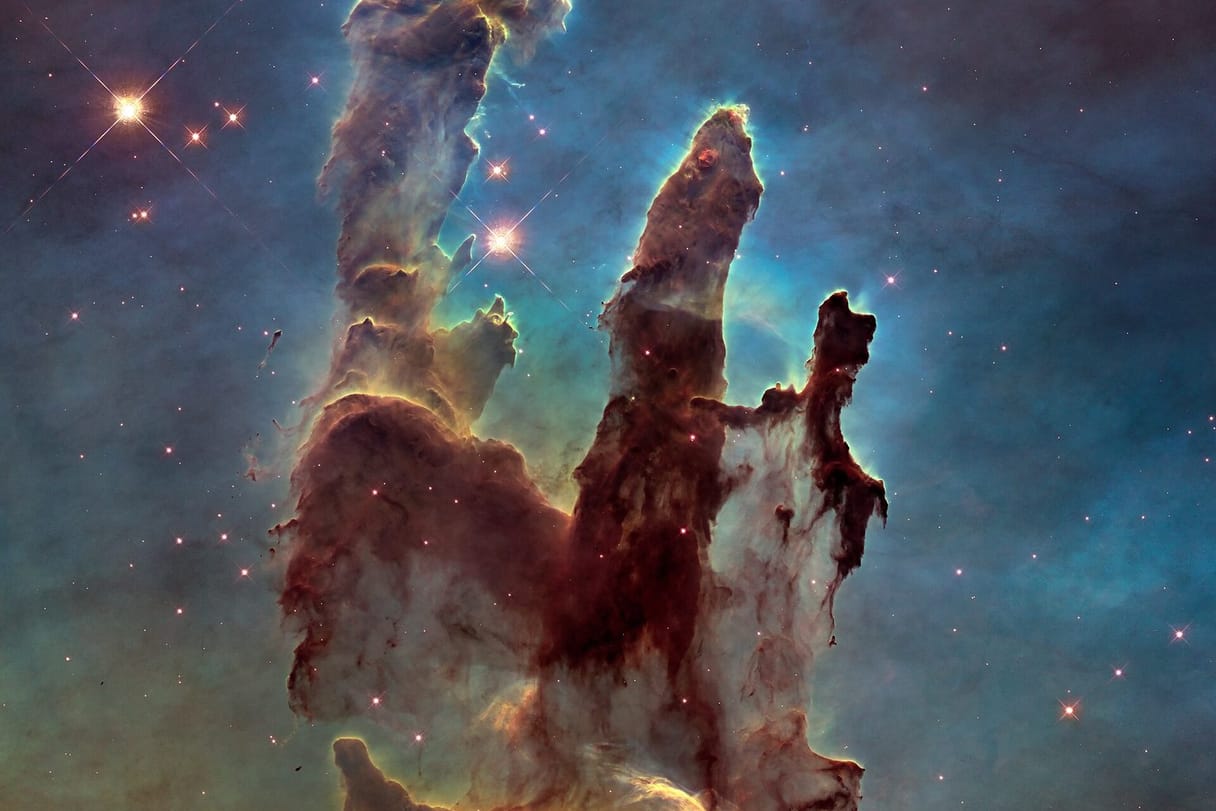
The more we learn about the age of the stars and the long history of life, the more the old psalm can mean. It asks the question every one of us can ask under a night sky, and it answers with God’s care: “When I consider your heavens, the work of your fingers, the moon and the stars, which you have ordained, what is man, that you think of him? What is the son of man, that you care for him?” (Psalm 8:3–4). The God who made a universe this vast also knows your name.
Common questions
Do Orthodox Christians believe in evolution?
The Orthodox churches have no single official statement on evolution, and Orthodox Christians hold a range of views. Theodosius Dobzhansky, one of the founders of modern evolutionary biology, was a lifelong Orthodox Christian who wrote in 1973 that he was both a creationist and an evolutionist, because evolution is the way God creates. Many Orthodox theologians see in evolution an echo of the Greek Fathers’ picture of a creation made to grow toward God.
Is the Big Bang compatible with Christianity?
Yes. The theory that the universe expanded from an extremely hot, dense beginning was first proposed in 1927 by Georges Lemaître, a Belgian physicist who was also a Catholic priest. The church confesses that God is the creator of “all that is, seen and unseen,” and that confession does not depend on any one scientific account of how the universe developed.
How old is the earth according to the Bible?
The Bible does not give the age of the earth. Some readers have added up the ages in the genealogies of Genesis to arrive at about six thousand years, though Genesis gives its genealogies to trace a family and a promise. Geologists date the earth to about 4.5 billion years, and the mainline churches, like most other churches, accept the findings of science on that question.
If God used evolution, did God create through death?
Evolution means that death and suffering existed long before human beings, which is a hard question for Christian faith. Paul wrote that “the whole creation has been groaning together” in labor pains (Romans 8:22), and he looked for the day when creation itself will be set free. Christians who accept evolution trust that God shares the suffering of creation in Christ and will heal it.
Sources
- Episcopal General Convention 2006, Resolution A129: Affirm Evolution and Science Education
- Genesis 1:1–31 (WEB)
- Psalm 104:24 (WEB)
- Romans 8:18–23 (WEB)
- Augustine, The Literal Meaning of Genesis 1.19.39 (World History Encyclopedia excerpt)
- Basil the Great, Hexaemeron, Homily 5 (New Advent)
- Irenaeus, Against Heresies, Book IV, chapter 38 (New Advent)
- General Assembly of the Presbyterian Church (USA), 2002 statement on evolution (NCSE)
- Nothing in Biology Makes Sense Except in the Light of Evolution (Wikipedia)
- Ask The UMC: What is the United Methodist position on evolution?
- Westminster Abbey: Charles Darwin
- Charles Kingsley (Wikipedia)
- Frederick Temple (Wikipedia)
- Aubrey Moore (Wikipedia)
- Acts 17:28 (WEB)