Life after death
Christians believe that death is real but does not have the last word. The church proclaims that those who die are held in God’s love and are “with Christ” (Philippians 1:23), and that at the end God will raise the dead and make all things new (1 Corinthians 15; Revelation 21). Orthodox and many mainline Christians pray for the dead and entrust them to God’s mercy. Scripture is confident about the hope and reserved about the details.
I am the resurrection and the life. Those who believe in me, even though they die, will live
John 11:25, NRSVUE

If you are asking what happens when you die, you may be grieving someone you love, keeping watch at a bedside, or lying awake with a fear of your own. The Christian answer begins with a promise: death is real, and it does not have the last word. The church proclaims that those who die are held in God’s love and are “with Christ” (Philippians 1:23), and that at the end God will raise the dead and make all things new. Every Easter night, Orthodox churches read aloud a sermon attributed to John Chrysostom, archbishop of Constantinople around 400 CE, which ends with a shout of victory over death: “Christ is risen, and not one dead remains in the grave.” Scripture is sure of that hope and modest about the details.
What does the Bible say happens when you die?
The Old Testament mostly pictures the dead going down to Sheol, the shadowy underworld where all the dead go. Psalm 6 describes Sheol as a place of silence: “In Sheol, who shall give you thanks?” (Psalm 6:5). Ecclesiastes says that at death “the dust returns to the earth as it was, and the spirit returns to God who gave it” (Ecclesiastes 12:7).
Hope for life beyond death grew slowly in Israel, as God’s people came to trust that God’s faithfulness reaches past the grave. The clearest promise of resurrection in the Hebrew Bible comes in the Book of Daniel, which scholars date to the 160s BCE:
Many of those who sleep in the dust of the earth shall awake, some to everlasting life and some to shame and everlasting contempt.
Daniel 12:2, NRSVUE
By the time of Jesus, the Pharisees believed in the resurrection and the Sadducees did not (Acts 23:8). Jesus taught the resurrection of the dead, and the first Christians proclaimed that God had raised Jesus himself as “the first fruit of those who are asleep” (1 Corinthians 15:20). (See Did Jesus really rise from the dead?)
Do you go to heaven right away when you die?
The New Testament speaks of being with Christ at death. Jesus said to the man crucified beside him:
He replied, “Truly I tell you, today you will be with me in paradise.”
Luke 23:43, NRSVUE
Paul, facing possible execution, wrote of “having the desire to depart and be with Christ, which is far better” (Philippians 1:23). Elsewhere he said he was “willing rather to be absent from the body and to be at home with the Lord” (2 Corinthians 5:8).
The same New Testament places the resurrection of the dead at the end, when Christ comes again (1 Thessalonians 4:13–14; 1 Corinthians 15:51–52). Christians hold the two promises together. Between death and the final resurrection, the dead are with Christ and at rest, and they still wait, with the whole creation, for the day when God makes all things new.
The church has never defined what that waiting is like. Eastern Orthodox Christians describe salvation as theosis, a Greek word for being healed and made one with God, and many Orthodox teachers hold that this growth does not stop at death. Gregory of Nyssa, a fourth-century bishop in what is now Turkey, taught that the soul goes on forever “from glory to glory” (2 Corinthians 3:18), always receiving more of God and always longing for more. Orthodox churches pray for the dead at every Divine Liturgy, though they never accepted the Western doctrine of purgatory; see Is purgatory in the Bible?
What is the resurrection of the body?
Both ancient creeds end with the resurrection. The Apostles’ Creed confesses “the resurrection of the body, and the life everlasting.” The Nicene Creed says, “We look for the resurrection of the dead, and the life of the world to come.”
The Christian hope differs from the Greek philosophical idea, found in Plato, that the soul is naturally immortal and is better off once it escapes the body. Christians believe that God made us as bodily creatures, loves us body and soul, and will raise the whole person. Christians have always spoken of the soul too, but the creeds rest their hope on God’s own act of raising the dead.
Paul expected the questions “How are the dead raised?” and “With what kind of body do they come?” (1 Corinthians 15:35). He answered by comparing a seed with the plant that grows from it:
So it is with the resurrection of the dead. What is sown is perishable; what is raised is imperishable. It is sown in dishonor; it is raised in glory. It is sown in weakness; it is raised in power. It is sown a physical body; it is raised a spiritual body.
1 Corinthians 15:42–44, NRSVUE
Paul’s seed is still part of Orthodox worship. At an Orthodox memorial service a dish of boiled wheat, called kolyva, is set out in front of the congregation, recalling Jesus’s words: “unless a grain of wheat falls into the earth and dies, it remains by itself alone. But if it dies, it bears much fruit” (John 12:24).
Christians hold this hope in more than one way. Some expect God to raise a transformed version of the body that was buried. Others read Paul’s “spiritual body” as a way of saying that everything that makes a person who they are, their history and their loves, will be kept and completed by God, without trying to picture it physically. Both confess with the creed that the dead are held by God and that God will give them life.
Will we be judged when we die?
The Letter to the Hebrews says that “it is appointed for men to die once, and after this, judgment” (Hebrews 9:27). The Nicene Creed names the judge: Christ “will come again in glory to judge the living and the dead.” If that thought frightens you, remember who the judge is. He is the same Jesus whose critics complained, “This man welcomes sinners, and eats with them” (Luke 15:2).
Judgment is also good news for the people the world has wronged. In the Book of Revelation the martyrs cry out, “How long, Master, the holy and true, until you judge and avenge our blood” (Revelation 6:10). Scripture’s pictures of judgment, including the fire and the outer darkness in Jesus’s parables, answer that cry, because cruelty matters to God and God does not forget it. Jesus aimed his sharpest warnings at people who harm “little ones” (Matthew 18:6) and ignore the hungry (Matthew 25:41–46).
Many Christians believe that some people will be punished forever, out of reverence for those warnings. Many mainline theologians, with a long line of teachers in the Christian East, read them as picture-language for judgment on wrongdoing, and they trust that the God who is love (1 John 4:8) judges in order to heal. Isaac the Syrian, a seventh-century bishop of Nineveh, taught that the pain of Gehenna is God’s love itself, felt as suffering by those who have turned against it, and he hoped that even that pain would end. Gregory of Nyssa hoped that God’s judgment would purify every soul, so that in the end God will be “all in all” (1 Corinthians 15:28). See Is hell real?
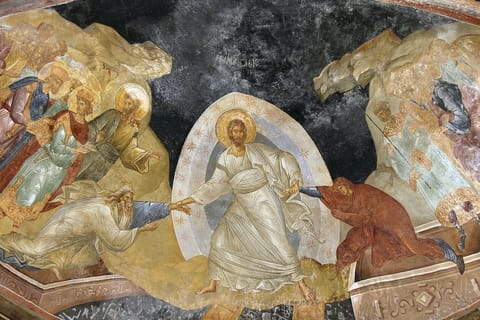
The Orthodox Easter icon, called the Anastasis (Greek for “resurrection”), paints the same hope. In it the risen Christ stands on the broken doors of the underworld and pulls Adam and Eve, the parents of the whole human race, out of their tombs. (See Did Jesus go to hell?) Paul’s confidence is the ground of Christian comfort:
For I am convinced that neither death, nor life, nor angels, nor rulers, nor things present, nor things to come, nor powers, nor height, nor depth, nor anything else in all creation will be able to separate us from the love of God in Christ Jesus our Lord.
Romans 8:38–39, NRSVUE
What do the mainline churches teach about death?
The mainline churches treat a funeral as a service of the resurrection. The United Methodist Church calls its funeral “A Service of Death and Resurrection,” and it opens, as the Episcopal funeral does, with Jesus’s promise that he is the resurrection and the life (John 11:25). The Presbyterian Church (U.S.A.) calls its funeral “a service of witness to the resurrection.” Funerals in the Evangelical Lutheran Church in America (ELCA) begin with a thanksgiving for the person’s baptism, in which, Paul says, Christians were buried with Christ so that they might rise with him (Romans 6:4).
The Eastern Orthodox churches hold memorial services on the third, ninth, and fortieth days after a death and on its anniversaries. A hymn at those services asks Christ to give the departed rest with the saints, where there is no sickness, sorrow, or sighing. The service ends with the chant “Memory eternal,” which the Orthodox Church in America explains as “the supplication that God would remember the dead.”
These churches confess the same creeds and the same hope of resurrection, and they differ mostly about whether and how to pray for the dead. For what Christians hope for at the end, see What is heaven like?
Is it wrong for a Christian to grieve?
No. Paul wrote to believers “so that you don’t grieve like the rest, who have no hope” (1 Thessalonians 4:13), which assumes that they will grieve. Augustine, who believed firmly in the resurrection, wept for his mother Monica after her death and wrote about those tears in his Confessions. Jesus himself wept at the grave of his friend Lazarus (John 11:35), though he had come to raise him. Your tears belong to your love, and Jesus shed them too.
If you are facing death, or keeping watch with someone who is, you can pray the psalm often read at funerals: “So teach us to count our days, that we may gain a heart of wisdom” (Psalm 90:12). You can also ask a priest or pastor to come and pray with you; no one has to face death alone.
Martin Luther gave Christians a prayer for the end of each day that echoes the last words of Jesus on the cross, “Father, into your hands I commit my spirit!” (Luke 23:46). It is a prayer for any night, including the last:
I thank Thee, my Heavenly Father, through Jesus Christ, Thy dear Son, that Thou hast graciously kept me this day, and I pray Thee to forgive me all my sins, where I have done wrong, and graciously keep me this night. For into Thy hands I commend myself, my body and soul, and all things. Let Thy holy angel be with me, that the Wicked Foe may have no power over me. Amen.
Martin Luther, Evening Prayer, from the Small Catechism (1529), trans. Triglot Concordia (1921)
Common questions
Do people become angels when they die?
No. In Scripture angels and human beings are different kinds of creatures. When Jesus says the risen dead “are like the angels” (Luke 20:36), he means that they cannot die anymore and do not marry. Christians hope to be raised as the human beings God made them to be, healed and made whole.
Will I see my loved ones again after death?
Christians hope so. Paul comforted grieving Christians with the promise that they would be caught up “together with them” to be with the Lord forever (1 Thessalonians 4:17). Scripture describes the life to come as a shared life: a great banquet, and a city full of people.
Can the dead see us or watch over us?
Scripture does not say that the dead watch our daily lives. The Letter to the Hebrews speaks of “so great a cloud of witnesses” around the church (Hebrews 12:1), and the Apostles’ Creed confesses “the communion of saints,” the one family of God’s people, living and dead, bound together in Christ. Orthodox Christians express that bond at memorial services, where they name the dead before God and sing “Memory eternal.”
Is it wrong for a Christian to be afraid of dying?
No. Fear of death is a human reaction, and Jesus himself prayed in anguish before his death. The church meets that fear with gentleness and with promises, above all Paul’s words that nothing, not even death, can separate us from the love of God in Christ Jesus. Talking with a priest or pastor, and praying the psalms, can help.
Sources
- Daniel 12:2 (WEB)
- Luke 23:39–43 (WEB)
- Philippians 1:21–23 (WEB)
- 1 Corinthians 15:35–44 (WEB)
- 1 Thessalonians 4:13–14 (WEB)
- Romans 8:38–39 (WEB)
- Hebrews 9:27 (WEB)
- 1 Timothy 2:3–4 (WEB)
- Revelation 6:9–10 (WEB)
- The Paschal Sermon of John Chrysostom (Orthodox Church in America)
- Orthodox Church in America, The Orthodox Faith: Funeral
- Sebastian Brock, “Isaac the Syrian on universal salvation and the mystery of Gehenna”
- United Methodist Book of Worship, A Service of Death and Resurrection
- Presbyterian Church (U.S.A.), The Funeral: A Service of Witness to the Resurrection (Reformed Worship)
- Augustine, Confessions, Book IX (New Advent)
.jpg)