Pets, animals, and heaven
The Bible does not say directly whether pets go to heaven, but it gives Christians grounds for hope. Psalm 36:6 says God saves “humans and animals alike,” and Paul writes that “the creation itself will be set free” (Romans 8:21). Christian teachers have disagreed: Thomas Aquinas thought animals would not be part of the new creation, while John Wesley and C. S. Lewis hoped they would be. Entrusting a beloved animal to God’s care is a faithful hope.
you save humans and animals alike, O Lord.
Psalm 36:6, NRSVUE
If you are grieving an animal you loved, your grief is real, and you can bring it to God. The Bible never answers the question “Do pets go to heaven?” in so many words. It does say a great deal about God’s care for animals and about God’s plan to heal the whole creation, and many Christians, including John Wesley and C. S. Lewis, have found in those passages a real hope that the animals people love are not lost forever.
Christians cannot promise more than Scripture promises. They can entrust the animals they love to the God of whom the psalmist says, “you save humans and animals alike, O Lord” (Psalm 36:6). The Hebrew verb in that verse, hoshia, is the Bible’s ordinary word for “save.”
What does the Bible say about animals?
The Bible treats animals as God’s own creatures, whose lives matter to God. In the Hebrew of Genesis, the same phrase, nephesh chayyah, describes the animals God creates (“living creatures,” Genesis 1:24) and the first human after God breathes into him (“a living soul,” Genesis 2:7).
After the flood, God makes a covenant with the animals as well as with people:
“As for me, I am establishing my covenant with you and your descendants after you and with every living creature that is with you, the birds, the domestic animals, and every animal of the earth with you, as many as came out of the ark.
Genesis 9:9–10, NRSVUE
The psalms praise God’s care for every creature: “The LORD is good to all. His tender mercies are over all his works” (Psalm 145:9). The Book of Jonah ends with God asking why he should not be concerned about the great city of Nineveh, with its people “and also many animals” (Jonah 4:11). Jesus said that five sparrows are sold for two small coins, yet “not one of them is forgotten by God” (Luke 12:6). If God remembers each sparrow, the animal you loved is not forgotten either.
Scripture also admits what human beings do not know. Ecclesiastes notes that humans and animals die alike and asks, “Who knows the spirit of man, whether it goes upward, and the spirit of the animal, whether it goes downward to the earth?” (Ecclesiastes 3:21).
Will animals be part of the new creation?
The strongest grounds for hope come from passages about the renewal of all creation. Paul writes that the whole creation is waiting for God’s redemption:
For the creation waits with eager longing for the revealing of the children of God, for the creation was subjected to futility, not of its own will, but by the will of the one who subjected it, in hope that the creation itself will be set free from its enslavement to decay and will obtain the freedom of the glory of the children of God.
Romans 8:19–21, NRSVUE
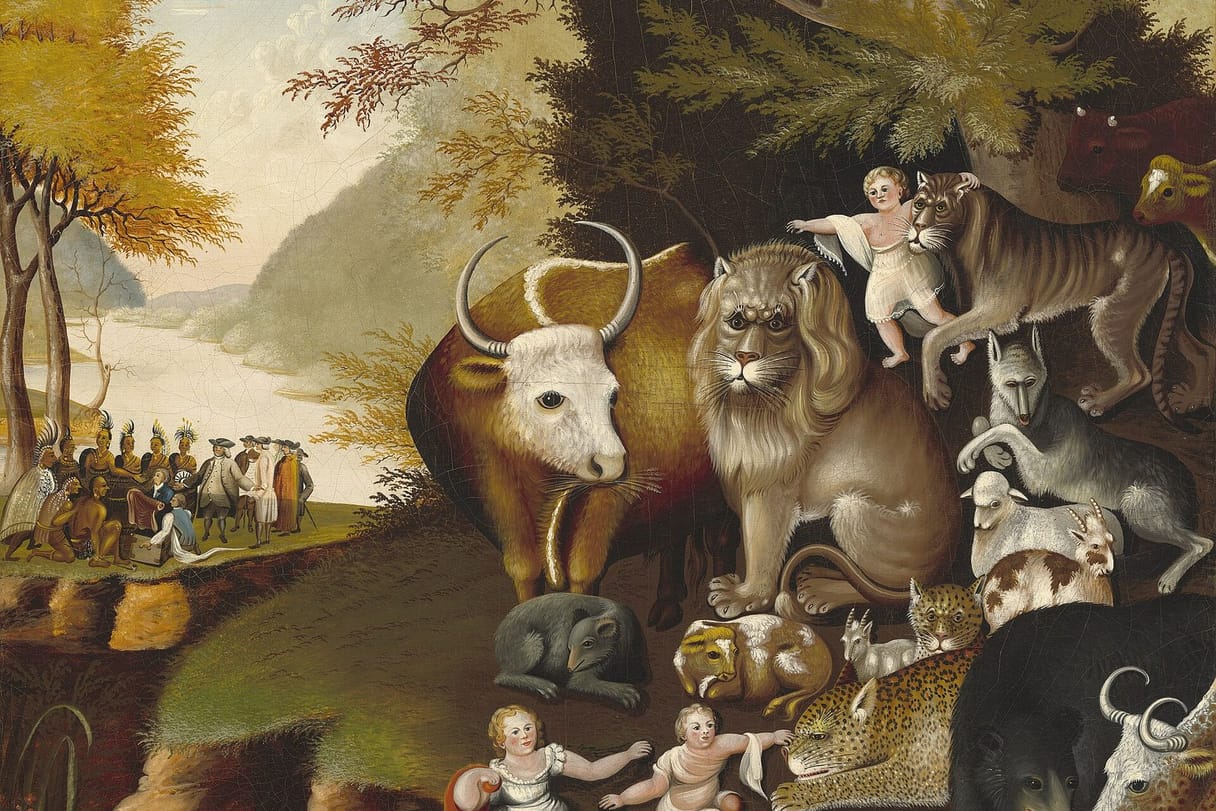
Isaiah’s vision of the peaceable kingdom includes animals:
The wolf shall live with the lamb; the leopard shall lie down with the kid; the calf and the lion will feed together, and a little child shall lead them.
Isaiah 11:6, NRSVUE
The passage ends, “They will not hurt nor destroy in all my holy mountain” (Isaiah 11:9). The Letter to the Colossians says that through Christ God was pleased “to reconcile all things to himself by him, whether things on the earth or things in the heavens” (Colossians 1:20). In Revelation, God says, “Behold, I am making all things new” (Revelation 21:5).
None of these verses mentions individual pets. Together they show that God’s salvation reaches beyond human beings to the whole created world. (See What is heaven like?)
What did Thomas Aquinas teach about animals and heaven?
Thomas Aquinas, the great thirteenth-century Dominican theologian, held that animals do not live on after death. Following Aristotle, he taught that an animal’s soul is the life of its body and cannot exist on its own: “as the souls of brute animals have no per se operations they are not subsistent” (Summa Theologiae I, question 75, article 3). On this view, an animal’s soul does nothing apart from its body, so it does not survive the body’s death.
A section of the Summa on the end of the world (Supplement, question 91, article 5) concludes that animals and plants “will not remain in this renewal.” Its reasoning is that the renewed world will be free of all decay, and that animals, unlike human souls, cannot be made incorruptible. Aquinas was one of the most influential theologians of the medieval Western church, and Christians who follow him on this point do so for careful reasons.
What did John Wesley and C. S. Lewis say?
John Wesley, the Anglican priest whose preaching gave rise to Methodism, read Romans 8 more broadly. In his sermon “The General Deliverance,” he preached that at the end “the whole brute creation will then, undoubtedly, be restored.”
C. S. Lewis took up the question in chapter 9 of The Problem of Pain, “Animal Pain.” He thought that animals without any sense of self could hardly be said to live on. Tame animals that have something like a personality were different, because they receive that personality through their relationship with people. Lewis suggested, “with great readiness to be set right by real theologians,” that “certain animals may have an immortality, not in themselves, but in the immortality of their masters.” He wrote, “the man will know his dog: the dog will know its master and, in knowing him, will be itself.”
Lewis admitted that “the complete silence of Scripture and Christian tradition on animal immortality” was a serious objection. He did not think it was fatal, since the Bible was not written to answer every question.
What do the churches teach about animals in heaven?
No major church has made an official ruling on whether pets go to heaven. The Christian East has thought deeply, though, about God’s love for the whole creation. Isaac the Syrian, a seventh-century monk and bishop whose writings are treasured in the Orthodox churches, described a merciful heart as one that burns with love for all creation, for people, birds, and animals, and even for demons, and that prays for them with tears. Orthodox theology, following Maximus the Confessor, also gives human beings a priestly place in the world: they are meant to gather up the whole creation and offer it back to God. Neither teacher answered the question about pets, but both give Christians room to hope that the creatures they love are held in God’s memory.
Christians therefore hold a range of views. Some, following Aquinas, believe animals will not be raised. Others, following Wesley and Lewis, hope that God will restore the animals they have loved. Many Christians find that the second hope fits the God who saves “humans and animals alike” and who is making all things new, while admitting that Scripture does not give a direct promise.
How can a Christian grieve a pet?
You can grieve without embarrassment. The love between you and your animal was one of God’s good gifts, and losing it hurts. Many people find that a pet’s death is the first great loss they have known, or that it reopens older griefs, and both are reasons to be gentle with yourself. You can thank God for the animal’s life, tell God the truth about your sorrow, and entrust the one you loved to the God whose “tender mercies are over all his works.”
If the loss raises harder questions about why animals suffer at all, see Why does God allow suffering? For the Christian hope for people who die, see What happens when you die?
The same God who made the animal you loved also gave you the love you felt for it, and both are held in God’s care. In Isaac the Syrian’s picture of the merciful heart, grief for a creature is a small share in the mercy of God, who holds every living thing.
Common questions
Do animals have souls?
It depends on what you mean by soul. The Hebrew Bible uses the same phrase, nephesh chayyah (“living creature” or “living soul”), for animals in Genesis 1:24 and for the first human in Genesis 2:7. Thomas Aquinas taught that animals have souls in the sense of a principle of life, but that an animal’s soul cannot exist apart from its body. Scripture does not settle the question.
Is it okay to grieve the death of a pet?
Yes. Grief is the cost of love, and the love between people and their animals is a good gift from God. Jesus said that not one sparrow “is forgotten by God” (Luke 12:6). You can bring your grief to God in prayer as openly as any other sorrow.
Is it wrong to pray for my pet?
Christians may bring every concern to God, and the psalms praise God for caring for animals. Thanking God for an animal’s life and entrusting it to God’s care is a fitting prayer. It makes no claim to know more than Scripture says.
Does the Bible say the lion will lie down with the lamb?
Not in those exact words. Isaiah 11:6 says that “the wolf shall live with the lamb” and “the leopard shall lie down with the kid,” and that “the calf and the lion will feed together.” The passage pictures a healed creation in which animals no longer harm one another.
Sources
- Psalm 36:6 (WEB)
- Romans 8:19–23 (WEB)
- Isaiah 11:6–9 (WEB)
- Genesis 9:9–10 (WEB)
- Ecclesiastes 3:19–21 (WEB)
- Thomas Aquinas, Summa Theologiae I, q. 75, a. 3 (New Advent)
- Thomas Aquinas, Summa Theologiae, Supplement, q. 91, a. 5 (New Advent)
- John Wesley, Sermon 60, “The General Deliverance” (Wesley Corpus)
- C. S. Lewis, The Problem of Pain, ch. 9, “Animal Pain” (Internet Archive)
- Colossians 1:19–20 (WEB)