Cremation and Christian burial
Cremation is not a sin. The Bible never forbids it, and the hope of resurrection does not depend on keeping a body intact: God raises the dead whether they were buried, lost at sea, or burned. Early Christians preferred burial, following Jewish custom and the burial of Jesus. The mainline Protestant churches now accept cremation fully, while the Orthodox churches keep burial as the ancient practice.
What is sown is perishable; what is raised is imperishable.
1 Corinthians 15:42, NRSVUE
Christians are free to choose cremation, and the mainline Protestant churches commend the cremated to God with the same prayers and the same hope of resurrection as the buried. You may be planning a funeral, thinking about your own death, or grieving someone whose body has already been cremated. Whichever brought you here, the one you are thinking of rests in the love of God. Christians buried their dead for most of the church’s history, and some churches still keep that custom. The mainline Protestant churches accept cremation fully, while the Orthodox churches keep burial as the ancient Christian practice, and both do so out of reverence for the body God made.
Does the Bible say anything about cremation?
The Bible never commands burial and never forbids burning the dead. The clearest story of a cremation in Scripture is told with honor. When the Philistines killed King Saul and his sons and hung their bodies on the wall of Beth-shan, the men of Jabesh-gilead rescued them:
all the valiant men set out, traveled all night long, and took the body of Saul and the bodies of his sons from the wall of Beth-shan. They came to Jabesh and burned them there. Then they took their bones and buried them under the tamarisk tree in Jabesh and fasted seven days.
1 Samuel 31:12–13, NRSVUE
David later sent the people of Jabesh-gilead a blessing: “Blessed are you by the LORD, that you have shown this kindness to your lord, even to Saul, and have buried him” (2 Samuel 2:5). Scripture treats their act as faithful love.
Some Christians point to passages where burning is a punishment or an outrage. Achan and his family were stoned and burned after the fall of Jericho (Joshua 7:25), and the prophet Amos condemned Moab because “he burned the bones of the king of Edom into lime” (Amos 2:1). In both passages the wrong is the punishment or the desecration of an enemy’s body. Neither passage speaks to a family who chooses cremation, in love, for someone they have lost.
The Bible’s deepest word about the body after death applies to every kind of death: “you are dust, and you shall return to dust” (Genesis 3:19). Burial returns a body to dust slowly; cremation does so quickly.
Why did early Christians bury their dead?
The first Christians were Jews or followers of Jewish practice, and Jewish custom was burial, as with Abraham’s burial of Sarah in the cave of Machpelah (Genesis 23:19). Jesus himself was buried: Joseph of Arimathea and Nicodemus wrapped his body in linen with spices, “as the custom of the Jews is to bury” (John 19:40). Paul’s summary of the gospel includes “that he was buried, that he was raised on the third day” (1 Corinthians 15:4). Christians who were laid in the earth were following their Lord into the tomb in hope of following him out of it.
Burial also set Christians apart in the Roman world, where many people burned their dead. The Christian writer Minucius Felix, in his Latin dialogue Octavius from the late second or early third century, explained the Christian view. A body that is turned to dust, water, ashes, or smoke, he wrote, is “reserved for God in the custody of the elements,” and Christians do not fear any loss from the way a body is laid to rest, though they keep “the ancient and better custom of burying in the earth” (Octavius 34). Even in the early church, then, burial was the better custom, and cremation did not put a body beyond God’s reach.
Can God raise a body that has been cremated?
Yes. Christians faced that question under persecution. In 177 CE, during the persecution of the church at Lyons in Gaul, the authorities burned the bodies of the martyrs and swept the ashes into the Rhône River. According to the letter of the churches of Lyons and Vienne, preserved by the historian Eusebius, the persecutors mocked them: “Now let us see if they will rise again” (Church History 5.1.63). The church never doubted that the martyrs would rise.
Augustine, writing in the early fifth century, made the same point about Christians killed in the sack of Rome who could not be buried. He reminded his readers of Jesus’ promise that “not a hair of their head shall perish,” and concluded that even if the dead were devoured by beasts, “their blessed resurrection will not hereby be hindered” (City of God 1.12). Funerals and tombs, he wrote, are “rather the solace of the living than the comfort of the dead.”
Paul describes the resurrection body as God’s gift, as different from the body that was buried as a plant is from its seed: “God gives it a body even as it pleased him, and to each seed a body of its own” (1 Corinthians 15:38). He goes on:
What is sown is perishable; what is raised is imperishable. It is sown in dishonor; it is raised in glory. It is sown in weakness; it is raised in power. It is sown a physical body; it is raised a spiritual body.
1 Corinthians 15:42–44, NRSVUE
The Book of Revelation pictures the sea giving up its dead at the end of time (Revelation 20:13). Christians understand the resurrection in different ways: some as a literal remaking of the body, others as a new and spiritual life beyond anything we can picture. Either way, the hope rests on God’s power and faithfulness, and no fire or sea can defeat that power. No created thing, Paul wrote, “will be able to separate us from God’s love which is in Christ Jesus our Lord” (Romans 8:38–39).
Why do the Orthodox churches keep burial?
The Eastern Orthodox churches do not permit cremation for their members and keep burial as the ancient Christian practice. Their reasons come from the center of Orthodox faith. In Orthodox teaching the body belongs to the whole person whom God made and will raise, and Paul called it “a temple of the Holy Spirit” (1 Corinthians 6:19). Christians who are buried follow Christ, who was himself laid in a tomb (John 19:41–42). On Good Friday, Orthodox congregations carry the epitaphios, an embroidered icon of Christ’s body laid out for burial, in procession around the church, and at an Orthodox funeral the mourners come forward to give the one who has died a last kiss.
The Orthodox position deserves respect as faithfulness to the church’s oldest custom. Orthodox teachers do not claim that God cannot raise the cremated; the Orthodox churches, like all Christians, honor martyrs whose bodies were burned.
What do the mainline churches teach?
The ELCA, the Presbyterian Church (U.S.A.), the United Methodist Church, and the Episcopal Church accept cremation without hesitation, and Protestant churches in Europe and North America began accepting it in the late nineteenth and early twentieth centuries. Their funeral services provide for the burial of ashes as well as bodies, and they commit both to God with the same prayers.
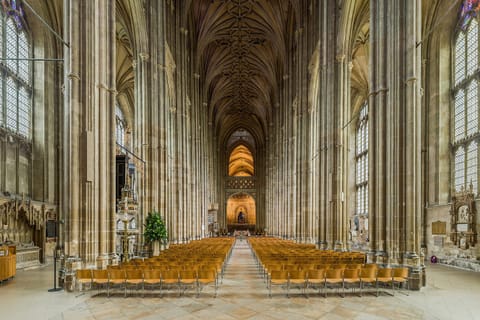
Many mainline congregations have a columbarium, a structure with niches for the ashes of the dead, often built into a church wall, chapel, or garden, so that members are laid to rest where they worshiped. In the Church of England, William Temple, who died in 1944, was the first Archbishop of Canterbury to be cremated, and his ashes were buried in the cloister of Canterbury Cathedral.
How should Christians care for ashes?
Whatever you choose, treat the remains of the dead with the reverence owed to a body that was, as Paul said, “a temple of the Holy Spirit” (1 Corinthians 6:19). Many priests and pastors encourage families to give ashes a lasting place: a grave, a churchyard, or a columbarium niche with the person’s name on it. A named resting place lets children and grandchildren visit, pray, and remember. If you are planning a funeral, talk with your parish priest or pastor, who can explain your church’s customs and help you choose.
Grief belongs to love, and Christians grieve with hope. Paul wrote so that Christians “don’t grieve like the rest, who have no hope,” because “God will bring with him those who have fallen asleep in Jesus” (1 Thessalonians 4:13–14). For more on that hope, see What happens when you die? and What is heaven like?
Whatever was done with the body of someone you love, that person is safe in God’s keeping. Jesus said that not one sparrow falls to the ground apart from the Father, and that “the very hairs of your head are all numbered” (Matthew 10:30). The love that knew them in life holds them still, and the church entrusts all its dead, buried or cremated, to that love in the hope of the resurrection.
Common questions
Can you go to heaven if you are cremated?
Yes. Salvation rests on God’s love and grace, which hold every one of the dead, however their bodies were laid to rest. Augustine wrote in the fifth century that even Christians whose bodies were never buried, or were devoured by beasts, would not be kept from their resurrection.
Do Lutherans, Presbyterians, and Methodists allow cremation?
Yes. The ELCA, the Presbyterian Church (U.S.A.), the United Methodist Church, and the Episcopal Church all permit cremation, and their funeral services provide for the burial of ashes as well as bodies. Many of their congregations have a columbarium, a wall or garden with niches for ashes.
Is it a sin to scatter ashes?
Scripture leaves the choice to the family’s wisdom, and some burial services provide for committing the dead to the sea or the elements as well as to the ground. Many pastors still encourage families to give ashes a lasting resting place, so that the dead have a place where they can be remembered and prayed for.
Is it wrong to keep ashes at home?
Scripture says nothing about it, so it is a question of pastoral wisdom. Many pastors and priests encourage families to inter ashes in a cemetery, churchyard, or columbarium so that the person has a lasting place of rest and the family and later generations have a place to visit.
Why do Orthodox Christians not allow cremation?
The Eastern Orthodox churches hold to burial as the ancient Christian practice and do not permit cremation for their members. Burial follows the example of Jesus’ own burial and expresses reverence for the body and hope in the resurrection. Other churches respect that discipline while permitting cremation themselves.
Sources
- 1 Samuel 31:11–13 (WEB)
- 2 Samuel 2:4–5 (WEB)
- 1 Corinthians 15:35–44 (WEB)
- Revelation 20:13 (WEB)
- Minucius Felix, Octavius, chapter 34 (New Advent)
- Eusebius, Church History 5.1 (New Advent)
- Augustine, City of God 1.12 (New Advent)
- The Book of Common Prayer (1979), The Burial of the Dead: Rite Two
- 1 Corinthians 6:19–20 (WEB)
- John 19:38–42 (WEB)
- William Temple (Wikipedia)
- Matthew 10:29–30 (WEB)
- Cremation in Christianity (Wikipedia)