Christ’s descent to the dead
The Apostles’ Creed says that after Jesus died and was buried, “He descended to the dead.” The older wording, “He descended into hell,” uses hell in its old sense of the place of all the dead, good and bad alike. Orthodox Christians celebrate the descent in their Easter icon, where the risen Christ pulls Adam and Eve from their tombs. Christians draw this teaching from 1 Peter 3:18–20 and 4:6, which say the gospel was preached even to the dead.
For to this end the Good News was preached even to the dead, that they might be judged indeed as men in the flesh, but live as to God in the spirit.
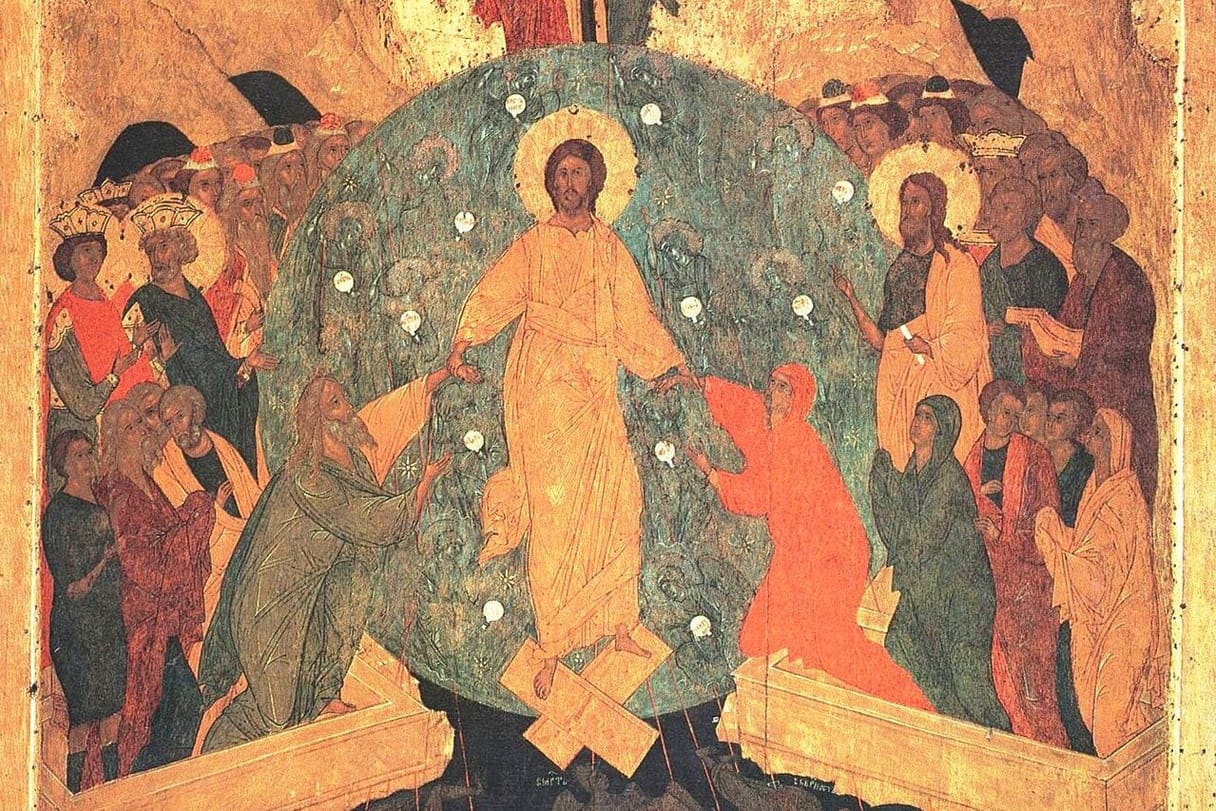
In the modern wording used in many mainline churches, the Apostles’ Creed confesses that Jesus “was crucified, died, and was buried. He descended to the dead. On the third day he rose again.” The United Methodist Hymnal of 1989, for example, prints “He descended to the dead” in its creed, and the Orthodox churches celebrate the same event every Easter. In the church’s teaching, Christ goes to the dead as their rescuer, the one who comes to set them free.
People often come to this line of the creed with a worry. Some fear that Jesus suffered the torments of hell after he died; others are thinking of someone they love who has died, and wonder whether God’s love can reach so far. The church’s ancient answer is a word of hope: when Jesus died, he went where all the dead go, and he carried the light of God with him.
What does “he descended into hell” mean?
The older English text of the creed, still used in many churches, says, “He descended into hell.” In older English, hell could mean the hidden place of all the dead, good and bad alike. The Hebrew Bible calls the place of the dead Sheol, and the Greek New Testament calls it Hades. Modern English uses hell almost only for the place of punishment, so most mainline churches now say “He descended to the dead.”
Christians drew the teaching from Scripture before it entered the creed. In his sermon at Pentecost, Peter quotes Psalm 16 and says that David “spoke about the resurrection of the Christ, that his soul wasn’t left in Hades” (Acts 2:31). Jesus compared his coming death to Jonah’s three days in the fish: “so will the Son of Man be three days and three nights in the heart of the earth” (Matthew 12:40).
The phrase came into the creed late. Around 400 CE, Rufinus of Aquileia wrote that the clause “is not added in the Creed of the Roman Church, neither is it in that of the Oriental Churches,” though he found it in the creed of his own church at Aquileia in northern Italy. Rufinus thought the line added little to the word “buried.” For him it meant that Jesus truly died and went where the dead go. The Church of England kept the teaching in Article III of its Thirty-Nine Articles: “As Christ died for us, and was buried; so also it is to be believed, that he went down into Hell.”
Even in this simplest sense, the line is a comfort: no one who dies goes anywhere Christ has not already been.
What does the Bible say about Christ’s descent to the dead?
The main passage is in the First Letter of Peter:
Because Christ also suffered for sins once, the righteous for the unrighteous, that he might bring you to God, being put to death in the flesh, but made alive in the Spirit, in whom he also went and preached to the spirits in prison, who before were disobedient when God waited patiently in the days of Noah while the ship was being built.
Scholars disagree about who the “spirits in prison” were. Many modern commentators think they were the rebellious angels of Genesis 6, and that Christ announced his victory to them. Others, following many early Christian writers, read them as the human dead, beginning with the people of Noah’s generation. A few verses later, the same letter speaks directly about the human dead:
For to this end the Good News was preached even to the dead, that they might be judged indeed as men in the flesh, but live as to God in the spirit.
The Letter to the Ephesians says that Christ “first descended into the lower parts of the earth” (Ephesians 4:9–10), a phrase some interpreters read as the realm of the dead and others as the earth itself, where Christ came down at his birth. In the Book of Revelation, the risen Christ tells John not to be afraid and then says, “I was dead, and behold, I am alive forever and ever. Amen. I have the keys of Death and of Hades” (Revelation 1:18).
What did the early church teach?
Early Christian writers read these passages as good news for the dead. Irenaeus of Lyons, writing around 180 CE, taught that “the Lord descended into the regions beneath the earth, preaching His advent there also,” and declaring forgiveness of sins to those who believed in him (Against Heresies 4.27.2). An ancient Greek sermon for Holy Saturday, often attributed to Epiphanius of Salamis, imagines the scene: “He has gone to search for Adam, our first father, as for a lost sheep.”
Medieval English Christians called the event the Harrowing of Hell, from an old verb meaning to raid or plunder.
What is the Anastasis icon?
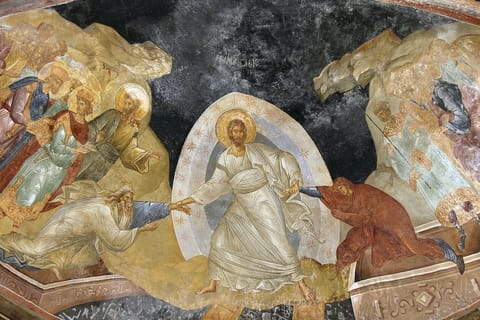
In the Eastern Orthodox churches, the Easter icon is called the Anastasis, the Greek word for “resurrection.” It shows the risen Christ at work among the dead. He stands in shining white on the broken doors of Hades, with locks, keys, and bolts scattered in the darkness below. He grasps Adam and Eve by their wrists and pulls them out of their tombs, while kings and prophets of Israel wait to follow. The best-known example, painted around 1320, is the fresco in the Chora Church in Istanbul.
Orthodox Christians sing the same faith again and again in the Easter season: “Christ is risen from the dead, trampling down death by death, and upon those in the tombs bestowing life!” On Easter night, Orthodox churches also read the Paschal sermon attributed to St. John Chrysostom, which proclaims, in the Orthodox Church in America’s translation: “O Hell, where is your victory? Christ is risen, and you are overthrown.” The icon, the hymn, and the sermon all teach that Easter begins among the dead, and that hell is a prison whose doors Christ has broken.
What happens on Holy Saturday?
Holy Saturday, the day between Good Friday and Easter, is the day the church remembers Christ among the dead. In the Revised Common Lectionary, the shared table of Bible readings used by the ELCA, the PC(USA), the United Methodist Church, and the Episcopal Church, the epistle for Holy Saturday is 1 Peter 4:1–8, which includes the verse about the gospel preached to the dead.
In Orthodox churches, the service of Holy Saturday morning, usually sung on Friday evening, gathers around the epitaphios, an embroidered icon of Christ’s body laid in the tomb, and the people sing lamentations over it. The ancient Holy Saturday sermon attributed to Epiphanius begins: “Today a great silence reigns on earth, a great silence and a great stillness.” The church’s long wait ends at the Easter Vigil; see Did Jesus really rise from the dead?
What does the descent say about God’s reach to the dead?
The descent to the dead means that God is present even in death. The Psalms said so long before:
Where could I go from your Spirit? Or where could I flee from your presence? If I ascend up into heaven, you are there. If I make my bed in Sheol, behold, you are there!
Some early writers spoke mainly of Christ freeing the righteous of Israel who had waited for him; others read the descent as good news for all the dead, since 1 Peter says the gospel was preached to people who had been disobedient in Noah’s day. Paul writes that every knee will bow at the name of Jesus, “of those in heaven, those on earth, and those under the earth” (Philippians 2:10).
The descent to the dead has given many Christians hope for people who died without hearing the gospel. A long line of teachers, from Gregory of Nyssa and Isaac the Syrian to Kallistos Ware, has hoped that God’s mercy will reach every one of the dead, and many Christians read hell itself as the Bible’s picture-language for judgment on wrongdoing. Christians who believe that some may finally refuse God still confess with the whole church that Christ holds “the keys of Death and of Hades.” See Is hell real?, Do non-Christians go to hell?, and What happens when you die? For the creed in which the phrase appears, see The Apostles’ Creed.
If you are grieving someone, or if you have known a darkness so deep that God seemed far away, this line of the creed is for you. Christ has already gone down into the lowest place, and he went there to bring people home. Every Holy Saturday the church waits beside his tomb, trusting that Easter morning is coming for the living and for the dead.
Common questions
Where was Jesus between his death and resurrection?
The creeds teach that Jesus was among the dead between Good Friday and Easter morning, because he truly died. In Acts 2:31 Peter preaches that Christ’s soul “wasn’t left in Hades,” the Greek name for the realm of the dead. Christians call that day Holy Saturday and keep it as a day of waiting and prayer.
Did Jesus suffer in hell for our sins?
Most churches do not teach that Jesus suffered the torments of the damned after his death. The New Testament places his suffering on the cross, and his last word in John’s Gospel is “It is finished” (John 19:30). The descent to the dead is pictured in Scripture and in ancient art as a victory: Christ comes to the dead as the one who holds “the keys of Death and of Hades” (Revelation 1:18).
Why do some churches say “descended to the dead” instead of “descended into hell”?
In modern English, hell usually means the place of punishment, while the creed meant the realm of all the dead, which the Bible calls Sheol in Hebrew and Hades in Greek. Modern ecumenical English texts of the Apostles’ Creed, used in many mainline churches, say “He descended to the dead,” which states the original meaning more clearly. Some churches and services keep the traditional wording.
What is the Harrowing of Hell?
The Harrowing of Hell is the medieval English name for Christ’s descent to the dead, from an old verb meaning to raid or plunder. Medieval plays and paintings showed Christ breaking down the gates of the underworld and leading Adam, Eve, and the righteous of Israel out into light. Eastern Orthodox churches show the same scene in their Easter icon, called the Anastasis.
Sources
- Book of Common Prayer (1979), Morning Prayer: Rite Two (the Apostles’ Creed)
- The Thirty-Nine Articles of Religion (1571), Article III
- Rufinus, Commentary on the Apostles’ Creed 18 (New Advent)
- Irenaeus, Against Heresies 4.27.2 (New Advent)
- John Chrysostom, The Paschal Sermon (Orthodox Church in America)
- Orthodox Church in America, Selected Liturgical Hymns: the Paschal Troparion
- Did Jesus descend into hell or to the dead? (UM News)
- 1 Peter 3:18–20 (WEB)
- 1 Peter 4:6 (WEB)
- Ephesians 4:9–10 (WEB)
- Psalm 139:7–8 (WEB)


.jpg)