Methodists, Lutherans, Presbyterians, Baptists, and Episcopalians
Methodists, Lutherans, Presbyterians, Baptists, and Episcopalians are all Protestant Christians who worship the Trinity and trust that God saves people by grace through faith in Jesus Christ. They differ in how the church is governed (by bishops, elders, or each congregation), in whether infants are baptized, in how Christ is present in Communion, and in their founders: Martin Luther, John Calvin, the Church of England, the early English Baptists, and John Wesley.
There is one body and one Spirit, even as you also were called in one hope of your calling, one Lord, one faith, one baptism, one God and Father of all, who is over all and through all and in us all.
Perhaps you have moved to a new town, or married into another church, or driven past a Methodist, a Lutheran, a Presbyterian, a Baptist, and an Episcopal church on the same street and wondered what sets them apart. All five are Protestant churches that worship one God, Father, Son, and Holy Spirit, and trust that God saves people by grace through faith in Jesus Christ. They differ in how they govern the church, in whom they baptize, and in how they understand Christ’s presence at the Lord’s Table. They are one family, and each has kept a particular gift for the whole church.
What do these churches have in common?
All five receive the Bible as the Word of God and the highest authority for faith, and all teach, with the Reformers of the sixteenth century, that salvation is God’s free gift in Christ, received by faith. All celebrate baptism and the Lord’s Supper. The Lutheran, Presbyterian, Methodist, and Episcopal churches confess the Apostles’ and Nicene Creeds, and American Baptists, whose congregations state their own doctrine, hold the same faith in the Trinity and in Christ.
When Christians in Corinth began saying “I follow Paul” and “I follow Apollos,” Paul answered, “Is Christ divided? Was Paul crucified for you?” (1 Corinthians 1:12–13). Martin Luther made a similar plea in 1522, asking his followers to “call themselves Christians, not Lutherans.”
Where did each church come from?
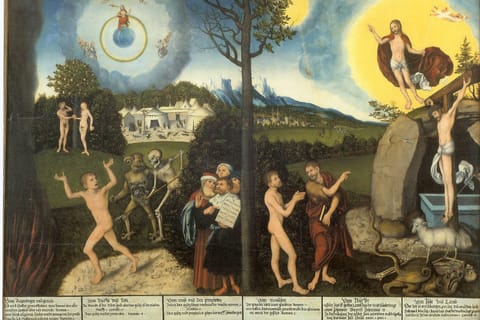
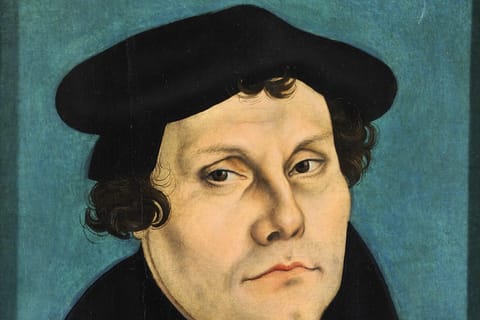
- Lutherans follow Martin Luther, the German monk and professor whose Ninety-Five Theses of 1517 began the Reformation. Their founding statement of faith is the Augsburg Confession of 1530. See what do Lutherans believe?
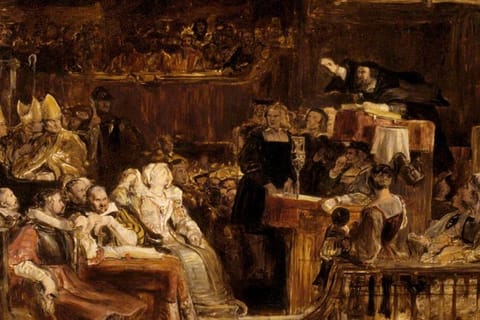
- Presbyterians belong to the Reformed tradition of John Calvin in Geneva, which John Knox carried home to Scotland in 1559. See what do Presbyterians believe?
- Episcopalians belong to the Anglican Communion, the worldwide family of churches descended from the Church of England, whose first Book of Common Prayer appeared in 1549. See what do Episcopalians believe?
- Baptists began among English Separatists, Puritans who had left the Church of England. In 1609 the exiled pastor John Smyth baptized himself and his congregation in Amsterdam on their profession of faith, and in 1612 Thomas Helwys founded the first Baptist church in England. Roger Williams founded the first Baptist church in America, at Providence, in 1638.
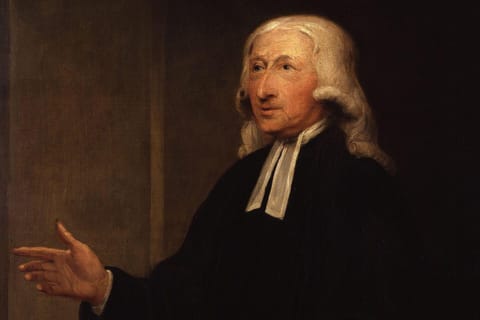
- Methodists follow John Wesley, a priest of the Church of England who felt his heart “strangely warmed” in 1738. American Methodists organized as a church in Baltimore in 1784. See what do Methodists believe?
How are the churches governed?
Two of the five names describe church government. Episcopal comes from the Greek episkopos, “overseer” or “bishop,” and Presbyterian from presbyteros, “elder.” Both words appear in the New Testament: Paul greets the church at Philippi “with the overseers and servants” (Philippians 1:1), and Paul and Barnabas “appointed elders for them in every assembly” (Acts 14:23).
Episcopalians are led by bishops, whom they understand as successors of the apostles. The ELCA and the United Methodist Church also have bishops, and in the United Methodist Church “clergy appointments are made annually by the bishop.” Presbyterian congregations are governed by a session of elders elected by the members, within regional presbyteries and a national General Assembly. Baptists hold that each congregation governs itself; American Baptists speak of “autonomous congregations, responsible for articulating their own doctrine, style of worship and mission.” Each church finds its pattern in Scripture. Bishops bind the church together across generations, elders seek God’s will by deciding together in prayer, and Baptist congregations protect the freedom of every believer to answer God.
Who is baptized, and how?
The Lutheran, Presbyterian, Methodist, and Episcopal churches baptize infants as well as adults. They see baptism as God’s gift, given before a person can ask for it, and they point to Peter’s words at Pentecost: “the promise is to you and to your children” (Acts 2:39).
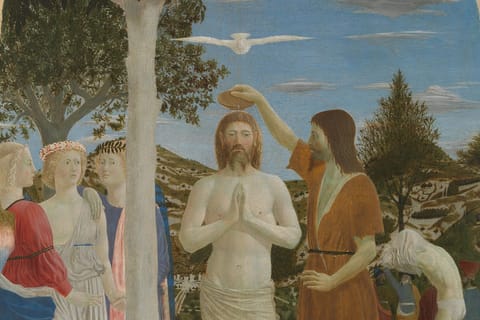
Baptists practice believers’ baptism. American Baptists describe it as “an act of full immersion following Christ’s example,” given to those mature enough to understand its meaning. In the plunge beneath the water they see the picture Paul gave:
We were buried therefore with him through baptism into death, that just as Christ was raised from the dead through the glory of the Father, so we also might walk in newness of life.
The two practices honor the same Lord. Infant baptism proclaims that God’s grace reaches a person first, and believers’ baptism proclaims that each person answers that grace with faith of their own. For how the mainline churches receive one another’s baptisms, see the mainline churches on baptism.
What do they believe about Communion?
All five churches gather at the Lord’s Table because Christ commanded it, and all of them hear Paul’s words about the meal:
The cup of blessing which we bless, isn’t it a sharing of the blood of Christ? The bread which we break, isn’t it a sharing of the body of Christ? Because there is one loaf of bread, we, who are many, are one body; for we all partake of the one loaf of bread.
Lutherans confess in the Augsburg Confession that the body and blood of Christ are “truly present” in the Supper. Presbyterians follow Calvin in teaching that Christ is present by the Holy Spirit, who feeds believers with Christ himself as they receive in faith. Episcopalians receive the bread and wine as the Body and Blood of Christ and leave the manner of his presence a mystery. United Methodists also teach that Christ is truly present. Baptists call the Supper an ordinance, an act Christ commanded, in which the bread and cup “symbolize the broken body and shed blood offered by Christ.”
Sunday worship differs among the five churches too. Episcopal and Lutheran services follow a written liturgy, and Presbyterian worship centers on preaching Scripture. Methodist services range from formal liturgy to simple gatherings for hymns and preaching, and Baptist worship centers on the sermon and congregational singing.
Where do the mainline churches stand today?
Each of these families includes mainline churches and more conservative ones. The mainline members are the Evangelical Lutheran Church in America (ELCA), the Presbyterian Church (U.S.A.), the United Methodist Church, the Episcopal Church, and American Baptist Churches USA. The first four ordain women and gay and lesbian clergy and permit their clergy to marry same-sex couples. American Baptist congregations have ordained women since the 1880s, and on questions of sexuality they differ from one another.
These churches have drawn closer together. The ELCA entered full communion, sharing sacraments and clergy, with the PC(USA) in 1997, the Episcopal Church in 2001, and the United Methodist Church in 2009. The United Methodist Church approved full communion with the Episcopal Church in 2024, and the Episcopal Church’s General Convention is expected to take up the proposal in 2027.
The more conservative churches in these families include the Lutheran Church–Missouri Synod, the Presbyterian Church in America, the Global Methodist Church, the Anglican Church in North America, and the Southern Baptist Convention, the largest Protestant denomination in the United States. Their members hold their convictions out of reverence for Scripture as they read it. For more on the mainline family, see what is mainline Protestantism?
How do I find the right church for me?
The best way to learn the difference between these churches is to worship with them. Visit a congregation for several Sundays, notice how the people pray and care for their neighbors, and bring your questions to the pastor. Paul wrote that “there are various kinds of gifts, but the same Spirit” (1 Corinthians 12:4). Lutherans have guarded the gift of grace, Presbyterians the sovereignty of God, Episcopalians the beauty of common prayer, Baptists the freedom of conscience, and Methodists the hope of holiness.
John Wesley preached a sermon called “Catholic Spirit,” using catholic in its old sense of “universal,” and in it he asked, “Though we cannot think alike, may we not love alike?” Whichever door you walk through on Sunday morning, you will be welcomed into the one hope Paul gave the Ephesians:
There is one body and one Spirit, even as you also were called in one hope of your calling, one Lord, one faith, one baptism, one God and Father of all, who is over all and through all and in us all.
Common questions
What is the difference between Methodists and Baptists?
Methodists baptize infants as well as adults, and United Methodist pastors are appointed to their congregations each year by a bishop. Baptists baptize those who profess faith for themselves, by full immersion, and each Baptist congregation governs itself and calls its own pastor. Methodists treasure John Wesley’s teaching on grace and holiness, and Baptists treasure personal faith and freedom of conscience.
Which of these churches is the oldest?
Of these five, the Lutheran churches are the oldest, going back to Martin Luther’s Ninety-Five Theses of 1517 and the Augsburg Confession of 1530. The Reformed churches, which include the Presbyterians, and the Church of England, the mother church of the Episcopalians, also took shape in the sixteenth century. Baptists emerged in the early seventeenth century and Methodists in the eighteenth.
Can I take Communion in a church of another denomination?
The ELCA, the Presbyterian Church (U.S.A.), the United Methodist Church, and the Episcopal Church all welcome Christians from other churches to receive Communion. The ELCA and the Episcopal Church ask that those who receive be baptized, while United Methodists and Presbyterians welcome all who come in faith. Practice in Baptist churches varies by congregation, and any pastor will be glad to explain before the service.
How do I choose which church to join?
Worship with a congregation for several Sundays, and notice how it prays, how it preaches the gospel, and how it cares for its neighbors. Talk with the pastor about your questions. Many Christians find a home in a different tradition from the one they grew up in, and they find the same Christ there.
Sources
- Ephesians 4:4–6 (WEB)
- 1 Corinthians 1:10–13 (WEB)
- Romans 6:3–4 (WEB)
- 1 Corinthians 10:16–17 (WEB)
- Martin Luther, A Sincere Admonition (1522), Luther’s Works 45:70–71, quoted in “Lutheranism: What’s in a Name?” (Concordia Lutheran Conference)
- John Smyth (Wikipedia)
- Thomas Helwys (Wikipedia)
- First Baptist Church in America (Harvard Pluralism Project)
- American Baptist Churches USA, 10 Facts About American Baptists
- The Ordination of Edith Hill (American Baptist Churches USA)
- Ask The UMC: Our pastor is being moved. How is this decision made? (umc.org)
- Lutheran-Episcopal full communion takes effect (Worldwide Faith News, 2001)
- Episcopal-Methodist full communion update (Episcopal Diocese of Western New York, 2026)
- Southern Baptist Convention continues membership slide (Associated Press, 2026)
- John Wesley, Sermon 39, “Catholic Spirit” (CCEL)