What Methodists, Lutherans, Presbyterians, and Episcopalians believe about baptism
The United Methodist Church, the Evangelical Lutheran Church in America, the Presbyterian Church (U.S.A.), and the Episcopal Church all baptize both infants and adults, with water in the name of the Father, the Son, and the Holy Spirit. All accept pouring or immersion. None of them baptizes anyone twice, and all receive baptisms from other churches given with water in the triune name. American Baptists and the Disciples of Christ reserve baptism for those old enough to profess faith.
For as many of you as were baptized into Christ have put on Christ.
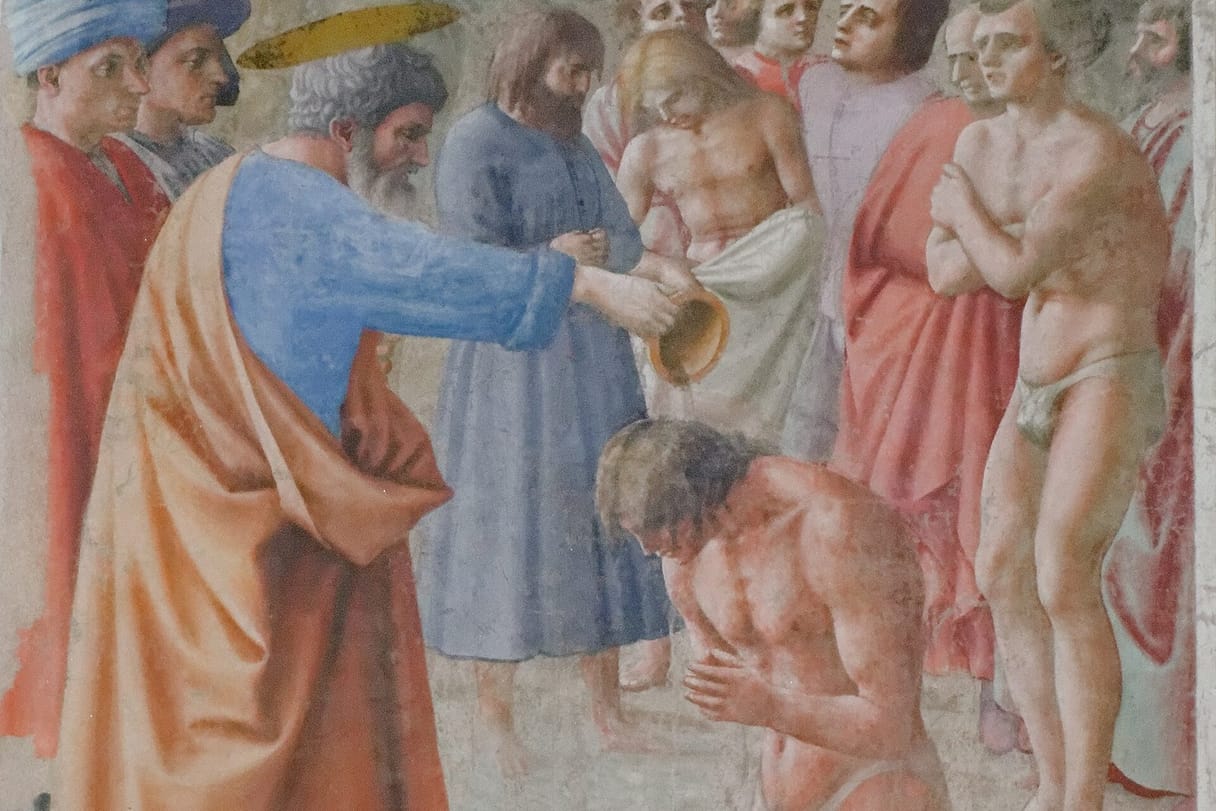
People often ask about baptism when a child is on the way and the family comes from different churches, or when they have joined a new congregation and wonder whether the baptism they received years ago still counts. The mainline churches give a reassuring answer. The United Methodist Church, the Evangelical Lutheran Church in America (ELCA), the Presbyterian Church (U.S.A.), and the Episcopal Church all teach that baptism is God’s gift, given once, by which a person is joined to Christ and to his church.
All four baptize infants as well as adults, all accept pouring or immersion, and all receive baptisms given in other churches with water in the name of the Father, the Son, and the Holy Spirit. American Baptist and Disciples churches, which baptize those old enough to profess faith, differ mainly on the question of infants.
| Church | Position in brief | Key statement and year |
|---|---|---|
| United Methodist Church | Infants and adults; sprinkling, pouring, or immersion; never repeated | By Water and the Spirit (1996) |
| Evangelical Lutheran Church in America | Infants and adults; immersion or pouring; “a person is baptized once” | The Use of the Means of Grace (1997) |
| Presbyterian Church (U.S.A.) | Believers and their children; water applied by hand, pouring, or immersion; recognizes all Trinitarian baptisms | Book of Order, W-3.0402–W-3.0408 (2025–2027) |
| Episcopal Church | Infants and adults; immersion or pouring; conditional baptism only where there is reasonable doubt | Book of Common Prayer (1979) |
| United Church of Christ | Practice varies by congregation; given once | Constitution, Preamble (1957) |
| Christian Church (Disciples of Christ) | Baptism of those who choose to follow Christ; founders taught immersion | Preamble to the Design; disciples.org |
| American Baptist Churches USA | Believers’ baptism by full immersion | 10 Facts About American Baptists |
What do Methodists believe about baptism?
The United Methodist Church, the largest Methodist church in the United States, set out its teaching in By Water and the Spirit, a statement adopted by its General Conference in 1996. It says that “the baptizing of a person, whether as an infant or an adult, is a sign of God’s saving grace.” Following John Wesley, United Methodists hold that God’s grace comes before any human response, so a child born into a Christian family is baptized as an infant and professes the faith personally later in life.
The statement says that “in United Methodist tradition, the water of baptism may be administered by sprinkling, pouring, or immersion.” The 1996 General Conference also declared that “the practice of re-baptism does not conform with God’s action in baptism.” A United Methodist who comes to a deeper faith reaffirms the baptismal vows instead. For more, see what do Methodists believe?
What do Lutherans believe about baptism?
The Evangelical Lutheran Church in America (ELCA), the largest Lutheran church in the United States, describes its practice in The Use of the Means of Grace, adopted by its Churchwide Assembly in 1997. It teaches that in baptism the triune God “delivers us from the forces of evil, puts our sinful self to death, gives us new birth, adopts us as children,” and makes us members of the church. Because “God, whose grace is for all, is the one who acts in Baptism,” candidates are of all ages, infants included.
The ELCA states that “a person is baptized once,” because of the unfailing nature of God’s promise. It warns that rebaptism “causes doubt” by turning attention to the adequacy of our own faith, and it invites those who come to a deeper faith to an Affirmation of Baptism. On the manner of baptism, it allows immersion or pouring and repeats Luther’s teaching that “it is not the water which does such great things, but the Word of God connected with the water.”
What do Presbyterians believe about baptism?
The Presbyterian Church (U.S.A.), the largest Presbyterian church in the United States, describes baptism in the Directory for Worship of its Book of Order. “Both believers and their children are included in God’s covenant love,” it says, and the baptism of young children “witnesses to the truth that God claims people in love even before they are able to respond in faith.”
The Directory teaches that “God’s grace is sufficient; therefore Baptism is not repeated.” It calls for “a visible and generous use of water,” which may be applied with the hand, by pouring, or through immersion. And it states that the PC(USA) “recognizes all baptisms by other Christian churches that are administered with water and performed in the name of the triune God.”
What do Episcopalians believe about baptism?
The Episcopal Church, the member of the worldwide Anglican Communion in the United States and several other countries, follows the 1979 Book of Common Prayer. In its baptismal rite, the priest, or an assisting priest or deacon, immerses the candidate or pours water on the candidate, saying the words of baptism in the name of the Father, the Son, and the Holy Spirit. Infants and adults are baptized in the same service. The prayer book’s catechism explains why infants are included:
“Infants are baptized so that they can share citizenship in the Covenant, membership in Christ, and redemption by God.”
The prayer book treats water and the name of the Father, Son, and Holy Spirit as the essential parts of baptism. It provides a conditional form of the baptismal words only when there is reasonable doubt that a person was baptized in that way, so a baptism from another church is not repeated.
What do the United Church of Christ, the Disciples of Christ, and American Baptists believe?
The United Church of Christ’s constitution recognizes two sacraments, Baptism and the Lord’s Supper. Practice varies by congregation: the UCC notes that some congregations baptize “infants through adults,” and that the water used ranges “from a small amount to full immersion.” Baptism, it says, “occurs only once.”
The Christian Church (Disciples of Christ) confesses that “through baptism into Christ we enter into newness of life and are made one with the whole people of God.” Disciples describe baptism as “at once a divine gift and a human response,” in which a person chooses to follow God’s call, and the church’s founders taught immersion as the accepted form.
American Baptist Churches USA practices believers’ baptism, “an act of full immersion following Christ’s example,” for those mature enough to understand its meaning, which the church describes as resurrection to new life in Christ.
What Scripture and tradition do these churches draw on?
Every one of these churches baptizes because Jesus told his disciples to make disciples of all nations, “baptizing them in the name of the Father and of the Son and of the Holy Spirit” (Matthew 28:19). Paul describes what baptism means:
Or don’t you know that all of us who were baptized into Christ Jesus were baptized into his death? We were buried therefore with him through baptism into death, that just as Christ was raised from the dead through the glory of the Father, so we also might walk in newness of life.
The churches that baptize infants point to Peter’s words at Pentecost, “the promise is to you and to your children” (Acts 2:39), and to whole households baptized together (Acts 16:33). The New Testament never says how much water was used. The Didache, a church manual from around the year 100, tells Christians to baptize in running water if they can, and otherwise to “pour out water thrice upon the head into the name of Father and Son and Holy Spirit.”
Baptism also makes one people out of many. Paul told the Galatians:
For as many of you as were baptized into Christ have put on Christ. There is neither Jew nor Greek, there is neither slave nor free man, there is neither male nor female; for you are all one in Christ Jesus.
Because there is “one Lord, one faith, one baptism” (Ephesians 4:5), the Nicene Creed confesses “one baptism for the forgiveness of sins,” and the mainline churches do not baptize anyone twice. See what is the Nicene Creed? For what happens to those who die unbaptized, see do you have to be baptized to be saved?
What does your baptism mean for you?
If you were baptized, as an infant or as an adult, by pouring or by immersion, God has already named you and claimed you as Christ’s own. Your baptism does not wear out. On days when you doubt, you can return to it as a promise God made to you and will keep.
But now the LORD who created you, Jacob, and he who formed you, Israel, says: “Don’t be afraid, for I have redeemed you. I have called you by your name. You are mine.
Common questions
Do Methodists baptize babies?
Yes. The United Methodist Church baptizes infants as well as adults. Its 1996 statement By Water and the Spirit says that “the baptizing of a person, whether as an infant or an adult, is a sign of God’s saving grace.” A person baptized as an infant later professes the faith for themselves.
Do Lutherans rebaptize people?
No. The ELCA teaches that “a person is baptized once,” because God’s promise does not fail. Lutherans who come to a deeper faith are invited to an Affirmation of Baptism in their congregation instead.
Will a Presbyterian church accept my baptism from another church?
Yes. The PC(USA)’s Book of Order says the church recognizes all baptisms by other Christian churches that are administered with water and performed in the name of the Father, the Son, and the Holy Spirit. You will not be baptized again.
Is sprinkling a valid baptism?
In the mainline churches, yes. United Methodist teaching allows baptism by sprinkling, pouring, or immersion, and the Presbyterian Book of Order allows water to be applied with the hand, by pouring, or by immersion. The ELCA prefers a generous use of water but teaches that God can use whatever water we have.
Do Episcopalians baptize by immersion?
The Episcopal Book of Common Prayer allows either. The minister immerses the candidate or pours water on the candidate while saying the words of baptism in the name of the Father, the Son, and the Holy Spirit.
Sources
- Matthew 28:19 (WEB)
- Acts 2:38–39 (WEB)
- Romans 6:3–4 (WEB)
- Galatians 3:27–28 (WEB)
- Ephesians 4:4–6 (WEB)
- Isaiah 43:1 (WEB)
- The Didache, ch. 7 (New Advent)
- United Methodist Church, By Water and the Spirit: A United Methodist Understanding of Baptism (1996), study edition
- ELCA, The Use of the Means of Grace (1997)
- PC(USA), Book of Order 2025–2027, Directory for Worship W-3.0402–W-3.0408
- Book of Common Prayer (1979), Holy Baptism
- Book of Common Prayer (1979), Holy Baptism: Additional Directions (conditional baptism)
- Book of Common Prayer (1979), Catechism
- United Church of Christ, Preamble to the Constitution
- United Church of Christ, We Are One at Baptism and at the Table
- Christian Church (Disciples of Christ), Communion and Baptism
- Christian Church (Disciples of Christ), Our Mission, Vision, and Confession (Preamble to the Design)
- American Baptist Churches USA, 10 Facts About American Baptists