The church year
The church year, also called the liturgical calendar, is the cycle of seasons and feasts by which churches retell the life of Christ every year. It begins on the First Sunday of Advent and moves through Christmas, Epiphany, Lent, Holy Week, Easter, and Pentecost to the long season after Pentecost. Each season has its own color, prayers, and Bible readings. Two dates anchor the calendar: Christmas on December 25 and Easter, which moves.
For everything there is a season and a time for every matter under heaven:
Ecclesiastes 3:1, NRSVUE
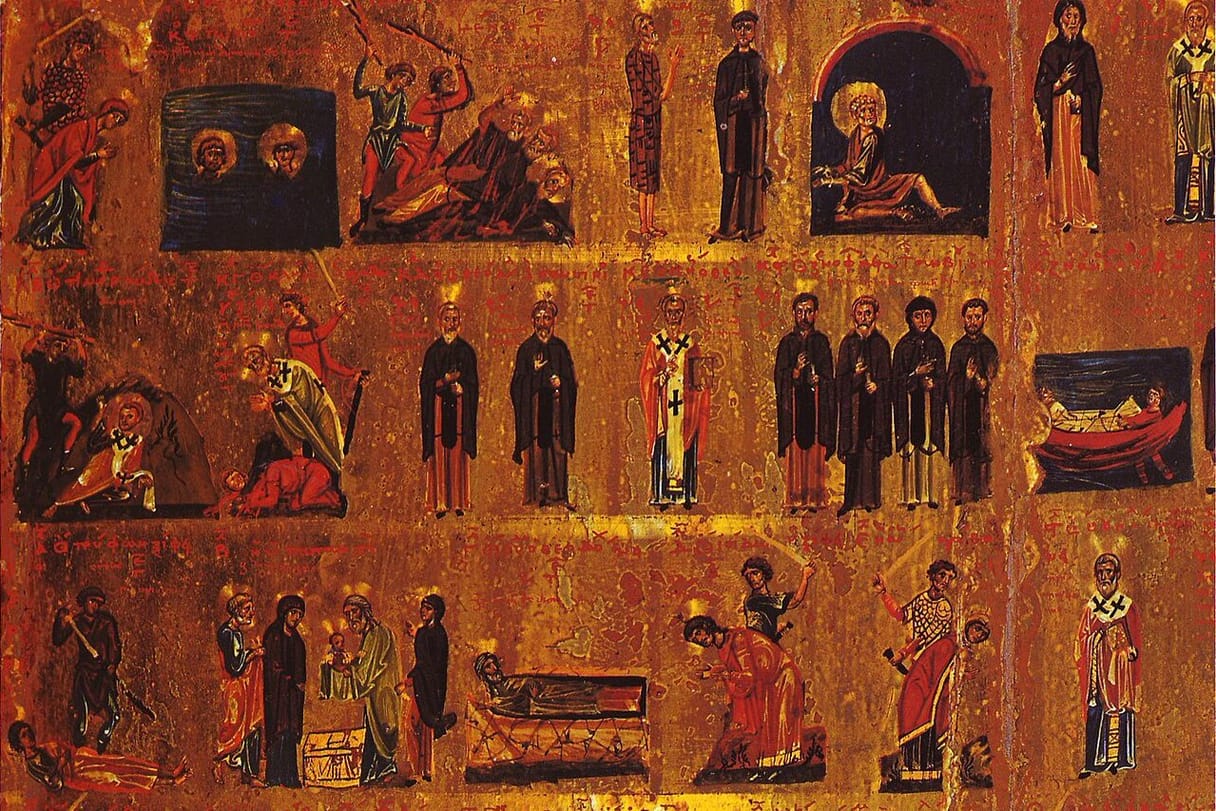
The church year is the calendar of seasons and feasts by which Christians retell the story of Jesus Christ every twelve months, from the promise of his coming to his birth, death, resurrection, and the gift of the Holy Spirit. If you have walked into a church and wondered why the colors had changed or why the hymns turned somber in Lent, you have met the church year already. It is a way of praying through time, so that your own weeks and seasons are gathered, year by year, into the life of Christ.
The Evangelical Lutheran Church in America (ELCA), the Presbyterian Church (U.S.A.), the United Methodist Church, and the Episcopal Church all keep it, with the same seasons on the same dates, and the Eastern Orthodox churches keep a church year of their own. The year is built on two cycles of feasts: one follows the movable date of Easter Day, and the other follows the fixed date of December 25, Christmas Day.
What are the seasons of the church year?
The church year has six main seasons, with Holy Week and the Day of Pentecost marked as high points of their own. Here are the dates for the church year that begins in Advent 2026, with the colors most mainline churches use:
| Season | Dates in 2026–2027 | Usual color |
|---|---|---|
| Advent | November 29 – December 24, 2026 | Violet or blue |
| Christmas | December 25, 2026 – January 5, 2027 | White or gold |
| The Epiphany and the season after | January 6 – February 9, 2027 | White for the feast, then green |
| Lent | February 10 – March 27, 2027 | Violet or unbleached linen |
| Holy Week (the last week of Lent) | March 21 – 27, 2027 | Red or violet |
| Easter | March 28 – May 16, 2027 | White or gold |
| The Day of Pentecost | May 16, 2027 | Red |
| The season after Pentecost | May 17 – November 27, 2027 | Green |
The year opens with Advent, the four Sundays before Christmas, a season of preparation for Christ’s birth and for his coming again; see Advent. Christmas follows and lasts twelve days, from December 25 to January 5. The Epiphany on January 6 remembers the wise men who worshiped the child Jesus. The Sundays after the Epiphany begin with the baptism of Jesus and end with his transfiguration on the mountain.
Lent begins on Ash Wednesday and lasts forty days, not counting Sundays, a time of prayer, fasting, and turning back to God; see Lent. Holy Week, its last week, runs from Palm Sunday through Maundy Thursday and Good Friday to Holy Saturday. On Good Friday many churches leave the altar bare.
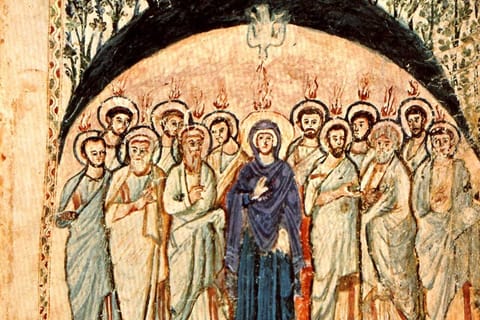
Easter is a season of fifty days, from Easter Day to the Day of Pentecost, and the joy of the resurrection fills all fifty days. Ascension Day falls on a Thursday forty days after Easter, May 6 in 2027. The Day of Pentecost remembers the Holy Spirit coming upon the disciples in Jerusalem:
When the day of Pentecost had come, they were all together in one place. And suddenly from heaven there came a sound like the rush of a violent wind, and it filled the entire house where they were sitting. Divided tongues, as of fire, appeared among them, and a tongue rested on each of them.
Acts 2:1–3, NRSVUE
The season after Pentecost fills nearly half the year. Its first Sunday is Trinity Sunday, and its last Sunday, often called Christ the King or the Reign of Christ, closes the church year. Many churches call the green weeks after the Epiphany and after Pentecost “Ordinary Time.” The name comes from the ordinal numbers used to count those Sundays, such as the Fifth Sunday. These long green weeks are a time for growing in faith in the ordinary days of life, where most of life with God is lived.
What do the liturgical colors mean?
Churches change the colors of the altar hangings and the clergy’s vestments with the seasons. The ELCA’s worship office explains that blue in Advent suggests hope, white at Christmas recalls “the purity of the newborn Christ,” purple in Lent suggests “repentance and solemnity,” red at Pentecost is “the color of fire,” and green after Pentecost indicates “our growth in faith.” White or gold marks Easter and other feasts of Christ.
Customs vary from church to church. Many churches use blue in Advent; others use violet, the traditional Western color. Some use plain unbleached linen in Lent instead of violet.
Why is every Sunday a feast?
Every Sunday is a feast of Christ. The first Christians gathered on Sunday, the first day of the week, because they proclaimed that Jesus had risen on that day. Each Sunday is therefore a small Easter. The Russian language still calls Sunday voskresenie, “resurrection.” Because every Sunday is a feast of the resurrection, the six Sundays in Lent are not counted in Lent’s forty days.
Many mainline congregations celebrate Holy Communion every Sunday, and Eastern Orthodox parishes celebrate the Divine Liturgy every Sunday. See What is Communion?
What is the Revised Common Lectionary?
A lectionary is a fixed plan of Bible readings. Most mainline churches use the Revised Common Lectionary, first published in 1992 by the Consultation on Common Texts, an ecumenical body whose members have included the ELCA, the Presbyterian Church (U.S.A.), the United Methodist Church, and the Episcopal Church. The Revised Common Lectionary grew out of the Common Lectionary of 1983, which was itself adapted from the Roman Catholic lectionary of 1969. As a result, Lutheran, Presbyterian, Methodist, and Episcopal congregations that follow the lectionary hear the same readings on a given Sunday.
Each Sunday the lectionary appoints a first reading, usually from the Old Testament, a psalm, a second reading from the New Testament, and a Gospel. The lectionary runs in a three-year cycle: the Gospels of Matthew, Mark, and Luke are read in successive years, and readings from John’s Gospel come each year, especially around Easter. The church year that begins in Advent 2026 is Year B, the year of Mark.
How is the date of Easter set?
Western churches use this rule: Easter Day is the first Sunday after the full moon that falls on or after March 21, so it can come no earlier than March 22 and no later than April 25. Easter is tied to the moon because the Gospels place the death and resurrection of Jesus at the time of Passover, which follows the Jewish lunar calendar.
In 325 the Council of Nicaea, the gathering of bishops that produced the first form of the Nicene Creed, decided that all churches should keep Easter on the same Sunday, without depending on the Jewish calendar. The council did not write down a formula; the rule now in use was worked out afterward. Orthodox churches apply the same rule to the older Julian calendar, so their Easter often falls later. In 2027, Western Easter falls on March 28 and Orthodox Easter on May 2.
Easter sets the dates of the whole movable cycle. Ash Wednesday comes forty-six days before Easter, Ascension Day forty days after, and the Day of Pentecost on the fiftieth day. See Is Easter a pagan holiday? for the history of the feast.
What are the major feasts of the church year?
The greatest feasts of the Western church year are Easter Day, Ascension Day, the Day of Pentecost, Trinity Sunday, All Saints’ Day (November 1), Christmas Day (December 25), and the Epiphany (January 6). Many churches keep All Saints’ Day on the Sunday after November 1. On All Saints’ Day the church gives thanks for all the saints, known and unknown, and many congregations read aloud the names of members who died during the year.
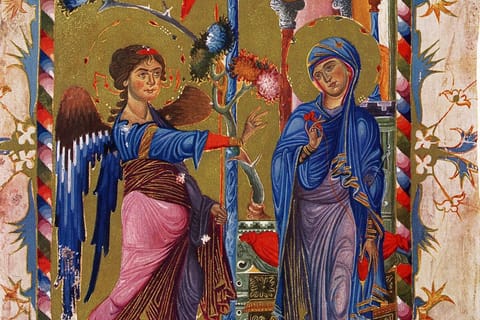
The calendar also keeps feasts of Christ on fixed dates, such as the Annunciation on March 25 and the Transfiguration on August 6, and days for the apostles, the evangelists, and other saints. Ash Wednesday and Good Friday are the traditional fast days.
The Eastern Orthodox year begins on September 1. Above all its feasts stands Pascha (Easter), which Orthodox Christians call the Feast of Feasts, and around it are twelve Great Feasts, seven of Christ and five of his mother, Mary. At the Easter service before dawn, every Orthodox church reads John Chrysostom’s Paschal Homily, which invites everyone to the feast, both “you that have fasted and you that have disregarded the fast,” and proclaims to death and hell, “Christ is risen, and you are overthrown!” For the history of the December feast, see Is Christmas a pagan holiday?
Each Sunday and feast also has its own collect, a short prayer that gathers up the theme of the day. For prayers for everyday needs, see Prayers.
The collect Thomas Cranmer wrote for the First Sunday in Advent opens the church year and gathers the whole of it into one prayer:
Almighty God, give us grace that we may cast away the works of darkness, and put upon us the armour of light, now in the time of this mortal life, in which thy Son Jesus Christ came to visit us in great humility; that in the last day, when he shall come again in his glorious Majesty, to judge both the quick and the dead, we may rise to the life immortal, through him who liveth and reigneth with thee and the Holy Ghost, now and ever. Amen.
Collect for the First Sunday in Advent, Book of Common Prayer (1662)
Common questions
When does the church year begin?
The church year begins on the First Sunday of Advent, the fourth Sunday before Christmas. In 2026 that is Sunday, November 29. The year ends on the Saturday before Advent, after the last Sunday after Pentecost, which many churches call Christ the King.
What is Ordinary Time?
Ordinary Time is a name many churches use for the green seasons of the year: the weeks after the Epiphany and the long stretch after Pentecost. The name comes from the ordinal numbers used to count its Sundays, such as the Fifth Sunday; the weeks are ordinary only in that sense. Other churches call these weeks the season after the Epiphany and the season after Pentecost.
Do Orthodox Christians have the same church year?
Orthodox Christians keep a church year with the same center and a different shape. The Eastern Orthodox church year begins on September 1 and is built around Pascha (Easter), the Feast of Feasts, and twelve Great Feasts of Christ and his mother. Orthodox churches figure Easter by the older Julian calendar, so their Easter often falls later than in the West. In 2027 Western Easter falls on March 28 and Orthodox Easter on May 2.
What are the colors of the church year?
The usual colors are violet or blue for Advent, white or gold for Christmas and Easter, green for the seasons after the Epiphany and after Pentecost, violet for Lent, red or violet for Holy Week, and red for the Day of Pentecost. Customs vary from church to church, and some churches use plain unbleached linen in Lent.
Sources
- Vanderbilt Divinity Library, Revised Common Lectionary: Frequently Asked Questions
- ELCA Worship, Liturgical colors
- Ecclesiastes 3:1 (WEB)
- Acts 2:1–3 (WEB)
- OrthodoxWiki, “Great Feasts”
- OrthodoxWiki, “Paschal Homily” (John Chrysostom)
- Book of Common Prayer (1662), Collect for the First Sunday in Advent (Baskerville printing, justus.anglican.org)