Halloween and All Saints’ Day
Christians can celebrate Halloween, whose name means All Hallows’ Eve, the night before All Saints’ Day on November 1, one of the principal feasts of the church year. They can enjoy costumes, candy, and carved pumpkins with a clear conscience, and many churches keep all three days of the season: Halloween, All Saints’ Day, and All Souls’ Day on November 2. Christians should still stay away from real occult practices such as séances, and from costumes that demean other people.
Therefore, since we are surrounded by so great a cloud of witnesses, let us also lay aside every weight and the sin that clings so closely, and let us run with perseverance the race that is set before us.
Hebrews 12:1, NRSVUE
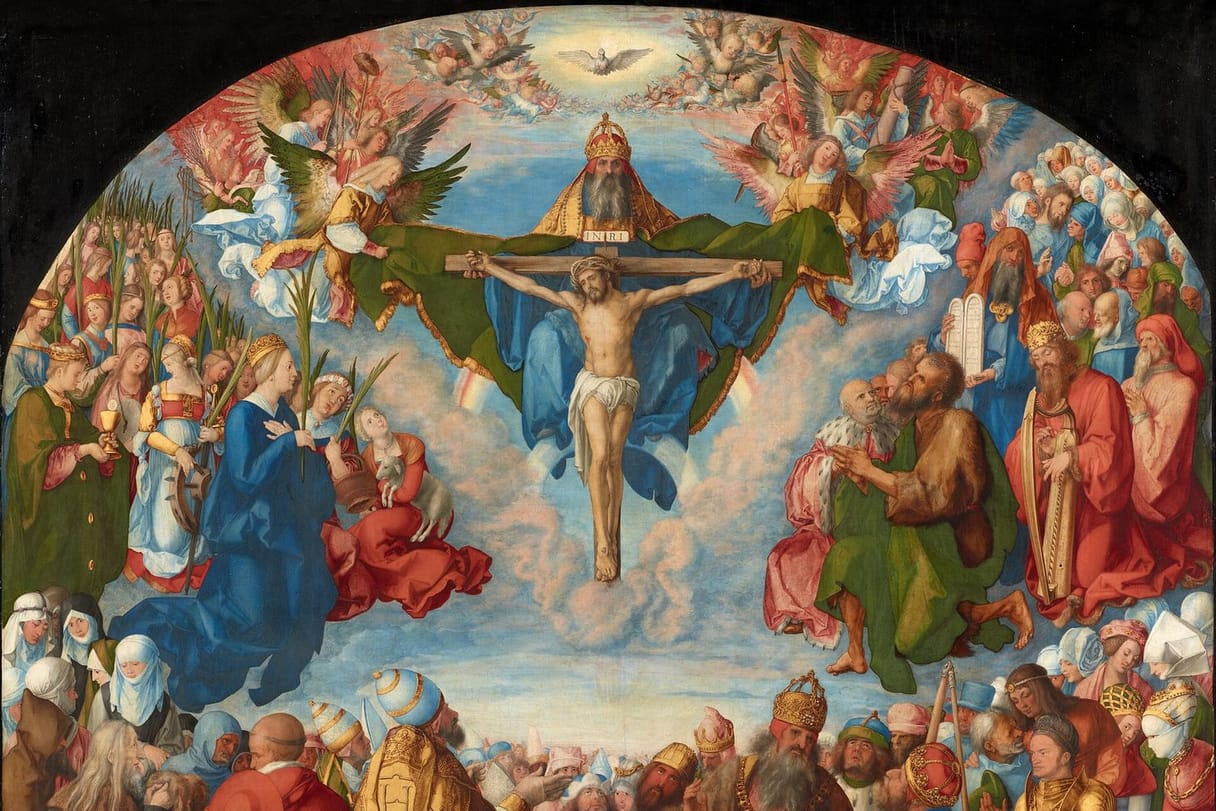
Christians can celebrate Halloween, and they can do more than tolerate it. Perhaps you are a parent deciding whether your children may go trick-or-treating, or you grew up in a church that warned against the holiday and you still feel uneasy about it. Halloween is the eve of All Saints’ Day. At its best it opens a season when Christians remember the saints and the people they have loved and lost, laugh at death because Christ has defeated it, and welcome the neighborhood’s children at the door.
The things to avoid on Halloween are the same things to avoid on any other night: real occult practices, cruelty, and mockery of other people.
What does Halloween mean?
“Hallow” is an old English word for a saint or holy person, and “All Hallows” means all the saints. The Online Etymology Dictionary records “Halloween” from the 1560s as a Scottish shortening of “All Hallows’ Even,” meaning the evening before All Saints’ Day.
Christians have long kept the evening before a great feast as part of the feast, in the way the Jewish Sabbath begins at sundown. Halloween is the eve of All Saints’ Day in the same way that Christmas Eve is the eve of Christmas.
Is Halloween a pagan holiday?
Halloween has both Christian and pre-Christian roots. Stephen Winick, a folklorist at the Library of Congress, writes that it “remains pretty certain” that Halloween originated with Samhain, a Celtic festival in Ireland that began the dark half of the year. Winick also cautions that some popular claims about Samhain, such as the idea that it was the Celtic New Year, rest on a conjecture from the late nineteenth century.
The name and date of Halloween come from the church. In Rome, Pope Boniface IV dedicated the Pantheon to the Virgin Mary and all the martyrs on May 13, 609 or 610, and Gregory III (731–741) dedicated a chapel in St. Peter’s Basilica to all the saints and fixed its feast on November 1. Under Gregory IV (827–844) the November 1 feast spread to the whole Western church. Some writers claim the date was chosen to replace Samhain, but the earliest evidence for the November 1 feast comes from a chapel in Rome, far from Ireland and Britain.
Even where Halloween customs have older roots, Christians are free to enjoy them, as they enjoy Christmas trees and Easter eggs. Paul wrote that Christians may differ over special days, so long as each honors the Lord:
Some judge one day to be better than another, while others judge all days to be alike. Let all be fully convinced in their own minds. Those who observe the day, observe it for the Lord.
Romans 14:5–6, NRSVUE
Paul also told the Colossians, “Let no one therefore judge you in eating or drinking, or with respect to a feast day” (Colossians 2:16). Christmas and Easter raise the same question; see Is Christmas a pagan holiday? and Is Easter a pagan holiday?
What are All Saints’ Day and All Souls’ Day?
All Saints’ Day, November 1, celebrates all the saints, known and unknown, who now live with God. Lutheran, Presbyterian, Methodist, and Episcopal churches all keep it, often on the Sunday that follows. The Orthodox churches keep their feast of All Saints on the first Sunday after Pentecost.
The day celebrates what the Apostles’ Creed calls “the communion of saints”: the living and the dead belong to one family in Christ, and death does not break that bond. The Letter to the Hebrews describes the saints as a crowd cheering on the living:
Therefore, since we are surrounded by so great a cloud of witnesses, let us also lay aside every weight and the sin that clings so closely, and let us run with perseverance the race that is set before us.
Hebrews 12:1, NRSVUE
All Souls’ Day, November 2, is also called the Commemoration of All Faithful Departed. It remembers all the Christian dead, especially family members and friends who have died. For anyone who is grieving, it is a gentle day: a time to say a beloved name aloud in church and to entrust that person again to God. The custom spread from the monasteries of Cluny in France, where Abbot Odilo (who died in 1048) ordered an annual commemoration of all the faithful departed. The Orthodox churches remember their dead on several “Saturdays of souls” through the year instead.
Winick notes that the three days, October 31 through November 2, have traditionally formed one festival, sometimes called Hallowmas. Different communities stress different days. In Louisiana, families have visited and decorated graves on All Saints’ Day, and among Mexican Americans All Souls’ Day, or Día de los Muertos, is widely celebrated. For more on what Christians believe about the dead, see What happens when you die?
Why do some Christians avoid Halloween?
Some Christians avoid Halloween because of its images of witches, demons, and ghosts, and because they believe its roots are pagan. They often cite the Law of Moses, which forbids divination, fortune-telling, sorcery, and anyone who is “a necromancer,” someone who consults the dead (Deuteronomy 18:10–11).
Those Christians are right that real attempts to tell the future or contact the dead have no place in Christian life. Most Christians who celebrate Halloween see a witch costume as a game of dress-up, and they read Deuteronomy’s law as concerned with actual divination and spells. Christians who sit out Halloween for the sake of conscience deserve respect, and Paul’s counsel in Romans 14 asks those who celebrate and those who abstain to honor one another. Families on both sides can still be good neighbors to each other on October 31. For what the church teaches about evil and the devil, see Is Satan real?
How can Christians celebrate Halloween well?
The best way to celebrate Halloween is to keep the feast in view. Go to church on All Saints’ Day, or the Sunday after, when some churches read aloud the names of members who have died in the past year. Light a candle at home and pray for those you have loved and lost.
Be generous at the door, too. Handing out treats to the children of your neighborhood is a simple act of hospitality, and it may be the one night of the year when you meet some of your neighbors. Choose costumes that do not demean anyone, and skip séances, spirit boards, and fortune-telling, which Deuteronomy forbids.
And laugh at death. Skeletons and graveyards lose their terror for people who believe that Christ has risen. Paul taunts death itself: “Death, where is your sting? Hades, where is your victory?” (1 Corinthians 15:55). John Chrysostom’s Easter sermon, read aloud in Orthodox churches at the midnight service every Easter, takes up Paul’s taunt and answers it: Christ is risen, and death and Hades are overthrown. Nothing, Paul writes, “will be able to separate us from God’s love which is in Christ Jesus our Lord” (Romans 8:38–39).
An old prayer for All Saints’ Day, still in the Book of Common Prayer, gathers the whole season into a few lines:
Almighty God, you have knit together your elect in one communion and fellowship in the mystical body of your Son Christ our Lord: Give us grace so to follow your blessed saints in all virtuous and godly living, that we may come to those ineffable joys that you have prepared for those who truly love you; through Jesus Christ our Lord, who with you and the Holy Spirit lives and reigns, one God, in glory everlasting. Amen.
The Book of Common Prayer (1979), Collect for All Saints’ Day
Common questions
Is Halloween a sin?
Christians are free to enjoy Halloween. Dressing up, trick-or-treating, and carving pumpkins are innocent fun, and handing out candy is a small act of hospitality. What would be wrong on Halloween is what would be wrong on any day: real attempts to contact the dead or tell the future, cruelty, vandalism, or costumes that mock other people.
Will I go to hell for celebrating Halloween?
Your place with God rests on his grace, and a night of costumes and candy with your neighbors can be one more way to enjoy the good gifts he gives.
Can Christians go trick-or-treating?
Yes. Trick-or-treating is a neighborhood custom of costumes and treats, and handing out candy is a simple way to be generous and welcoming to the children on your street. Some churches host their own trunk-or-treat or fall festivals as well.
Why are some Christians against Halloween?
Some Christians avoid Halloween because of its imagery of witches, demons, and the dead, and because they believe it has pagan roots. They point to Deuteronomy 18:10–12, which forbids divination and consulting the dead, and Ephesians 5:11, which says to take no part in the works of darkness. Their conscience deserves respect, and Paul told Christians to be fully convinced in their own minds about such matters (Romans 14:5).
What is Hallowmas?
Hallowmas is an old name for three connected days: Halloween on October 31, All Saints’ Day on November 1, and All Souls’ Day on November 2. All Saints’ Day honors all the saints, and All Souls’ Day remembers all the faithful departed.
Sources
- Book of Common Prayer (1979), Collects for Holy Days (All Saints’ Day)
- Catholic Encyclopedia (1907), “All Saints’ Day”
- Catholic Encyclopedia (1907), “All Souls’ Day”
- Stephen Winick, “Welcome to Folklife Today, and…Happy Halloween!” Library of Congress (2013)
- Online Etymology Dictionary, “Halloween”
- Hebrews 12:1 (WEB)
- Romans 14:5–6 (WEB)
- Deuteronomy 18:10–12 (WEB)
- 1 Corinthians 15:55 (WEB)

_-_Google_Art_Project.jpg)