The origins of Easter
Easter is the Christian feast of Jesus’ resurrection, and it is not a pagan holiday; it grew out of Passover, the festival at which Jesus was crucified. In most languages its name comes from Pascha, from the Hebrew word for Passover. Only the English and German names may come from a pagan source: the monk Bede wrote in 725 that the month of Easter was named for an Anglo-Saxon goddess, Eostre. Easter is not connected to the Babylonian goddess Ishtar.
For our paschal lamb, Christ, has been sacrificed.
1 Corinthians 5:7, NRSVUE
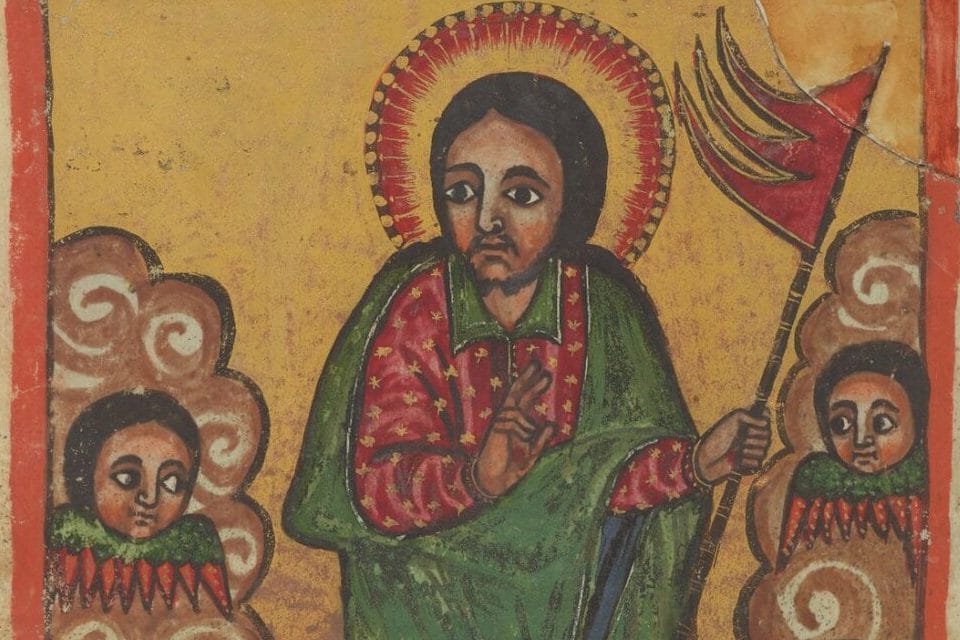
Easter is the Christian feast of the resurrection of Jesus, the oldest and greatest feast of the church’s year. If a friend or a video online has told you it has pagan roots, you can keep it with joy. The feast grew out of Passover, the Jewish festival at which Jesus died. In most languages it is still called by a form of Pascha, the word for Passover. Only the English and German names may come from a pagan source, an old month that the monk Bede said was named for a goddess. Some Christians prefer to call the day Resurrection Sunday for that reason, and their care to keep the feast centered on Christ is a good instinct.
What does Easter celebrate?
Easter celebrates the church’s proclamation that God raised Jesus from the dead on the third day after his crucifixion. Paul handed on that proclamation as the heart of the gospel:
For I handed on to you as of first importance what I in turn had received: that Christ died for our sins in accordance with the scriptures and that he was buried and that he was raised on the third day in accordance with the scriptures
1 Corinthians 15:3–4, NRSVUE
Since the first century Christians have kept Sunday, the day of the resurrection, as the Lord’s Day, and they kept a yearly Pascha from at least the second century. Christians hold the resurrection in different ways, some as a physical event and others as a truth deeper than the literal, and all confess with the creed that Christ “rose again” (see Did Jesus really rise from the dead?).
How is Easter connected to Passover?
The Gospels place Jesus’ death at Passover, the feast that remembers God freeing Israel from slavery in Egypt. Mark says the Last Supper took place “On the first day of unleavened bread, when they sacrificed the Passover” (Mark 14:12). John places the crucifixion on “the Preparation Day of the Passover” (John 19:14), the day the lambs were killed.
Paul drew the connection within about twenty-five years of Jesus’ death:
Clean out the old yeast so that you may be a new batch of dough, as you really are unleavened. For our paschal lamb, Christ, has been sacrificed. Therefore, let us celebrate the festival, not with the old yeast, the yeast of malice and evil, but with the unleavened bread of sincerity and truth.
1 Corinthians 5:7–8, NRSVUE
Many churches still sing Paul’s words at Holy Communion in their old English form, “Christ our Passover is sacrificed for us; therefore let us keep the feast.” In the second century Melito, bishop of Sardis, preached a long Easter sermon titled On Pascha that reads the Passover lamb of Exodus 12 as a figure of Christ. In Greek, Latin, French (Pâques), Spanish (Pascua), Italian (Pasqua), Dutch (Pasen), and Russian (Paskha), the feast is still named for Passover.
Where does the name “Easter” come from?
The English word comes from the Old English name for the month of April, Eosturmonath. Around 725 CE Bede, a monk of Jarrow in northern England, explained the name in his book The Reckoning of Time. In Faith Wallis’s translation, Bede wrote that the month “was once called after a goddess of theirs named Eostre, in whose honour feasts were celebrated in that month.” He added that the English “designate that Paschal season by her name, calling the joys of the new rite by the time-honoured name of the old observance.”
Bede is the only ancient writer who mentions Eostre, and scholars disagree about how much can be known about her. Many linguists connect her name to old words for dawn and for the east, the direction of the sunrise. The German name Ostern comes from the same root.
Bede’s account shows that the Anglo-Saxon church kept an old month name for the new Christian feast. It does not show that Christians borrowed the feast, its date, or its meaning from a goddess. Christians were keeping Pascha for centuries before the missionaries sent by Gregory the Great, bishop of Rome, reached the Anglo-Saxons in 597.
Is Easter named after Ishtar?
No. A claim that circulates online says that Easter comes from Ishtar, a goddess of ancient Mesopotamia. Ishtar’s name is Akkadian, a language of ancient Iraq, and Easter’s name is Old English. The two words only look alike in modern English spelling, and no historical link connects them.
Why does the date of Easter change?
Easter moves because Passover follows a lunar calendar. In the second century some churches in Asia Minor kept Easter on the fourteenth day of the Jewish month of Nisan, the date of Passover, whatever day of the week it fell on. Other churches, including Rome, kept it on the following Sunday. Polycarp, bishop of Smyrna, and Anicetus, bishop of Rome, disagreed about the practice in the mid-second century but remained in communion.
In 325 the Council of Nicaea, the gathering of bishops that also produced the first form of the Nicene Creed, decided that all churches should keep Easter on the same Sunday, without depending on the Jewish calendar. The council did not spell out a formula. The rule later followed in the West sets Easter on the first Sunday after the first full moon on or after March 21. Orthodox churches use the same rule with the older Julian calendar, so their Easter often falls later than the Western date. In 2025, the 1,700th anniversary of Nicaea, both fell on April 20.
Are Easter eggs and the Easter Bunny pagan?
Easter eggs have Christian roots. Christians traditionally gave up eggs during the fast of Lent and ate them again at Easter (see What is Lent?). Eastern Christians have long dyed eggs red in memory of the blood of Christ, and Christians have seen the egg as a picture of the sealed tomb from which life breaks out.
The Easter Bunny comes from German folklore about an Easter hare that brings eggs to good children. German writers mention the custom in 1572 and 1682, and German immigrants brought it to Pennsylvania in the eighteenth century. It is a children’s custom, and no church teaches it as part of the faith.
How should Christians keep Easter?
The Orthodox, Lutheran, Presbyterian, Methodist, and Episcopal churches all keep Easter as the greatest feast of the year. Many churches begin it with the Great Vigil of Easter on Saturday night, in which the church lights a new fire in the darkness and hears the story of the Exodus. Easter is a season of fifty days, lasting until the Day of Pentecost.
The Orthodox churches keep Pascha with special splendor. Near midnight the priest brings a lit candle out from the altar into the darkened church, the flame passes from candle to candle, and the congregation sings, again and again, that Christ is risen from the dead, trampling down death by death. All through the season Orthodox Christians greet one another with “Christ is risen!” and answer “Truly he is risen!” At the midnight service every Orthodox church reads the Paschal Sermon of John Chrysostom, the fourth-century archbishop of Constantinople, which welcomes everyone to the feast, those who fasted and those who did not, and proclaims that Christ’s descent among the dead has left Hades “embittered.” It ends, “Christ is risen, and life reigns!” The Orthodox icon of Easter, called the Anastasis (“resurrection”), shows the same victory: Christ stands on the broken gates of Hades and pulls Adam and Eve up out of their tombs by the hand.
For more on why Jesus died at Passover, see Why did Jesus die on the cross? and Was Jesus Jewish? For the parallel question about December 25, see Is Christmas a pagan holiday?
The deepest answer to the worry that Easter is pagan is the message of the empty tomb itself. The angel told the women, “He is not here, for he has risen, just like he said” (Matthew 28:6). Whatever name your language gives the feast, it carries that news to you: death does not have the last word over you or over anyone you love. With Paul, you can say on Easter morning, “Death, where is your sting? Hades, where is your victory?” (1 Corinthians 15:55).
Common questions
Is Easter named after Ishtar?
No. Ishtar was a goddess of ancient Mesopotamia, and her name is Akkadian. The English word Easter comes from Old English, and the two words only happen to look alike in English. In most languages, including Greek, Latin, French, Spanish, and Russian, the name of Easter comes from Pascha, the word for Passover.
Why does the date of Easter change every year?
Easter is tied to Passover, which follows a lunar calendar. Western churches keep Easter on the first Sunday after the first full moon on or after March 21, so it falls between March 22 and April 25. Orthodox churches use the same rule with the older Julian calendar, so their Easter is often later; in 2025 both fell on April 20.
What do Easter eggs have to do with Jesus?
Christians traditionally gave up eggs during the fast of Lent and ate them again at Easter, which made eggs a natural Easter food. Eastern Christians have long dyed Easter eggs red in memory of Christ’s blood, and Christians have seen the egg as a sign of the sealed tomb from which new life breaks out.
Is the Easter Bunny pagan?
The Easter Bunny comes from German folklore about an Easter hare that brings eggs to children, first recorded in the sixteenth and seventeenth centuries. German immigrants brought the custom to Pennsylvania in the eighteenth century. The Easter Bunny is a children’s custom that no church teaches as part of the faith, and it has no connection to any pagan worship.
Sources
- 1 Corinthians 5:7–8 (WEB)
- Exodus 12:1–14 (WEB)
- Mark 14:12–25 (WEB)
- John 19:14 (WEB)
- 1 Corinthians 15:3–4, 20 (WEB)
- Matthew 28:5–6 (WEB)
- Ēostre, including Bede, The Reckoning of Time, ch. 15, trans. Faith Wallis (Wikipedia)
- Easter controversy and the Council of Nicaea (Wikipedia)
- Easter egg (Wikipedia)
- Easter Bunny (Wikipedia)
- The Book of Common Prayer (1979), Holy Eucharist Rite II
- John Chrysostom, The Paschal Sermon (Orthodox Church in America)
.jpg)