Gratitude and Thanksgiving
Gratitude is the Christian’s answer to the goodness of God. Scripture says, “In everything give thanks” (1 Thessalonians 5:18), asking for thanks within every circumstance, even the hard ones. Jesus gave thanks over bread on the night he was betrayed, and the church’s central act of worship is called the Eucharist, from the Greek word for thanksgiving. Gratitude remembers God’s gifts, survives sorrow, and overflows into generosity toward others.
In everything give thanks, for this is the will of God in Christ Jesus toward you.
Gratitude is the Christian’s answer to the goodness of God. Each year Thanksgiving Day, on the fourth Thursday of November in the United States and the second Monday of October in Canada, invites a whole nation to pause and give thanks. Christians bring to that table a much older habit. Scripture calls believers to give thanks every day and in every circumstance, and the church gathers each week around a meal whose very name means thanksgiving. Perhaps you come to this season full of blessings, or perhaps you come tired and grieving. Either way, gratitude is a door that God holds open.
What does the Bible say about gratitude?
The Psalms sing thanks again and again. Psalm 136 repeats one line twenty-six times, so that worshipers can answer every verse together: “Give thanks to the LORD, for he is good, for his loving kindness endures forever” (Psalm 136:1). Psalm 103 shows that gratitude begins with memory: “Praise the LORD, my soul, and don’t forget all his benefits” (Psalm 103:2). Thanksgiving is the opposite of forgetting.
The New Testament roots gratitude in a simple truth about human life. “Every good gift and every perfect gift is from above, coming down from the Father of lights” (James 1:17). Paul asks the proud Corinthians, “what do you have that you didn’t receive?” (1 Corinthians 4:7). Your breath, your skills, the people who love you, and the grace of Christ all came as gifts. Gratitude sees life as it is.
Paul’s most famous word on thanks comes in a letter to a young and persecuted church:
Always rejoice. Pray without ceasing. In everything give thanks, for this is the will of God in Christ Jesus toward you.
What can the ten lepers teach about thankfulness?
Luke tells of ten men with leprosy who called to Jesus from a distance. He sent them to show themselves to the priests, and on the way all ten were healed. Then:
One of them, when he saw that he was healed, turned back, glorifying God with a loud voice. He fell on his face at Jesus’ feet, giving him thanks; and he was a Samaritan.
The one who returned was a foreigner, a man the others might have looked down on. Jesus asked, “Weren’t the ten cleansed? But where are the nine?” and then told the Samaritan, “Your faith has healed you” (Luke 17:17–19). The Greek verb behind “healed” in that last sentence, sōzō, is the word the New Testament also uses for “save.” All ten men were cured. The one who came back to give thanks found the healer himself, and with him a deeper wholeness.
Why is Holy Communion called the Eucharist?
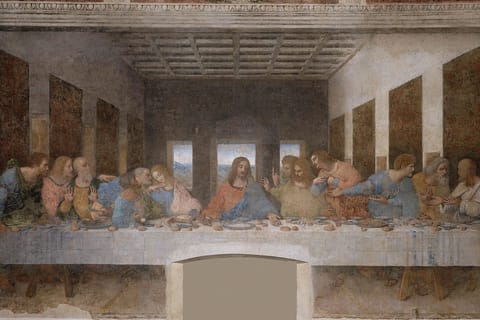
On the night he was betrayed, Jesus took bread and gave thanks. Paul passes on the story to the church at Corinth:
For I received from the Lord that which also I delivered to you, that the Lord Jesus on the night in which he was betrayed took bread. When he had given thanks, he broke it and said, “Take, eat. This is my body, which is broken for you. Do this in memory of me.”
The Greek verb for “given thanks” is eucharisteō, and from the same root comes eucharistia, thanksgiving, which gave the sacrament its name, the Eucharist. Jesus gave thanks with betrayal and death only hours away. The great prayer at Holy Communion still opens with an exchange that goes back at least to the third century, beginning “Lift up your hearts” and continuing “Let us give thanks to the Lord our God.” Lutherans, Presbyterians, Methodists, Episcopalians, and Orthodox Christians all pray it in their own words. See Holy Communion.
The Orthodox theologian Alexander Schmemann taught in For the Life of the World that human beings are created to be priests of creation. In his view, people are made to receive the world from God and to offer it back to God with thanks, and the Eucharist is where that calling is restored in Christ.
How can I give thanks when life is hard?
Paul wrote “In everything give thanks,” and the small word “in” matters. Paul asks for thanks in every circumstance and never calls evil good. He wrote his warmest letter of joy, to the Philippians, while he was in chains (see Philippians 1:13), and he told them, “I have learned in whatever state I am, to be content in it” (Philippians 4:11).
The prophet Habakkuk sang thanks in a year of total loss:
For even though the fig tree doesn’t flourish, nor fruit be in the vines, the labor of the olive fails, the fields yield no food, the flocks are cut off from the fold, and there is no herd in the stalls, yet I will rejoice in the LORD. I will be joyful in the God of my salvation!
John Chrysostom, the great preacher of Constantinople, was exiled by the imperial court and died in 407 at Comana in Pontus, on a forced march to a more distant exile. His last words, as early accounts report them, were “Glory to God for all things.” In twentieth-century Russia, in years of persecution, an Orthodox hymn of thanksgiving took those words as its title. Its author is uncertain, though it has long been linked to a priest who died in a Soviet prison camp.
Gratitude in suffering never requires pretending. Psalm 13 begins “How long, LORD?” and ends “I will sing to the LORD, because he has been good to me” (Psalm 13:6). Lament and thanks belong in the same prayer. If this is your first Thanksgiving after a loss, see Grieving during the holidays.
How does gratitude become generosity?
When ancient Israelites brought the first fruits of their harvest to the sanctuary, Deuteronomy gave them words to say. They began with their story, “My father was a Syrian ready to perish” (Deuteronomy 26:5), remembering slavery in Egypt and God’s rescue. Then they feasted, and the feast was meant to be shared:
You shall rejoice in all the good which the LORD your God has given to you, and to your house, you, and the Levite, and the foreigner who is among you.
Thanksgiving in Scripture includes the person without land and the stranger. Paul says the same of Christian giving: generosity “produces thanksgiving to God” (2 Corinthians 9:11), so that one person’s gratitude becomes another person’s reason to thank God. A Thanksgiving table with a place set for someone who would otherwise eat alone is a feast Deuteronomy would recognize. For more, see Wealth, generosity, and the common good and Christian hospitality.
How can I practice gratitude every day?
Gratitude grows with practice. Say grace before meals, even a single sentence. Martin Luther’s Small Catechism teaches Christians to begin each morning and end each evening by thanking God for keeping them through the night and the day. Before sleep, recall a few gifts of the day by name, such as a phone call, a meal, or a kindness. When you worship, let the words “Let us give thanks to the Lord our God” become your own. Paul’s instruction to the Colossians covers all of life: “Whatever you do, in word or in deed, do all in the name of the Lord Jesus, giving thanks to God the Father through him” (Colossians 3:17).
In 1662 the Church of England added to its Book of Common Prayer a General Thanksgiving written by Edward Reynolds, Bishop of Norwich. Christians of many churches still pray its central lines:
We bless thee for our creation, preservation, and all the blessings of this life; but above all for thine inestimable love in the redemption of the world by our Lord Jesus Christ; for the means of grace, and for the hope of glory.
A General Thanksgiving, The Book of Common Prayer (1662)
Common questions
Does “in everything give thanks” mean I must be thankful for bad things?
Paul asks Christians to give thanks in every circumstance, and he never calls evil good. You can thank God for his presence, for the people who love you, and for the gifts that remain, while still grieving what you have lost. The psalms of lament do both, moving from “How long?” to thanksgiving without pretending the pain away.
What is a good Christian prayer for Thanksgiving?
Psalm 136 can be prayed aloud around the table, with everyone answering each line, “for his loving kindness endures forever.” The General Thanksgiving, written by Bishop Edward Reynolds and added to the Book of Common Prayer in 1662, is a classic prayer of thanks for creation and redemption. A simple grace in your own words is just as welcome to God.
Why is Holy Communion called the Eucharist?
Eucharist comes from the Greek word eucharistia, which means thanksgiving. The New Testament says that Jesus took bread and “gave thanks” before he broke it (1 Corinthians 11:24), and the Greek verb there is eucharisteō. Christians around the world call the sacrament the Eucharist because at its center the church gives thanks for Christ.
How can I teach children to be grateful?
Children learn gratitude by practice and example. Say grace together at meals, name a few gifts of the day at bedtime, write thank-you notes, and let children help give food or money to people in need. When they hear you thank God and thank them, they learn that life is a gift.
Sources
- 1 Thessalonians 5:16–18 (WEB)
- Psalm 136 (WEB)
- Luke 17:11–19 (WEB)
- 1 Corinthians 11:23–26 (WEB)
- Habakkuk 3:17–18 (WEB)
- Deuteronomy 26:1–11 (WEB)
- Eucharist (Online Etymology Dictionary)
- Sursum corda (Wikipedia)
- Alexander Schmemann, For the Life of the World (Mere Orthodoxy)
- Chrysostom, Joannes, in A Dictionary of Greek and Roman Biography and Mythology (Perseus)
- Akathist of Thanksgiving, “Glory to God for All Things” (St. Vladimir’s Seminary)
- General Thanksgiving (An Episcopal Dictionary of the Church)