Christian hospitality
Christian hospitality is the practice of welcoming others, especially strangers, as Christ has welcomed us. The New Testament word for it, philoxenia, means love of strangers, and Hebrews 13:2 says that some who showed it “have entertained angels without knowing it.” Abraham fed three visitors at Mamre, Jesus ate with outcasts, and the early church opened its homes to the poor. Hospitality needs no large house, only an open door and real attention.
Don’t forget to show hospitality to strangers, for in doing so, some have entertained angels without knowing it.
Christian hospitality is the practice of welcoming others, especially strangers, as Christ has welcomed you. It begins with God, to whom the psalmist sings, “You prepare a table before me” (Psalm 23:5), and it continues every time a Christian opens a door, sets another place, or makes room in a conversation for someone new. Perhaps you live in a small apartment, or you are shy, or you are tired, or you have never hosted anyone. Hospitality is still yours to give, because its heart is attention and welcome.
What does the Bible mean by hospitality?
The New Testament word for hospitality is philoxenia, which joins two Greek words, philos (loving) and xenos (stranger). Hospitality in Scripture means love of strangers. Paul tells the Christians in Rome to be “given to hospitality” (Romans 12:13), and the Greek verb he uses, diōkontes, means pursuing or running after. Christians are to go looking for chances to welcome. The Letter to the Hebrews adds a promise:
Don’t forget to show hospitality to strangers, for in doing so, some have entertained angels without knowing it.
Scripture knows that welcome can be costly and tiring. The First Letter of Peter says, with a pastor’s realism, “Be hospitable to one another without grumbling” (1 Peter 4:9). Behind every command stands Israel’s memory of exile: “you shall love him as yourself; for you lived as foreigners in the land of Egypt” (Leviticus 19:34). For more on that command, see Immigrants and refugees in the Bible.
What happened when Abraham welcomed three strangers?
Genesis tells of Abraham resting at the entrance of his tent in the heat of the day:
The LORD appeared to him by the oaks of Mamre, as he sat in the tent door in the heat of the day. He lifted up his eyes and looked, and saw that three men stood near him. When he saw them, he ran to meet them from the tent door, and bowed himself to the earth,
Abraham and Sarah hurried to bake bread and prepare a calf for travelers they did not know, and through those visitors the Lord promised them a son. Hebrews 13:2 most likely remembers this story.
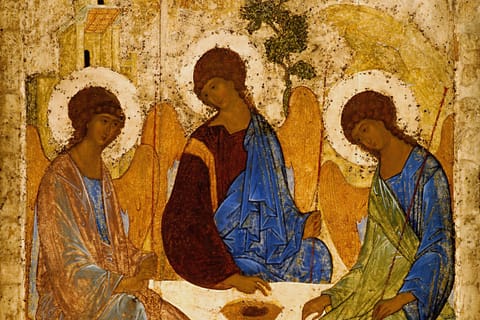
In the early fifteenth century the Russian monk and painter Andrei Rublev painted the three visitors as angels seated around a table with a single cup. The church has long read his icon as an image of the Holy Trinity, the Father, the Son, and the Holy Spirit, whose life is an eternal communion of self-giving love. The fourth side of the table, the side nearest the viewer, is open, and many who pray with the icon take that open place as an invitation. Hospitality reflects the life of God, who has made room for us at the table of divine love. See The Holy Trinity.
How did Jesus practice hospitality?
Jesus was often a guest. He told a would-be follower that “the Son of Man has no place to lay his head” (Luke 9:58), and he depended on the welcome of friends like Martha, Mary, and Lazarus. He invited himself to the home of Zacchaeus, a despised tax collector, who “received him joyfully” (Luke 19:6). His critics complained, “This man welcomes sinners, and eats with them” (Luke 15:2), and the complaint has become good news for everyone who has ever felt unwelcome.
Jesus also taught his followers to choose their guests in a new way:
But when you make a feast, ask the poor, the maimed, the lame, or the blind; and you will be blessed, because they don’t have the resources to repay you. For you will be repaid in the resurrection of the righteous.
After his resurrection, two disciples on the road to Emmaus met a stranger and urged him, “Stay with us, for it is almost evening” (Luke 24:29). At their table the guest became the host. He took bread, gave thanks, and broke it, and “Their eyes were opened and they recognized him” (Luke 24:31). Jesus said that at the last judgment he will tell the righteous, “I was a stranger and you took me in” (Matthew 25:35). Christ comes to us in the guest.
How did the early church welcome strangers?
The first Christians met in homes, “breaking bread at home” and eating “with gladness and singleness of heart” (Acts 2:46). Their welcome became famous. Around 362, the emperor Julian, who hoped to restore the old gods, wrote to a pagan high priest in Galatia, complaining that “the impious Galileans feed not only their own poor but ours as well.” In the 370s Basil of Caesarea built a great complex outside his city, later called the Basileias, which served as a hostel for travelers, a house for the poor, and a place of care for people with leprosy.
John Chrysostom urged the families of Constantinople to set aside a room for strangers in their own houses, so that they would “have a room, to which Christ may come.” He told them to say of it, “This is Christ’s cell; this building is set apart for Him” (Homily 45 on Acts). In the sixth century, Benedict of Nursia wrote in his Rule for monks that “All guests who present themselves are to be welcomed as Christ,” and that “Great care and concern are to be shown in receiving poor people and pilgrims” (chapter 53). Benedictine communities still keep guesthouses today.
Do I need a big home to practice hospitality?
When Jesus visited Martha and Mary, Martha “was distracted with much serving” while Mary listened at his feet. Jesus told her gently, “you are anxious and troubled about many things, but one thing is needed” (Luke 10:40–42). The guest matters more than the menu. A pot of soup, a folding chair, a cup of coffee, a walk with a newcomer, or a seat saved at church can all be holy welcome.
Everyone can offer hospitality. People who are single, widowed, married, or partnered, young or old, wealthy or poor, all have a door to open, even if the door is a park bench or a phone call. Receiving hospitality is holy too. If you are homebound, grieving, or new in town, letting someone care for you gives them the chance to meet Christ in you. For more on belonging, see Loneliness and the gift of community.
How do the mainline churches practice hospitality?
Many mainline churches describe the Lord’s Supper as Christ’s own table, where Christ is the host and every guest is welcome. The United Methodist invitation to Communion begins, “Christ our Lord invites to his table all who love him, who earnestly repent of their sin and seek to live in peace with one another.” For more, see Holy Communion.
The same welcome spills out of the sanctuary. Lutheran, Presbyterian, Methodist, and Episcopal congregations across the country host food pantries, community meals, shelters, recovery groups, and refugee families, often in the same fellowship halls where they hold coffee hour. Each of these is the old Christian practice of philoxenia in modern dress. See also The poor in the Bible.
The risen Christ still stands at the door. “Behold, I stand at the door and knock,” he says. “If anyone hears my voice and opens the door, then I will come in to him and will dine with him, and he with me” (Revelation 3:20). Every time you open your door to another person, you open it to him. Pray the words of the disciples at Emmaus over your own table: “Stay with us, for it is almost evening.”
Common questions
What does “entertained angels unaware” mean?
Hebrews 13:2 says that some who welcomed strangers “have entertained angels without knowing it.” The verse recalls Abraham and Sarah, who fed three travelers at Mamre and discovered that the Lord had visited them (Genesis 18). Christians take it as a reminder that any guest may bring God’s presence into the house.
What is the difference between hospitality and entertaining?
Entertaining often aims to impress guests with a beautiful home or a fine meal. Christian hospitality aims to welcome a person and give them attention, rest, and food. When Martha was “distracted with much serving,” Jesus told her that “one thing is needed” (Luke 10:40–42).
Can I practice hospitality if I live alone or have a small home?
Yes. Hospitality can be a pot of soup, a cup of coffee, a walk with a newcomer, or a seat saved for someone at church. People who are single, widowed, young, old, partnered, or living in one room all offer it, and Jesus himself, who had “no place to lay his head,” practiced it on the road.
Why do Christians say to welcome the stranger?
God told Israel, “The stranger who lives as a foreigner with you shall be to you as the native-born among you, and you shall love him as yourself; for you lived as foreigners in the land of Egypt” (Leviticus 19:34). Jesus said that whoever welcomes a stranger welcomes him (Matthew 25:35). Welcoming the stranger is part of loving God.
Sources
- Hebrews 13:1–2 (WEB)
- Genesis 18:1–8 (WEB)
- Luke 14:12–14 (WEB)
- Luke 24:13–35 (WEB)
- Luke 10:38–42 (WEB)
- Trinity (Andrei Rublev) (Wikipedia)
- Julian the Apostate to Arsacius, c. 362 (Roman Letters)
- Basileias (Wikipedia)
- John Chrysostom, Homily 45 on the Acts of the Apostles (New Advent)
- Rule of Benedict, chapter 53: The Reception of Guests (Benedictine Sisters of Erie)
- A Service of Word and Table I (United Methodist Book of Worship)