Episcopalians and Catholics
The Episcopal Church and the Roman Catholic Church share the creeds, bishops, the sacraments, and a liturgy built on the same ancient pattern. The main differences concern authority and discipline: Episcopalians do not accept the authority of the pope, allow priests to marry, ordain women and LGBTQ people, permit remarriage after divorce, and leave birth control to conscience. The Catholic Church has not recognized Anglican ordinations since 1896.
that they may all be one. As you, Father, are in me and I am in you, may they also be in us, so that the world may believe that you have sent me.
John 17:21, NRSVUE
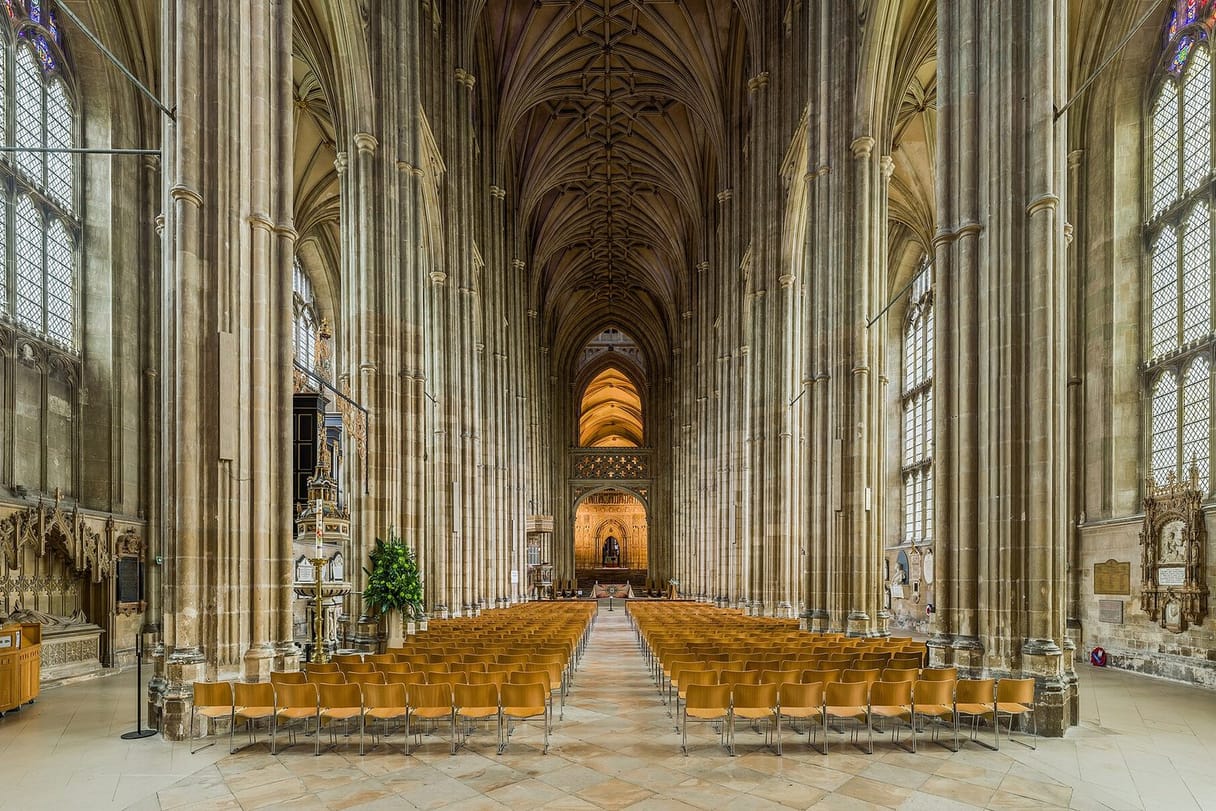
The Episcopal Church and the Roman Catholic Church are close relatives. They share the ancient creeds, bishops, the sacraments, and a liturgy built on the same pattern, and they differ mainly over the authority of the pope and over questions of church discipline such as married priests, the ordination of women, and marriage.
People often ask about the difference at a turning point, such as a wedding between a Catholic and an Episcopalian or a move from one church to the other. Each church has carried the faith of the apostles through many centuries, and each deserves to be understood on its own terms.
What do Episcopalians and Catholics have in common?
A visitor from either church will recognize much in the other. The Sunday Eucharist follows the same ancient pattern: readings from Scripture, a sermon, the creed, prayers, the great thanksgiving over bread and wine, and Communion. Both churches keep Advent, Christmas, Lent, Easter, and the feasts of the saints.
Both churches hold that Christ is truly present in the Eucharist. The Catholic Church explains that presence by the doctrine of transubstantiation, the teaching that the substance of the bread and wine becomes the body and blood of Christ. The Episcopal Catechism teaches that the inward grace of the sacrament “is the Body and Blood of Christ given to his people, and received by faith,” without defining how. See what is Holy Communion?
Both churches also have seven sacramental rites. Catholics count seven sacraments. Episcopalians call baptism and the Eucharist “the two great sacraments of the Gospel” and confirmation, ordination, marriage, reconciliation of a penitent, and anointing of the sick “sacramental rites.”
The two churches have talked seriously for more than fifty years through the Anglican–Roman Catholic International Commission, and each recognizes the other’s baptisms.
How do Episcopal and Catholic teaching compare?
| Question | Episcopal Church | Roman Catholic Church |
|---|---|---|
| Church government | Bishops, clergy, and lay people together in General Convention | The pope, with the bishops in communion with him |
| Married priests | Allowed for bishops, priests, and deacons | Latin-rite priests are celibate, with limited exceptions |
| Women ordained | All three orders, by canon since 1976 | Not ordained as priests |
| Same-sex marriage | Rites for all couples since 2015 | Not celebrated |
| Remarriage after divorce | Allowed with the bishop’s consent | Not allowed while a first valid marriage stands |
| Birth control | Permitted by Anglican teaching since 1930 | Artificial contraception forbidden |
| Communion | All baptized Christians invited | Ordinarily only Catholics and certain Eastern churches |
Do Episcopalians recognize the pope?
No. The Catholic Church teaches that the pope, the bishop of Rome, is the successor of Saint Peter, to whom Jesus said, “you are Peter, and on this rock I will build my assembly” (Matthew 16:18). The Greek word for “assembly,” ekklēsia, is the word usually translated “church.” The First Vatican Council in 1870 defined that the pope teaches infallibly when he solemnly defines a doctrine of faith or morals.
The Church of England rejected papal authority at the Reformation, and its Thirty-Nine Articles state, “The Bishop of Rome hath no jurisdiction in this Realm of England.” The Episcopal Church honors Saint Peter but does not accept that Christ gave the bishop of Rome authority over the whole church. Authority in the Episcopal Church is shared: its General Convention includes a House of Bishops and a House of Deputies of clergy and lay people, and its Presiding Bishop is elected for a nine-year term. See what do Episcopalians believe?
Can Episcopal priests marry?
Yes. Article XXXII of the Thirty-Nine Articles says that bishops, priests, and deacons “are not commanded by God’s Law, either to vow the estate of single life, or to abstain from marriage.” The New Testament assumes that church leaders could be married: Peter had a mother-in-law (Mark 1:30), and the First Letter to Timothy says that an overseer, or bishop, must be “the husband of one wife” (1 Timothy 3:2).
In the Latin, or Western, rite of the Catholic Church, priests promise celibacy, with limited exceptions, among them some married former Episcopal priests who have become Catholic priests.
Can women and LGBTQ people be priests?
In the Episcopal Church, yes. The 1976 General Convention declared that the church’s canons on ordination “shall be equally applicable to men and women.” Barbara Harris was consecrated the Episcopal Church’s first woman bishop in 1989, and Katharine Jefferts Schori was elected Presiding Bishop in 2006. Since 2012 the church’s canons have forbidden denying anyone access to the process for ordination because of sexual orientation or gender identity, and since 2015 its marriage rites have been open to same-sex couples. See can women be pastors?
The Catholic Church ordains only men as priests and does not marry same-sex couples.
How do the churches differ on divorce and birth control?
Jesus spoke sternly about divorce. In Mark 10:11–12 he says that a man or a woman who divorces and marries another “commits adultery.” Matthew’s version includes an exception “for the cause of sexual immorality” (Matthew 5:32). The Catholic Church holds that a valid sacramental marriage cannot be dissolved while both spouses live. The Episcopal Church also teaches that marriage is meant to be lifelong, but it allows a divorced person to marry again in church after consultation with the bishop and the bishop’s consent, under its canon on marriage after divorce. See is divorce a sin?
On birth control, the Anglican bishops at the Lambeth Conference of 1930 resolved that where there is “a clearly felt moral obligation to limit or avoid parenthood,” and a sound reason not to abstain, “other methods may be used, provided that this is done in the light of the same Christian principles.” The Catholic Church takes the opposite position: it forbids artificial contraception and permits only natural methods of spacing births.
Does the Catholic Church recognize Episcopal priests?
No. In the bull Apostolicae Curae, dated September 13, 1896, Pope Leo XIII declared ordinations performed with the Anglican rite “absolutely null and utterly void,” arguing that the Anglican ordination services of the Reformation era were defective in form and intention. The Archbishops of Canterbury and York replied the next year in Saepius Officio, defending Anglican orders.
The Episcopal Church holds that its bishops stand in the apostolic succession and that its sacraments are true sacraments. In practice, a former Episcopal priest who becomes a Catholic priest is ordained again.
Communion follows from this. The Episcopal Church invites all baptized Christians, Catholics included, to receive Communion. The Catholic Church ordinarily does not admit members of other churches to Communion at Mass, with exceptions for the Orthodox and a few other churches.
For the place of Mary in each tradition, see what do Christians believe about Mary?
If you love people on both sides of this line, you can pray with them the prayer Jesus prayed for all who would believe in him:
that they may all be one; even as you, Father, are in me, and I in you, that they also may be one in us; that the world may believe that you sent me.
Common questions
Is the Episcopal Church Catholic or Protestant?
Both, in different senses. The Episcopal Church is Protestant because it came out of the English Reformation and does not accept the authority of the pope. It is catholic, meaning universal, because it keeps the ancient creeds, bishops, and sacraments and confesses one holy catholic and apostolic church.
Can a Catholic take Communion in an Episcopal church?
The Episcopal Church invites all baptized Christians, including Roman Catholics, to receive Communion. The Catholic Church’s own discipline is stricter: it ordinarily does not admit members of other churches, including Episcopalians, to Communion at Mass, so Catholics who want to follow that discipline should ask their priest.
Do Episcopalians honor Mary and the saints?
Yes. The Book of Common Prayer keeps feasts of Mary, the apostles, and many other saints, and the Catechism describes the communion of saints as the whole family of God, the living and the dead. Whether to ask Mary and the saints for their prayers is left to personal devotion.
Do Episcopalians believe Christ is present in the Eucharist?
Yes. The Episcopal Catechism teaches that the inward grace of Holy Communion is the Body and Blood of Christ given to his people and received by faith. The Catholic Church explains the change with the doctrine of transubstantiation; the Episcopal Church affirms Christ’s presence without defining how it happens.
Sources
- The Thirty-Nine Articles of Religion (1571), in the Book of Common Prayer (1979), Historical Documents
- Book of Common Prayer (1979), Catechism, pp. 845–862
- Leo XIII, Apostolicae Curae (1896) (Wikipedia summary)
- Lambeth Conference 1930, Resolution 15 (Project Canterbury)
- USCCB, Guidelines for the Reception of Communion
- General Convention Resolution 1976-B005 (ordination of women)
- An Episcopal Dictionary of the Church: Open Communion
- Mark 10:11–12 (WEB)
- John 17:20–21 (WEB)