Mary, the mother of Jesus
All Christians honor Mary as the mother of Jesus, and the creeds confess that Christ was born of the Virgin Mary. Since the Council of Ephesus in 431, the church has called her Theotokos, the God-bearer or Mother of God. Christians differ on later teachings: Orthodox Christians honor her as ever-virgin, celebrate her falling asleep (the Dormition), and ask for her prayers, while most Protestants honor her as a model of faith without praying to her.
Here am I, the servant of the Lord; let it be with me according to your word.
Luke 1:38, NRSVUE
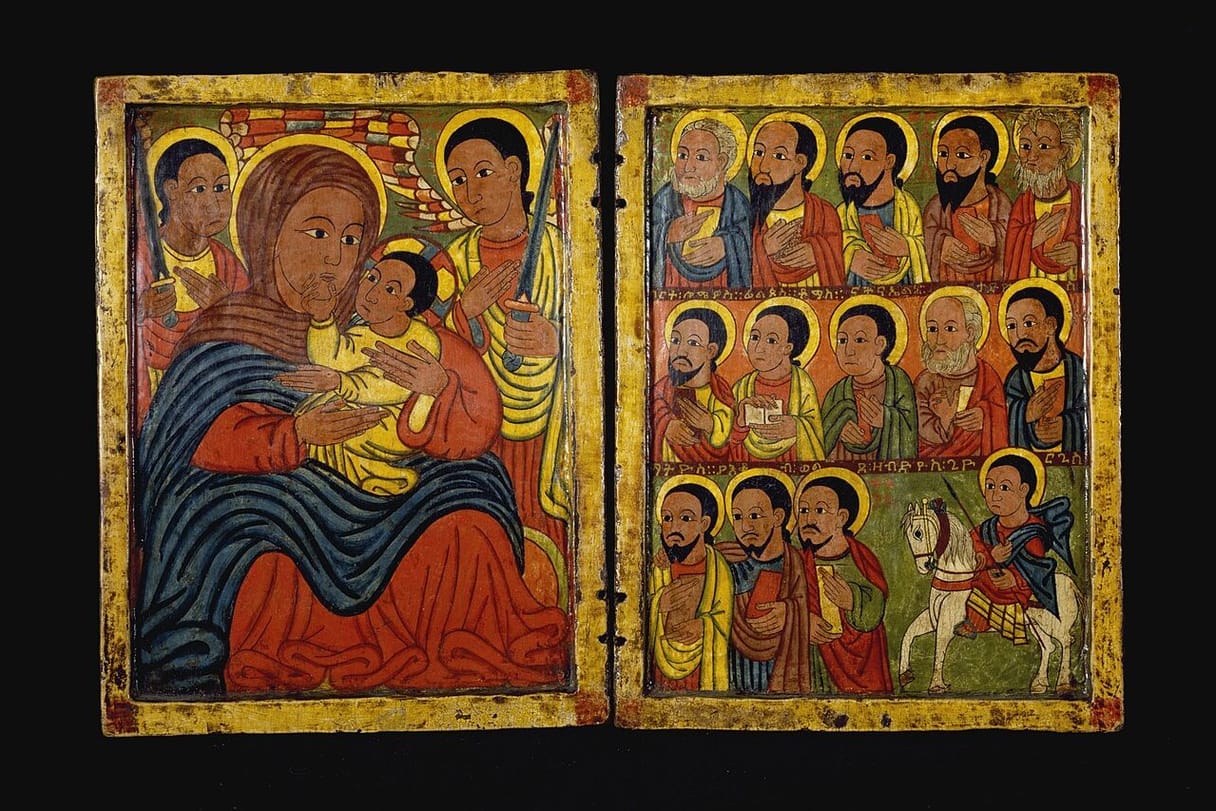
Mary is the mother of Jesus, and every Christian church honors her. The creeds confess that Christ was “born of the Virgin Mary,” and Christians of every tradition hear her story each Advent and Christmas. Some readers come to this question because they grew up in a church that said little about her and now feel drawn to her. Others have Orthodox or Anglican friends who ask for Mary’s prayers and wonder what that means. Christians differ about some later teachings, but all can learn from the young woman of Nazareth who said yes to God.
What does the Bible say about Mary?
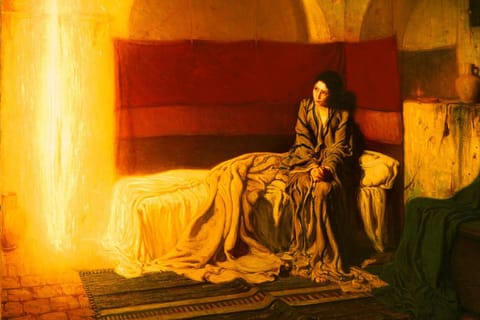
Luke’s Gospel tells the most about her. The angel Gabriel visits a young woman of Nazareth engaged to Joseph and tells her she will bear a son and name him Jesus (Luke 1:26–35). Her answer has made her a model of faithful trust for Christians ever since:
Then Mary said, “Here am I, the servant of the Lord; let it be with me according to your word.” Then the angel departed from her.
Luke 1:38, NRSVUE
When Mary visits her relative Elizabeth, Elizabeth greets her: “Blessed are you among women, and blessed is the fruit of your womb! Why am I so favored, that the mother of my Lord should come to me?” (Luke 1:42–43). Mary answers with the song the church calls the Magnificat:
And Mary said,
“My soul magnifies the Lord,
and my spirit rejoices in God my Savior,
for he has looked with favor on the lowly state of his servant.
Surely from now on all generations will call me blessed,
for the Mighty One has done great things for me,
and holy is his name;Luke 1:46–49, NRSVUE
The song goes on to praise the God who “has put down princes from their thrones, and has exalted the lowly” and “has filled the hungry with good things” and “sent the rich away empty” (Luke 1:52–53).
Mary’s faith did not spare her sorrow. After the birth of Jesus, Luke twice says that Mary “kept all these sayings” in her heart (Luke 2:19, 2:51), and the first time he adds that she was “pondering them”. The old man Simeon warns her that “a sword will pierce through your own soul” (Luke 2:35). At the wedding at Cana, she tells the servants, “Whatever he says to you, do it” (John 2:5). She stands near the cross, where Jesus entrusts her to the beloved disciple (John 19:25–27), and she is among the believers praying in Jerusalem before Pentecost (Acts 1:14). Paul’s only mention of her is that God’s Son was “born to a woman” (Galatians 4:4).
Why is Mary called the Mother of God?
The title is first of all a statement about Jesus. In the early 400s, Nestorius, the patriarch of Constantinople, objected to calling Mary Theotokos. Cyril of Alexandria answered that the child Mary bore was God the Word made flesh (John 1:14), one person, both divine and human. The Council of Ephesus in 431 agreed with Cyril. To call Mary the God-bearer is to say that the one she bore is God the Son himself, born as a human being. Elizabeth’s words, “the mother of my Lord” (Luke 1:43), already point in that direction. The title also holds a wonder Christians have never exhausted, that the eternal Son of God was carried and nursed by a human mother. For the belief behind the title, see Is Jesus God?
The Orthodox, Anglican, and Lutheran churches all use the title, and Martin Luther and the English Reformers accepted it because they judged it scriptural and in line with the ancient church.
What do Orthodox Christians believe about Mary?
The Eastern Orthodox churches honor Mary as the Theotokos and as “ever-virgin,” teaching that she remained a virgin all her life; for how they read the Gospel passages about Jesus’ family, see the article on whether Jesus had brothers and sisters. They call her Panagia, “all-holy,” honor her as the first and greatest of the saints, and ask for her prayers. An Orthodox hymn sung at nearly every Divine Liturgy praises her as “more honorable than the cherubim.”
Orthodox teaching also holds that Mary shared the human condition of every descendant of Adam and Eve. Orthodox writers such as Kallistos Ware, an Orthodox bishop and Oxford scholar, describe her holiness as the fruit of God’s grace and of her own free response to it. In Orthodox thought Mary’s “yes” in Luke 1:38 matters because she could have said no. God chose to become human with the free consent of a human being.
On August 15 Orthodox Christians keep the Dormition, or falling asleep, of the Theotokos. The church holds that Mary truly died and that Christ took her, body and soul, into the life of the resurrection. The icon of the Dormition shows Mary lying on her bier surrounded by the apostles, while Christ stands behind her holding her soul as a small child wrapped in white. The picture reverses the icon of the Nativity, so that the mother who once held her infant son is now held by him.
The Orthodox greet Mary with the angel’s words from Luke 1:28, “Rejoice, you highly favored one! The Lord is with you” (Luke 1:28), joined to Elizabeth’s blessing in Luke 1:42. Western Christians know the same greeting as the Hail Mary.
What do Protestants believe about Mary?
The Reformers did not reject Mary. Martin Luther and the English Reformers accepted her as Theotokos and held that she remained a virgin. They objected to the late medieval practice of praying to Mary and the saints, which they believed threatened the place of Christ, the “one mediator between God and men” (1 Timothy 2:5). Article XXII of the Church of England’s Thirty-Nine Articles calls the invocation of saints “grounded upon no warranty of Scripture.”
Most Protestants today honor Mary as a model of faith and humility, believe she had other children after Jesus, and do not pray to her. Most Protestant churches confess the creeds and so confess that Christ was born of the Virgin Mary; for how Christians hold that belief today, see the article on whether Jesus was born of a virgin.
What do the mainline churches teach about Mary?
The mainline churches, including the Evangelical Lutheran Church in America (ELCA), the Presbyterian Church (U.S.A.), the United Methodist Church, and the Episcopal Church, all confess the Apostles’ and Nicene Creeds, and so all confess that Christ was born of the Virgin Mary. They honor her as the mother of the Lord and as the first disciple, the one who heard God’s word and kept it.
The Lutheran and Anglican churches also keep feasts of Mary in their calendars. Both keep the Annunciation (March 25) and the Visitation (May 31), and on August 15 the ELCA keeps the day as Mary, Mother of Our Lord, while Anglican churches keep it as Saint Mary the Virgin.
When a woman in the crowd called Mary’s womb blessed, Jesus answered, “On the contrary, blessed are those who hear the word of God, and keep it” (Luke 11:27–28). Protestant teachers have often read those words as the key to Mary’s honor: she is blessed above all for her faith. Luther made the same point in his 1521 commentary on the Magnificat, and even when devotion to Mary declined in the sixteenth century, Anglicans and Lutherans kept singing her song at evening prayer.
Members of these churches are free to differ on questions the creeds leave open, such as whether Mary had other children, and whether to ask for her prayers.
Is it right to ask Mary to pray for us?
Christians answer differently. Orthodox Christians and many Anglicans ask Mary to pray for them in the way they ask fellow Christians on earth to pray for them. Many Protestants believe prayer should be addressed to God alone.
Both sides agree that worship belongs to God alone. The Second Council of Nicaea in 787, the seventh and last council that the Orthodox count as ecumenical, distinguished the honor given to the saints and their icons from the worship that belongs only to God. Christians who ask for Mary’s prayers understand the communion of saints as one family of the living and the dead in Christ, “surrounded by so great a cloud of witnesses” (Hebrews 12:1).
If you are unsure where you stand, you can do what every tradition does and pray Mary’s own song. The Magnificat praises God from its first line to its last, and it teaches what Mary teaches by her example, to trust God’s word and to rejoice in the God who lifts up the lowly.
Mary’s life holds every season of faith. She said yes to God without knowing what it would cost, kept God’s word in her heart when she did not understand it, and stayed near her son at the cross when others fled. Whatever you believe about her later life, she shows you how to receive Christ and how to keep faith through joy and grief alike.
Common questions
Do Christians worship Mary?
No. Orthodox Christians and many Anglicans honor Mary and ask her to pray for them, as Christians ask one another to pray, but no church worships her as God. The Second Council of Nicaea in 787 distinguished the honor given to the saints from the worship that belongs to God alone.
What is the Hail Mary?
The Hail Mary is a prayer that joins two greetings from Luke’s Gospel: the angel Gabriel’s words to Mary in Luke 1:28 and Elizabeth’s words in Luke 1:42. Eastern Orthodox Christians pray a similar greeting that begins “Rejoice, O Virgin Theotokos” and praises her for bearing the Savior. The Western closing request, “pray for us sinners now and at the hour of our death,” was added in the fifteenth century.
What is the Magnificat?
The Magnificat is Mary’s song of praise in Luke 1:46–55, named for its first word in Latin. In it Mary praises God for looking on her lowliness and for bringing down the powerful and lifting up the lowly. Anglican Evening Prayer and Lutheran evening prayer sing it, and Orthodox Christians sing it at morning prayer (Matins).
When is the feast of Saint Mary the Virgin?
August 15. Orthodox Christians keep the day as the Dormition, or falling asleep, of the Theotokos, one of the great feasts of their year. Anglican churches keep it as Saint Mary the Virgin, and the ELCA keeps it as Mary, Mother of Our Lord.
Sources
- Luke 1:26–38 (WEB)
- Luke 1:39–55 (WEB)
- John 2:1–5 and John 19:25–27 (WEB)
- Luke 11:27–28 (WEB)
- Hebrews 12:1 (WEB)
- Book of Common Prayer (1979), Collects for Holy Days
- Church of England, The Thirty-Nine Articles of Religion
- Second Council of Nicaea
- Living Lutheran, “Mary, Mother of Our Lord” (2018)
- Kallistos Ware, The Orthodox Church (Penguin, new ed. 1993)
- Dormition of the Mother of God