Abortion and the churches
The Bible never mentions abortion. The ELCA, the PC(USA), the United Methodist Church, and the Episcopal Church teach that unborn life has great value and support legal abortion in at least some circumstances, while the Orthodox churches and many other Christians, following the early church, teach that abortion is gravely wrong. Christians reason from verses about God forming life in the womb (Psalm 139:13), the command not to murder, and a law about harm to a pregnancy in Exodus 21:22–25, and they reach different conclusions.
For it was you who formed my inward parts; you knit me together in my mother’s womb.
Psalm 139:13, NRSVUE

Some people come to this question while facing a pregnancy they did not plan. Some once ended a pregnancy and still carry the memory, and others hold a deep conviction that unborn life must be protected. Whichever of these is yours, God meets you with love. The Bible never mentions abortion, and Christians who love Scripture and revere life have reached different conclusions about it.
Does the Bible mention abortion?
No. The Hebrew Bible and the New Testament contain no law, story, or saying about deliberately ending a pregnancy. People in the ancient world knew of abortion, so the silence is real, and Christians on every side do well to claim no more from Scripture than it says.
Christian teaching against abortion began very early. The Didache, a short handbook of Christian teaching usually dated to the late first or early second century, lists among its commands: “you shall not murder a child by abortion nor kill that which is begotten” (Didache 2).
What does Psalm 139 say about life in the womb?
The passage Christians quote most often on this question is a prayer of wonder at God’s knowledge of each person:
For it was you who formed my inward parts; you knit me together in my mother’s womb. I praise you, for I am fearfully and wonderfully made. Wonderful are your works; that I know very well.
Psalm 139:13–14, NRSVUE
Similar words appear at the call of the prophet Jeremiah: “Before I formed you in the womb, I knew you. Before you were born, I sanctified you” (Jeremiah 1:5). In Luke’s Gospel, Elizabeth, pregnant with John the Baptist, tells Mary, “the baby leaped in my womb for joy” (Luke 1:44).
Christians who oppose abortion read these passages as showing that God knows and loves each human being from the start, and that the unborn child is already someone. Other Christians agree that the passages teach God’s care for every life from its beginning, and note that they are poems and stories of calling, written without any question about abortion in view. Both readings take the passages seriously, and neither can claim that the verses settle every case. Every reader can receive the psalm’s deepest teaching, that God knew and loved each person before anyone else did.
What does Exodus 21:22–25 say?
Exodus 21 contains the only biblical law about harm to a pregnancy:
When men fight and strike a pregnant woman so that her children come out, and there is no harm, he shall surely be fined as the woman’s husband imposes on him, and he shall pay as the judges determine. But if there is harm, you shall give life for life …
Exodus 21:22–23, translated from the Hebrew1
The Hebrew of Exodus 21:22 says literally that “her children come out,” and translations divide over what that means. Many translations read “miscarriage.” Others, such as the New International Version and the World English Bible, read “she gives birth prematurely”; the NIV gives “miscarriage” in a footnote as the alternative. The difference matters. If the verse describes a miscarriage, the law punishes the loss of the pregnancy with a fine and the death of the woman with death, which many Jewish and Christian interpreters have taken to mean that the law did not treat the fetus as a full person. If the verse describes a premature birth, then “harm” may refer to the child as well as the mother.
The passage concerns an accidental injury during a fight. It says nothing about a decision to end a pregnancy, so neither side should rest too much weight on it. Jewish law has drawn its own conclusions from the wider tradition. The Mishnah, compiled around 200 CE, rules that when a woman’s life is in danger during childbirth, her life comes first, until the greater part of the child has been born (Mishnah Oholot 7:6).
Why do many Christians oppose all abortion?
Many Christians hold that abortion is always gravely wrong, and they stand in a long line of teaching. Besides the Didache, Basil of Caesarea, a fourth-century bishop whom the Orthodox honor as one of the Three Holy Hierarchs, wrote in a letter of church rules that “the woman who purposely destroys her unborn child is guilty of murder,” whether or not the fetus was fully formed (Letter 188). The Eastern Orthodox churches and many evangelical Christians hold the same view today, reading Psalm 139 together with the commandment “You shall not murder” (Exodus 20:13). Their conviction comes from love for the most defenseless human lives.
Basil’s rule was also pastoral. He limited the penance to ten years rather than a lifetime, and he wrote that a woman’s treatment should “depend not on mere lapse of time, but on the character of their repentance.” In the Orthodox tradition, penance is medicine, given to heal a wounded soul and bring it back to God.
What do the mainline churches teach?
The mainline churches try to hold two convictions together. Unborn life is precious, and a pregnant woman may face a grave decision before God in circumstances no law can foresee.
The Evangelical Lutheran Church in America’s 1991 social statement Abortion says, “A developing life in the womb does not have an absolute right to be born, nor does a pregnant woman have an absolute right to terminate a pregnancy.” It teaches that “Abortion ought to be an option only of last resort.” It calls abortion morally responsible when the woman’s life is threatened, and it says a woman should not be “morally obligated” to carry to term a pregnancy that resulted from rape or incest. The ELCA opposes ending a pregnancy once the fetus could live outside the womb, except to save the mother’s life or in cases of lethal fetal abnormality.
The Presbyterian Church (U.S.A.) speaks in a similar way. Its 1992 policy statement says, “The strong Christian presumption is that since all life is precious to God, we are to preserve and protect it. Abortion ought to be an option of last resort.” It also says a woman’s considered decision to end a pregnancy “can be a morally acceptable, though certainly not the only or required, decision.”
The United Methodist Social Principles begin from reverence for life: “Our commitment to the sanctity of human life makes us reluctant to condone abortion.” They recognize that “tragic conflicts of life with life may justify decisions to terminate the life of a fetus,” support the legal option of abortion in those limited circumstances, and add, “we do not condone bullying or shaming people for their decisions or actions.”
The Episcopal Church’s General Convention adopted a statement in 1988 that begins, “All human life is sacred. Hence, it is sacred from its inception until death,” and that regards “all abortion as having a tragic dimension” (Resolution 1988-C047). In 2022 the Convention affirmed that “all Episcopalians should be able to access abortion services and birth control with no restriction on movement, autonomy, type, or timing” (Resolution 2022-D083).
Christians who disagree about abortion law still share a great deal: reverence for life, compassion for women in hard circumstances, and support for mothers, children, and adoption. For wider background on these churches, see what is mainline Protestantism?
Will God forgive me for having an abortion?
Yes. If you have had an abortion and carry grief, guilt, or questions no one has answered, God is close to you, and God’s mercy is greater than anything you have done:
The Lord is merciful and gracious, slow to anger and abounding in steadfast love. He will not always accuse, nor will he keep his anger forever. He does not deal with us according to our sins nor repay us according to our iniquities.
Psalm 103:8–10, NRSVUE
Some people feel relief after an abortion, some feel sorrow, and many feel both. Whatever you feel, you can bring all of it to God in prayer, just as it is. Scripture promises, “If we confess our sins, he is faithful and righteous to forgive us the sins and to cleanse us from all unrighteousness” (1 John 1:9). The PC(USA)’s statement says it must be clearly stated that “there is no biblical evidence to support the idea that abortion is an unpardonable sin.” For more, see the unforgivable sin.
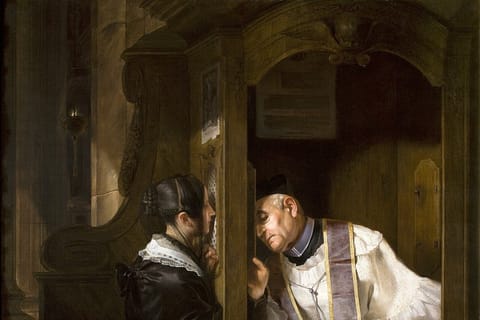
You do not have to carry the weight alone. A priest or pastor can listen in confidence, pray with you, and, if you wish, hear your confession and declare God’s forgiveness; see do I have to confess my sins to a priest? and will God forgive me?. “The LORD is near to those who have a broken heart, and saves those who have a crushed spirit” (Psalm 34:18).
Julian of Norwich, an English anchoress of the fourteenth century, heard Christ speak a word of comfort that she believed was meant for every Christian. It belongs to anyone who comes to this page carrying sorrow:
Thou shalt not be overcome … For He loveth and enjoyeth us, and so willeth He that we love and enjoy Him and mightily trust in Him; and all shall be well.
Julian of Norwich, Revelations of Divine Love, chapter 68, ed. Grace Warrack (1901)
Notes
-
Hebrew (Westminster Leningrad Codex): וְכִֽי־יִנָּצ֣וּ אֲנָשִׁ֗ים וְנָ֨גְפ֜וּ אִשָּׁ֤ה הָרָה֙ וְיָצְא֣וּ יְלָדֶ֔יהָ וְלֹ֥א יִהְיֶ֖ה אָס֑וֹן עָנ֣וֹשׁ יֵעָנֵ֗שׁ כַּֽאֲשֶׁ֨ר יָשִׁ֤ית עָלָיו֙ בַּ֣עַל הָֽאִשָּׁ֔ה וְנָתַ֖ן בִּפְלִלִֽים׃ וְאִם־אָס֖וֹן יִהְיֶ֑ה וְנָתַתָּ֥ה נֶ֖פֶשׁ תַּ֥חַת נָֽפֶשׁ׃ Veyatse’u yeladeha means literally “and her children go out”; ason means “harm” or “disaster”; nefesh tachat nafesh means “life for life.” ↩︎
Common questions
Will God forgive me for having an abortion?
Yes. God’s mercy reaches everyone who turns to God, and Scripture promises, “If we confess our sins, he is faithful and righteous to forgive us the sins” (1 John 1:9). If grief or guilt weighs on you, a priest or pastor can pray with you and, if you wish, hear your confession and declare God’s forgiveness.
When does life begin according to the Bible?
The Bible does not answer the question in scientific or legal terms. Psalm 139 and Jeremiah 1:5 speak of God knowing and forming a person in the womb, and many Christians conclude that a human person exists from conception. Other Christians note that these are poems about God’s care and calling, and the Presbyterian Church (U.S.A.) has acknowledged that its members hold several different views on when human life begins.
Is abortion murder according to the Bible?
The Bible does not use the word abortion, so it never calls abortion murder. The Didache, a Christian handbook from the late first or early second century, forbade abortion alongside murder, and many Orthodox and evangelical Christians still hold that abortion takes a human life. The mainline churches regard abortion as a serious moral matter but do not call it murder.
What do the mainline churches say about abortion?
The ELCA, the PC(USA), the United Methodist Church, and the Episcopal Church all treat abortion as a grave moral decision, and all support legal access to abortion in at least some circumstances. They differ in emphasis. The ELCA calls abortion an option only of last resort and opposes it after the fetus could live outside the womb, with narrow exceptions, while the Episcopal Church’s General Convention affirmed access to abortion without restriction in 2022.
Sources
- Psalm 139:13–16 (WEB)
- Exodus 21:22–25 (WEB)
- Jeremiah 1:5 (WEB)
- The Didache, chapter 2 (New Advent)
- Mishnah Oholot 7:6 (Sefaria)
- Basil of Caesarea, Letter 188, canon 2 (New Advent)
- Episcopal Church General Convention, Resolution 1988-C047, Adopt a Statement on Childbirth and Abortion
- Episcopal Church General Convention, Resolution 2022-D083, Affirm the Reproductive Rights and Autonomy of All Episcopalians
- ELCA social statement, Abortion (1991)
- PC(USA), Problem Pregnancies and Abortion (1992)
- United Methodist Social Principles: Reproductive Health and Abortion