Guns, violence, and the peace of Christ
The Bible was written long before firearms, and it speaks often about violence and peace. Jesus told Peter, “Put your sword back into its place,” and the prophets foresaw a day when the nations “beat their swords into plowshares.” The ELCA, the PC(USA), the United Methodist Church, and the Episcopal Church grieve with the victims of gun violence and call Christians, including the many church members who hunt or own guns, to work for safer communities.
They shall beat their swords into plowshares, and their spears into pruning hooks.
The Bible was written long before anyone made a firearm, and it speaks often about violence, grief, and the peace God desires for every community. Perhaps you are reading this after another shooting in the news, or after one in your own town. Perhaps you have lost someone. Perhaps you own guns for hunting or for the protection of your family and want to think about them as a Christian. Scripture has words for each of these, and the mainline churches have tried to speak them with care.
If you are thinking about ending your life, please call or text 988 in the United States to reach the 988 Suicide and Crisis Lifeline, or find a line in your country at findahelpline.com. You are loved, and help is near.
What does the Bible say about violence?
Violence enters the Bible almost as soon as human beings leave the garden. When Cain kills his brother Abel, God says, “The voice of your brother’s blood cries to me from the ground” (Genesis 4:10). From that first murder on, Scripture insists that God hears the cry of every person whose life is taken by violence.
The commandment “You shall not murder” guards the gift of life. Jesus went further and traced violence back to its roots in the heart, warning that anger and contempt for a brother or sister already stand under judgment (Matthew 5:21–22). Christians have long disagreed about whether force may be used to protect the innocent, and the tradition from Augustine onward has allowed it in narrow cases (see killing in war or self-defense). The whole tradition agrees that human life is precious to God and that peace is God’s will for the world.
What did Jesus mean by “those who take the sword will die by the sword”?
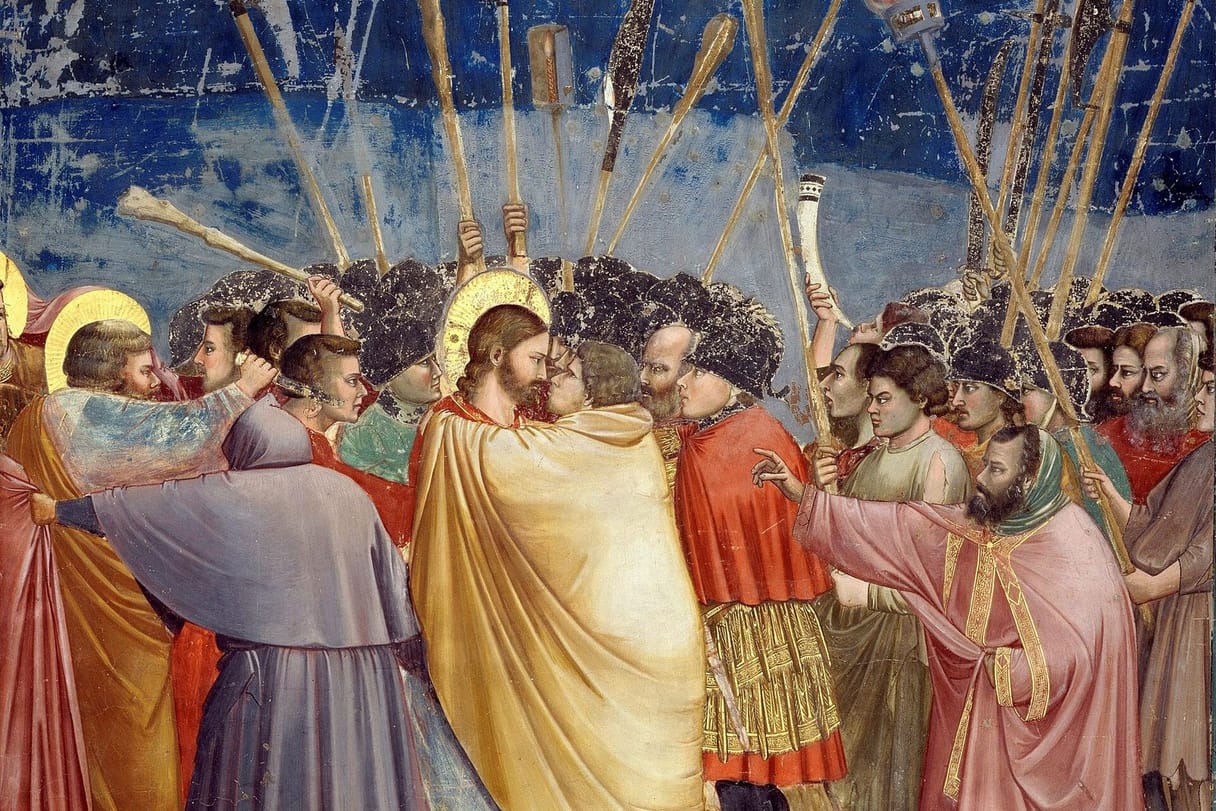
On the night of his arrest, when the soldiers came for Jesus in the garden of Gethsemane, one of his disciples drew a sword and struck the high priest’s servant. Jesus stopped him:
Then Jesus said to him, “Put your sword back into its place, for all those who take the sword will die by the sword.
Jesus could have been defended that night, and he chose to meet his enemies without a weapon. Around the year 200, Tertullian of Carthage wrote that the Lord, “in disarming Peter,” had disarmed every soldier (On Idolatry 19). Christians today draw different conclusions from his words, and Gethsemane still shows how Christ himself met violence.
A few verses in Luke are sometimes read differently. Earlier that evening Jesus told the disciples that whoever had no sword should sell a cloak and buy one, and when they showed him two swords he said, “That is enough” (Luke 22:36–38). Some Christians read the passage as permission to carry arms for protection. Many interpreters read it as a figure of speech about the danger ahead, because a few hours later Jesus refused to let a sword be used on his behalf.
What does “swords into plowshares” mean?
The prophets Isaiah and Micah share a vision of the day when God will judge between the nations and teach them peace:
They will beat their swords into plowshares, and their spears into pruning hooks. Nation will not lift up sword against nation, neither will they learn war any more. But every man will sit under his vine and under his fig tree. No one will make them afraid, for the mouth of the LORD of Armies has spoken.
The weapons in the vision are remade into farm tools, and the people who once carried them can rest at home without fear. Micah’s promise answers the fear that leads many people to arm themselves. God desires a world where nobody needs to be afraid. The prophet Zechariah pictures the same peace in a city where old men and women once again walk the streets with their staffs and the streets are “full of boys and girls playing” (Zechariah 8:4–5).
How should Christians grieve after a shooting?
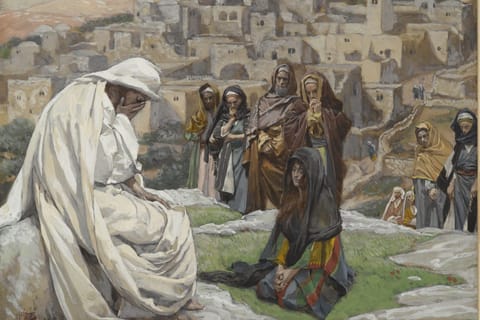
Matthew’s Gospel tells of King Herod’s slaughter of the children of Bethlehem and recalls the words of Jeremiah: “Rachel weeping for her children. She refuses to be comforted for her children, because they are no more” (Jeremiah 31:15). The Bible makes room for grief that will not be hurried. At the tomb of his friend Lazarus, “Jesus wept” (John 11:35). Paul asks the church to “weep with those who weep” (Romans 12:15).
If you have lost someone to gun violence, the psalm is for you: “The LORD is near to those who have a broken heart, and saves those who have a crushed spirit” (Psalm 34:18). Your church can hold you in prayer and walk with you through the long months after the funerals end (see grief and the Christian hope).
Many gun deaths never reach the news. According to the Pew Research Center, 54 percent of gun deaths in the United States in 2021 were suicides. Families who lose someone this way carry a particular sorrow, often with questions that have no answers in this life (see why God allows suffering), and the church surrounds them with the same love and hope it offers every grieving family (see suicide and the Christian faith).
What do the mainline churches teach about gun violence?
The mainline churches have each spoken about gun violence as a wound in the life of the nation. In 1994 the ELCA Church Council adopted a social message on community violence that named “readily available weapons of destruction” as part of a wider culture of violence. The message also recognized that many ordinary citizens see owning a gun as “their last line of defense against the chaos in society.”
The 219th General Assembly of the Presbyterian Church (U.S.A.) approved the report Gun Violence, Gospel Values: Mobilizing in Response to God’s Call in 2010. It encouraged congregations to work with their neighbors on community-based efforts against gun violence, drawing on the example of Heeding God’s Call, a faith-based movement that began in Philadelphia.
The United Methodist Church’s resolution “Our Call to End Gun Violence,” in its 2016 Book of Resolutions, begins in lament: “United Methodists mourn with the victims and families of those wounded or killed.” It asks congregations to make the prevention of gun violence part of their prayer, and it asks United Methodist gun owners to help by safely storing and securing their guns. It does not call for a ban on guns. In the Episcopal Church, nearly 100 bishops belong to Bishops United Against Gun Violence, a network formed in early 2013 after the shootings of 2012 at a Sikh temple in Oak Creek, Wisconsin, and at Sandy Hook Elementary School in Newtown, Connecticut.
Christians disagree, in good faith, about which laws would best reduce gun deaths, and many devoted church members hunt, shoot for sport, or keep a gun for protection. The churches address all of them as fellow members called to protect life.
What can I do?
Jesus said, “Blessed are the peacemakers, for they shall be called children of God” (Matthew 5:9). Peacemaking can start close to home: praying for victims by name, keeping any guns in your home locked and stored safely, mentoring a young person, supporting a neighbor after a loss, or joining your congregation in work for a safer community (see Micah 6:8).
A prayer from the Book of Common Prayer of 1662, said at Evening Prayer for centuries, asks for the peace that only God can give:
O God, from whom all holy desires, all good counsels, and all just works do proceed; Give unto thy servants that peace which the world cannot give; that both our hearts may be set to obey thy commandments, and also that by thee, we, being defended from the fear of our enemies, may pass our time in rest and quietness; through the merits of Jesus Christ our Saviour. Amen.
The Second Collect at Evening Prayer, Book of Common Prayer (1662)
If you are struggling and there is a gun in your home, ask someone you trust to keep it for a while, and call or text 988 in the United States, any hour of the day or night.
Common questions
Can Christians own guns?
Many faithful Christians own guns for hunting, sport, or the protection of their homes, and the mainline churches count them among their members. The United Methodist resolution on gun violence asks gun owners to store their guns safely and securely. Christians disagree about the right laws, and they share a calling to protect life and seek peace.
What does “live by the sword, die by the sword” mean?
The saying comes from Matthew 26:52, where Jesus tells Peter, who has just drawn a sword to defend him, “Put your sword back into its place, for all those who take the sword will die by the sword.” Christians have read it as a warning that violence breeds more violence and as a sign of the way Jesus chose to meet his enemies.
Did Jesus tell his disciples to buy swords?
In Luke 22:36 Jesus tells the disciples that whoever has no sword should buy one, and when they show him two swords he says, “That is enough.” Some Christians read the passage as permission to carry arms for protection. Many interpreters read it as a figure of speech about the danger ahead, since a few hours later Jesus stopped a disciple from using a sword.
Where can I get help if I am thinking about suicide?
In the United States you can call or text 988 to reach the 988 Suicide and Crisis Lifeline at any hour. Outside the United States, findahelpline.com lists crisis lines by country. If a gun is in your home and you are struggling, asking a trusted person to hold it for a while is an act of care for yourself.
Sources
- Matthew 26:51–52 (WEB)
- Isaiah 2:4 (WEB)
- Micah 4:3–4 (WEB)
- Luke 22:36–38 (WEB)
- Jeremiah 31:15 (WEB)
- Tertullian, On Idolatry, chapter 19 (New Advent)
- From Controlling Guns to Making Peace: An Assessment of ELCA Social Policy and Public Witness (Journal of Lutheran Ethics)
- Gun Violence, Gospel Values: Mobilizing in Response to God’s Call (PC(USA), 2010)
- Ways United Methodists can take a stand against gun violence (ResourceUMC)
- United Methodist Church works to end gun violence (UM News, 2016)
- Bishops United Against Gun Violence
- What the data says about gun deaths in the U.S. (Pew Research Center)
- The Book of Common Prayer (1662), Evening Prayer
- 988 Suicide & Crisis Lifeline