What Methodists, Lutherans, Presbyterians, and Episcopalians believe about abortion
The United Methodist Church, the ELCA, the Presbyterian Church (U.S.A.), and the Episcopal Church all treat abortion as a grave moral decision, honor unborn life, and support legal access to abortion in at least some circumstances. They differ on limits. The Methodist and Lutheran statements accept abortion reluctantly and support some legal limits, while recent Presbyterian and Episcopal assemblies have opposed government restrictions on access. All of them call their congregations to compassion for women facing the decision.
For you formed my inmost being. You knit me together in my mother’s womb.

People search for their church’s teaching on abortion for many reasons. Some face a pregnancy that frightens them. Some are preparing to vote, or trying to understand a friend. Some had an abortion years ago and still wonder whether their church would receive them. Whatever brings you here, you should know that the mainline churches hold two convictions together. Every human life is precious to God, and a woman facing a hard pregnancy must make a grave decision before God in circumstances no law can foresee.
The United Methodist Church, the Evangelical Lutheran Church in America (ELCA), the Presbyterian Church (U.S.A.), and the Episcopal Church all support legal access to abortion in at least some circumstances. They differ on where the limits belong.
| Church | Position in brief | Key statement and year |
|---|---|---|
| United Methodist Church | Reluctant to condone abortion; supports the legal option in “tragic conflicts of life with life” | Social Principles, “Reproductive Health and Abortion” (revised 2024) |
| Evangelical Lutheran Church in America | Abortion is “an option only of last resort”; opposes both a total ban and no regulation at all | Social statement Abortion (1991) |
| Presbyterian Church (U.S.A.) | Abortion is a last resort that can be morally acceptable; opposes laws limiting access | Problem Pregnancies and Abortion (1992); General Assembly resolution (2022) |
| Episcopal Church | Every abortion has “a tragic dimension”; access should have no restriction on timing | General Convention resolutions 1988-C047 and 2022-D083 |
| United Church of Christ | Supports freedom of choice and calls abortion health care | General Synod resolutions (1971, 2023) |
| Christian Church (Disciples of Christ) | Upholds freedom of conscience; opposes writing one religious view into law | General Assembly resolution (1975) |
| American Baptist Churches USA | Opposes abortion as birth control; acknowledges deep differences among members | Resolution on abortion (1988, modified 1994 and 2002) |
What do Methodists believe about abortion?
The United Methodist Church, the largest mainline Methodist church in the United States, states its position in its Social Principles, revised in 2024. Their section on reproductive health and abortion says, “Our commitment to the sanctity of human life makes us reluctant to condone abortion.” The church rejects abortion as a means of birth control or gender selection, and it opposes late-term abortion except when the mother’s life is in danger or severe abnormalities threaten the viability of the fetus.
The Social Principles also recognize that “tragic conflicts of life with life may justify decisions to terminate the life of a fetus,” and in those limited circumstances the church supports “the legal option of abortion.” They urge anyone considering abortion to seek medical advice and pastoral counsel, encourage alternatives such as adoption, and say, “we do not condone bullying or shaming people for their decisions or actions.” See what do Methodists believe?
What do Lutherans believe about abortion?
The Evangelical Lutheran Church in America, the largest Lutheran church in the United States, teaches from its 1991 social statement Abortion. The statement says, “A developing life in the womb does not have an absolute right to be born, nor does a pregnant woman have an absolute right to terminate a pregnancy.” It calls abortion “an option only of last resort.”
The ELCA judges abortion morally responsible when a pregnancy clearly threatens the woman’s life, and it says that a woman should not be morally obligated to carry to term a pregnancy that results from rape or incest. On law, it opposes both “the total lack of regulation of abortion” and “legislation that would outlaw abortion in all circumstances.” It supports laws that prohibit abortion after the fetus is viable, except when the mother’s life is threatened or when lethal abnormalities mean the newborn will die very soon.
What do Presbyterians believe about abortion?
The Presbyterian Church (U.S.A.), the largest Presbyterian church in the United States, adopted Problem Pregnancies and Abortion at its 1992 General Assembly. The statement says, “The strong Christian presumption is that since all life is precious to God, we are to preserve and protect it. Abortion ought to be an option of last resort.” It also teaches that a woman’s considered decision to end a pregnancy “can be a morally acceptable, though certainly not the only or required, decision,” and it says abortion should not be used as a method of birth control.
In July 2022 the General Assembly voted 348 to 38 to affirm that “women and pregnant people are full moral agents, created in the image of God,” and to reject government attempts to limit access to contraception and abortion care.
What do Episcopalians believe about abortion?
The Episcopal Church, the American member of the worldwide Anglican Communion, speaks through resolutions of its General Convention. In 1988 the Convention declared, “All human life is sacred. Hence, it is sacred from its inception until death.” The same resolution says, “We regard all abortion as having a tragic dimension,” opposes abortion as a means of birth control or for “any reason of mere convenience,” and asks that any law on abortion respect individual conscience.
In 2022 the Convention affirmed that “all Episcopalians should be able to access abortion services and birth control with no restriction on movement, autonomy, type, or timing” (Resolution 2022-D083). That resolution reaffirmed words from the 1988 statement, and both resolutions remain on the church’s record.
What do the United Church of Christ, the Disciples of Christ, and American Baptists believe?
The United Church of Christ has supported a woman’s freedom of choice since its General Synod adopted “Freedom of Choice Concerning Abortion” in 1971. In 2023 the General Synod voted 611 to 24 for a resolution “Denouncing the Dobbs Decision and Proclaiming Abortion as Healthcare.”
The Christian Church (Disciples of Christ) addressed abortion at its 1975 General Assembly, which affirmed “individual liberty, freedom of individual conscience, and sacredness of life for all persons” and opposed any attempt to impose one religious belief about abortion on all Americans by law.
American Baptist Churches USA adopted a resolution in 1988 that opposes abortion as a way of avoiding responsibility for conception or as a primary means of birth control. It describes members who believe abortion destroys a human being created in God’s image, and others who believe “it can be a morally acceptable action,” and it leaves each member free to advocate the public policy they believe in. The resolution says the role of the denomination’s General Board “is not to direct churches, but to assist them in carrying out ministry and advocacy according to their convictions.”
What Scripture and tradition do these churches draw on?
The Bible never mentions deliberately ending a pregnancy (see what does the Bible say about abortion?). Christians on every side of the question treasure the psalm of God’s care for life in the womb:
For you formed my inmost being. You knit me together in my mother’s womb. I will give thanks to you, for I am fearfully and wonderfully made. Your works are wonderful. My soul knows that very well.
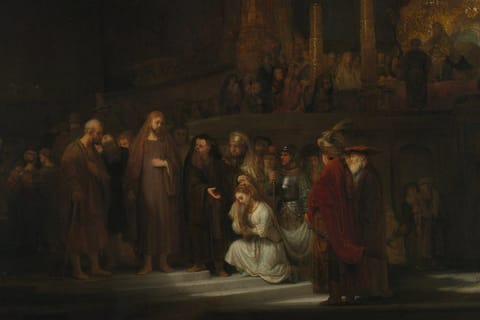
The American Baptist resolution shows how differently Christians read the same Bible. It lists Psalm 139 and Jeremiah 1:5 among the texts cited by members who oppose abortion, and Exodus 21:22–25, a law about harm to a pregnant woman, and Jesus’s mercy to the woman in John 8:1–11 among the texts cited by members who accept it in some cases. The tradition weighs in too: the Didache, a Christian handbook from around 100 CE, forbade abortion, and the Orthodox churches and many evangelicals hold that teaching today. The mainline churches honor that reverence for life and add a second concern, for the woman whose life and conscience are also in God’s hands.
A word for anyone carrying this question
In Genesis 16, Hagar is pregnant, mistreated, and alone in the wilderness when the angel of the LORD finds her by a spring. She gives God a name:
She called the name of the LORD who spoke to her, “You are a God who sees,” for she said, “Have I even stayed alive after seeing him?”
God sees you too, whatever you have decided or are still deciding. If you carry grief or guilt, “the LORD is near to those who have a broken heart” (Psalm 34:18), and no choice puts you beyond God’s mercy. See will God forgive me?
Common questions
Do Methodists support abortion?
The United Methodist Church says its commitment to the sanctity of human life makes it “reluctant to condone abortion.” It rejects abortion as a means of birth control or gender selection, and it supports the legal option of abortion only in limited circumstances, which it describes as “tragic conflicts of life with life.” It also says that it does not condone bullying or shaming anyone for their decisions.
Is the Lutheran church pro-life or pro-choice?
The ELCA's 1991 social statement asks its members to “move beyond the usual ‘prolife’ versus ‘pro-choice’ language.” It calls abortion an option only of last resort, opposes both a total ban and a total lack of regulation, and supports laws against abortion after the fetus is viable, with exceptions for the mother's life and lethal fetal abnormalities.
What is the Presbyterian Church (U.S.A.) stance on abortion?
The PC(USA) holds that all life is precious to God and that abortion should be an option of last resort, and it also teaches that a woman's considered decision to end a pregnancy can be morally acceptable. In 2022 its General Assembly affirmed that women are “full moral agents, created in the image of God” and opposed government efforts to limit access to contraception and abortion care.
Will a mainline church condemn me if I have had an abortion?
The mainline churches’ statements call for compassion toward anyone who has had an abortion. The PC(USA)'s 1992 statement says there is “no biblical evidence” that abortion is an unpardonable sin, and the United Methodist Social Principles reject shaming people for their decisions. A pastor in any of these churches can listen in confidence and pray with you.
Sources
- Psalm 139:13–14 (WEB)
- Genesis 16:13 (WEB)
- Exodus 21:22 (WEB)
- United Methodist Social Principles (2024): The Social Community, K. Reproductive Health and Abortion
- ELCA social statement, Abortion (1991)
- PC(USA), Problem Pregnancies and Abortion (1992)
- Resolution rejects government attempts to limit access to contraceptive and abortion care (PC(USA), 2022)
- Episcopal General Convention Resolution 1988-C047, Adopt a Statement on Childbirth and Abortion
- Episcopal General Convention Resolution 2022-D083, Affirm the Reproductive Rights and Autonomy of All Episcopalians
- The UCC fight for reproductive justice (UCC)
- Abortion is healthcare, General Synod says (UCC, 2023)
- Disciples of Christ General Assembly Resolution No. 0725 (2007), quoting Resolutions No. 7332 (1973) and No. 24 (1975)
- American Baptist Resolution Concerning Abortion and Ministry in the Local Church (1988, modified 1994 and 2002)
- ABCUSA: Policy statements and resolutions