What Methodists, Lutherans, Presbyterians, and Episcopalians believe about the death penalty
The United Methodist Church, the Evangelical Lutheran Church in America, the Presbyterian Church (U.S.A.), and the Episcopal Church all oppose the death penalty and call for its abolition, as do the United Church of Christ, the Disciples of Christ, and American Baptist Churches USA. Most of these positions date from the 1950s and 1960s. The churches ground them in the dignity of every person, the hope of repentance, unequal justice, and care for victims’ families.
As I live, says the Lord GOD, I have no pleasure in the death of the wicked, but that the wicked turn from his way and live.
The United Methodist Church, the Evangelical Lutheran Church in America (ELCA), the Presbyterian Church (U.S.A.), and the Episcopal Church all oppose the death penalty and call for its abolition. The United Church of Christ, the Christian Church (Disciples of Christ), and American Baptist Churches USA do the same. Most of these churches have held this position since the 1950s or 1960s.
People come to this question from very different places. Some have lost someone to murder and want to know whether their church will stand with them. Some love a person in prison. Some have served on a jury or want to know what their faith asks of them as citizens. The churches’ statements speak to all of them, and the Lutheran and Methodist statements make room for the grief of victims’ families.
| Church | Position in brief | Key statement and year |
|---|---|---|
| United Methodist Church | Opposes capital punishment and calls for its abolition; asks congregations to minister to families of victims | Social Principles (2024); opposition since 1956 |
| Evangelical Lutheran Church in America | Opposes the death penalty; supports life imprisonment without parole as an alternative | The Death Penalty, social statement (1991) |
| Presbyterian Church (U.S.A.) | Opposes the death penalty; called for a moratorium on executions | General Assembly actions (1959, 1985, 2000) |
| Episcopal Church | Opposes capital punishment as contrary to “the witness of Jesus” | Resolutions 1979-D004 and 2015-D025; opposition since 1958 |
| UCC, Disciples of Christ, American Baptists | All three call for abolition | UCC (1969); Disciples (1957); ABCUSA (1958, reaffirmed 1982 and 2000) |
What do Methodists believe about the death penalty?
The United Methodist Church, the largest Methodist church in the United States, opposes capital punishment. Its Social Principles, as revised in 2024, say that “our commitment to the inherent dignity and worth of every person and our historic stance as United Methodists compels us to oppose capital punishment and the imposition of the death penalty.” They note that the death penalty falls most heavily on people who are poor, uneducated, from marginalized racial and ethnic communities, or mentally impaired, and that many people have been wrongly convicted. They conclude, “We, therefore, call for the abolition of the death penalty.”
The same paragraph asks pastors and congregations to minister to those who have lost loved ones to violent crime. The Social Principles recall that John Wesley once preached at least 67 times in jails over nine months. According to the Pew Research Center, the Methodist Church’s General Conference first declared its opposition to the death penalty in 1956.
What do Lutherans believe about the death penalty?
The Evangelical Lutheran Church in America, the largest Lutheran church in the United States, adopted a social statement called The Death Penalty in 1991. It begins with victims, recalling that since Cain killed Abel “the blood of countless victims has cried out to the Lord.” It then says, “It is because of this church’s ministry with and to people affected by violent crime that we oppose the death penalty.” Executions, the statement argues, focus on the person convicted and give very little to the victim’s family.
The statement recognizes the government’s responsibility to protect people and to keep dangerous offenders from society. It asks that this be done in a way that “holds open the possibility of conversion and restoration.” Among its commitments: “we urge the abolition of the death penalty, and support alternative and appropriate punishment for capital crime, including the possibility of life sentence without parole.”
What do Presbyterians believe about the death penalty?
The Presbyterian Church (U.S.A.), the largest Presbyterian church in the United States, and the churches that formed it have opposed the death penalty since 1959. That year the General Assembly urged Christians to “seek the redemption of evil doers and not their death.” In 1985 the General Assembly affirmed that “capital punishment cannot be condoned by an interpretation of the Bible based upon the revelation of God’s love in Jesus Christ.”
In 2000 the 212th General Assembly reaffirmed that opposition and called for a moratorium on executions, citing strong evidence that the death penalty is applied in a racially biased way. In 2005, when the thousandth execution since 1976 took place in the United States, the church’s Stated Clerk said that the possibility of redemption must be left open for every human being.
What do Episcopalians believe about the death penalty?
The Episcopal Church, the member of the worldwide Anglican Communion in the United States, has opposed capital punishment since its 1958 General Convention. In 1979 the Convention reaffirmed “its opposition to capital punishment” and called on dioceses and members “to work actively to abolish the death penalty in their States” (Resolution 1979-D004).
In 2015 the Convention reaffirmed “its longstanding call to put an end to the death penalty,” saying that it “is disproportionately applied to the poor and to minorities and is in direct opposition to the witness of Jesus” (Resolution 2015-D025). It asked bishops in states with the death penalty to form task forces of clergy and lay people to work for its end.
What do the United Church of Christ, the Disciples of Christ, and American Baptists believe?
All three churches call for abolition. The General Synod of the United Church of Christ adopted a Resolution to Abolish Capital Punishment in 1969 and has reaffirmed it many times since. In 1957 the International Convention of Christian Churches (Disciples of Christ), meeting in Cleveland, resolved that “Christians can no longer justify support of the practice of capital punishment.”
American Baptists first adopted their resolution in 1958 and 1966, and the Executive Committee of their General Board reaffirmed it in 1982 and revised it in 2000. It appeals to “the sacredness of life and the obligation to ‘overcome evil with good’” and to “the hope and possibility of all to come under the redeeming and transforming action of God.” It states, “We as American Baptists, condemn the reinstatement of capital punishment and oppose its use under any new or old state or federal law.”
What Scripture and tradition do these churches draw on?
Christians who support capital punishment for murder point to the command given to Noah, which grounds the penalty in the image of God (Genesis 9:6), and to Paul’s words that the governing authority “doesn’t bear the sword in vain” (Romans 13:4). They hold the view out of a serious concern for justice, and the mainline churches share that concern.
The churches that oppose the death penalty read those passages alongside the rest of Scripture. God put a mark on Cain, the first murderer, “so that anyone finding him would not strike him” (Genesis 4:15). The prophet Ezekiel announced God’s will for the guilty:
As I live, says the Lord GOD, I have no pleasure in the death of the wicked, but that the wicked turn from his way and live.
Jesus set aside “an eye for an eye” for his followers (Matthew 5:38–39), and when a crowd was ready to stone a woman under the law of Moses, he said, “He who is without sin among you, let him throw the first stone at her” (John 8:7). Paul told the Christians in Rome, “Don’t be overcome by evil, but overcome evil with good” (Romans 12:21).
The tradition carries the same caution. The Mishnah, the early collection of Jewish law, says that a court which executed one person in seven years was called destructive (Makkot 1:10). In 412 Augustine pleaded with a Roman official not to execute men who had killed a priest: “Fulfil, Christian judge, the duty of an affectionate father” (Letter 133). For a fuller reading of the biblical texts, see What does the Bible say about the death penalty?
Justice and mercy at the cross
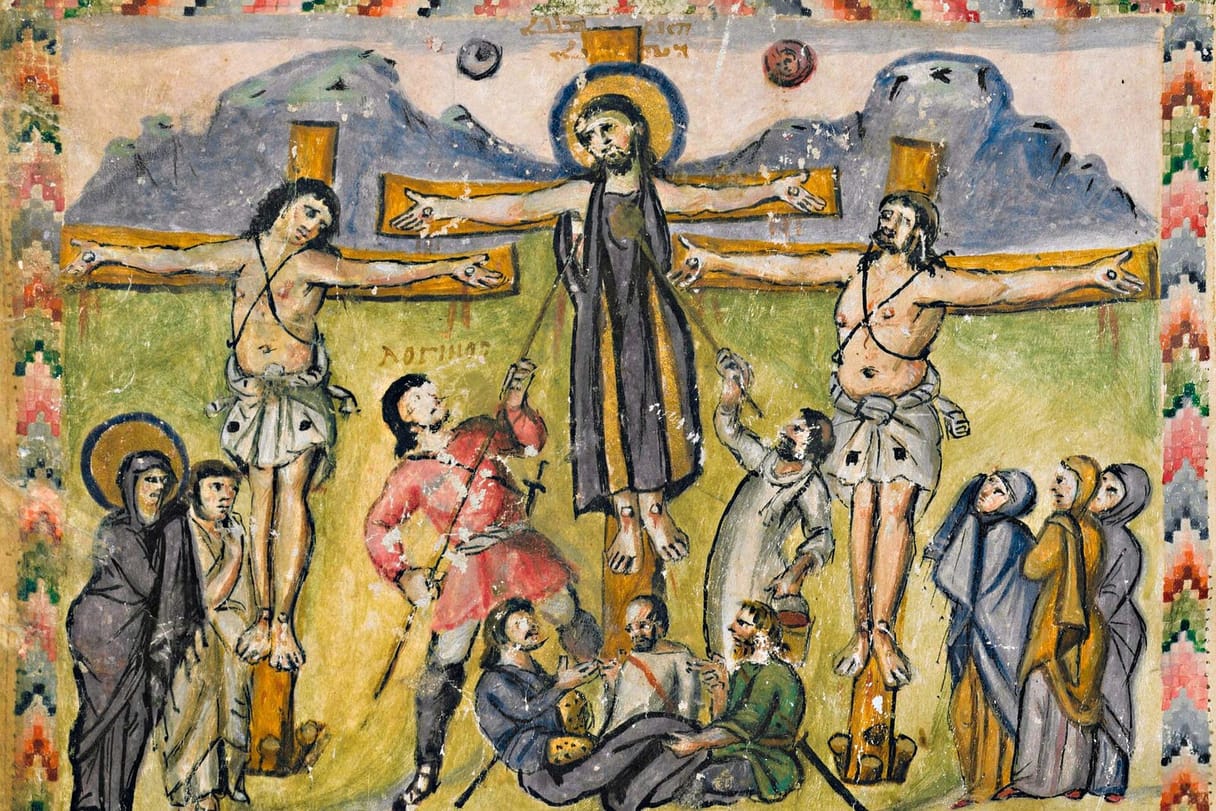
Christians worship a Lord who was himself condemned by a court and executed by the state. If you are grieving someone taken by violence, God hears your cry for justice, and the churches’ statements ask congregations to stand with you. If you love someone who has done terrible harm, God has not stopped loving that person either. For the hard work of mercy toward those who have hurt us, see Do I have to forgive someone who hurt me? As Jesus died, a condemned man beside him asked to be remembered:
He said to Jesus, “Lord, remember me when you come into your Kingdom.” Jesus said to him, “Assuredly I tell you, today you will be with me in Paradise.”
Common questions
Does the United Methodist Church support the death penalty?
No. The United Methodist Social Principles, revised in 2024, say that the church’s commitment to the dignity and worth of every person compels it to oppose capital punishment, and they “call for the abolition of the death penalty.” Methodist opposition goes back to a 1956 General Conference of the Methodist Church.
Do Lutherans believe in the death penalty?
The Evangelical Lutheran Church in America opposes the death penalty. Its 1991 social statement The Death Penalty recognizes the government’s duty to protect people, urges the abolition of capital punishment, and supports life imprisonment without parole as an alternative.
Do Episcopalians support the death penalty?
No. The Episcopal Church’s General Convention has opposed capital punishment since 1958 and reaffirmed that opposition in 1979 and 2015. In 2015 it called the death penalty “in direct opposition to the witness of Jesus.”
Why do some Christians support the death penalty?
Christians who support capital punishment for murder usually cite Genesis 9:6, which grounds the penalty in the image of God, and Romans 13:4, where Paul says the governing authority does not bear the sword in vain. They hold this view out of concern for justice and for the victims of violent crime. The mainline churches share that concern and conclude that the state can protect the public without killing.
Sources
- United Methodist Social Principles (2024): The Political Community, D. The Death Penalty and E. Criminal Justice
- ELCA social statement, The Death Penalty (1991)
- Presbyterian News Service: Stated Clerk on the 1,000th execution, summarizing General Assembly actions of 1959, 1985, and 2000 (2005)
- PC(USA), Moratorium on Capital Punishment (212th General Assembly, 2000)
- Episcopal General Convention Resolution 1979-D004, Reaffirm Opposition to Capital Punishment
- Episcopal General Convention Resolution 2015-D025, Abolish the Death Penalty
- Pew Research Center, Religious groups’ official positions on capital punishment (2009)
- UCC: Capital punishment
- Worldwide Faith News: Disciples of Christ and United Church of Christ statements on capital punishment (1998)
- American Baptist Resolution on Capital Punishment (1958, 1966, 1982, 2000)
- Augustine, Letter 133 (New Advent)
- Mishnah Makkot 1:10 (Sefaria)
- Ezekiel 33:11 (WEB)
- Luke 23:39–43 (WEB)