Satan and the powers of evil
Evil is real, and the Bible gives it a name: Satan. The word satan means “accuser” in Hebrew, and in Job and Zechariah “the satan” is a prosecutor in God’s heavenly court. Later writings developed this figure into the devil, the enemy of God. Many Christians believe Satan is a personal being; others take the name as a way of speaking about evil larger than any person. All Christians renounce Satan at baptism and trust that Christ has defeated evil.
Submit yourselves therefore to God. Resist the devil, and he will flee from you.
James 4:7, NRSVUE
Evil is real, and the Bible gives it a name: Satan. If you are asking because you are afraid, whether of the devil himself or of the darkness you have seen in the world or felt in your own heart, Scripture’s first word to you is good news: Christ has overcome evil, and nothing can separate you from the love of God. The Bible’s picture of Satan also grows over the centuries, from an official in God’s court to the great enemy of God.
Who is Satan in the Old Testament?
The Hebrew word satan means “adversary” or “accuser.” It is often an ordinary noun. In Numbers 22, the angel of the LORD himself stands in the road “as an adversary against him” to block the prophet Balaam (Numbers 22:22), and the Hebrew word there is satan.
With the definite article, ha-satan (“the satan”), the word appears in only two books of the Hebrew Bible: Job and Zechariah. In both, the satan is a member of God’s heavenly council whose job is to accuse. The NRSVUE translates the title as “the accuser” and notes that the Hebrew reads “the satan”:
One day the heavenly beings came to present themselves before the Lord, and the accuser also came among them. The Lord said to the accuser, “Where have you come from?” The accuser answered the Lord, “From going to and fro on the earth and from walking up and down on it.”
Job 1:6–7, NRSVUE
The accuser questions whether Job serves God “for nothing” and can act against Job only with God’s permission (Job 1:9–12). The Jewish Encyclopedia describes him in this story as “the celestial prosecutor” who “has no power of independent action.” In Zechariah 3 the accuser, again ha-satan in Hebrew, stands at the right hand of the high priest Joshua to accuse him, and the LORD rebukes the accuser (Zechariah 3:1–2). Even here, at the beginning, the accuser does not have the last word.
You can watch the idea grow within the Bible itself by comparing two accounts of the same event. The older account in 2 Samuel says that “the LORD’s anger burned against Israel, and he moved David against them” to take a census (2 Samuel 24:1). The later retelling in Chronicles says instead: “Satan stood up against Israel, and moved David to take a census of Israel” (1 Chronicles 21:1). Many scholars note that 1 Chronicles 21:1 is the only verse in the Hebrew Bible where Satan is clearly used as a proper name.
How did the satan become the devil?
In the centuries between the Old and New Testaments, Jewish writers developed a fuller account of evil spiritual powers. Books such as 1 Enoch told of rebellious angels, and the book of Jubilees named a chief of evil spirits, Mastema. Many scholars think contact with Persian religion, which pictured a struggle between a good god and an evil spirit, influenced this development, though how much is debated.
Later writers also connected the satan with the serpent in Eden. Genesis itself calls the serpent “more subtle than any animal of the field which the LORD God had made” and never mentions Satan (Genesis 3:1). The Wisdom of Solomon, a Jewish book included in the Apocrypha, says that “death entered into the world by the envy of the devil” (Wisdom 2:24). By the time of Revelation, the two figures have become one: “the old serpent, he who is called the devil and Satan, the deceiver of the whole world” (Revelation 12:9).
The English word devil comes from the Greek diabolos, “slanderer.” The name Lucifer comes from Isaiah 14:12, “How you have fallen from heaven, shining one, son of the dawn!” (Isaiah 14:12), a verse that in context mocks the king of Babylon (Isaiah 14:4). The Hebrew word for “shining one,” helel, most likely refers to the morning star. Interpretations by the church fathers, and Jerome’s Latin translation, which renders helel as lucifer (“light-bearer,” the Latin name for the morning star), led Christians to apply the name to Satan.
Rabbinic Judaism took a different path. In the Babylonian Talmud, the rabbi Reish Lakish says, “Satan, the evil inclination, and the Angel of Death are one” (Bava Batra 16a), tying Satan closely to the human pull toward wrongdoing.
What does the New Testament say about Satan?
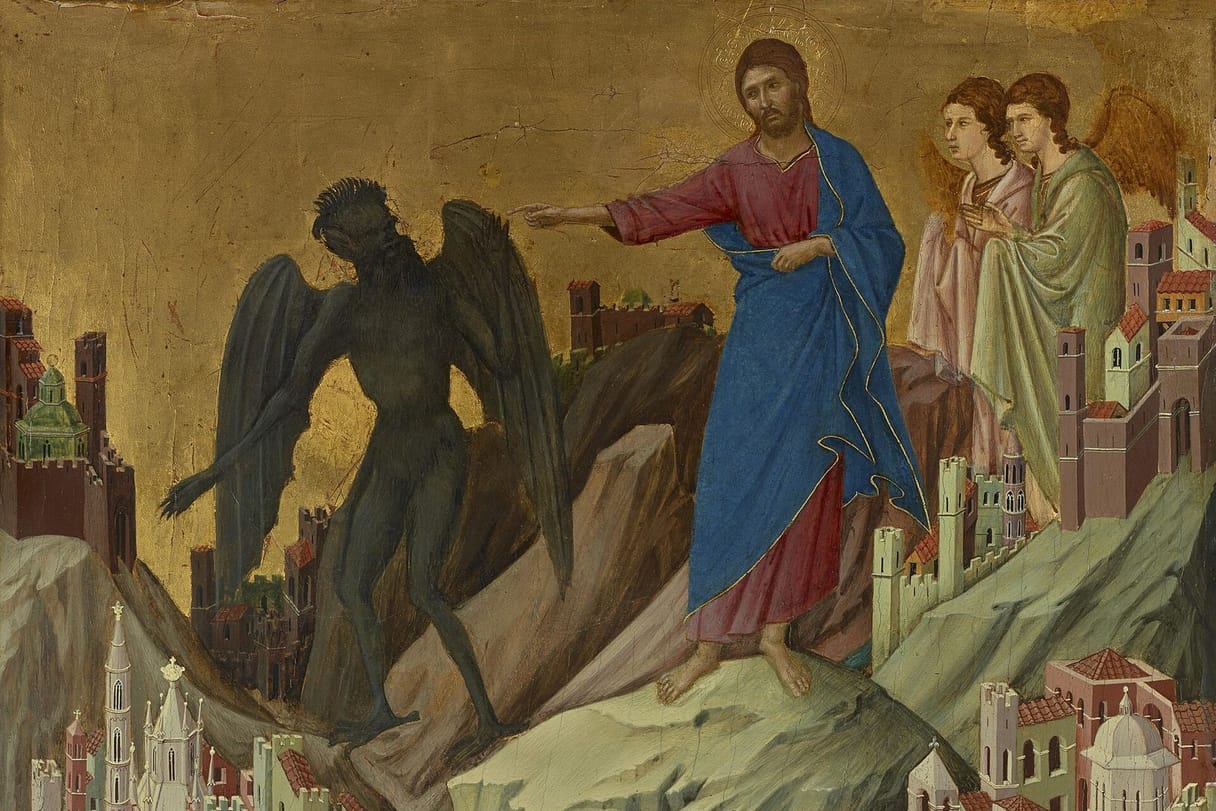
The New Testament speaks of Satan often. Jesus is tested by the devil in the wilderness (Mark 1:13; Matthew 4:1) and answers, “Get behind me, Satan!” (Matthew 4:10). John’s Gospel calls the devil “a liar, and the father of lies” (John 8:44). First Peter warns:
Discipline yourselves; keep alert. Like a roaring lion your adversary the devil prowls around, looking for someone to devour. Resist him, steadfast in your faith, for you know that your brothers and sisters in all the world are undergoing the same kinds of suffering.
1 Peter 5:8–9, NRSVUE
Paul widens the picture beyond one figure: “our wrestling is not against flesh and blood, but against the principalities, against the powers, against the world’s rulers of the darkness of this age” (Ephesians 6:12).
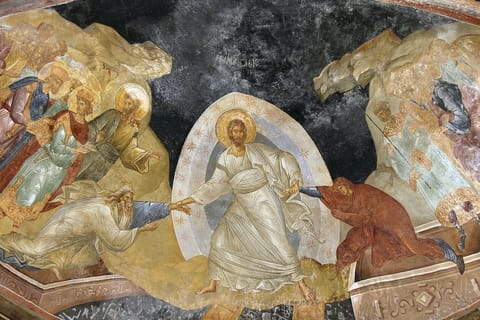
Above all, the New Testament announces that evil has been defeated. “To this end the Son of God was revealed: that he might destroy the works of the devil” (1 John 3:8). On the cross Christ “stripped the principalities and the powers” (Colossians 2:15), and “the God of peace will quickly crush Satan under your feet” (Romans 16:20). Revelation’s images of the devil thrown into a lake of fire belong to a book of symbolic visions (see What is the Book of Revelation about?), and they carry the same promise: evil will come to an end.
Do Christians have to believe in a personal devil?
Faithful Christians answer this in more than one way. Many Christians, including many Orthodox, evangelical, and Pentecostal believers, hold that Satan is a fallen angel, a spirit God created good, who became evil by his own choice. Christian teachers have held that view since the early centuries, and it keeps the whole church mindful of how serious evil is.
Many mainline Christians are more cautious. They note how the figure developed over centuries, and they read Satan as the Bible’s way of naming evil that is personal in its effects without insisting it is a person: deception, accusation, cruelty, and the social systems that corrupt and destroy what God has made. Both readings agree on what matters most. Evil is real, it is more than the sum of individual bad choices, it is no equal of God, and it has no final power over anyone who belongs to Christ. Augustine taught that evil has no being of its own; he called it “the absence of good,” a corruption of something God made good (Enchiridion 11).
What do Christians renounce at baptism?
The baptism services of the mainline churches ask the candidate, or the parents of a child, to renounce evil before turning to Christ. In the Lutheran service the questions come in three:
- “Do you renounce the devil and all the forces that defy God?”
- “Do you renounce the powers of this world that rebel against God?”
- “Do you renounce the ways of sin that draw you from God?”
To each the answer is “I renounce them.” The United Methodist service gathers the same three into one question, asking candidates to “renounce the spiritual forces of wickedness, reject the evil powers of this world, and repent of your sin,” and the Presbyterian and Episcopal services ask much the same. The questions name evil at three levels: spiritual, social, and personal. Then the candidate turns to Jesus Christ and confesses the faith of the church. Christians resist evil chiefly by turning toward Christ, and the order of the questions teaches it.
The practice is ancient, and the Eastern Orthodox churches keep its oldest form. In the fourth century Cyril of Jerusalem described how candidates faced west, the direction of darkness, and said, “I renounce you, Satan,” then turned east toward the light to confess their faith. Cyril explained what the renunciation meant: “I fear your might no longer,” because Christ has overthrown it (Mystagogical Catechesis 1). Orthodox baptisms today still begin with the candidate facing west to renounce Satan and turning east to unite with Christ.
Should I be afraid of Satan?
Scripture calls Christians to stand firm in faith and to live without fear: “Resist the devil, and he will flee from you” (James 4:7). Paul was “persuaded that neither death, nor life, nor angels, nor principalities, nor things present, nor things to come, nor powers … will be able to separate us from God’s love which is in Christ Jesus our Lord” (Romans 8:38–39). Jesus taught his disciples to pray, “deliver us from the evil one” (Matthew 6:13), and you can pray those words whenever fear comes. For the deeper question of why God permits evil at all, see Why does God allow suffering? and What is sin?
Martin Luther gave Christians a short prayer to say before sleep in his Small Catechism, and it ends with these words: “I put myself in your care, body and soul and all that I have. Let Your holy angels be with me, so that the evil enemy will not gain power over me. Amen.” You can pray it tonight and rest in the care of the God who has already overcome the darkness.
Common questions
Is Lucifer the same as Satan?
The name Lucifer comes from Isaiah 14:12, “How you have fallen from heaven, shining one, son of the dawn!” Jerome’s Latin translation renders “shining one” as lucifer, the Latin name for the morning star. In context the verse is a taunt against the king of Babylon. Later Christian interpreters applied the verse to the fall of Satan, which is how Lucifer became another name for the devil.
Was the serpent in Genesis Satan?
Genesis itself calls the serpent “more subtle than any animal of the field which the LORD God had made” and does not mention Satan. Later writings made the connection: the Wisdom of Solomon says “death entered into the world by the envy of the devil,” and Revelation 12:9 speaks of “the old serpent, he who is called the devil and Satan.”
Is Satan as powerful as God?
Christianity does not teach two equal powers, one good and one evil. In Job the accuser can act only with God’s permission, and Augustine taught that evil has no being of its own: it is a lack or corruption of something good. The New Testament proclaims that the Son of God was revealed “that he might destroy the works of the devil” (1 John 3:8).
What did Jesus mean by “Get behind me, Satan”?
Jesus said these words to Peter after Peter rebuked him for predicting his suffering and death (Mark 8:33). Jesus explained, “you have in mind not the things of God, but the things of men.” The word satan here keeps its old meaning of adversary: anyone, even a friend, who tries to turn someone away from God’s purpose.
Sources
- Job 1:6–12 (WEB)
- Zechariah 3:1–2 (WEB)
- 1 Chronicles 21:1 (WEB)
- 2 Samuel 24:1 (WEB)
- Revelation 12:9 (WEB)
- 1 Peter 5:8–9 (WEB)
- Book of Common Prayer (1979), Holy Baptism
- United Methodist Book of Worship, The Baptismal Covenant I
- Jewish Encyclopedia (1906), “Satan”
- Babylonian Talmud, Bava Batra 16a (Sefaria)
- Cyril of Jerusalem, Mystagogical Catechesis 1 (Catechetical Lecture 19)
- Augustine, Enchiridion (Handbook on Faith, Hope and Love), ch. 11
- Martin Luther, Small Catechism, Evening Prayer, trans. Robert E. Smith (Project Wittenberg)