Demons and spiritual warfare
The Gospels describe Jesus driving out demons. The Orthodox churches and many other Christians believe demons are real fallen angels, while many mainline Christians read the demons of Scripture as a first-century way of naming evil and illness. The churches agree that mental illness is not demon possession and should be treated by doctors. The New Testament’s central message about evil powers is that Christ has defeated them, so Christians need not live in fear.
For I am persuaded that neither death, nor life, nor angels, nor principalities, nor things present, nor things to come, nor powers, nor height, nor depth, nor any other created thing will be able to separate us from God’s love which is in Christ Jesus our Lord.
Christian churches agree that evil is real and that Christ has overcome it, and they speak about demons with care. People usually ask about demons for a reason: a frightening experience, a film they cannot stop thinking about, a relative who says an illness is spiritual, or a fear about their own thoughts. Whatever brought you here, the New Testament’s first word about evil powers is good news. Jesus is stronger than all of them, and he meets frightened people with compassion.
The Orthodox churches and most evangelical and Pentecostal churches teach that demons are fallen angels. Many mainline Christians are cautious about describing demons as personal beings, and the baptismal services of the mainline churches still ask candidates to renounce evil before they confess Christ (see Is Satan real?). The Church of England, which keeps a ministry of exorcism for rare cases, places it under the bishop and requires that it be done “in collaboration with the resources of medicine.”
If you are reading because you are frightened, you may want to start with the last section of this page. If you are in crisis or thinking about harming yourself, call or text 988 in the United States to reach the 988 Suicide & Crisis Lifeline, or find a helpline in another country at findahelpline.com.
What does the Bible say about demons?
The Hebrew Bible says very little about demons. Jewish writings from the centuries just before Jesus, such as the book of 1 Enoch, developed a much fuller picture of evil spirits, and by the first century many Jews believed that spirits could cause illness and madness. The Gospels reflect that world.
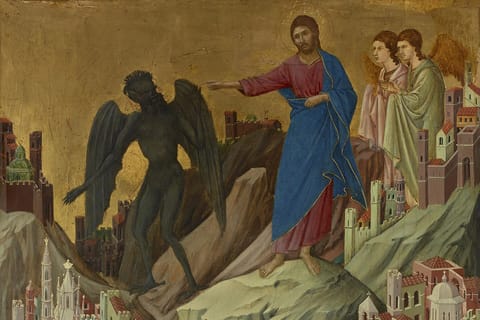
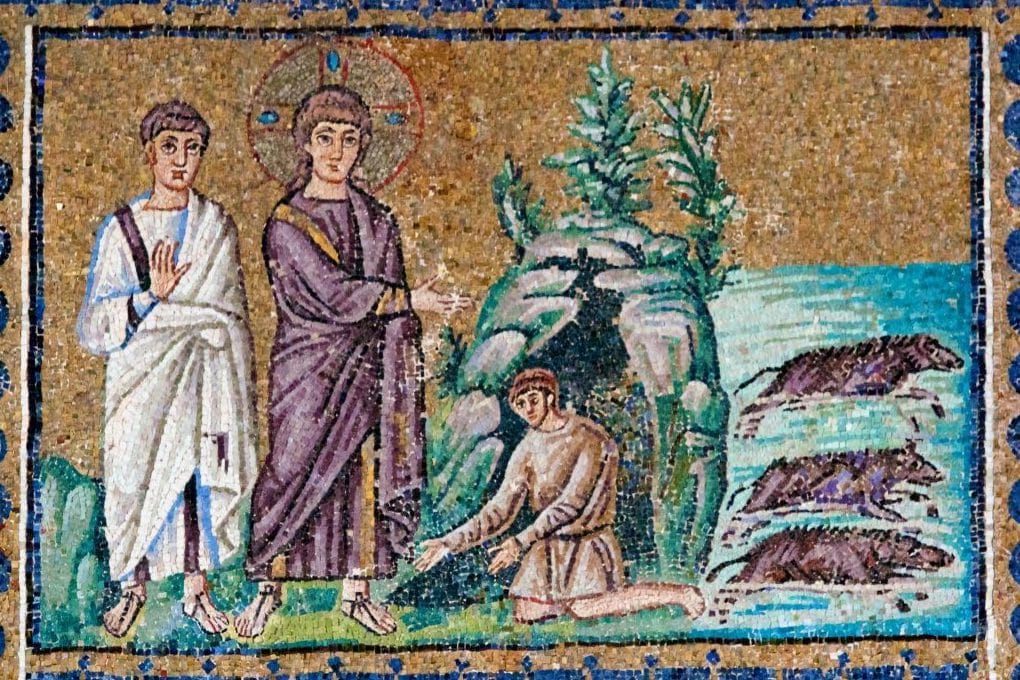
Mark, the earliest Gospel, places an exorcism at the very start of Jesus’ public work. In the synagogue at Capernaum, a man “with an unclean spirit” cried out, and Jesus said, “Be quiet, and come out of him!” The people asked, “What is this? … For with authority he commands even the unclean spirits, and they obey him!” (Mark 1:23–27). Mark also tells of a man in the country of the Gerasenes who lived among the tombs, crying out night and day, until Jesus healed him (Mark 5:1–20).
Jesus himself explained what the exorcisms meant: “if I by God’s finger cast out demons, then God’s Kingdom has come to you” (Luke 11:20). In the Gospels, each person set free is a sign that God’s reign has begun to break the hold of evil, and that God has come close to people whom everyone else had given up on.
How should Christians read Jesus’ exorcisms?
Christians read these stories in different ways, and both readings take them seriously. Many, including the Orthodox churches and most Pentecostal and evangelical churches, take them as Jesus’ victories over real evil spirits. Many mainline Christians read them as healings described in the language of their time, when seizures, deafness, and mental illness were commonly explained as the work of spirits.
The story of the boy in Mark 9 helps explain the second reading. His father says the spirit “throws him down; and he foams at the mouth, grinds his teeth, and becomes rigid” (Mark 9:18). Matthew’s version of the story calls the boy “epileptic” (Matthew 17:15), translating a Greek word that literally means “moonstruck.” Many readers today recognize in these stories conditions that doctors now treat.
Both readings see the same thing in Jesus: compassion for people whom others feared and shut out. The man from the tombs ends the story “sitting, clothed, and in his right mind” (Mark 5:15), and Jesus sends him home with the words, “Go to your house, to your friends, and tell them what great things the Lord has done for you and how he had mercy on you” (Mark 5:19). The boy in Mark 9 lies so still that people say he is dead, “But Jesus took him by the hand and raised him up; and he arose” (Mark 9:27). Each of Jesus’ exorcisms ends with a person restored to life and to the people who love them.
What does “spiritual warfare” mean in Ephesians 6?
The phrase “spiritual warfare” comes from Ephesians 6, which says that “our wrestling is not against flesh and blood, but against the principalities, against the powers, against the world’s rulers of the darkness of this age” (Ephesians 6:12). Many scholars think the “principalities and powers” of Ephesians include the forces that work through human institutions, such as empire, greed, and cruelty, as well as spiritual evil. Mainline baptismal services name both. The United Methodist service, for example, asks candidates to “renounce the spiritual forces of wickedness” and to “reject the evil powers of this world,” and Lutheran, Presbyterian, and Episcopal services ask much the same.
The armor the letter describes is made of ordinary Christian virtues: truth, righteousness, “the Good News of peace,” faith, salvation, and “the word of God” (Ephesians 6:14–17). Then the letter asks for prayer. In Ephesians, spiritual warfare means telling the truth, doing justice, making peace, trusting God, and praying for one another. Those are the ordinary practices of the Christian life, and every believer already has them within reach.
Do churches still perform exorcisms?
A few churches keep a formal rite for rare cases. The Orthodox baptismal service itself begins with prayers of exorcism said over every candidate, who then faces west to renounce Satan and turns east to unite with Christ. Those prayers belong to every baptism, and they say nothing about whether the person being baptized is possessed.
The Church of England’s bishops issued guidelines in 1975, reissued in 2012, which say that such ministry “should be undertaken by experienced persons authorized by the diocesan bishop” and “should be done in collaboration with the resources of medicine.” Other Anglican churches likewise leave it to the bishop to decide whether an exorcism is needed and who is to perform it. In practice, most people who bring such fears to a priest receive prayer, the sacraments, and help in finding medical care.
Is mental illness demon possession?
Mental illness is not demon possession. Depression, anxiety, obsessive-compulsive disorder, bipolar disorder, and psychosis are illnesses of the brain and mind, and doctors and therapists can treat them. The Church of England requires medical collaboration in any deliverance ministry for that reason. Telling a person with mental illness that a demon is the cause can delay treatment and add shame to suffering. Medicine, therapy, and prayer belong together (see Is anxiety a sin?).
Some people with anxiety or obsessive-compulsive disorder are tormented by intrusive fears of being possessed or of having committed an unforgivable sin. Those fears are a known symptom, and they usually ease with treatment (see What is the unforgivable sin?). If that describes you, God is with you in the fear, and help is near. If you hear voices, feel controlled by something outside yourself, or cannot stop frightening thoughts, please see a doctor and tell a pastor you trust.
Should Christians be afraid of demons?
Some Christians speak often of spiritual warfare and pray earnestly for deliverance, and many of them say they have found freedom in that prayer. Across all the churches, the New Testament’s great theme is Christ’s victory. The apostles proclaimed that the battle has already been won:
Having stripped the principalities and the powers, he made a show of them openly, triumphing over them in it.
Athanasius of Alexandria, the fourth-century bishop honored in the Orthodox churches as a pillar of the faith, taught the same in On the Incarnation. By being lifted up on the cross, he wrote, Christ “cleared the air of the malignity both of the devil and of demons of all kinds,” and wherever Christ is named, the deceptions of evil spirits are exposed.
Paul named every power he could think of and declared all of them powerless against God’s love:
For I am persuaded that neither death, nor life, nor angels, nor principalities, nor things present, nor things to come, nor powers, nor height, nor depth, nor any other created thing will be able to separate us from God’s love which is in Christ Jesus our Lord.
“God didn’t give us a spirit of fear, but of power, love, and self-control” (2 Timothy 1:7), and “perfect love casts out fear” (1 John 4:18). If you are afraid, you need no special words or rituals. The prayer Jesus taught, “deliver us from the evil one” (Matthew 6:13), is enough, and God hears it (see Does God love me?). If your fear is overwhelming, talk to a doctor and a pastor, and if you are in crisis, call or text 988.
An old Irish prayer known as St. Patrick’s Breastplate surrounds the one who prays with the presence of Christ. You can pray it at night, or whenever you are afraid:
Christ with me, Christ before me, Christ behind me, Christ in me, Christ beneath me, Christ above me, Christ on my right, Christ on my left, Christ when I lie down, Christ when I sit down, Christ when I arise.
St. Patrick’s Breastplate, traditionally attributed to Patrick, translated by Kuno Meyer (1911)
Common questions
Can a Christian be possessed by a demon?
The New Testament never describes a follower of Jesus as possessed by a demon, and Paul taught that nothing in creation can separate Christians from God’s love. Many pastors and theologians therefore teach that a baptized Christian need not fear possession. If you are frightened that you might be possessed, the fear itself is often a symptom of anxiety or obsessive-compulsive disorder, both of which are common and treatable, and God is with you in it.
Is it dangerous to use a Ouija board or play with the occult?
The Bible forbids consulting mediums and spirits (Deuteronomy 18:10–12), and Christians are wise to stay away from practices that seek hidden power apart from God. If you played with one out of curiosity, Christ’s protection is far stronger than any game. You can tell God about any regret and leave it with him.
What do Christians renounce at baptism?
The baptismal services of the ELCA, the PC(USA), the United Methodist Church, and the Episcopal Church all ask candidates to renounce evil before they profess faith in Christ. In the Orthodox service, the candidate faces west to renounce Satan and then turns east to unite with Christ. In every version the candidate turns toward Jesus Christ, and that turning is the church’s answer to evil.
Do mainline churches perform exorcisms?
Rarely. In the Anglican churches, only the bishop can decide whether an exorcism is needed and who will perform it, and the Church of England requires that the ministry be done together with medical care. Most people who bring such fears to a mainline pastor receive prayer, pastoral care, and help in finding medical treatment.
Sources
- Mark 1:21–28 (WEB)
- Mark 5:1–20 (WEB)
- Mark 9:14–29 (WEB)
- Ephesians 6:10–17 (WEB)
- Colossians 2:15 (WEB)
- Romans 8:38–39 (WEB)
- Church of England, House of Bishops’ Guidelines for Good Practice in the Deliverance Ministry (1975, revised 2012)
- Order of Christ the Saviour, On Deliverance Ministry within The Episcopal Church
- Book of Common Prayer (1979), Holy Baptism
- United Methodist Book of Worship, The Baptismal Covenant I
- Athanasius, On the Incarnation of the Word (New Advent)
- Kuno Meyer, Selections from Ancient Irish Poetry: “The Deer’s Cry” (St. Patrick’s Breastplate) (Wikisource)
- 988 Suicide & Crisis Lifeline