Suffering and the love of God
Christians do not claim to know fully why God allows suffering, and the Bible never gives one complete explanation. Jesus rejected the idea that suffering is God’s punishment for sin (Luke 13:1–5; John 9:1–3). Christians have pointed to human free will, to a world still growing toward what God intends, and above all to the cross, where God in Christ shares human suffering. The church’s final answer is a promise: God “will wipe every tear from their eyes” (Revelation 21:4).
I consider that the sufferings of this present time are not worth comparing with the glory about to be revealed to us.
Romans 8:18, NRSVUE

If you are suffering now, you do not have to solve the problem of suffering before you can pray. Many of the people in the Bible who asked why God allows suffering asked it of God, in prayer, in anger and in tears. Christians do not claim a complete explanation. They hold on to a God who has come close to suffering in Jesus Christ and who promises to wipe away every tear.
Is suffering God’s punishment for sin?
If you are afraid that your pain is a punishment, Jesus himself speaks to that fear. When people told him about Galileans whom Pilate had killed, and about eighteen people killed when a tower fell, he asked:
“Do you think that because these Galileans suffered in this way they were worse sinners than all other Galileans? No, I tell you, but unless you repent you will all perish as they did.”
Luke 13:2–3, NRSVUE
His disciples once saw a man blind from birth and asked whose sin had caused it. Jesus answered, “This man didn’t sin, nor did his parents” (John 9:1–3). Some suffering does follow from sin, as when a drunk driver hurts a family. Even so, the suffering of a particular person is no sign of how God judges that person.
What does the Book of Job teach about suffering?
The Book of Job is the Bible’s longest answer to the question, and much of its answer is a warning against bad answers. Job loses his children, his wealth, and his health. His three friends come to comfort him, and at first they do it well:
They sat with him on the ground seven days and seven nights, and no one spoke a word to him, for they saw that his suffering was very great.
Job 2:13, NRSVUE
Then they start explaining. For most of the book they insist that Job must have sinned. Job curses the day he was born (Job 3:1–3) and demands that God answer him. When God finally speaks “out of the whirlwind” (Job 38:1), God gives Job no explanation, only a vision of a creation far larger than Job had imagined. And God says to the friends, “you have not spoken of me the thing that is right, as my servant Job has” (Job 42:7). The man who complained spoke rightly, and the men who defended God with neat theories did not.
What are the psalms of lament?
A lament is a prayer of complaint and grief addressed to God. Many of the psalms are laments, and they teach that faith can include protest. Psalm 22 begins:
My God, my God, why have you forsaken me? Why are you so far from helping me, from the words of my groaning? O my God, I cry by day, but you do not answer; and by night but find no rest.
Psalm 22:1–2, NRSVUE
Jesus prayed the first line of Psalm 22 from the cross (Mark 15:34). When you cannot find your own words, these psalms give you words that Jesus himself prayed. For more on praying this way, see Is it wrong to question God?
What is a theodicy, and what answers have Christians given?
A theodicy is an attempt to explain why a good, all-powerful God permits evil. The word comes from the Greek theos (God) and dikē (justice), and the philosopher Gottfried Leibniz introduced it in a book he published in 1710. Christians have offered several theodicies. Each one helps a little, and each one has limits.
The most familiar is the free-will answer. God made human beings able to love, and love that is forced is not love. Freedom to love means freedom to refuse, and much suffering comes from human cruelty, greed, and neglect. Augustine of Hippo wrote in the early 400s that God “would never permit the existence of anything evil among His works, if He were not so omnipotent and good that He can bring good even out of evil” (Enchiridion 11). Thomas Aquinas quoted that sentence in the 1200s when he answered the objection that evil disproves God (Summa Theologiae I, q. 2, a. 3). The free-will answer leaves earthquakes, childhood cancer, and the suffering of animals unexplained, since no human chose them.
A second answer goes back to Irenaeus of Lyons, a bishop writing in the late 100s, who taught that God made humanity young and still growing. God could have made people perfect from the start, he wrote, “but man could not receive this [perfection], being as yet an infant” (Against Heresies 4.38). On this view, the world is a place where people learn goodness by experience, including the experience of hardship. The philosopher of religion John Hick developed this idea in Evil and the God of Love (1966), borrowing the poet John Keats’s phrase “soul-making.” Its limit is that much suffering crushes people and does not help them grow, and infants who die in pain do not grow from it.
A third answer is the hope of glory. Paul sets suffering inside a larger story in which all creation is in labor, waiting to be set free:
We know that the whole creation has been groaning together as it suffers together the pains of labor, and not only the creation, but we ourselves, who have the first fruits of the Spirit, groan inwardly while we wait for adoption, the redemption of our bodies.
Romans 8:22–23, NRSVUE
Paul says that “the sufferings of this present time are not worth comparing with the glory about to be revealed to us” (Romans 8:18). Hope leaves the suffering unexplained; it promises that suffering will not have the last word. You can read more in What does Romans 8:28 mean?
Why does no theodicy fully work?
Every theodicy falls short when it meets a particular grave. The church answers evil with the whole of its faith: God’s good creation, Christ’s suffering with the world, his resurrection, and the promise that God will make all things new.
The Eastern Orthodox tradition is especially wary of explanations that make every evil part of God’s plan. After the Indian Ocean tsunami of 2004, the Orthodox theologian David Bentley Hart argued in The Doors of the Sea that Christians should not tell grieving people that God willed such deaths for some hidden good. The New Testament, he pointed out, treats suffering and death as enemies that Christ came to defeat: “The last enemy that will be abolished is death” (1 Corinthians 15:26). In the Orthodox icon of the Resurrection, Christ stands on the broken gates of death and pulls Adam and Eve out of their graves, picturing death as an enemy God has overthrown.
Theodicies can also wound when they are offered to someone in fresh grief. Telling a mourning parent that God needed another angel, or that suffering builds character, repeats the mistake of Job’s friends. The better first response is the one those friends gave at the beginning, when they stayed with Job on the ground in silence.
In Night, his memoir of Auschwitz and Buchenwald, Elie Wiesel tells how the prisoners at Buna were forced to watch the hanging of two other prisoners and a young boy. As the boy was dying, a man behind Wiesel asked where God was, and Wiesel heard a voice within himself answer that God was there, hanging on the gallows. In the memoir, that answer expresses the crisis of faith of a Jewish teenager who could not believe in a God who allowed such a thing. The German theologian Jürgen Moltmann later drew on the scene to say that God, in the crucified Christ, suffers with the victims. Christians should take care not to make a Jewish survivor’s words about the murder of a Jewish child say only what Christians want them to say.
Where is God when we suffer?
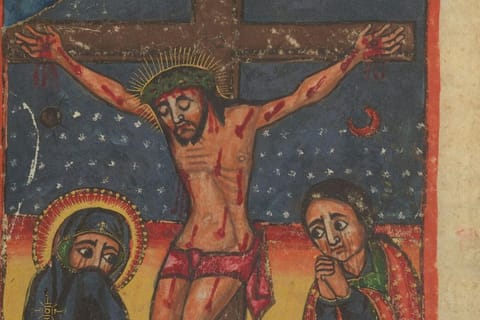
The Christian answer is the cross. Christians believe that in Jesus, God took suffering on from the inside. The prophet Isaiah described a servant who was “a man of suffering and acquainted with disease” and who “has borne our sickness and carried our suffering” (Isaiah 53:3–4), and the church has always read that passage in the light of Christ. At the grave of his friend Lazarus, “Jesus wept” (John 11:35). If you are weeping, you are in the company of the Son of God. For more, see Why did Jesus die on the cross?
Paul names every kind of affliction he can think of, and then says that none of them can separate us from the love of God in Christ Jesus (Romans 8:35–39). The Bible ends with a promise:
He will dwell with them; they will be his peoples, and God himself will be with them and be their God; he will wipe every tear from their eyes.
Revelation 21:3–4, NRSVUE
What do the churches teach about suffering?
The Evangelical Lutheran Church in America, the Presbyterian Church (U.S.A.), the United Methodist Church, and the Episcopal Church, with Christians of every tradition, teach that God is good, that God does not delight in anyone’s suffering, and that the full answer to evil is the life, death, and resurrection of Christ. The Book of Lamentations states that conviction in one line: “For he does not afflict willingly, nor grieve the children of men” (Lamentations 3:33). For the related question of whether God plans each hardship, see Does everything happen for a reason? If you are praying and hear nothing back, see Why doesn’t God answer my prayers?
God holds you in love now, before you understand your suffering, and even if you never fully understand it in this life. Julian of Norwich, a fourteenth-century English mystic, heard Christ say to her in a vision that “all shall be well, and all shall be well, and all manner of thing shall be well” (Revelations of Divine Love, chapter 27). Christians hold on to that promise in the dark, trusting the God who wept at Lazarus’s grave to keep it.
Common questions
Is suffering a punishment from God?
Jesus said it is not. When people asked him whether victims of violence and of a falling tower were worse sinners than others, he answered, “No, I tell you” (Luke 13:1–5). When his disciples asked whose sin caused a man’s blindness, he said that neither the man nor his parents had sinned (John 9:1–3).
Does God cause suffering?
The mainline churches teach that God is good and takes no pleasure in anyone’s pain; Lamentations says that God “does not afflict willingly.” Augustine taught that God permits evil only because God can bring good even out of it. Christians trust that God works in and through suffering without being its author.
Why does God allow children to suffer?
No theodicy answers this well, and Christians do best to admit it. The suffering of children is the hardest objection to every explanation, from Irenaeus to the present. What Christians can say is that God holds every child close, that Jesus welcomed children, and that the promise of Revelation 21 is for them first.
Is it wrong to be angry at God when I suffer?
Job, Jeremiah, and the writers of the psalms of lament all brought their anger and confusion to God in prayer. At the end of the Book of Job, God says that Job, who complained bitterly, spoke what was right, while his tidy-minded friends did not (Job 42:7). God can bear your anger, and bringing it to God is itself a kind of faith.
Sources
- Luke 13:1–5 (WEB)
- John 9:1–3 (WEB)
- Job 2:11–13; 38:1–4; 42:7 (WEB)
- Psalm 22:1–2 (WEB)
- Romans 8:18–39 (WEB)
- Revelation 21:3–4 (WEB)
- Irenaeus, Against Heresies 4.38–39
- Augustine, Enchiridion, chapter 11
- Thomas Aquinas, Summa Theologiae I, q. 2, a. 3
- 1 Corinthians 15:26; Lamentations 3:33 (WEB)
- David Bentley Hart, The Doors of the Sea: Where Was God in the Tsunami? (Eerdmans, 2005)
- Britannica: Theodicy
- Julian of Norwich, Revelations of Divine Love, chapter 27 (CCEL)