Images of God
Christian teaching holds that God has no visible appearance, because God is spirit and has no body (John 4:24). The Bible says, “No one has seen God at any time” (John 1:18), and the prophets describe their visions of God in symbols such as light, fire, and a throne. Christians believe God is shown most fully in Jesus, “the image of the invisible God” (Colossians 1:15). Paintings of God as an old man draw on one vision, in Daniel 7:9.
He is the image of the invisible God, the firstborn of all creation.
Christian teaching holds that God has no body and cannot be seen. Yet the longing to see God runs all through Scripture. In one of the psalms God says “Seek my face,” and the psalmist answers, “I will seek your face, LORD” (Psalm 27:8). If you have ever prayed and wondered whom you are speaking to, or tried to picture God and found that every picture fell short, you are in good company. The churches teach that the invisible God has been made known in a human face, the face of Jesus Christ.
The historic confessions agree that God is beyond sight. The Thirty-Nine Articles of the Church of England describe God as “without body, parts, or passions,” the Methodist Articles of Religion of the United Methodist Church say “without body or parts,” and the Westminster Confession in the Presbyterian Church (U.S.A.)’s Book of Confessions calls God “a most pure spirit, invisible.”
Has anyone ever seen God?
The Bible says that no one has. John’s Gospel says so in its prologue, and then adds how God has been made known:
No one has seen God at any time. The only born Son, who is in the bosom of the Father, has declared him.
The First Letter of John repeats the first sentence word for word and adds a different kind of sight: “No one has seen God at any time. If we love one another, God remains in us” (1 John 4:12).
Even Moses, with whom God spoke “face to face, as a man speaks to his friend” (Exodus 33:11), is told, “You cannot see my face, for man may not see me and live” (Exodus 33:20). God shelters him in a cleft of the rock and lets him see only God’s back as the divine glory passes. When Moses later reminds Israel of the day God spoke at Mount Sinai, he stresses that the people saw nothing: “you heard the voice of words, but you saw no form; you only heard a voice” (Deuteronomy 4:12).
Does God have a body?
Jesus told the Samaritan woman at the well, “God is spirit, and those who worship him must worship in spirit and truth” (John 4:24). Through the prophet Hosea, God says, “I am God, and not man” (Hosea 11:9). The Bible does speak of God’s hand, arm, eyes, and face. Thomas Aquinas, who opened his discussion of God’s nature by asking whether God is a body, explained such language as a way of describing God’s power and knowledge by comparison with human bodies (Summa Theologiae I, q. 3, a. 1).
The same reasoning applies to Genesis 1:27, which says that God created humankind “in his own image … male and female.” Because both women and men bear the image of God, the image cannot be a physical likeness. Gregory of Nazianzus, one of the fourth-century Cappadocian Fathers, made the same point when he mocked anyone who would “consider our God to be a male” because God is called God and Father (Oration 31.7). For more on that point, see Does God have a gender?
What did the prophets see?
The prophets describe their visions of God with great reverence and restraint. Isaiah saw “the Lord sitting on a throne, high and lifted up,” and he describes only the edge of the royal robe and the six-winged seraphim who covered their faces and sang:
In the year that King Uzziah died, I saw the Lord sitting on a throne, high and lifted up; and his train filled the temple. Above him stood the seraphim. Each one had six wings. With two he covered his face. With two he covered his feet. With two he flew. One called to another, and said, “Holy, holy, holy, is the LORD of Armies! The whole earth is full of his glory!”
Ezekiel, after describing a figure of fire and light surrounded by a rainbow, takes care to call it “the appearance of the likeness of the LORD’s glory” (Ezekiel 1:28), a phrase that stands three steps away from God.
Scripture also gives many pictures of God, and none of them is a portrait. God is a rock, a shepherd, and a consuming fire, and “God is light, and in him is no darkness at all” (1 John 1:5). God is like a mother comforting her child (Isaiah 66:13) and an eagle hovering over its young (Deuteronomy 32:11). Each picture shows something true about how God loves and protects, and Isaiah reminds his readers that God is greater than all of them: “To whom then will you liken God? Or what likeness will you compare to him?” (Isaiah 40:18).
Why do paintings show God as an old man with a beard?
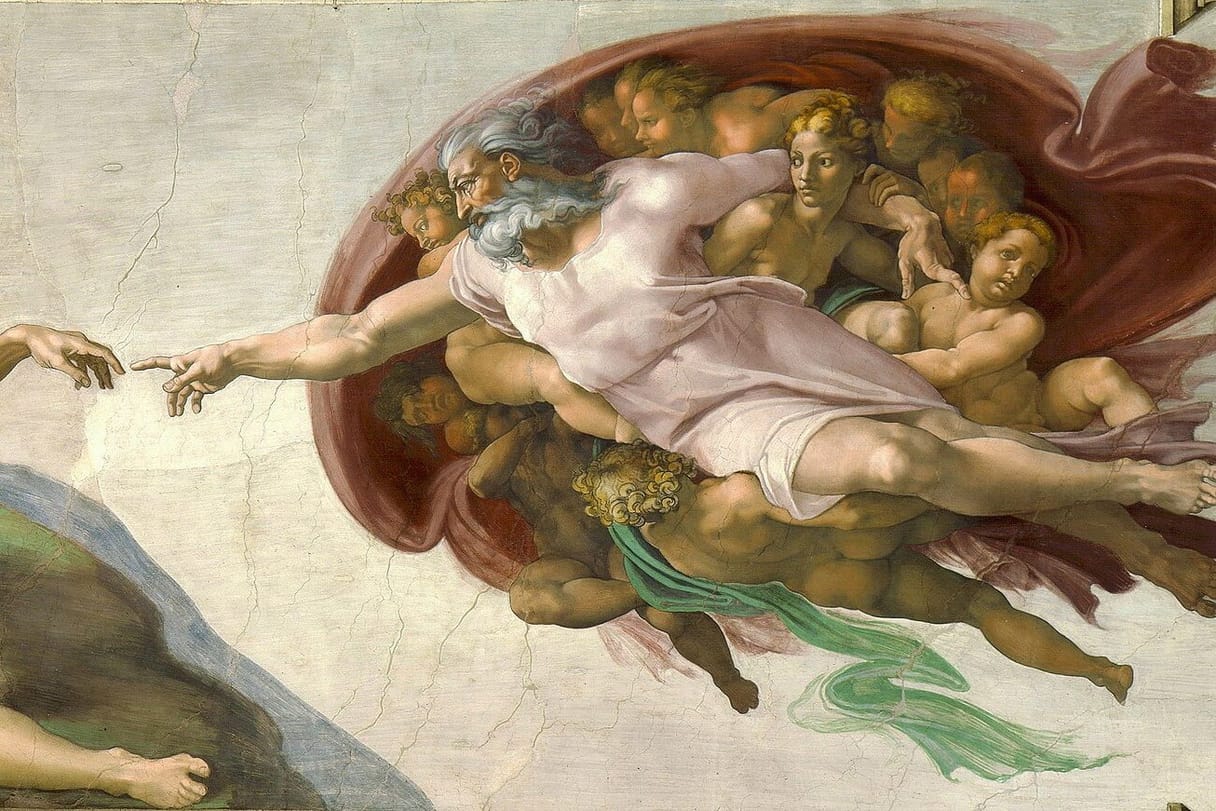
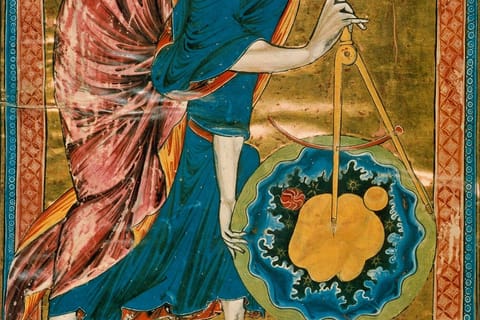
The old man with a white beard comes from a single vision in the book of Daniel. Daniel sees “one who was Ancient of Days,” whose “clothing was white as snow, and the hair of his head like pure wool” (Daniel 7:9). Early Christian art rarely pictured God the Father at all, and often showed only a hand reaching down from the clouds. Western artists of the later Middle Ages and the Renaissance drew on Daniel’s vision, and Michelangelo’s Sistine Chapel ceiling, painted between 1508 and 1512, fixed the image of a powerful, white-bearded Creator in the Western imagination.
Christians who love such paintings have generally understood them as symbols of God’s eternity and authority, and many have prayed before them with real devotion. No church teaches that God looks like an old man.
What does the Second Commandment say about images?
The commandment forbids Israel to make “an idol, nor any image of anything that is in the heavens above, or that is on the earth beneath” and to “bow yourself down to them” (Exodus 20:4–5). Deuteronomy gives the reason: “you saw no kind of form on the day that the LORD spoke to you” (Deuteronomy 4:15). Lutherans, following Augustine, count this command as part of the First Commandment, and the Orthodox, Anglican, and Reformed churches number it separately as the Second.
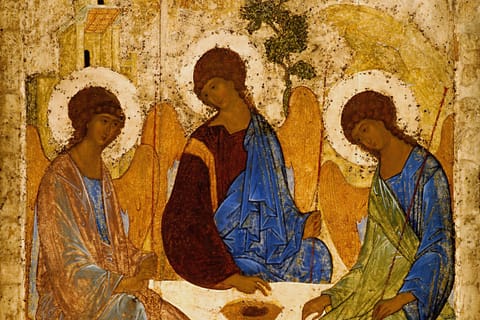
In the eighth century, Byzantine emperors ordered icons destroyed on the grounds that they broke the commandment. The Second Council of Nicaea, which met in 787 and which the Orthodox count as the seventh ecumenical council, restored them. The council approved images of Christ, Mary, the angels, and the saints, to which believers may give “honourable reverence,” but “not indeed that true worship of faith which pertains alone to the divine nature.” It explained, “the honour which is paid to the image passes on to that which the image represents.” Before the council met, the monk John of Damascus had taught that the invisible God could never be pictured, and that once the Son of God took flesh and was seen, Christians could picture what had been seen.
The Reformation divided Protestants on the question. The Reformed tradition, including the Heidelberg Catechism in the PC(USA)’s Book of Confessions, teaches that God should not be portrayed in any visible form, and Reformed churches removed images from worship out of reverence for God’s holiness. Martin Luther opposed the destruction of images, and Lutheran churches kept crucifixes and altar paintings. Article XXII of the Thirty-Nine Articles rejected the “worshipping and adoration” of images, yet Anglican churches kept stained glass, and icons are common in Anglican churches today.
How do Christians see God in Jesus?
Christians believe the clearest answer to the question of what God looks like is a human life:
He is the image of the invisible God, the firstborn of all creation.
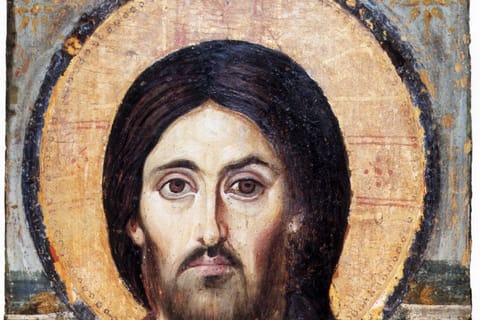
When the apostle Philip asked Jesus to show them the Father, Jesus answered, “He who has seen me has seen the Father” (John 14:9). Paul wrote that God gives “the light of the knowledge of the glory of God in the face of Jesus Christ” (2 Corinthians 4:6). What Christians see in Jesus is God’s character: mercy toward sinners, healing for the sick, welcome for outsiders, and love that goes to the cross. If you want to know what God is like, read the Gospels and watch what Jesus does. The Gospels say nothing about his appearance (see What did Jesus look like? and Is Jesus God?).
Will we see God in heaven?
The New Testament also promises a fuller sight. Jesus said, “Blessed are the pure in heart, for they shall see God” (Matthew 5:8), and 1 John says that “we will see him just as he is” (1 John 3:2). Christian tradition calls that hope the beatific vision, the sight of God that makes the saints happy (see What is heaven like?).
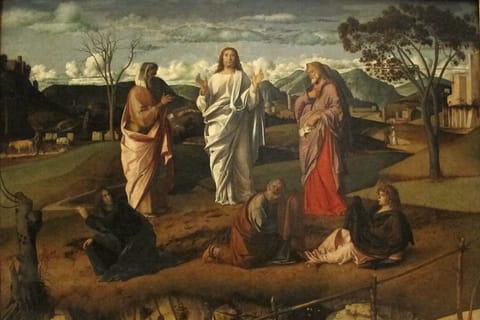
Eastern Orthodox Christians connect that hope with the Transfiguration, when Jesus’ “face shone like the sun, and his garments became as white as the light” (Matthew 17:2). Gregory Palamas, the fourteenth-century archbishop of Thessalonica, taught that God’s inner being stays beyond all sight, and that the light the disciples saw on the mountain was God’s own uncreated light, which the saints can begin to share even in this life. In Orthodox teaching, to see God is to be changed by God, and Christians call that change theosis, sharing in God’s life.
Augustine, looking back on the years he spent searching for God in the wrong places, addressed God as Beauty itself. His word, translated “Fairness” below, is the Latin pulchritudo, “beauty”:
Too late did I love Thee, O Fairness, so ancient, and yet so new! Too late did I love Thee! For behold, Thou wert within, and I without, and there did I seek Thee … Thou didst touch me, and I burned for Thy peace.
Augustine, Confessions 10.27, trans. J. G. Pilkington (Nicene and Post-Nicene Fathers, 1887)
Common questions
Is it wrong to make a picture of God?
Christians disagree. The Orthodox churches, following the Second Council of Nicaea in 787, honor images of Christ, Mary, the angels, and the saints, while the Reformed tradition teaches that God should not be pictured in any visible form. Most mainline churches use religious art freely and agree that an image may be honored for what it represents but never worshiped.
What does it mean that people are made in God’s image?
Genesis 1:27 says that God created humankind in God’s image, “male and female.” Because God has no body, Christian teachers have read the image of God as something other than a physical likeness, such as the capacity to know, love, and answer God and to care for creation. Every human being bears that image, which is why every person deserves honor.
Will we see God in heaven?
The New Testament promises that God’s people will one day see God. Jesus said, “Blessed are the pure in heart, for they shall see God,” and 1 John says that “we will see him just as he is.” Christian tradition calls this hope the beatific vision. Irenaeus of Lyons wrote in the second century that “the life of man consists in beholding God.”
Is God a man?
God is not male or female. In the fourth century Gregory of Nazianzus mocked the idea that God is male just because the words for God and Father are masculine, and the Bible compares God to a mother as well as a father. Christians believe that the Son of God became a man, Jesus of Nazareth, but God’s own being has no body and no sex.
Sources
- John 1:18 (WEB)
- 1 John 4:12 (WEB)
- John 4:24 (WEB)
- Isaiah 6:1–3 (WEB)
- Daniel 7:9 (WEB)
- Colossians 1:15 (WEB)
- Deuteronomy 4:12–16 (WEB)
- Exodus 20:4–5 (WEB)
- Second Council of Nicaea (787), Decree (New Advent)
- Thomas Aquinas, Summa Theologiae I, q. 3, a. 1 (New Advent)
- The Thirty-Nine Articles of Religion (Church of England)
- Gregory of Nazianzus, Oration 31 (Fifth Theological Oration), 7 (New Advent)
- Irenaeus, Against Heresies 4.20.7 (New Advent)
- Gregory Palamas
- Augustine, Confessions 10.27, trans. J. G. Pilkington (CCEL)


.jpg)