The meaning of the cross
In history, Jesus died because the Roman governor Pontius Pilate had him crucified as a threat to public order, with the cooperation of the temple leadership. In faith, the New Testament says he died “for our sins” and out of love, to reconcile the world to God. Christians have explained how the cross saves in several ways: as victory over evil, as satisfaction for sin, as a revelation of God’s love, and as Christ bearing our penalty.
But God proves his love for us in that while we still were sinners Christ died for us.
Romans 5:8, NRSVUE
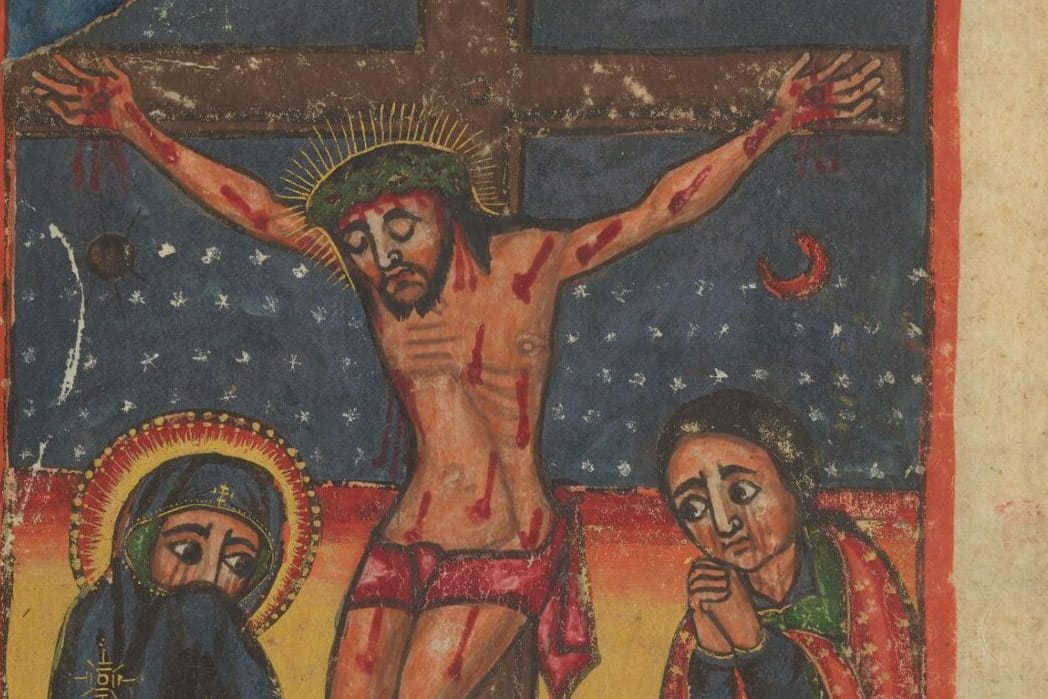
Many people grow up hearing that Jesus died for their sins and are left wondering what that means, or why a loving God would want such a death. The New Testament answers first with love: it says the cross is where God shows his love for sinners (Romans 5:8). In history, Rome crucified Jesus as a threat to public order. In faith, the church confesses that he gave his life to reconcile the world to God, and Christians across the centuries have reached for many images to say how.
Why did the Romans crucify Jesus?
Crucifixion was a Roman punishment for slaves, rebels, and others the empire wanted to make an example of. It was slow, painful, humiliating, and public by design, and it was meant to warn anyone watching. After the slave revolt led by Spartacus was crushed in 71 BCE, the Roman general Crassus crucified 6,000 of the captured rebels.
Jesus came to Jerusalem at Passover, when the city was full of pilgrims celebrating Israel’s liberation from Egypt. He disrupted the trade in the temple courts and said, “My house will be called a house of prayer for all the nations” (Mark 11:17). Mark says the chief priests and scribes then looked for a way to kill him but feared “a riot among the people” (Mark 14:2).
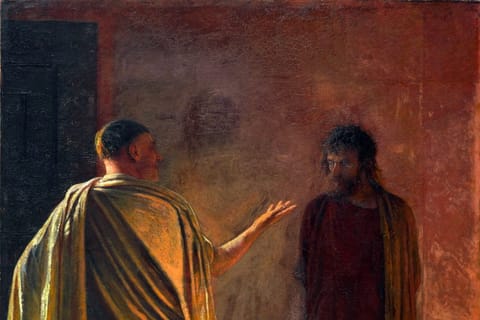
Rome executed Jesus as a political threat. The charge posted on the cross read, “The King of the Jews” (Mark 15:26). To Pilate, a Galilean teacher hailed by crowds and talking about God’s kingdom was a possible rebel. For the human responsibility for his death, see Who killed Jesus?
What does the Bible say about why Jesus died?
The New Testament never treats Jesus’ death as an accident. The earliest summary of the faith, which Paul received and passed on, says “that Christ died for our sins according to the Scriptures” (1 Corinthians 15:3). Jesus himself, in Mark, describes his mission this way:
For the Son of Man came not to be served but to serve and to give his life a ransom for many.
Mark 10:45, NRSVUE
Above all, the New Testament says the cross shows God’s love:
But God proves his love for us in that while we still were sinners Christ died for us.
Romans 5:8, NRSVUE
The New Testament writers reach for many images to say what the cross accomplished. Mark speaks of a ransom that sets captives free. Paul speaks of reconciliation: “God was in Christ reconciling the world to himself, not reckoning to them their trespasses” (2 Corinthians 5:19). Colossians speaks of victory: “Having stripped the principalities and the powers, he made a show of them openly, triumphing over them” (Colossians 2:15). First Peter, echoing Isaiah 53, says “He himself bore our sins in his body on the tree” and also that Christ suffered “leaving you an example, that you should follow his steps” (1 Peter 2:21–24). Jesus himself calls it love for friends: “Greater love has no one than this, that someone lay down his life for his friends” (John 15:13).
How have Christians explained the cross?
The theological word for these explanations is atonement, an English word formed from “at-one-ment,” meaning reconciliation. The ancient councils that wrote the creeds did not define a theory of the atonement, and the church has prayed with several explanations side by side. Each one tries to put into words a love that Christians find larger than any one picture.
The earliest Christian teachers mostly described the cross as a rescue. Humanity had fallen into captivity to sin, death, and the devil, and Christ came to set the captives free. Irenaeus, bishop of Lyons in the second century, taught that Christ “did, through His transcendent love, become what we are, that He might bring us to be even what He is Himself.” Irenaeus added that God freed us “not by violent means” but “by means of persuasion.” Gregory of Nyssa, in the fourth century, pictured the devil as a greedy fish who swallowed Christ’s humanity without seeing the divinity inside it, so that “the hook of the Deity might be gulped down along with the bait of flesh.” The Letter to the Hebrews says much the same in other words: Christ shared our flesh and blood “that through death he might bring to nothing him who had the power of death” and “might deliver all of them who through fear of death were all their lifetime subject to bondage” (Hebrews 2:14–15). The Swedish theologian Gustaf Aulén named this view Christus Victor, “Christ the Victor,” in a book published in English in 1931.
The Eastern Orthodox churches have kept this picture at the center. Athanasius of Alexandria taught in On the Incarnation that the Word of God took a body that could die so that, by dying, he might undo death and corruption for everyone. At Easter, Orthodox Christians sing that Christ is risen “trampling down death by death,” and their icon of the Resurrection, the Anastasis, shows the risen Christ standing on the broken gates of Hades and pulling Adam and Eve from their tombs. Orthodox theologians have often been wary of explanations that turn the cross into a legal transaction, and they describe salvation above all as healing and union with God, which they call theosis.
In the West, Anselm, Archbishop of Canterbury, asked in Cur Deus Homo (“Why God Became Man,” around 1098) why God needed to become human at all. He answered that human sin had dishonored God and that the debt was greater than any human being could repay. Only God could pay it, but a human being owed it. Anselm concluded that the satisfaction “none but God can make and none but man ought to make,” so “it is necessary for the God-man to make it.”
Peter Abelard (1079–1142), a French theologian, objected to both the ransom and the satisfaction views. He taught that Christ’s life and death reveal the depth of God’s love and awaken an answering love in us, which changes us and turns us back to God. Abelard’s view draws on verses such as “In this is love, not that we loved God, but that he loved us” (1 John 4:10).
John Calvin and the Reformed theologians after him developed Anselm’s ideas in the language of criminal law, a view called penal substitution. In their view, sinners deserve punishment from God’s justice, and Christ took that punishment in our place. They drew especially on Isaiah 53: “The punishment that brought our peace was on him; and by his wounds we are healed” (Isaiah 53:5). Many evangelical Christians hold this view as central to the gospel, and its defenders stress that it begins with God’s love, since God sent the Son.
Did God need Jesus to die in order to forgive us?
Scripture makes God the one who acts in love from beginning to end. “For God so loved the world, that he gave his only born Son,” and “God didn’t send his Son into the world to judge the world, but that the world should be saved through him” (John 3:16–17). Before the cross, Jesus forgave sins freely, telling a paralyzed man, “Son, your sins are forgiven you” (Mark 2:5). In his parable of the prodigal son, the father runs to meet his son before the son can finish his apology (Luke 15).
For these reasons, many Christians, mainline Christians among them, do not picture the cross as the Son changing an angry Father’s mind. Paul says “God was in Christ reconciling the world to himself,” which puts God on the giving side of the cross. Whatever else the cross accomplishes, Christians believe it is love’s own act. The same letter that says “God is love” (1 John 4:8) also calls Jesus “the atoning sacrifice for our sins.” For more on that verse, see What does John 3:16 mean?
What do the mainline churches teach?
The Nicene Creed says only that “for our sake he was crucified under Pontius Pilate,” without choosing among the explanations above. The mainline churches have kept that freedom. The Presbyterian Church (U.S.A.)’s Confession of 1967 lists the Bible’s images side by side, from “the sacrifice of a lamb” and “ransom of a slave” to “vicarious satisfaction of a legal penalty, and victory over the powers of evil,” and adds: “These are expressions of a truth which remains beyond the reach of all theory in the depths of God’s love for man.”
Mainline worship uses the language of sacrifice and offering. One eucharistic prayer in the Book of Common Prayer says that Christ “stretched out his arms upon the cross, and offered himself, in obedience to your will, a perfect sacrifice for the whole world.” The Anglican Thirty-Nine Articles and the United Methodist Articles of Religion both call Christ’s offering “perfect redemption, propitiation, and satisfaction” for the sins of the whole world. Martin Luther’s Small Catechism, which Lutherans in the ELCA learn, joins the images of ransom and victory: Christ has freed the believer from sin, death, and the power of the devil with his own blood and innocent suffering.
Lutherans, Presbyterians, Methodists, and Episcopalians pray with all of these images and do not bind their members to a single theory. They share the conviction of the New Testament that the cross reveals God’s love and opens the way to forgiveness for everyone. For what that forgiveness means for you, see Will God forgive me? and What does it mean to be saved?
Charles Wesley, whose hymns Methodists and many other Christians still sing, wrote of the cross as mercy that comes looking for each person:
He left His Father’s throne above,
So free, so infinite His grace;
Emptied Himself of all but love,
And bled for Adam’s helpless race;
’Tis mercy all, immense and free;
For, O my God, it found out me.Charles Wesley, “And Can It Be” (1738), third stanza
Common questions
What does atonement mean?
The English word atonement was formed from “at-one-ment” and means reconciliation, making two estranged parties one again. Christians use it for the reconciliation between God and humanity that Christ brings. Paul says that “God was in Christ reconciling the world to himself.”
Did Jesus know he was going to die?
The Gospels say he did. Mark reports that Jesus “began to teach them that the Son of Man must suffer many things, and be rejected by the elders, the chief priests, and the scribes, and be killed, and after three days rise again.” In John, Jesus says that no one takes his life from him and that he lays it down of his own accord.
Do mainline Christians believe in penal substitution?
Some do, and many draw on other explanations as well. Mainline worship uses the language of sacrifice, redemption, and reconciliation, and the Anglican Thirty-Nine Articles and the United Methodist Articles of Religion both speak of Christ’s offering as “redemption, propitiation, and satisfaction.” The mainline churches do not require their members to hold any single theory of the atonement.
Why is the cross a symbol of Christianity?
The cross was a Roman instrument of shameful execution, and the first Christians knew how strange it was to preach a crucified Messiah. They kept the cross at the center because they believed God had turned the worst that people could do into the means of salvation. Paul wrote that he proclaimed “Christ crucified.”
Sources
- Mark 10:45 (WEB)
- 1 Corinthians 15:3 (WEB)
- 2 Corinthians 5:19 (WEB)
- Colossians 2:15 (WEB)
- 1 Peter 2:21–24 (WEB)
- Irenaeus, Against Heresies, Book 5, Preface and ch. 1
- Irenaeus, Against Heresies, Book 3, ch. 18
- Gregory of Nyssa, The Great Catechism, ch. 24 (NPNF II.5)
- Anselm, Cur Deus Homo, Book 2, ch. 6
- Athanasius, On the Incarnation of the Word (New Advent)
- Orthodox Church in America, Selected Liturgical Hymns: the Paschal Troparion
- PC(USA), The Book of Confessions (2016), Confession of 1967, 9.09
- Book of Common Prayer (1979), Holy Eucharist: Rite Two, Eucharistic Prayer A
- United Methodist Articles of Religion
- Charles Wesley, “And Can It Be” (1738), Hymnary.org
.jpg)