John 3:16 in context
John 3:16 says God loved the world in this way: he gave his only Son, so that everyone who believes in him may not perish but have eternal life. In John’s Gospel “the world” (Greek kosmos) means the world that did not know God, so the verse says God loves even those who turn away. The next verse gives the purpose: God sent the Son “not to condemn the world” but so that the world “might be saved through him.”
For God so loved the world that he gave his only Son, so that everyone who believes in him may not perish but may have eternal life.
John 3:16, NRSVUE
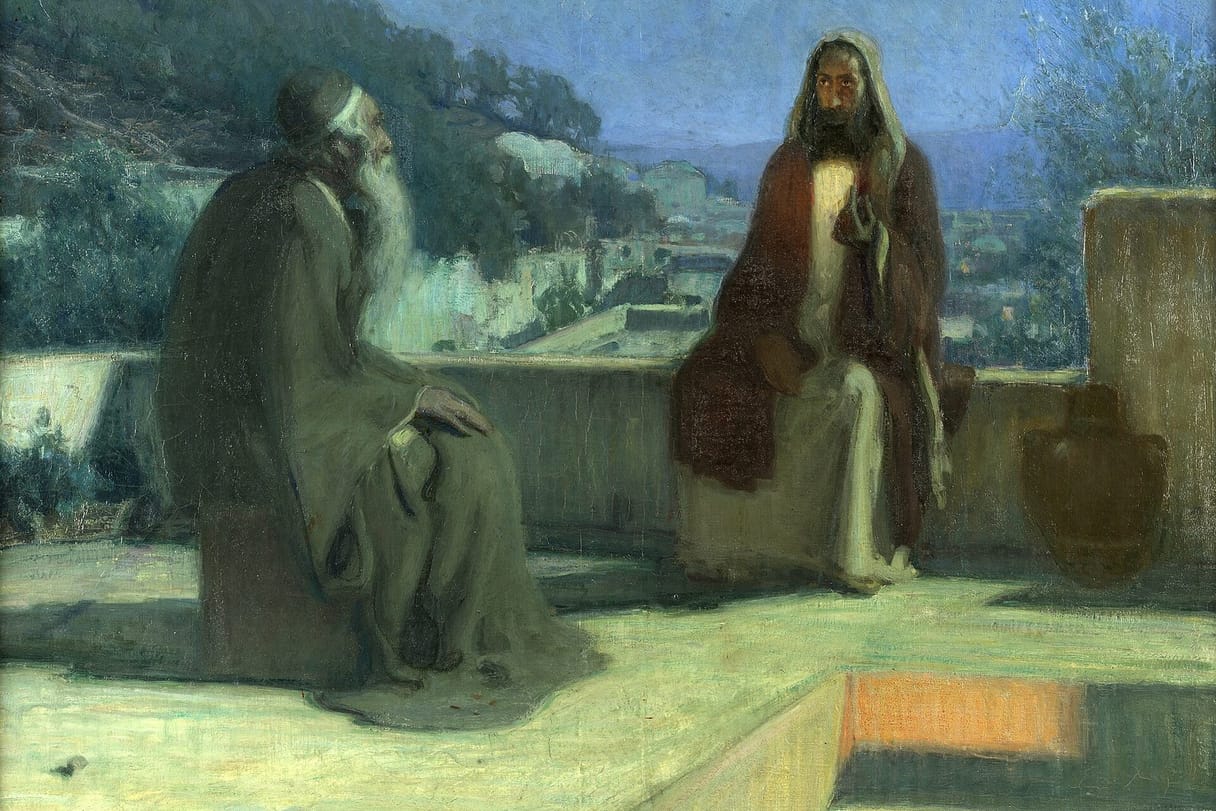
John 3:16 tells you how God loves the world: God gave the Son, so that everyone who believes in him may have eternal life. If you learned the verse as a child, it can be worth reading again slowly in its setting. It was first spoken at night, to a man full of questions, and the verse after it says that God sent the Son to save the world.
What does John 3:16 say?
“For God so loved the world that he gave his only Son, so that everyone who believes in him may not perish but may have eternal life.
“Indeed, God did not send the Son into the world to condemn the world but in order that the world might be saved through him.
John 3:16–17, NRSVUE
The King James Version, which many people memorized, reads, “For God so loved the world, that he gave his only begotten Son, that whosoever believeth in him should not perish, but have everlasting life.” John 3:16 is best read together with John 3:17, which states God’s purpose in sending the Son: to save the world.
Who was Nicodemus, and why does it matter?
John 3:16 belongs to a conversation at night. Nicodemus was a Pharisee and “a leader of the Jews” who came to Jesus in the dark:
Now there was a Pharisee named Nicodemus, a leader of the Jews. He came to Jesus by night and said to him, “Rabbi, we know that you are a teacher who has come from God, for no one can do these signs that you do unless God is with that person.”
John 3:1–2, NRSVUE
Jesus told him, “unless one is born anew, he can’t see God’s Kingdom” (John 3:3). The Greek word anōthen, “anew,” can also mean “from above,” and “born anew” is where the phrase “born again” comes from. Nicodemus took it literally and was confused: “How can these things be?” (John 3:9).
Nicodemus is a picture of searching, slow faith. He appears twice more in John’s Gospel. Later he defends Jesus before the other leaders, asking that Jesus be given a fair hearing (John 7:50–51). After the crucifixion, John reminds his readers that Nicodemus was the one “who at first came to Jesus by night,” and now he brings about a hundred pounds of myrrh and aloes to bury Jesus (John 19:39). John 3:16 was first spoken to a cautious, questioning man who took a long time to come into the light, and Jesus was patient with him.
Some interpreters think Jesus’s words end at verse 15, so that verses 16–21 are the Gospel writer’s reflection on the conversation. Either way, the verse sums up what the conversation is about.
What does “lifted up” have to do with John 3:16?
Just before John 3:16, Jesus refers to a strange story from the Book of Numbers. When the Israelites in the wilderness were dying from snakebites, God told Moses to make a bronze serpent and put it on a pole, and “If a serpent had bitten any man, when he looked at the serpent of bronze, he lived” (Numbers 21:8–9). Jesus says:
And just as Moses lifted up the serpent in the wilderness, so must the Son of Man be lifted up, that whoever believes in him may have eternal life.
John 3:14–15, NRSVUE
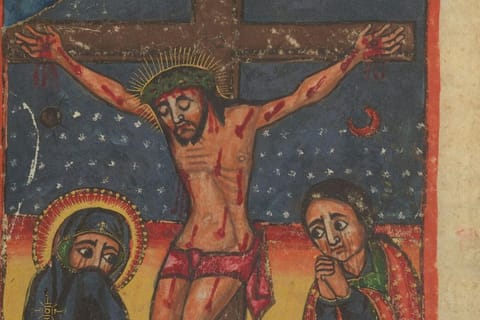
In John’s Gospel, being “lifted up” means the cross. Later Jesus says, “And I, if I am lifted up from the earth, will draw all people to myself” (John 12:32). So when John 3:16 says God “gave” his Son, it means more than sending him to be born. It means giving him up to death, out of love. For more, see Why did Jesus die on the cross?
What do the key words in John 3:16 mean?
The little word “so” is the Greek houtōs, which usually means “in this way” or “thus.” The verse tells you how God loved the world, by giving the Son, as well as how much. The NET Bible translates it, “For this is the way God loved the world.”
“The world” is the Greek kosmos. In John’s Gospel, “the world” often means humanity as it has turned away from God: “He was in the world, and the world was made through him, and the world didn’t recognize him” (John 1:10). So John 3:16 says God loves the world that rejects him. It is a verse about God loving enemies before it is a verse about God loving friends.
“Only Son” translates the Greek monogenēs, which means “only” or “one and only.” The King James Version translated it “only begotten,” and the Nicene Creed uses the language of begetting to confess that the Son is “of one Being with the Father.” In John 3:16 the word shows the cost of the gift: God gave the one who was most his own.
To “believe in him,” in John’s Gospel, means to trust a person and to hold on to him. It is the response of someone who comes toward the light, as Nicodemus slowly did.
“Eternal life,” in John, is the life of God’s new age, and it starts now. Jesus defines it in a prayer: “This is eternal life, that they should know you, the only true God, and him whom you sent, Jesus Christ” (John 17:3). Eternal life is knowing God, beginning in this life and continuing beyond death.
The Eastern Orthodox tradition draws out what that knowing means. Athanasius of Alexandria wrote in the fourth century that the Son of God “was made man that we might be made God” (On the Incarnation 54), meaning that the life the Son gives is a share in God’s own life. Orthodox Christians call this theosis, the slow healing and transformation of a person by union with God.
What about John 3:18?
The verse after John 3:17 is harder: “He who believes in him is not judged. He who doesn’t believe has been judged already, because he has not believed in the name of the only born Son of God” (John 3:18). Many Christians have read this verse to mean that everyone who does not explicitly believe in Christ is lost, and that reading deserves to be stated fairly.
John then explains what the judgment is: “This is the judgment, that the light has come into the world, and men loved the darkness rather than the light, for their works were evil” (John 3:19). In John, judgment is the darkness people choose when they turn from the light. Jesus says later, “I came not to judge the world, but to save the world” (John 12:47), and the First Letter to Timothy says that God “desires all people to be saved” (1 Timothy 2:4). Read in light of John 3:17 and John 12:47, John 3:16–18 is a promise and an invitation, and many Christians across the centuries, from Gregory of Nyssa in the fourth century to Isaac the Syrian in the seventh, have hoped that God’s love will finally reach every person. See Do non-Christians go to hell? and What does it mean to be saved?
What does John 3:16 mean for you today?
John 3:16 means that God’s attitude toward the world, and toward you, is love. God did not wait for the world to become lovable. The First Letter of John puts it this way:
In this is love, not that we loved God but that he loved us and sent his Son to be the atoning sacrifice for our sins.
1 John 4:10, NRSVUE
The same letter says it in three words: “God is love” (1 John 4:16). If you have wondered whether that love includes you, read Does God love me? and, for who the Son is, Who is Jesus? Like Nicodemus, you can come with questions, even at night.
Paul prayed for the church in Ephesus that they would come to know this love, and you can pray his words for yourself and for the people you love:
that Christ may dwell in your hearts through faith, to the end that you, being rooted and grounded in love, may be strengthened to comprehend with all the saints what is the width and length and height and depth, and to know Christ’s love which surpasses knowledge, that you may be filled with all the fullness of God.
Common questions
What does “so loved” mean in John 3:16?
The Greek word houtōs, translated “so,” usually means “in this way” or “thus.” The verse is saying how God loved the world, by giving the Son, as well as how much. The NET Bible translates it, “For this is the way God loved the world.”
What does “only begotten” mean?
The King James Version’s “only begotten” translates the Greek monogenēs, which means “only” or “one and only.” Modern translations such as the NRSVUE say “only Son.” The church’s Nicene Creed uses the language of begetting to confess that the Son shares the Father’s very being.
Who is speaking in John 3:16, Jesus or John?
Many English Bibles print John 3:16 as part of Jesus’s words to Nicodemus, but some interpreters think Jesus’s speech ends at verse 15. In that reading, verses 16–21 are the Gospel writer’s reflection on what Jesus said. Either way, the church receives the verse as Scripture and as the heart of the gospel.
Does John 3:18 mean that non-Christians are condemned?
Many Christians have read it that way, out of reverence for the words of Scripture. John 3:19 then explains the condemnation as people loving darkness rather than light, and John says elsewhere that Jesus came “not to judge the world, but to save the world” (John 12:47). Many Christians across the centuries have hoped that God’s love will finally reach everyone.
Sources
- John 3:1–21 (WEB)
- John 3:16 (KJV)
- John 3:16 (NET)
- Bible Hub: Greek text of John 3:16
- Numbers 21:8–9 (WEB)
- John 7:50–51; 19:39 (WEB)
- John 12:32, 47 (WEB)
- John 17:3 (WEB)
- 1 John 4:9–10, 16 (WEB)
- 1 Timothy 2:3–4 (WEB)
- Athanasius, On the Incarnation of the Word, ch. 54
- Gregory of Nyssa, On the Soul and the Resurrection