What Jesus looked like
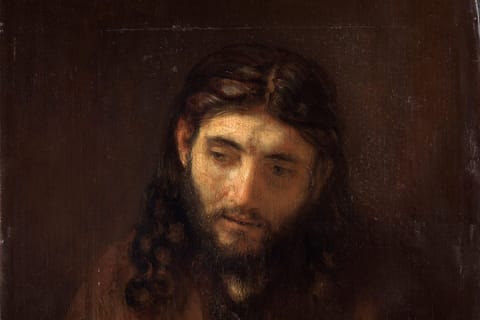
The Gospels never describe Jesus’ face, height, or coloring, so no one knows exactly what he looked like. As a Jewish man from first-century Galilee, he most likely had brown eyes, dark brown or black hair, and olive to brown skin. He probably wore a knee-length tunic and a wool mantle with tassels, and he probably kept his hair fairly short. The long-haired, bearded Jesus of later art developed centuries after his death.
And the king will answer them, ‘Truly I tell you, just as you did it to one of the least of these brothers and sisters of mine, you did it to me.’
Matthew 25:40, NRSVUE
No one knows exactly what Jesus looked like, because the Gospels never describe his face. Many Christians have wished they could see it. You may have grown up with a picture of Jesus on a Sunday school wall and only later wondered why he looked so little like a Jewish man from Galilee. History can tell you something about his appearance, and the church’s tradition can tell you where to look for his face today.
Does the Bible describe what Jesus looked like?
The New Testament gives no physical description of Jesus during his life. The Gospel writers wanted their readers to know what Jesus said and did, and they seem to have thought his appearance did not matter to that message.
A few passages have been read as hints, though none is a portrait. Some early Christians applied Isaiah’s Suffering Servant to Jesus, of whom Isaiah says, “He has no good looks or majesty. When we see him, there is no beauty that we should desire him” (Isaiah 53:2). The Book of Revelation describes the risen Christ in a vision with hair “white as white wool,” eyes “like a flame of fire,” and a face “like the sun shining at its brightest” (Revelation 1:14–16). That vision uses symbols of age, wisdom, and glory and does not describe how Jesus looked in Galilee.
One Gospel detail suggests that Jesus looked ordinary. When the soldiers came to arrest him at night, Judas had to tell them, “Whoever I kiss, he is the one. Seize him.” (Matthew 26:48). Jesus seems to have looked much like the disciples around him.
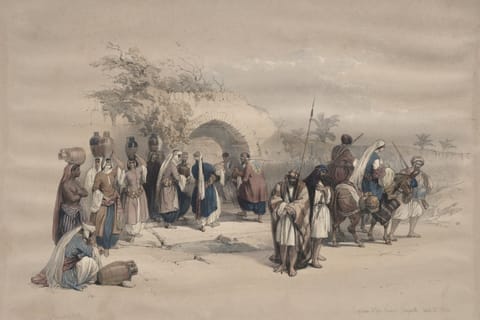
What would a Jewish man from first-century Galilee have looked like?
Jesus was a Jew, and his features were those of the Jewish people of his time and place; see Was Jesus Jewish? The Letter to the Hebrews says, “it is evident that our Lord has sprung out of Judah” (Hebrews 7:14).
Joan Taylor, professor of Christian Origins and Second Temple Judaism at King’s College London, studied the question in her book What Did Jesus Look Like? (2018). Drawing on research into skeletons from ancient Judea by the Israeli anthropologist Yossi Nagar, she concludes that Jesus most likely had brown eyes, dark brown or black hair, and olive to brown skin. Jesus worked as a carpenter or builder (Mark 6:3) and walked the roads of Galilee, so he was probably lean.
Taylor also argues that Jesus’ hair was probably fairly short. Greco-Roman men of the time kept their hair short, and among Jews long hair marked a man under a Nazirite vow, which also forbade wine. Jesus drank wine, and his critics called him “a gluttonous man and a drunkard” (Matthew 11:19). Like many Jewish men of his day, he may have worn a short beard.
What did Jesus wear?
The Gospels mention Jesus’ clothes more often than his body. A sick woman was healed when she “touched his clothes” (Mark 5:27), and Matthew says she touched “the fringe of his garment” (Matthew 9:20). The Law of Moses told Israelites to wear such fringes “that you may see it, and remember all the LORD’s commandments” (Numbers 15:39). Even his clothing was a reminder to love God’s law.
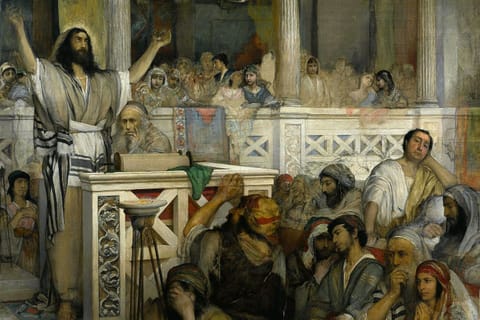
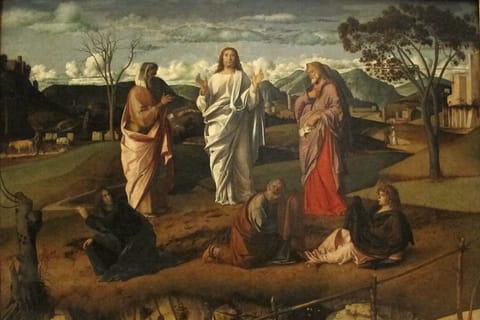
Taylor describes the clothing of an ordinary Jewish man: a knee-length tunic, a mantle of undyed wool worn over it, and simple leather sandals. At the crucifixion, the soldiers divided Jesus’ clothes and cast lots for his tunic, which was “without seam, woven from the top throughout” (John 19:23). His clothes were ordinary until the transfiguration, when “his clothing became glistening, exceedingly white, like snow, such as no launderer on earth can whiten them” (Mark 9:3).
What are the earliest pictures of Jesus?
The first Christians mostly pointed to Christ with symbols, such as a fish, an anchor, or the prophet Jonah, whose three days in the great fish prefigured the resurrection. Pictures of Jesus himself began to appear around 200 CE.
The oldest surviving pictures of Jesus come from a house church at Dura-Europos, a Roman frontier town on the Euphrates River in Syria. An inscription dates the house to 232 or 233 CE, and Christians converted it into a church before the town was abandoned during a Persian siege in 256. The baptistery walls show the Good Shepherd carrying a sheep, the healing of a paralyzed man, and Christ and Peter walking on the water. In these paintings Jesus is a young man, beardless and short-haired. Archaeologists uncovered the church in 1931–32, and the paintings are now at the Yale University Art Gallery.
Wall paintings in the catacombs of Rome, the underground burial places of early Christians, also show Jesus as a youthful, beardless Good Shepherd. A painting in the catacomb of Commodilla from the late fourth century is one of the first to show him with a beard. Beside the graves of those they had lost, early Christians pictured Jesus as a shepherd carrying a sheep on his shoulders.
Where did the familiar image of Jesus come from?
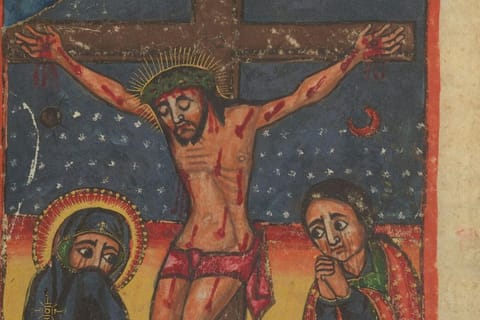
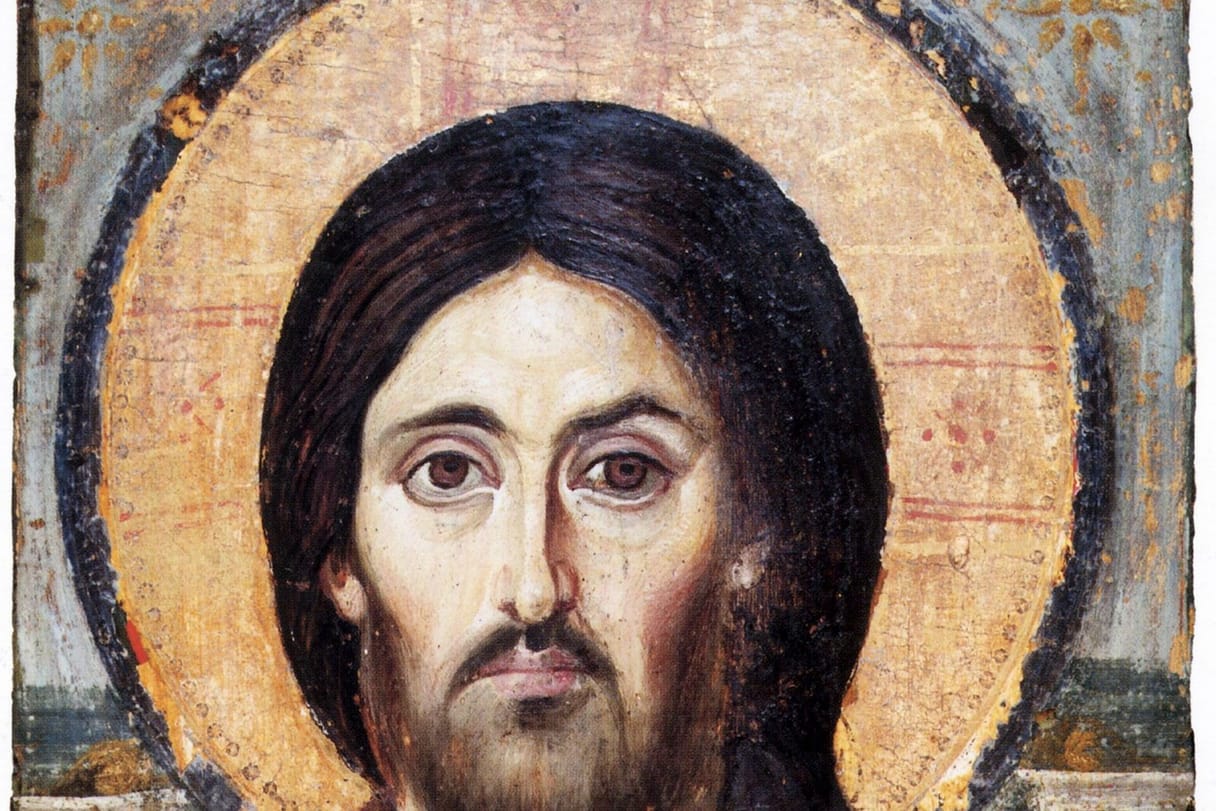
The bearded, long-haired Jesus appeared in Christian art around 300 CE and became standard in the Eastern church by the sixth century. In the West, a beardless Jesus remained common for centuries longer. Taylor argues that the bearded image drew on pictures of an enthroned ruler and on statues of Zeus, and that artists meant it to show Christ’s heavenly majesty. It was never a record of his human face.
The most famous early example is the icon of Christ Pantocrator (“ruler of all”) at Saint Catherine’s Monastery on Mount Sinai, painted in hot wax in the sixth century. It is the oldest surviving icon of Christ as Pantocrator. The art historian Kurt Weitzmann noted that the two sides of the face differ slightly, which many viewers read as a picture of Christ’s two natures, divine and human, as the Council of Chalcedon had defined them in 451.
Was Jesus white?
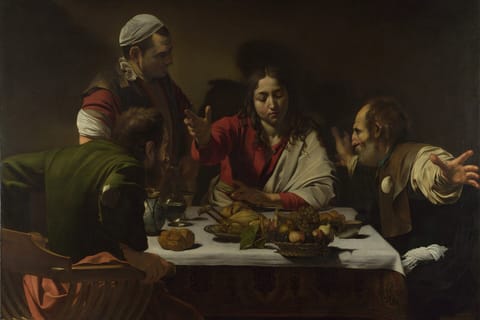
Jesus was a Jew of the eastern Mediterranean, and he did not look like the fair-skinned, light-haired figure of much European and American art. Christians in many cultures have painted Christ in their own likeness, and there is a true insight in that habit, because the church believes Christ shares the humanity of every people. The danger comes when one people’s image of Jesus is used to claim that he belongs to them more than to others. Scripture closes the door on that claim: “There is neither Jew nor Greek … for you are all one in Christ Jesus” (Galatians 3:28). See What does the Bible say about racism?
Does it matter what Jesus looked like?
Jesus’ appearance matters because his body was real. The Council of Chalcedon confessed that Christ is “of one substance with us as regards his manhood; like us in all respects, apart from sin.” He had a particular face, a particular voice, and a particular family, and Christians believe God came among us in that ordinary human way.
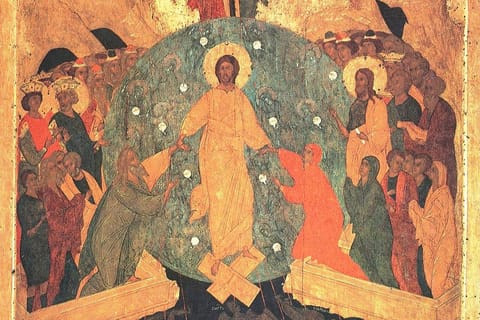
Eastern Orthodox Christians draw the same conclusion from their icons. In the eighth century, when Byzantine emperors were destroying religious images, John of Damascus argued that the invisible God could never be pictured, and yet God had become visible in Jesus, so Christians may paint the one they have seen. The Second Council of Nicaea agreed with him in 787, and the Orthodox still celebrate the return of the icons every year on the first Sunday of Lent, the Sunday of Orthodoxy.
Jesus himself told his followers where else to look for him. In his parable of the sheep and the goats, the king says that whatever you do for the hungry, the stranger, the sick, or the prisoner, “you did it to me” (Matthew 25:40). Christians have always believed that the face of Christ can be seen in the face of a neighbor in need. For more on the person behind the pictures, see Who is Jesus?
You may never know the color of his eyes, but you are not left without his face. Paul writes that God “has shone in our hearts to give the light of the knowledge of the glory of God in the face of Jesus Christ” (2 Corinthians 4:6). Look for that face in the Gospels, in the bread and wine of Holy Communion, and in the person beside you who needs your help.
Common questions
Was Jesus white?
No. Jesus was a Jew from Galilee, in a land then ruled by Rome, and he would have looked like other Jewish men of the eastern Mediterranean in his time. The historian Joan Taylor concludes that he most likely had brown eyes, dark hair, and olive to brown skin. Pale, fair-haired images of Jesus come from later European art.
Did Jesus have long hair?
Probably not. Joan Taylor points out that Jewish and Greco-Roman men of the time usually kept their hair short, and that long hair was the mark of a man under a Nazirite vow, which also forbade wine. Jesus drank wine, so his hair was likely short. He may have had a short beard.
What is the oldest picture of Jesus?
The oldest surviving pictures of Jesus come from a house church at Dura-Europos in Syria, decorated in the 230s or 240s CE. They show the Good Shepherd, the healing of a paralyzed man, and Jesus and Peter walking on the water. The paintings are now at the Yale University Art Gallery.
Why is Jesus shown with a halo?
The halo comes from classical art, where it was a feature of the sun god. Christian artists borrowed it and placed it around Jesus’ head to show his heavenly nature. The halo is a symbol of holiness and was never meant to show how Jesus looked.
Sources
- Isaiah 53:2 (WEB)
- Revelation 1:14–16 (WEB)
- Matthew 25:40 (WEB)
- Joan Taylor, “What did Jesus really look like?” BBC News, December 24, 2015
- Joan E. Taylor, What Did Jesus Look Like? (Bloomsbury T&T Clark, 2018)
- Yale University Art Gallery, Dura-Europos: Excavating Antiquity
- Yale University Art Gallery, Baptistery wall painting: Christ Walking on Water
- Christ Pantocrator, Saint Catherine’s Monastery, Sinai
- Depiction of Jesus
- Book of Common Prayer (1979), Historical Documents: the Definition of Chalcedon
- John of Damascus and the defense of icons