The death of Jesus and the Jewish people
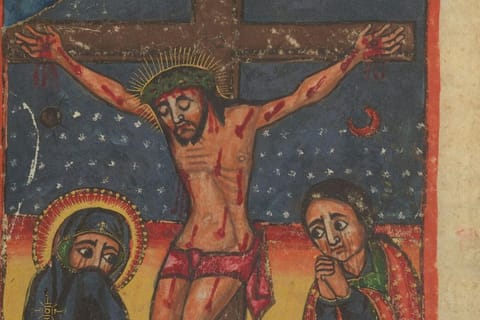
Roman soldiers crucified Jesus on the orders of Pontius Pilate, the Roman governor of Judea, around 30 CE. The Gospels say that some of the temple leadership, including the high priest Caiaphas, handed him over to Pilate. The Jewish people as a whole were never responsible, as the ELCA, the PC(USA), and the Episcopal Church have declared. Christians confess that Jesus died for the sins of all, and they look first at their own part in his death.
So Pilate, wishing to satisfy the crowd, released Barabbas for them, and after flogging Jesus he handed him over to be crucified.
Mark 15:15, NRSVUE
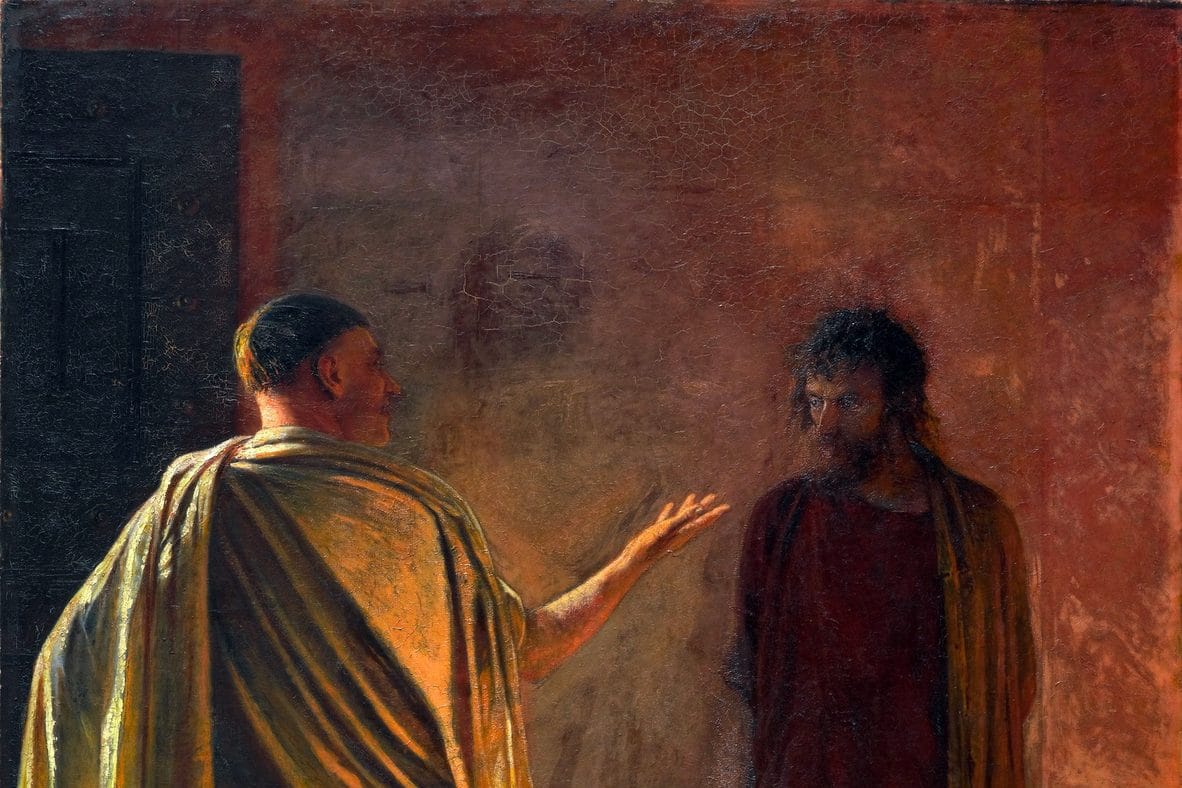
Some people ask who killed Jesus because they heard as children that “the Jews killed Jesus.” Others are asking what the cross has to do with them. In history, Roman soldiers crucified Jesus on the orders of Pontius Pilate, and the churches today reject blaming the Jewish people for his death. In faith, Christians confess that Jesus died for the sins of everyone, and each believer comes to the cross first as one who needs its mercy.
Who ordered the crucifixion of Jesus?
Pontius Pilate, the Roman prefect of Judea from 26 to 36 CE, ordered Jesus’ execution. Crucifixion was a Roman punishment, used on slaves and rebels as a public warning, and Roman soldiers carried it out. The creeds Christians say every week name the man responsible: Jesus “suffered under Pontius Pilate.”
Mark gives the sentence in a single verse:
So Pilate, wishing to satisfy the crowd, released Barabbas for them, and after flogging Jesus he handed him over to be crucified.
Mark 15:15, NRSVUE
The soldiers then mocked Jesus in the governor’s headquarters, dressing him in purple and a crown of thorns and saluting him, “Hail, King of the Jews!” (Mark 15:16–20). The charge posted on the cross was political: “The King of the Jews” (Mark 15:26). To Rome, a Galilean hailed by crowds at Passover as a king was a threat to order.
Sources outside the Bible agree. The Roman historian Tacitus, writing around 116 CE, says that Christ “suffered the extreme penalty during the reign of Tiberius at the hands of one of our procurators,” Pontius Pilate. The Jewish writers Philo and Josephus describe Pilate as a harsh governor who offended Jewish religious feeling and used force against crowds. Josephus says Pilate was finally removed after his troops violently put down a gathering of Samaritans.
What role did the temple leaders play?
The Gospels say that some of the chief priests and their allies wanted Jesus out of the way. After Jesus drove the sellers out of the temple, “The chief priests and the scribes heard it, and sought how they might destroy him. For they feared him” (Mark 11:18). They looked for a way to “seize him by deception” and wanted to avoid the festival days, “because there might be a riot among the people” (Mark 14:1–2). After a night hearing, they “bound Jesus, carried him away, and delivered him up to Pilate” (Mark 15:1).
John’s Gospel gives the high priest Caiaphas a political reason:
“You do not understand that it is better for you to have one man die for the people than to have the whole nation destroyed.”
John 11:50, NRSVUE
Caiaphas was high priest from about 18 to 36 CE, and Roman governors appointed the high priest. Pilate kept him in office for his whole term. The temple leaders who handed Jesus over were a small group whose position depended on keeping peace with Rome, and John shows them afraid of what Rome might do to their nation.
Why do scholars read the Gospel accounts with care?
The Gospels were written forty to seventy years after Jesus’ death, at a time when the young church was in painful conflict with synagogue leaders. Many scholars think that conflict shaped how the Gospels tell the Passion. They notice that the Gospels portray Pilate as reluctant and even washing his hands of Jesus’ blood (Matthew 27:24), while Philo and Josephus describe a governor who did not hesitate to shed blood.
In John’s Gospel, “the Jews” often means the religious authorities in Jerusalem, since Jesus, his disciples, and most of the crowds in John’s story are Jews too. The Gospels also show many ordinary Jews on Jesus’ side. The leaders feared the people, and on the way to the cross “a great multitude of the people followed him, including women who also mourned and lamented him” (Luke 23:27). Careful preaching explains these passages so that no one hears them as an accusation against all Jews.
Did the Jews kill Jesus?
The charge that the Jews as a people are guilty of killing Jesus, sometimes called the charge of deicide (killing God), is false and has caused immense suffering. Christians used Matthew 27:25, where the crowd cries “May his blood be on us and on our children!” (Matthew 27:25), to justify contempt and violence against Jews for centuries. If you were taught that charge, you were taught something many Christians once believed, and the churches have since repented of it.
The New Testament itself spreads the responsibility widely. In Acts, the first believers pray that “both Herod and Pontius Pilate, with the Gentiles and the people of Israel, were gathered together against your holy servant Jesus” (Acts 4:27). Paul says that “the rulers of this world” crucified “the Lord of glory” because they did not understand God’s wisdom (1 Corinthians 2:8). And Luke records Jesus praying from the cross, “Father, forgive them, for they don’t know what they are doing,” a prayer missing from some early manuscripts (Luke 23:34).
What do the mainline churches teach?
Several mainline churches have formally rejected the charge that the Jewish people killed Jesus. On October 26, 1964, the Episcopal Church’s General Convention resolved to “reject the charge of deicide against the Jews and condemn anti-Semitism.” In 1987 the General Assembly of the Presbyterian Church (U.S.A.) commended to its members a study paper that repudiates the old labeling of Jews as “Christ-killers” and acknowledges “the church’s long and deep complicity in the proliferation of anti-Jewish attitudes and actions.”
The Evangelical Lutheran Church in America faced the anti-Jewish writings of its own namesake. In 1543 Martin Luther wrote On the Jews and Their Lies, which urged that synagogues be burned. The ELCA’s Church Council answered in its 1994 Declaration to the Jewish Community: “we reject this violent invective, and yet more do we express our deep and abiding sorrow over its tragic effects on subsequent generations.” The ELCA’s 1998 Guidelines for Lutheran-Jewish Relations state: “Blame for the death of Jesus should not be attributed to Judaism or the Jewish people.” For more on Jesus’ own Jewish faith, see Was Jesus Jewish?
Who is responsible for Jesus’ death, in Christian faith?
Christian faith gives an answer that history cannot. Jesus says in John’s Gospel, “No one takes it away from me, but I lay it down by myself” (John 10:18). The church confesses that “for our sake he was crucified,” and Paul writes that “while we were yet sinners, Christ died for us” (Romans 5:8). Eastern Orthodox Christians sing at Easter that Christ rose “trampling down death by death.” In their tradition the cross is above all the place where God, entering death freely, defeated it from within.
For this reason Christians are called on Good Friday to look first at their own sins. The cross shows what human fear, cruelty, and love of power do when they meet God’s love, and every person shares in that human condition. It also shows God’s love meeting all of it with forgiveness. See Why did Jesus die on the cross? and What does the Bible say about racism?
A Passion hymn by the Lutheran pastor Johann Heermann (1630) answers the question in the first person:
Who was the guilty? Who brought this upon thee?
Alas, my treason, Jesus, hath undone thee!
’Twas I, Lord Jesus, I it was denied thee;
I crucified thee.Johann Heermann, “Ah, Holy Jesus,” translated by Robert Bridges (1897), second stanza
Common questions
Did the Jews kill Jesus?
No. Roman soldiers crucified Jesus on the orders of the Roman governor Pontius Pilate. A small group of temple leaders who held office under Rome handed him over, while Jesus, his disciples, and many in the crowds who mourned him were Jews. The Evangelical Lutheran Church in America’s guidelines for relations with Jews state that blame for the death of Jesus “should not be attributed to Judaism or the Jewish people.”
Why did Pontius Pilate have Jesus crucified?
Pilate’s duty was to keep order in Judea for Rome, especially at Passover, when Jerusalem was full of pilgrims. Jesus had been hailed by crowds and was accused of claiming to be a king, and the charge on the cross read “The King of the Jews.” Crucifixion was the punishment Rome used for rebels.
What does “His blood be on us and on our children” mean?
Matthew 27:25 puts those words in the mouth of the crowd before Pilate. For centuries some Christians used the verse to blame all Jews for Jesus’ death, with terrible results. The Evangelical Lutheran Church in America and the Episcopal Church have formally rejected blaming the Jewish people for Jesus’ death, and a 1987 Presbyterian study paper commended by the PC(USA) General Assembly repudiates calling Jews “Christ-killers.”
Who was Caiaphas?
Joseph Caiaphas was the Jewish high priest in Jerusalem from about 18 to 36 CE. Roman governors appointed the high priest, and Pilate kept Caiaphas in office for his whole term. In the Gospels, Caiaphas presides over the hearing that leads to Jesus being handed over to Pilate.
Sources
- Mark 15:1–26 (WEB)
- John 11:47–50 (WEB)
- Matthew 27:24–25 (WEB)
- Tacitus, Annals 15.44, Livius.org
- Episcopal General Convention, “Deicide and the Jews” (October 26, 1964)
- PC(USA), A Theological Understanding of the Relationship between Christians and Jews (1987)
- A Declaration of the ELCA to the Jewish Community (1994)
- ELCA, Guidelines for Lutheran-Jewish Relations (1998)
- Encyclopaedia Britannica, Jesus: Jewish Palestine at the time of Jesus
- Orthodox Church in America, Selected Liturgical Hymns: the Paschal Troparion
- Johann Heermann, “Ah, Holy Jesus,” translated by Robert Bridges (Hymnary.org)