Was Jesus married?
Most historians conclude that Jesus was not married, because no ancient source says he had a wife. The New Testament names his mother, brothers, and sisters, and mentions the wives of Peter and other apostles, but never a wife of Jesus. Later claims rest on a damaged passage in the Gospel of Philip, on novels such as The Da Vinci Code, and on the “Gospel of Jesus’s Wife” papyrus, which was exposed as a forgery in 2016.
Let marriage be held in honor among all, and let the bed be undefiled
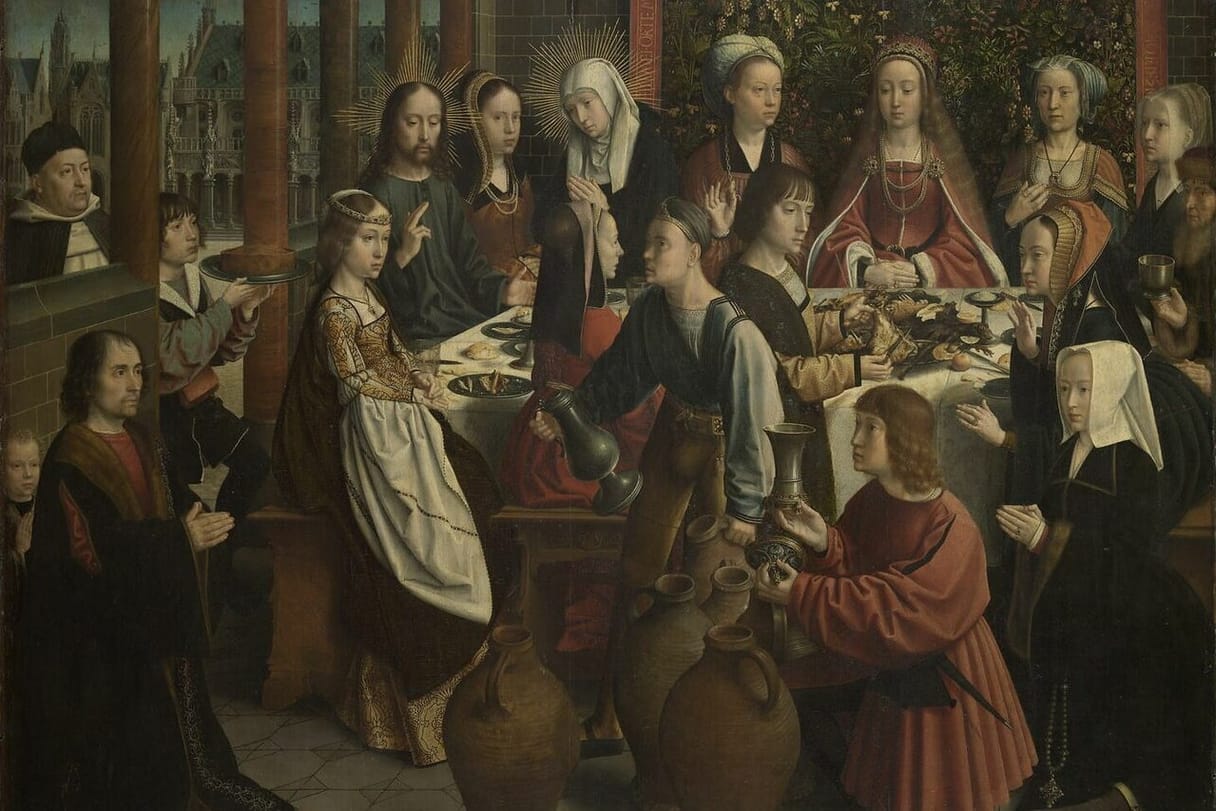
No ancient source says that Jesus was married, and most historians, Christian and non-Christian, conclude that he was single. People come to the question for many reasons. Some have read a popular novel or seen a headline about a papyrus. Some want to know whether Jesus understood love and longing the way they do, and some who are single wonder whether a life without marriage can be whole. The Gospels speak to each of them with a Lord who was fully human, who blessed a wedding at Cana, and who gave his whole life to the kingdom of God.
What does the New Testament say about Jesus’s family?
The Gospels name the members of Jesus’s family. When he preached in his hometown of Nazareth, the people asked:
Isn’t this the carpenter, the son of Mary and brother of James, Joses, Judah, and Simon? Aren’t his sisters here with us?
The neighbors name a mother, brothers, and sisters, and no wife (see did Jesus have brothers and sisters?). The Gospels also name the women who traveled with Jesus and supported his ministry: “Mary who was called Magdalene,” “Joanna, the wife of Chuzas, Herod’s steward,” Susanna, and many others (Luke 8:1–3). Luke identifies Joanna by her husband, but he names no woman as the wife of Jesus. As he was dying, Jesus entrusted his mother to the disciple he loved (John 19:26–27), and no widow appears at the cross or the tomb.
The New Testament does mention the wives of other leaders. Mark tells of Peter’s mother-in-law (Mark 1:30), and Paul, writing in the 50s CE, defended his right to travel with a wife:
Have we no right to take along a wife who is a believer, even as the rest of the apostles, and the brothers of the Lord, and Cephas?
Paul names the apostles, Jesus’s brothers, and Cephas (Peter) as married men. If Jesus had been married, he would have been the strongest example for Paul’s argument, and Paul does not mention him. Historians treat that silence as significant. For the reliability of these sources, see was Jesus a real person?
Would a Jewish man of his time have been unmarried?
Most Jewish men in first-century Galilee married, and the rabbis later counted marriage and children as a duty. There were exceptions. God commanded the prophet Jeremiah, “You shall not take a wife” (Jeremiah 16:2), as a sign of coming judgment. The first-century writers Philo and Josephus describe some Essenes, a strict Jewish movement, as living without wives. John the Baptist and Paul were unmarried, and Paul wrote, “Yet I wish that all men were like me” (1 Corinthians 7:7).
Jesus himself spoke of people who give up marriage for God’s sake:
For there are eunuchs who were born that way from their mother’s womb, and there are eunuchs who were made eunuchs by men; and there are eunuchs who made themselves eunuchs for the Kingdom of Heaven’s sake. He who is able to receive it, let him receive it.
Many scholars think Jesus may have been describing his own way of life, given over completely to proclaiming the kingdom of God. For Jesus’s Jewish world, see was Jesus Jewish?
What does the Gospel of Philip say about Mary Magdalene?
The Gospel of Philip is one of the texts found in 1945 near Nag Hammadi, in Egypt. The surviving copy is in Coptic, the language of Egyptian Christians, and dates from the fourth century. The text itself was probably written in the late second or third century, long after the New Testament Gospels (see who wrote the Gospels?).
One passage says, “There were three who always walked with the Lord: Mary, his mother, and her sister, and Magdalene, the one who was called his companion.” The word translated “companion,” koinōnos, is borrowed from Greek and can mean a partner, an associate, or a fellow believer, as well as a spouse.
A second passage says that the Savior loved Mary Magdalene more than the other disciples and used to kiss her. The manuscript is damaged at that point. There are holes in the page, and the word saying where he kissed her is missing, so translations that print “on her mouth” are filling the gap with a guess. The Gospel of Philip also gives the kiss a spiritual meaning, saying that “it is by a kiss that the perfect conceive and give birth. For this reason we also kiss one another.” The passage has in mind the kiss of peace that early Christians shared, which Paul calls a “holy kiss” (Romans 16:16), and it says nothing of a marriage. For what the New Testament says about Mary Magdalene, the first witness of the resurrection in John’s Gospel, see who was Mary Magdalene?
What about The Da Vinci Code?
Dan Brown’s 2003 novel The Da Vinci Code made the idea of a married Jesus famous, and it is a work of fiction. It drew on the 1982 book Holy Blood, Holy Grail, which claimed that Jesus and Mary Magdalene founded a royal bloodline guarded by a secret society called the Priory of Sion. The documents about the Priory turned out to be forgeries, planted in the French national library in the 1960s by the man who had founded the Priory himself in 1956.
The novel also claims that the figure beside Jesus in Leonardo da Vinci’s Last Supper is Mary Magdalene. Art historians identify the figure as the apostle John, whom painters of the period traditionally showed as a beardless young man leaning toward Jesus.
Some readers find the idea of a married Jesus appealing because they want a Jesus who is close to them and who knew tenderness and human love. That longing is a good one, and the Gospels already answer it. They show a Jesus who wept at the grave of his friend Lazarus (John 11:35) and who counted women among his disciples.
What was the “Gospel of Jesus’s Wife”?
In September 2012 Karen King, a historian at Harvard Divinity School, announced a small Coptic papyrus fragment containing the words “Jesus said to them, ‘My wife…’” The press quickly called it the Gospel of Jesus’s Wife. Many scholars doubted it from the start, because its text seemed to be copied from a modern edition of the Gospel of Thomas.
In June 2016 the journalist Ariel Sabar, writing in The Atlantic, traced the papyrus to an owner whose account of its origins collapsed under investigation. King then said that the evidence “tips the balance toward forgery.” Scholars now regard the fragment as a modern fake.
Would it matter if Jesus had been married?
The question is historical, and the evidence points to a single man. Many theologians add that a married Jesus would not contradict the Nicene Creed, which confesses that he “was made man.” The Letter to the Hebrews says that Jesus can be “touched with the feeling of our infirmities” and was “in all points tempted like we are, yet without sin” (Hebrews 4:15). The same letter says, “Let marriage be held in honor among all” (Hebrews 13:4).
The church honors both callings. John’s Gospel places the first of Jesus’ signs at a wedding: “This beginning of his signs Jesus did in Cana of Galilee” (John 2:11), and the Eastern Orthodox wedding service reads that story as its Gospel. The New Testament calls Jesus the bridegroom and the church his bride (Mark 2:19; Revelation 19:7). The mainline churches allow their clergy to marry, and most Orthodox parish priests are married, while Orthodox monks and bishops remain single.
If you are married, Jesus blessed the wedding feast and the love that begins there. If you are single, by choice or by circumstance, he lived that life himself and filled it with friendship, prayer, and work for the kingdom of God. Either way, you are following a Lord who knows the whole of a human life from the inside and who calls you his friend (John 15:15).
Common questions
Did Jesus have children?
No ancient source says that Jesus had children. The idea of a secret bloodline descended from Jesus and Mary Magdalene comes from modern books, especially Holy Blood, Holy Grail (1982) and the novel The Da Vinci Code (2003). Those books relied on documents about a secret society, the Priory of Sion, that were forged in France in the twentieth century.
Was Mary Magdalene Jesus’s wife?
The New Testament presents Mary Magdalene as a disciple whom Jesus healed, who supported his ministry, stood near the cross, and was the first witness of the resurrection in John’s Gospel. It never calls her his wife. The Gospel of Philip, written more than a century later, calls her his companion, a word that can mean a partner in faith as well as a spouse.
Would it matter if Jesus had been married?
Many theologians have said that a married Jesus would not contradict the creeds, which confess that he was fully human, and Scripture holds marriage in honor. The question is historical, and the historical evidence points to a single man. Christians honor both marriage and the single life because Jesus honored both.
Why did the church teach that Jesus was celibate?
The church taught it because the Gospels and the earliest Christian writers never mention a wife, while they do mention the wives of Peter and other apostles. Jesus also spoke of people who forgo marriage “for the Kingdom of Heaven’s sake” (Matthew 19:12). Christian tradition has read his single life as complete devotion to his mission.
Sources
- Mark 6:3 (WEB)
- 1 Corinthians 9:5 (WEB)
- Luke 8:1–3 (WEB)
- Matthew 19:12 (WEB)
- Hebrews 13:4 (WEB)
- The Gospel of Philip, trans. Wesley W. Isenberg (Gnostic Society Library)
- Bart Ehrman, Jesus Kissing Mary Magdalene (The Bart Ehrman Blog)
- Gospel of Jesus’s Wife likely a fake, bizarre backstory suggests (Live Science, 2016)
- Gospel of Jesus’ Wife (Wikipedia)
- John 2:1–11 (WEB)