The four Gospels and their authors
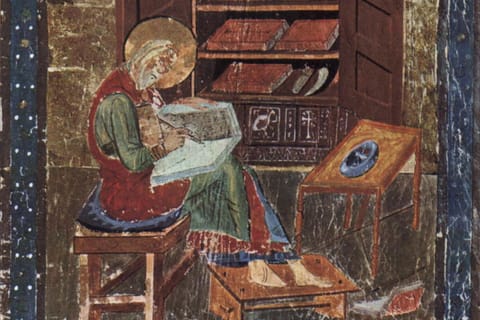
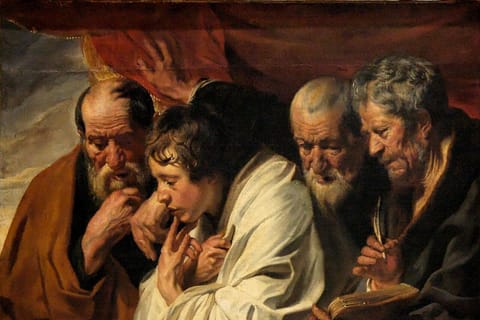
The four Gospels do not name their authors. By the second century, the church had attached the names Matthew, Mark, Luke, and John, and early writers such as Papias and Irenaeus linked Mark to Peter and Luke to Paul. Most scholars today think Mark was written first, around 70 CE, that Matthew and Luke drew on Mark around 80 to 90 CE, and that John was completed around 90 to 100 CE.
But these are written so that you may continue to believe that Jesus is the Messiah, the Son of God, and that through believing you may have life in his name.
John 20:31, NRSVUE
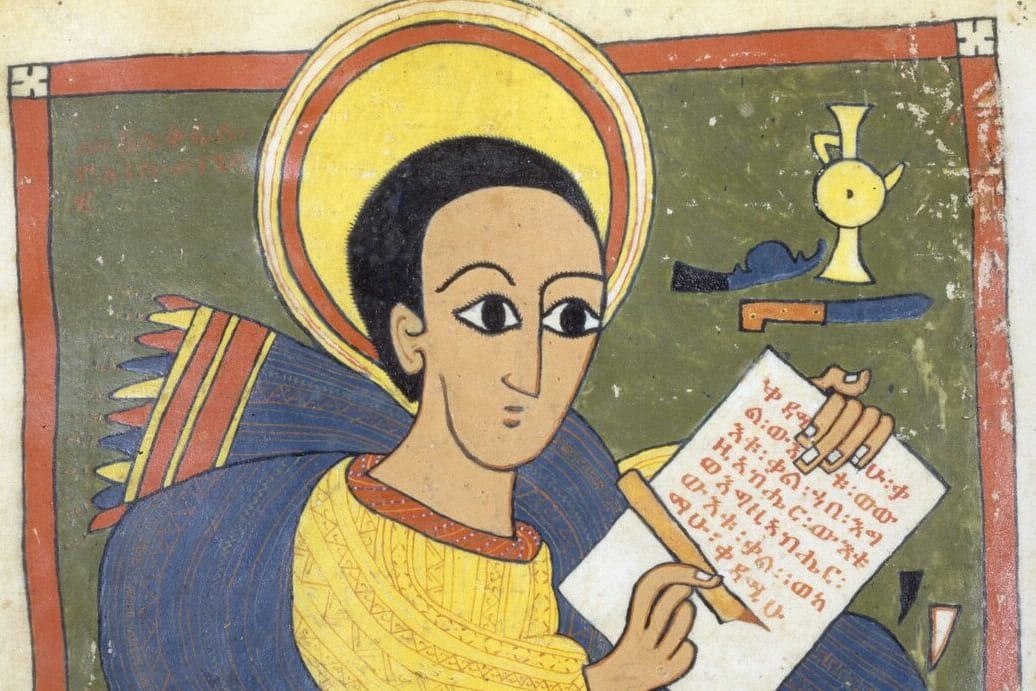
The Gospels were written so that their readers might come to trust Jesus and find life in him. None of the four names its author. By the second century the church knew them as Matthew, Mark, Luke, and John, and most scholars today date them from about 70 to 100 CE. Whoever held the pen, the church has received all four as a faithful witness to Jesus Christ, and Christians still open them hoping to meet him there.
What did the early church say about the Gospel writers?
The oldest surviving testimony about the Gospel writers comes from Papias, a bishop in Asia Minor in the early second century. His words survive because the historian Eusebius quoted them in his Church History (3.39). Papias reported that Mark, “having become the interpreter of Peter, wrote down accurately, though not in order, whatsoever he remembered” of what Christ said and did. He also said that “Matthew wrote the oracles in the Hebrew language.”
Around 180 CE, Irenaeus, bishop of Lyon, gave the fuller account that became the church’s standard (Against Heresies 3.1.1). Matthew, he wrote, “issued a written Gospel among the Hebrews in their own dialect.” Mark, “the disciple and interpreter of Peter,” handed down in writing what Peter had preached. Luke, “the companion of Paul, recorded in a book the Gospel preached by him.” And John, “the disciple of the Lord, who also had leaned upon His breast,” published his Gospel while living at Ephesus.
Paul mentions a Luke among his companions, calling him “the beloved physician” (Colossians 4:14). A Mark also appears in Paul’s letters and in Acts.
What do the Gospels say about themselves?
Only two of the Gospels say anything about how they were written. Luke opens with a formal preface:
Since many have undertaken to compile a narrative about the events that have been fulfilled among us, just as they were handed on to us by those who from the beginning were eyewitnesses and servants of the word, I, too, decided, as one having a grasp of everything from the start, to write a well-ordered account for you, most excellent Theophilus, so that you may have a firm grasp of the words in which you have been instructed.
Luke 1:1–4, NRSVUE
Luke does not claim to be an eyewitness. He says that earlier accounts existed and that he wrote after studying what eyewitnesses had handed on, so that Theophilus could be sure of what he had been taught.
John’s Gospel ends by pointing to its source, an unnamed follower called “the disciple whom Jesus loved.” It says, “This is the disciple who testifies about these things, and wrote these things. We know that his witness is true” (John 21:24). The “we” in that verse suggests that a community around this disciple finished and published the book. John also states why he wrote: “these are written so that you may continue to believe that Jesus is the Messiah, the Son of God” (John 20:31).
Mark begins with a single line: “The beginning of the good news of Jesus Christ” (Mark 1:1). Matthew gives no account of its own writing.
Which Gospel came first, and how are they related?
Matthew, Mark, and Luke are called the Synoptic Gospels, from a Greek word meaning “seen together,” because they tell many of the same stories in the same order and often in the same words. Most scholars explain this by “Markan priority”: Mark was written first, and Matthew and Luke each used Mark as a source. Mark is the shortest Gospel, and most of its material reappears in the other two.
Matthew and Luke also share a large body of sayings of Jesus that Mark lacks, such as the Lord’s Prayer and the Beatitudes. Many scholars think both drew on a lost collection of sayings, which they call Q, from the German Quelle, “source.” A growing minority of scholars doubt that Q existed and think Luke used Matthew directly.
Most scholars date the Gospels roughly like this:
- Mark: around 70 CE, near the time of the Jewish War against Rome and the destruction of the Temple.
- Matthew: around 80 to 90 CE, written by a Jewish Christian deeply versed in the Scriptures.
- Luke: around 80 to 90 CE, the first volume of a two-part work that continues in the Acts of the Apostles.
- John: completed around 90 to 100 CE, drawing on the testimony of the beloved disciple.
Did the apostles write the Gospels?
On this point Christians hold a range of views. Many Christians, including many conservative scholars, hold that the traditional authors wrote the Gospels, or stand directly behind them, much as Papias and Irenaeus said. They point out that the Gospels circulated under these four names very early and under no other names.
Most university scholars think the authors were Greek-speaking Christians of the second generation, who were themselves not apostles. Still, many of them accept part of the tradition. Mark may well have been written by a Christian named Mark, and the Gospel of John clearly rests on the witness of a disciple close to Jesus.
Christian faith does not hang on settling these questions. The churches received the Gospels because they recognized in them the apostolic witness to Jesus Christ. For the historical case that Jesus lived, preached, and was crucified under Pontius Pilate, see Was Jesus a real person?
Why does the church keep four different Gospels?
The four Gospels differ in order, detail, and emphasis. Matthew presents Jesus as the teacher who fulfills the Law and the prophets. Mark moves fast and dwells on the cross. Luke shows Jesus’s mercy to the poor, to women, and to outsiders. John reflects at length on who Jesus is, “the Word” who “became flesh and lived among us” (John 1:14).
In the second century a Christian named Tatian blended the four Gospels into one continuous story, the Diatessaron. The wider church kept the four distinct books instead, choosing to hear four witnesses with all their differences. Each Gospel shows something of Jesus that the others leave out. For more on those differences, see Are there contradictions in the Bible?
In mainline churches, as in the Orthodox churches, the Gospels hold a place of special honor in worship. In many congregations the people stand for the Gospel reading, and in Orthodox churches the book of the Gospels rests on the altar and is carried in procession before it is read. The Revised Common Lectionary, the three-year cycle of Sunday readings used by many mainline churches, reads through Matthew, Mark, and Luke in turn, with John woven through each year. For where to begin reading them yourself, see Where should I start reading the Bible? and Who wrote the Bible?
Before the Gospel is read in the Orthodox Divine Liturgy, the priest prays silently, in words anyone can use before opening the Gospels at home:
Illumine our hearts, O God who lovest mankind, with the pure light of thy divine knowledge, and open the eyes of our understanding to the comprehension of the proclamation of thy Gospel.
The Prayer before the Gospel, Divine Liturgy, in Isabel F. Hapgood, Service Book of the Holy Orthodox-Catholic Apostolic Church (1906)
Common questions
Were the Gospels written by eyewitnesses?
Most scholars think the Gospel writers were not themselves eyewitnesses and drew on the memories of those who were. Luke says so openly: he relied on accounts handed down by eyewitnesses. The Gospel of John says its testimony comes from the disciple whom Jesus loved.
Which Gospel was written first?
Most scholars think Mark was written first, around 70 CE, and that Matthew and Luke used Mark as a source. Mark is the shortest Gospel, and most of its material reappears in Matthew and Luke. A minority of scholars hold other views of how the first three Gospels are related.
Why are there four Gospels instead of one?
The early church kept four distinct witnesses. In the second century a Christian named Tatian combined the four into a single harmony, the Diatessaron, and the wider church kept the four Gospels side by side. Each gives its own portrait of the same Lord.
Who wrote the Gospel of Thomas?
The Gospel of Thomas is a collection of sayings attributed to Jesus, known in full from a Coptic manuscript found in Egypt in 1945. It was not written by the apostle Thomas and is not part of the New Testament. Scholars debate how much of it reflects early tradition.
Sources
- Luke 1:1–4 (WEB)
- John 20:30–31; 21:24 (WEB)
- Mark 1:1 (WEB)
- Colossians 4:14 (WEB)
- Irenaeus, Against Heresies 3.1 (New Advent)
- Eusebius, Church History 3.39, quoting Papias (New Advent)
- Gospel of Mark (Wikipedia)
- Gospel of John (Wikipedia)
- Q source (Wikipedia)
- Diatessaron (Wikipedia)
- Isabel F. Hapgood, Service Book of the Holy Orthodox-Catholic Apostolic (Greco-Russian) Church (1906), Internet Archive