Speaking in tongues
Speaking in tongues, also called glossolalia, is speech in a language the speaker has not learned, understood as a gift of the Holy Spirit. It appears at Pentecost in Acts 2 and among the gifts Paul lists in 1 Corinthians 12–14. Pentecostal churches, which grew from the Azusa Street revival of 1906, often teach it as the sign of the Spirit. The mainline churches teach that it is one gift among many, given to some, and not required for salvation.
Now there are various kinds of gifts, but the same Spirit.
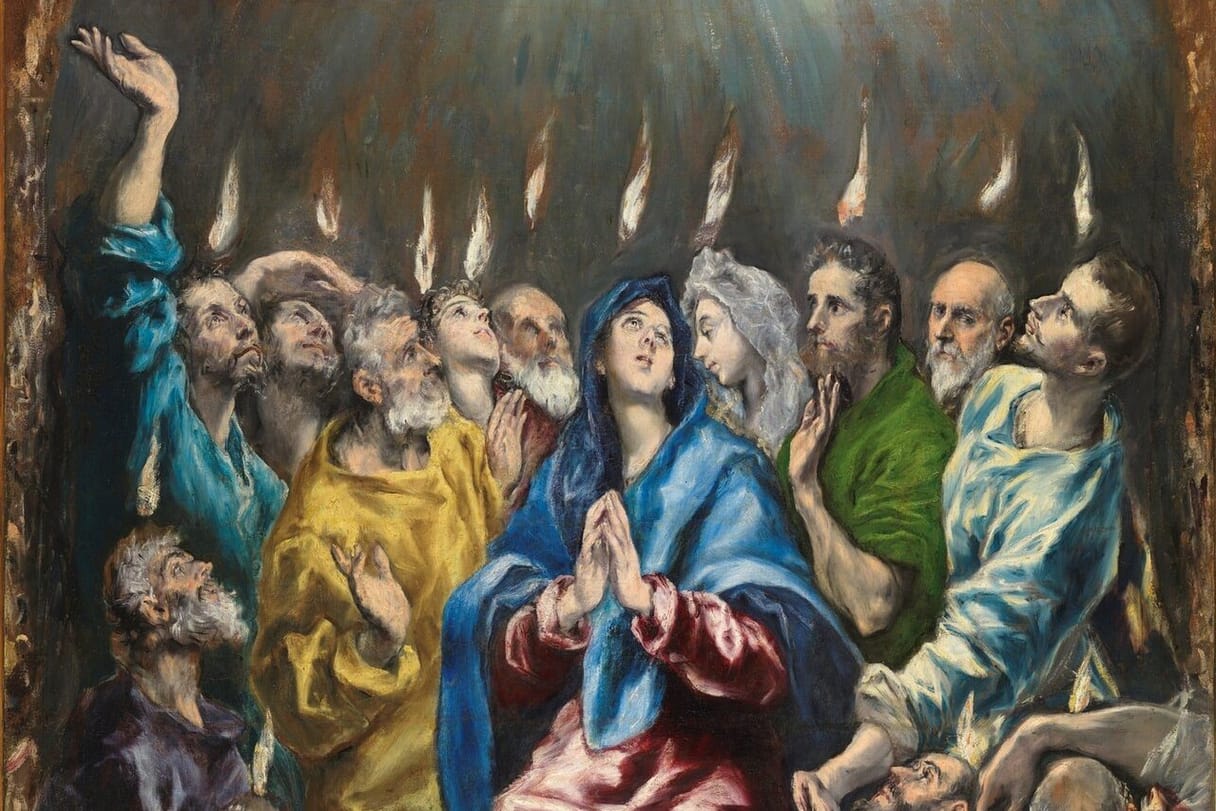
Speaking in tongues means speaking, praying, or praising God in a language the speaker has not learned, as a gift of the Holy Spirit. You may be asking because you have the gift and wonder what to make of it, or because you have been told you lack something if you do not. Scripture’s answer is gentle for both: the same Spirit gives many gifts, and every Christian has received the Spirit.
Scholars call it glossolalia, from the Greek glōssa, which means both “tongue” and “language,” and lalia, “speech.” Pentecostal churches give it a central place, and many teach that it is the sign that a believer has been baptized in the Spirit. The Evangelical Lutheran Church in America, the Presbyterian Church (U.S.A.), the United Methodist Church, and the Episcopal Church treat it as one of many gifts that the Spirit gives to some Christians, and none of them requires it.
What happened at Pentecost?
The Book of Acts tells how the Spirit came on Jesus’ followers at the Jewish feast of Pentecost, fifty days after Passover:
They were all filled with the Holy Spirit and began to speak with other languages, as the Spirit gave them the ability to speak. Now there were dwelling in Jerusalem Jews, devout men, from every nation under the sky. When this sound was heard, the multitude came together and were bewildered, because everyone heard them speaking in his own language.
At Pentecost the gift was understood. Pilgrims from Egypt, Rome, Crete, and Arabia said, “we hear them speaking in our languages the mighty works of God!” (Acts 2:11). Acts describes the same gift twice more: when the Spirit fell on the Roman centurion Cornelius and his household, the first Gentile believers (Acts 10:44–46), and when Paul laid hands on new believers in Ephesus (Acts 19:6). Christians read the Pentecost story in different ways, some as a literal account of a miracle and others as a story whose truth lies in its meaning: the gospel is for every nation and every language. For more on the Spirit in Acts, see What is the Holy Spirit?
What does Paul say about speaking in tongues?
Paul wrote the New Testament’s longest discussion of tongues, in 1 Corinthians 12–14, because the gift was causing trouble in the church at Corinth. He begins by saying that every gift comes from the same God:
Now there are various kinds of gifts, but the same Spirit. There are various kinds of service, and the same Lord. There are various kinds of workings, but the same God who works all things in all. But to each one is given the manifestation of the Spirit for the profit of all.
Tongues appear near the end of Paul’s list of gifts, with “the interpretation of languages” beside them (1 Corinthians 12:10). Paul then asks, “Do all speak with various languages?” and expects the answer no (1 Corinthians 12:30). Next comes his great chapter on love, which opens: “If I speak with the languages of men and of angels, but don’t have love, I have become sounding brass or a clanging cymbal” (1 Corinthians 13:1); see 1 Corinthians 13.
In chapter 14 Paul values the gift and limits it. A person speaking in tongues “speaks not to men, but to God, for no one understands” (1 Corinthians 14:2), and so builds up only himself, while prophecy, speech that others can understand, builds up the whole church (1 Corinthians 14:4–5). He states his own preference:
I thank my God, I speak with other languages more than you all. However, in the assembly I would rather speak five words with my understanding, that I might instruct others also, than ten thousand words in another language.
Paul set rules for worship: at most two or three people should speak in tongues, one at a time, and only if someone can interpret; otherwise the speaker should “keep silent in the assembly” and pray privately (1 Corinthians 14:27–28). He ends with balance: “don’t forbid speaking with other languages. Let all things be done decently and in order” (1 Corinthians 14:39–40).
Did speaking in tongues continue after the apostles?
Around 180 CE, Irenaeus of Lyons wrote that he heard “many brethren in the Church, who possess prophetic gifts, and who through the Spirit speak all kinds of languages” (Against Heresies 5.6.1). By the early fifth century, Augustine treated tongues as a sign for the first generation. The tongues at Pentecost showed “that the Gospel of God was to run through all tongues over the whole earth,” he preached, and once that sign had done its work, “it passed away.” A Christian who wanted to know whether he had received the Spirit, Augustine said, should “question his own heart. If he love his brother the Spirit of God dwells in him” (Homilies on the First Epistle of John 6.10).
How did Pentecostalism begin?
Modern Pentecostalism traces its roots to Los Angeles in 1906. William J. Seymour, a Black preacher born in Louisiana to formerly enslaved parents, had learned from the Holiness teacher Charles Parham that speaking in tongues was the sign of baptism in the Holy Spirit. On April 9, 1906, Seymour and others began speaking in tongues at a house on Bonnie Brae Street, and by mid-April the meetings had moved to a former African Methodist Episcopal church on Azusa Street. The Azusa Street revival ran most strongly from 1906 to 1909. In an age of segregation, Black and white worshipers prayed together under a Black pastor.
From Azusa Street the movement spread around the world. The Assemblies of God and many other Pentecostal churches teach that speaking in tongues is the “initial physical evidence” of baptism in the Holy Spirit. Christian History magazine reports that Pentecostals and charismatics numbered more than 500 million by 2000.
What is the charismatic renewal?
The charismatic renewal brought speaking in tongues into the mainline churches. On Passion Sunday in 1960, Dennis Bennett, rector of St. Mark’s Episcopal Church in Van Nuys, California, told his congregation that he and about seventy members had been speaking in tongues. The announcement divided the parish, Bennett resigned, and Time and Newsweek reported the story that summer. Bennett then became rector of a struggling parish in Seattle.
The mainline churches responded with caution and, in time, with welcome. In 1976 the United Methodist General Conference adopted guidelines on the movement, which remain, in revised form, in its Book of Resolutions. They point out that “in a biblical sense there is no such person as a ‘noncharismatic Christian,’” because every Christian has received gifts of grace. On the conflicts the movement raised, they say: “we plead for a spirit of openness and love.”
Do you have to speak in tongues to have the Holy Spirit?
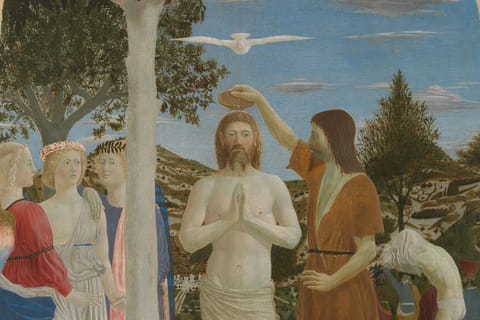
The mainline churches teach that you do not, because the Spirit is given to every Christian in baptism. In the Lutheran service the minister marks each newly baptized person with the cross and says, “child of God, you have been sealed by the Holy Spirit and marked with the cross of Christ forever,” and Presbyterian, Methodist, and Episcopal services likewise pray for the gift of the Spirit over the newly baptized. The Eastern Orthodox churches anoint the newly baptized with chrism, a holy oil, right after baptism, and the priest calls each anointing the seal of the gift of the Holy Spirit. In both traditions the Spirit comes as God’s gift to every baptized person, without waiting for any particular experience.
Paul names the signs that the Spirit is at work: “the fruit of the Spirit is love, joy, peace, patience, kindness, goodness, faith, gentleness, and self-control” (Galatians 5:22–23). Speaking in tongues is not on the list. For more on baptism, see Do you have to be baptized to be saved?
If you have received the gift of tongues, Paul’s teaching gives you a good path: thank God for it, use it mostly in private prayer, and in public worship seek what builds up others. If you have not received it, nothing is missing from your life in Christ. Paul himself wrote that “the Spirit himself makes intercession for us with groanings which can’t be uttered” (Romans 8:26), a promise for every Christian who prays; see How do I pray? For how the mainline churches hold together different kinds of worship, see What is a mainline Protestant church?
Orthodox Christians often begin their prayers by calling on the Holy Spirit with an ancient prayer that every Christian, with tongues or without, can pray:
O heavenly King, the Comforter, Spirit of Truth, who art in all places and fillest all things; Treasury of good things and Giver of life: Come and take up thine abode in us, and cleanse us from every stain; and save our souls, O Good One.
“O Heavenly King,” translated by Isabel F. Hapgood (1906)
Common questions
Do you have to speak in tongues to be saved?
Speaking in tongues is not required for salvation in the teaching of any mainline church, and most Pentecostal churches agree that a person can be saved without it. Paul taught that people are saved by God’s grace through faith, and he asked, “Do all speak with various languages?” expecting the answer no (1 Corinthians 12:30). The mainline churches teach that the Holy Spirit is given to every Christian in baptism.
Is speaking in tongues a real language?
At Pentecost, Acts says that visitors from many nations heard the apostles speaking in their own native languages. In 1 Corinthians, Paul describes tongues that no one present understands unless someone interprets. Most modern speaking in tongues is not a known human language, and Pentecostal Christians usually describe it as a language of prayer given by the Spirit.
Do mainline Christians speak in tongues?
Some do. The modern charismatic renewal in the mainline churches began in an Episcopal parish in Van Nuys, California, in 1960, and charismatic prayer groups meet in some Lutheran, Methodist, Presbyterian, and Episcopal congregations. Most mainline worship follows a written liturgy and does not include speaking in tongues.
Can speaking in tongues be fake?
Paul warned that tongues without love are like “sounding brass or a clanging cymbal” (1 Corinthians 13:1), and he required order in worship so that the gift would not become a show. The United Methodist Church’s guidelines say that an experience which leads to self-righteousness or hostility is open to serious question, while one that brings love, faith, and joy shows the Lord’s work.
Sources
- Acts 2:1–11 (WEB)
- 1 Corinthians 12:4–11, 12:29–31 (WEB)
- 1 Corinthians 14:1–40 (WEB)
- Irenaeus, Against Heresies 5.6.1 (New Advent)
- Augustine, Homilies on the First Epistle of John 6.10 (New Advent)
- ELCA, Why do Lutherans make the sign of the cross?
- Book of Common Prayer (1979), Holy Baptism
- Book of Resolutions: Guidelines: The UMC and the Charismatic Movement (umc.org)
- Pentecostalism: William Seymour (Christian History Institute)
- Charismatic and mainline (The Christian Century, 2006)
- Galatians 5:22–23 (WEB)
- OrthodoxWiki, “Chrismation”
- “O Heavenly King,” in Isabel F. Hapgood, Service Book of the Holy Orthodox-Catholic Apostolic Church (1906)



_Prado.jpg)